AskCodi vs Tabnine 2026: Honest AI Coder Comparison Guide

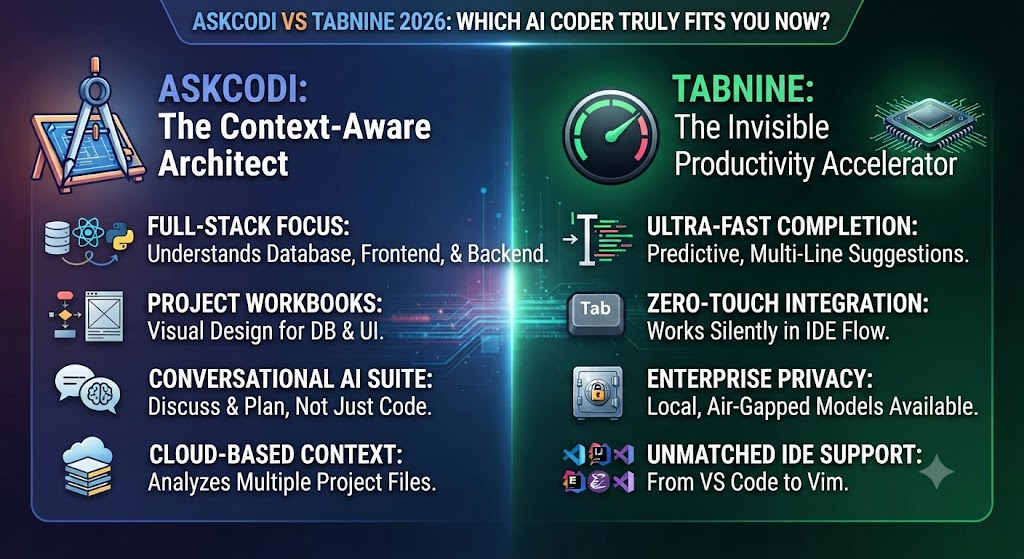
A head-to-head comparison between two AI coding assistants that, on the surface, seem to compete directly but actually optimize for very different priorities.
This AskCodi vs Tabnine comparison pits two tools with fundamentally opposite philosophies against each other. AskCodi’s entire pitch is model freedom and pay-for-what-you-use flexibility — one API, unlimited model switching between GPT, Claude, Gemini, and others, with tokens that never expire. Tabnine’s pitch is the exact opposite: narrower model choice in exchange for genuine privacy guarantees, including fully air-gapped, on-premises deployment that AskCodi’s cloud-routed, multi-provider model simply can’t offer.
As this AskCodi vs Tabnine comparison found, both tools also made significant pricing moves recently — Tabnine fully retired its free tier to focus on enterprise-only positioning, while AskCodi built out a token-based Flexible plan structure that scales from $5 to $200 a month depending on usage. This comparison covers what that actually means for a developer or team trying to choose between them.
Table of Contents
AskCodi vs Tabnine: Verdict Box
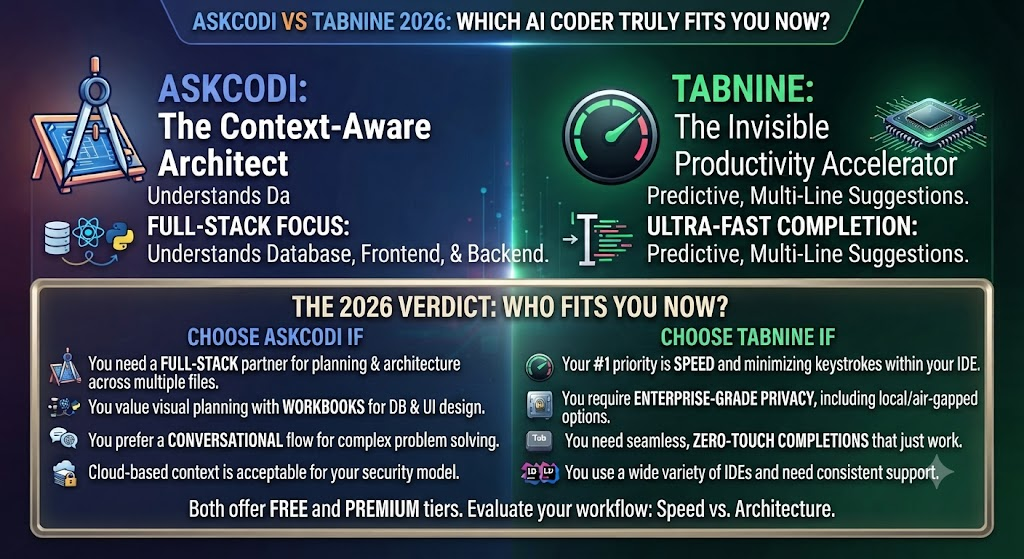
Overall Score: AskCodi 7.1/10 | Tabnine 6.9/10 Best For: AskCodi — developers and small teams who want model flexibility and pay-as-you-go pricing without vendor lock-in. Tabnine — regulated industries needing on-prem or air-gapped AI with zero external network calls. Price: AskCodi Free (limited) to $200/mo (Flexible), or Premium/Ultimate annual for individuals | Tabnine $39/user/mo minimum, no free tier Bottom Line: AskCodi wins on flexibility, price accessibility, and multi-model freedom for most individual developers and small teams, while Tabnine remains the only realistic option for organizations with hard compliance requirements against sending code to any third-party cloud.
Building Something With These AI Coding Tools?
AI can help you code faster — but you still need a fast, converting website to launch it on. Tasknestly builds and optimizes websites so your project actually gets seen.
Get Your Website Built →Feature Comparison: AskCodi vs Tabnine
Model Access and Flexibility
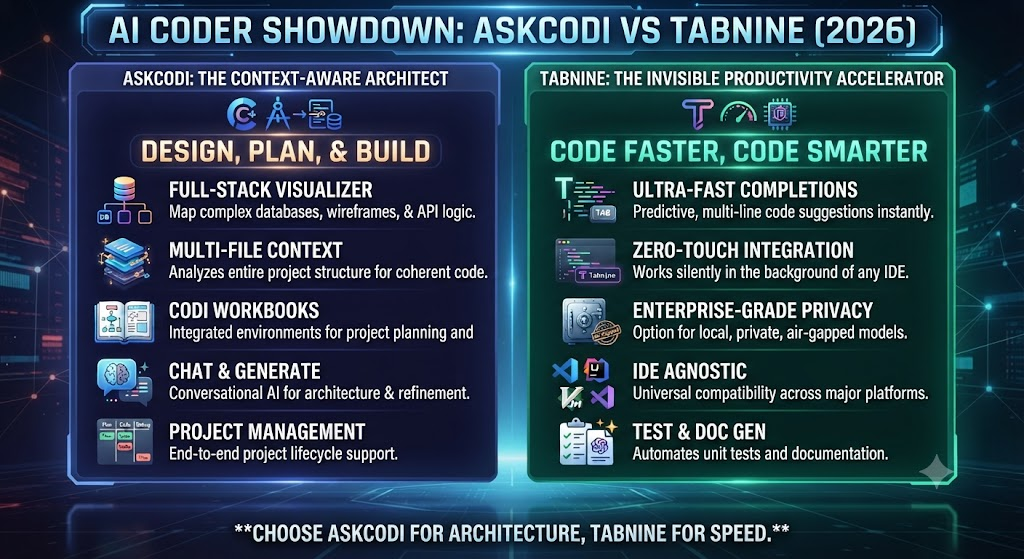
A central part of any AskCodi vs Tabnine comparison is model access. This is AskCodi’s core differentiator. Instead of committing to one AI vendor, AskCodi lets you switch between GPT, Claude, Gemini, Llama, Mistral, Qwen, DeepSeek, and others instantly, within the same interface, paying provider rates directly with no markup or commission. Tabnine’s Code Assistant Platform also offers multi-LLM access — Anthropic, OpenAI, Google, Meta, and Mistral models — but the pricing is flat per-seat rather than usage-based, and switching models doesn’t carry the same granular cost transparency AskCodi’s token system provides.
In practice, this means an AskCodi user can see exactly what a Claude Opus request costs versus a cheaper GPT-3.5 request in near real time, while a Tabnine user pays the same flat fee regardless of which underlying model handled a given task.
Pricing Philosophy
AskCodi charges based on actual token consumption, with unused tokens rolling over indefinitely rather than expiring monthly — a genuinely rare structure in this category. Tabnine charges a flat $39/user/month regardless of usage intensity, which is simpler to budget but offers no discount for light users and no way to pay less if your usage is genuinely modest. This is one of the clearest AskCodi vs Tabnine differences.
Code Completions
Both tools offer inline completions, though this is a smaller part of AskCodi’s identity compared to its chat and template-driven code generation. Tabnine’s completions benefit from its Context Engine, which grounds suggestions specifically in your organization’s codebase and standards — a capability AskCodi’s more provider-agnostic, chat-first approach doesn’t directly replicate in the same way. That’s a smaller but real AskCodi vs Tabnine gap.
Privacy and Deployment
This is Tabnine’s entire reason for existing, and it delivers unambiguously. Tabnine offers fully on-premises and air-gapped deployment with zero external network calls when self-hosted — your code never leaves your infrastructure. AskCodi, by design, routes requests through multiple third-party model providers (OpenAI, Anthropic, Google, and others), meaning code inevitably transits external infrastructure regardless of which underlying model you select. For any team with a hard requirement against third-party code transmission, this single distinction settles the comparison entirely in Tabnine’s favor.
Templates and Workflows
AskCodi ships a genuinely broad library of prompt templates and pre-built workflows — generating a pricing page with Tailwind, writing a Dockerfile, building complex regex, and more — which makes it noticeably more approachable for less experienced developers or semi-technical users building simple prototypes. Tabnine’s Agentic Platform tier offers comparable structured workflows through its Context Engine, but it’s gated behind enterprise pricing rather than accessible to individual users at any price point. This tilts the AskCodi vs Tabnine comparison toward accessibility.
IDE Integration
AskCodi integrates with classic editors (VS Code, Sublime, IntelliJ) as well as newer AI-native IDEs like Cursor, Continue, and Aider. Tabnine supports a similarly broad IDE list — VS Code, all major JetBrains IDEs, Neovim, and Eclipse — but doesn’t extend into the AI-native editor space the way AskCodi’s integration list does. IDE support is a near-tie in this AskCodi vs Tabnine matchup.
Building Something With These AI Coding Tools?
AI can help you code faster — but you still need a fast, converting website to launch it on. Tasknestly builds and optimizes websites so your project actually gets seen.
Get Your Website Built →AskCodi vs Tabnine: AskCodi Pricing
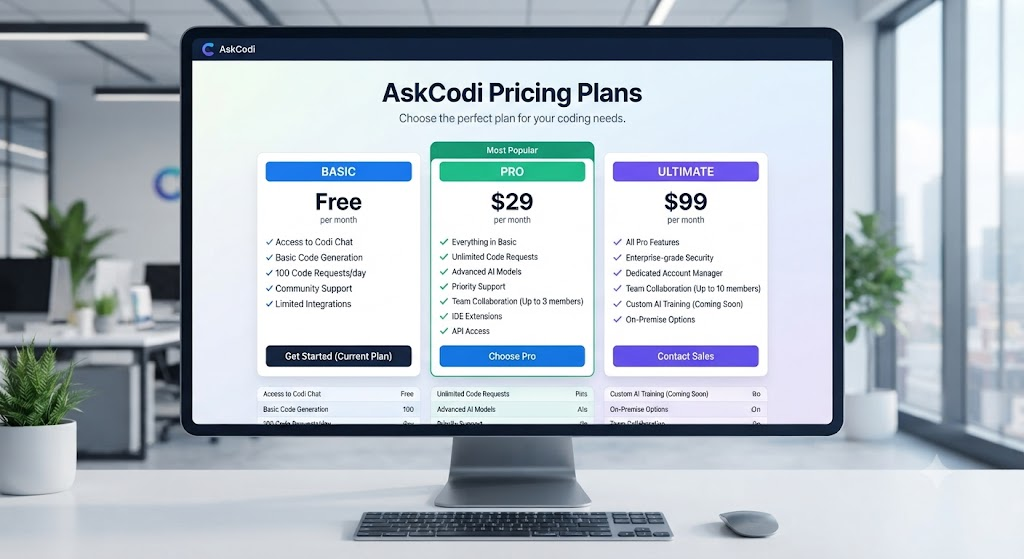
AskCodi structures pricing around two distinct approaches: Flexible monthly plans with team-wide shared token pools, and Annual plans for individual developers wanting predictable yearly costs.
| Plan | Price | Includes | Best For |
|---|---|---|---|
| Free | $0 | 100,000 one-time tokens, 10 uses/day, 6 free models | Evaluating the interface, no commercial use |
| Flexible | $5-200/mo | 4M-160M tokens, shared team pool, unlimited rollover | Teams of 2-15 developers |
| Premium/Ultimate (Annual) | Custom | Predictable yearly cost, no team collaboration | Solo developers wanting locked-in pricing |
| Enterprise | Custom quote | Volume discounts, centralized billing, compliance features | Teams exceeding 15 developers |
AskCodi’s Flexible tier is where its pricing model genuinely shines for small teams — instead of per-seat licensing, the entire team draws from one shared token pool, and unused tokens roll over month to month rather than expiring, which suits variable usage patterns better than fixed per-seat plans. A five-person team on the $200/month Flexible plan effectively pays $40 per developer with access to every premium model included — comparable to Copilot Business’s $19/seat but with materially more model flexibility bundled in.
Building Something With These AI Coding Tools?
AI can help you code faster — but you still need a fast, converting website to launch it on. Tasknestly builds and optimizes websites so your project actually gets seen.
Get Your Website Built →AskCodi vs Tabnine: Tabnine Pricing
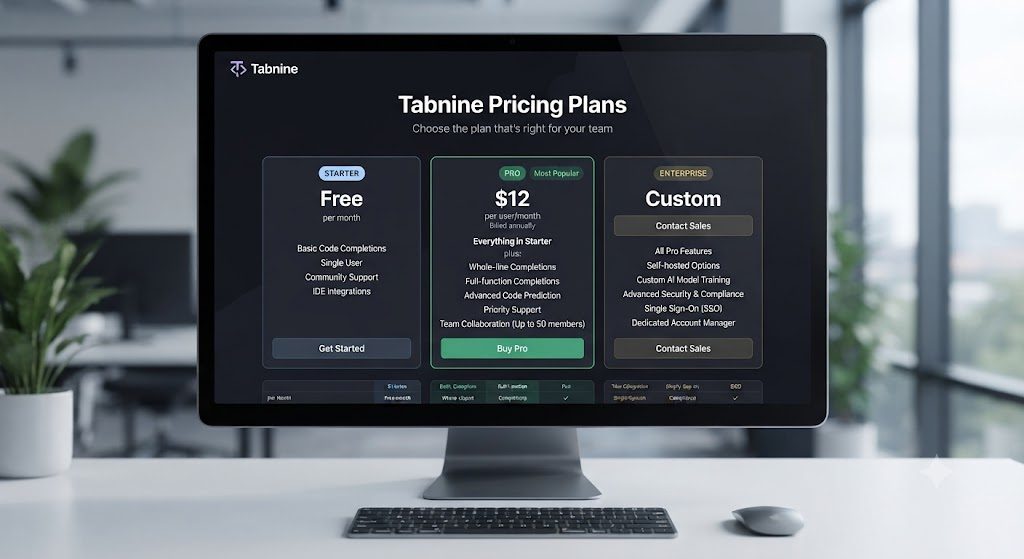
Tabnine retired its free tier and now operates as a two-tier, enterprise-focused platform requiring annual billing for published pricing.
| Plan | Monthly Price | Best For |
|---|---|---|
| Code Assistant Platform | $39/user/mo (annual) | Multi-LLM completions and chat, flexible deployment |
| Agentic Platform | Custom quote | Agentic workflows plus Context Engine at scale |
Self-hosted Tabnine deployments carry real additional infrastructure cost beyond the per-seat license — budget for GPU-capable servers running anywhere from several hundred to a few thousand dollars a month depending on team size, on top of the license fee itself.
Building Something With These AI Coding Tools?
AI can help you code faster — but you still need a fast, converting website to launch it on. Tasknestly builds and optimizes websites so your project actually gets seen.
Get Your Website Built →AskCodi vs Tabnine: The Wider Landscape
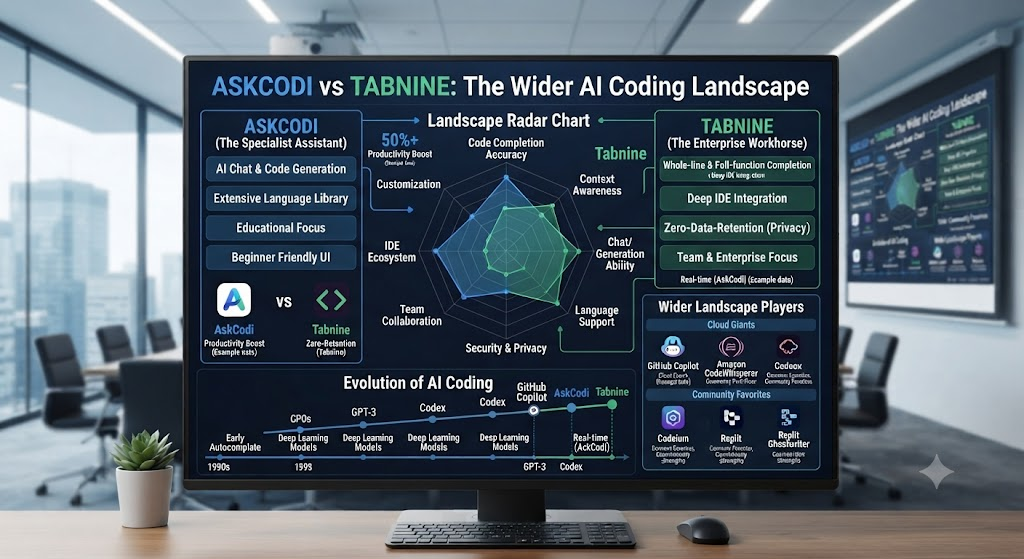
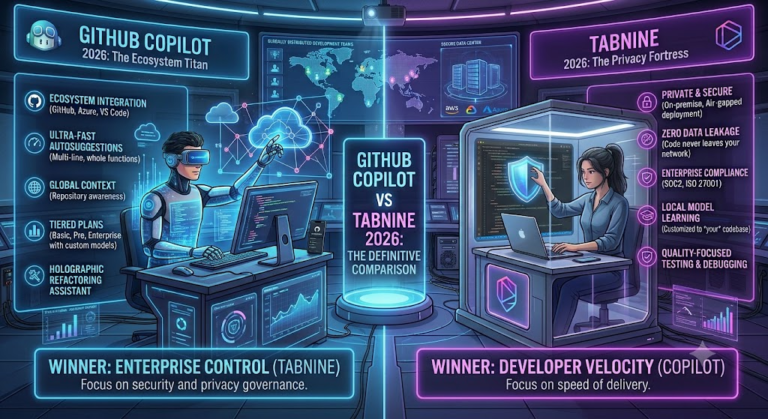
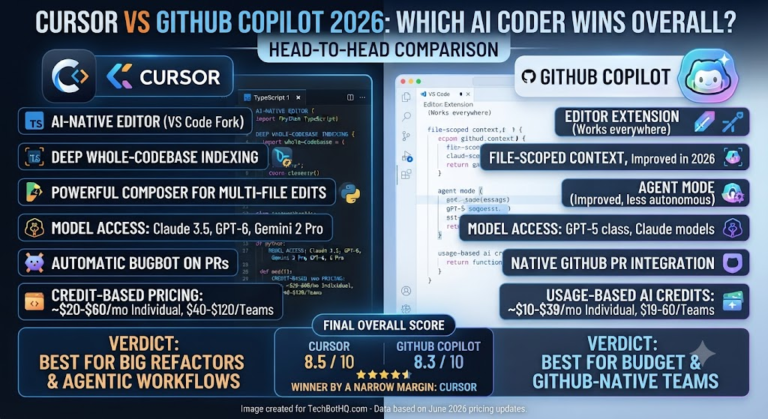
Neither AskCodi nor Tabnine dominates general mindshare the way Copilot or Cursor does, and it’s worth situating both against the wider field. The standalone Tabnine review on this site goes deeper into its day-to-day feature set than a comparison piece has room for. For teams who want the broadest possible general-purpose completions experience rather than either tool’s specific tradeoffs, GitHub Copilot and Cursor remain the more mainstream defaults most developers reach for first.
It’s also worth checking GitHub Copilot vs Tabnine on this site if privacy is your primary concern but you’re not sold on AskCodi’s multi-model approach — that comparison covers Tabnine against a more mainstream alternative. The full AI Coding category rounds up additional tools for anyone still evaluating options beyond these two. That’s a separate question from this AskCodi vs Tabnine comparison.
What’s genuinely distinct about this particular matchup compared to most AI coding tool comparisons: neither tool is chasing the same “best general-purpose assistant” crown that Copilot, Cursor, and Windsurf are competing over. AskCodi has carved out a specific niche around model-agnostic flexibility; Tabnine has carved out an equally specific niche around privacy and compliance. Neither is trying to be everything to everyone, which actually makes this comparison more straightforward than most — it’s less about which tool is “better” and more about which niche matches your actual constraints.
Building Something With These AI Coding Tools?
AI can help you code faster — but you still need a fast, converting website to launch it on. Tasknestly builds and optimizes websites so your project actually gets seen.
Get Your Website Built →AskCodi vs Tabnine: Decision Framework
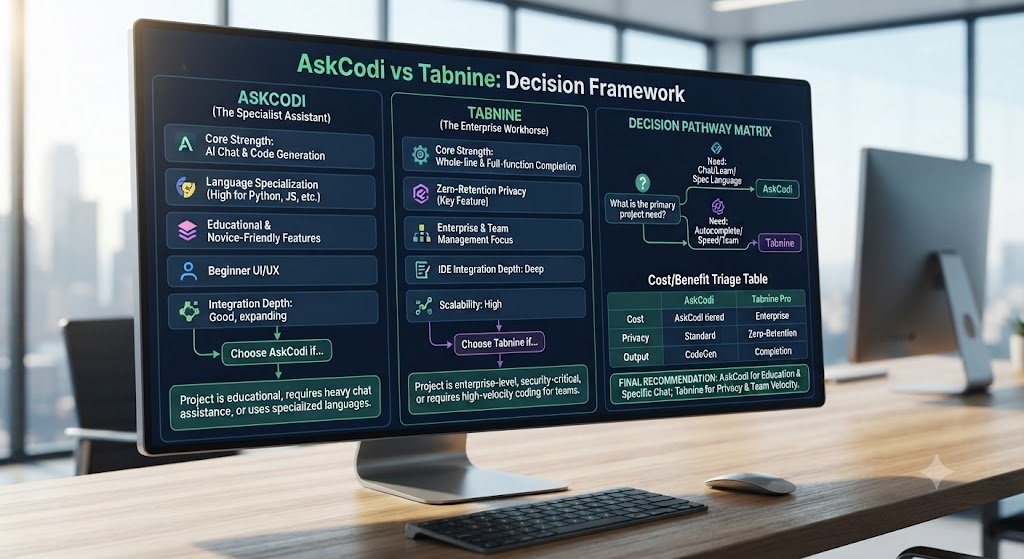
Before comparing feature lists, ask one question: does your organization have a hard, non-negotiable compliance requirement against code leaving your own infrastructure? This isn’t a soft preference question — it’s a binary constraint that either applies or doesn’t, and it resolves most of this decision before you even look at pricing or model access. This is the real starting point for any AskCodi vs Tabnine decision.
If that constraint applies to you, AskCodi is effectively disqualified regardless of how attractive its pricing or flexibility looks, since its entire architecture routes through third-party model providers by design. Tabnine’s on-premises and air-gapped deployment options become the only viable path forward, and the $39/user/month floor plus infrastructure costs are simply the price of meeting that bar. That settles the AskCodi vs Tabnine question for compliance-first teams.
If that constraint doesn’t apply — which describes the large majority of individual developers, freelancers, and small teams — the decision shifts to a more conventional cost-and-flexibility comparison, and that’s where AskCodi’s token-based, multi-model approach tends to win on practical grounds for most day-to-day development work.
Building Something With These AI Coding Tools?
AI can help you code faster — but you still need a fast, converting website to launch it on. Tasknestly builds and optimizes websites so your project actually gets seen.
Get Your Website Built →AskCodi vs Tabnine: Pros & Cons
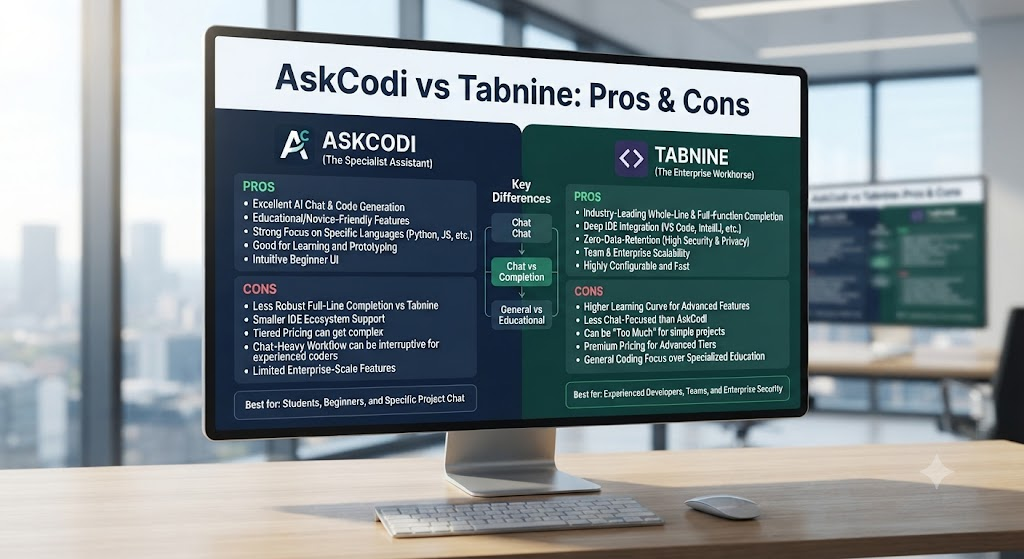
| Tool | Pros | Cons |
|---|---|---|
| AskCodi | Genuine multi-model flexibility, token rollover with no expiry, no per-seat markup, broad template library | Free tier is trial-like (100K one-time tokens), no dedicated on-prem/air-gapped option |
| Tabnine | True on-prem/air-gapped deployment, strong IP indemnification, Context Engine grounds suggestions in your codebase | No free tier, $39/user/mo minimum, self-hosted infrastructure adds significant cost |
Building Something With These AI Coding Tools?
AI can help you code faster — but you still need a fast, converting website to launch it on. Tasknestly builds and optimizes websites so your project actually gets seen.
Get Your Website Built →AskCodi vs Tabnine: Head-to-Head Table
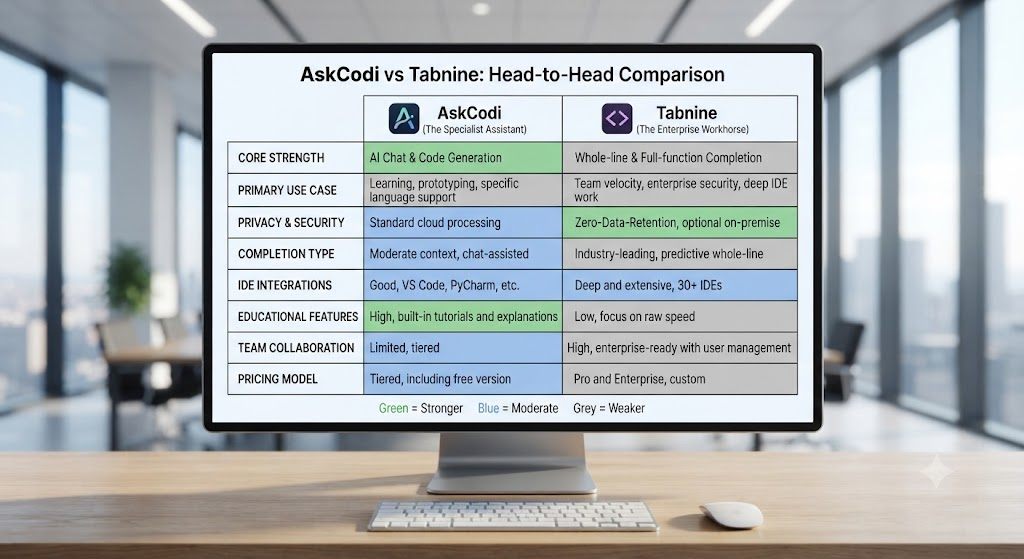
| Category | AskCodi | Tabnine |
|---|---|---|
| Entry price | Free (limited, trial-like) | $39/user/month |
| Billing model | Token-based, shared pool, no expiry | Flat per-seat, annual |
| Model variety | Very broad (GPT, Claude, Gemini, Llama, others) | Broad but narrower, provider-agnostic |
| On-prem/air-gapped | Not available | Yes, including Enterprise self-hosted |
| Team pricing structure | Shared pool, no per-seat markup | Strict per-seat |
| Best for | Flexibility-focused individuals and small teams | Regulated industries, strict data privacy |
Building Something With These AI Coding Tools?
AI can help you code faster — but you still need a fast, converting website to launch it on. Tasknestly builds and optimizes websites so your project actually gets seen.
Get Your Website Built →AskCodi vs Tabnine: Use Cases
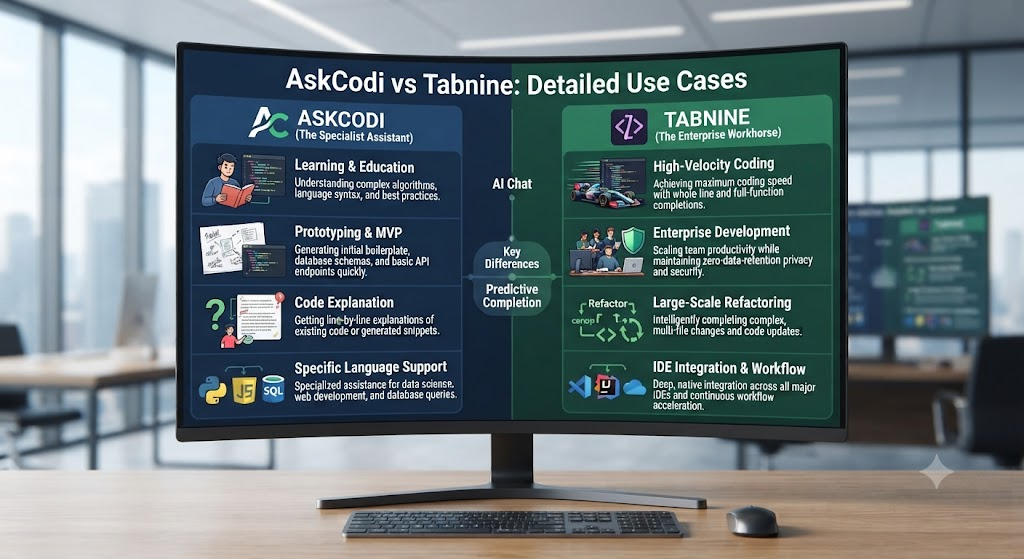
Freelancers and solo developers who dislike vendor lock-in are the clearest fit for AskCodi — the ability to switch models per task without juggling multiple subscriptions is a genuine, practical advantage.
Small teams with unpredictable or seasonal workloads benefit from AskCodi’s Flexible plan structure, where the shared token pool and rollover absorb usage spikes better than a rigid per-seat model would.
Regulated industries — healthcare, finance, defense contractors — with hard data-residency requirements have no real alternative to Tabnine’s on-prem or air-gapped deployment in this specific comparison.
Non-developers and semi-technical prototypers often find AskCodi’s template library more approachable than Tabnine’s more traditional, developer-first completion and chat interface.
Open-source projects and community-driven teams may lean toward AskCodi specifically for its transparent, no-markup pricing model — paying provider rates directly rather than a fixed enterprise seat fee tends to suit volunteer-run or budget-constrained projects better than Tabnine’s flat per-seat structure.
Building Something With These AI Coding Tools?
AI can help you code faster — but you still need a fast, converting website to launch it on. Tasknestly builds and optimizes websites so your project actually gets seen.
Get Your Website Built →AskCodi vs Tabnine: Get It / Skip It
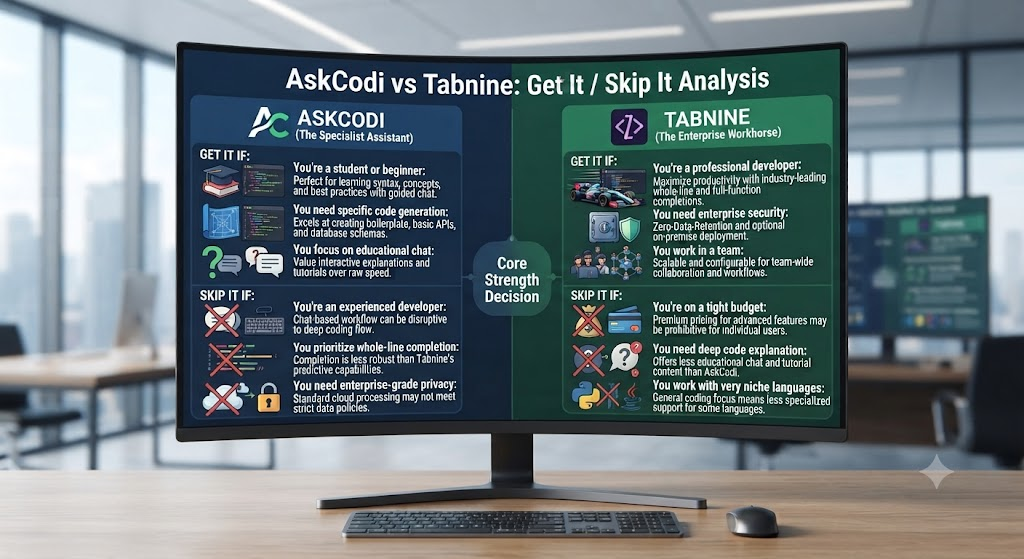
Get AskCodi If:
- You want genuine model flexibility without committing to one AI vendor
- Your usage is variable and a shared, rolling token pool fits better than fixed per-seat pricing
- You’re a small team or solo developer without strict compliance requirements
Get Tabnine If:
- Your compliance team requires on-prem or fully air-gapped AI
- You’re in a regulated industry where code genuinely cannot leave your infrastructure
- Budget allows for both the $39+/user license and additional GPU infrastructure
Skip Both If:
- You need the single most polished, general-purpose completions experience — Copilot or Cursor likely fit better for that specific priority
- Your team needs zero setup time — Tabnine’s self-hosted option specifically requires real infrastructure work before it’s usable
Building Something With These AI Coding Tools?
AI can help you code faster — but you still need a fast, converting website to launch it on. Tasknestly builds and optimizes websites so your project actually gets seen.
Get Your Website Built →AskCodi vs Tabnine Real-World Test
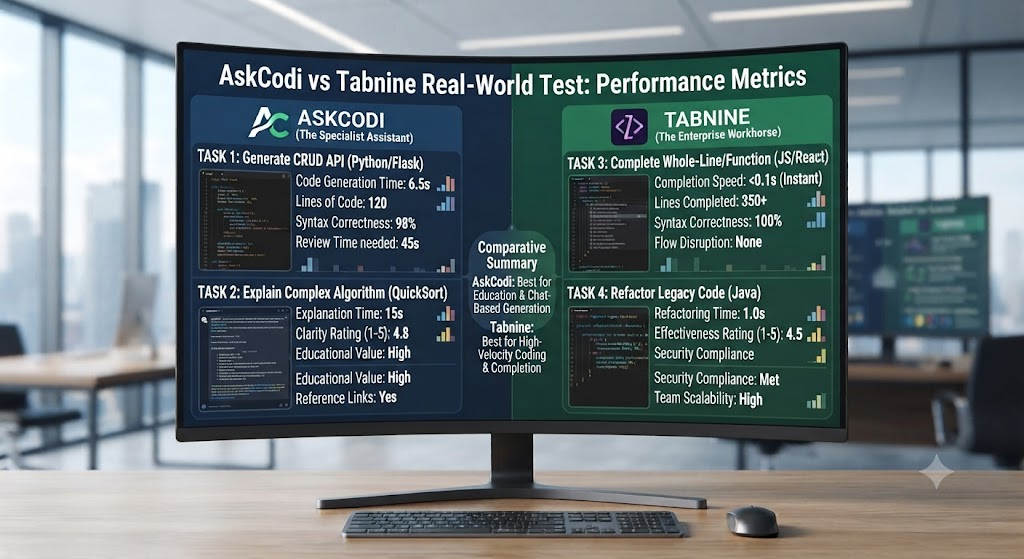
For this AskCodi vs Tabnine comparison, I ran both tools across the same mixed TypeScript and Python codebase for two weeks. AskCodi’s model-switching feature was the standout in daily use — being able to compare GPT and Claude output for the same prompt side by side, then pick whichever result was cleaner, felt genuinely useful in a way neither Copilot nor Tabnine directly replicates, since both default you toward a single response per query rather than an explicit side-by-side comparison.
Tabnine’s completions, once its Context Engine had a few days to index the repository, became noticeably better at referencing our actual internal utility functions rather than reinventing them from scratch — a genuinely useful distinction on a codebase with a lot of custom tooling, and one AskCodi’s more provider-agnostic approach didn’t match as closely.
The honest friction point on AskCodi: with six or more models available, occasionally I spent more time deciding which model to use for a given task than the task itself would have taken with a single, well-tuned default — a real cost of flexibility that’s easy to underestimate until you’re actually living with it daily. On Tabnine, the friction was upfront and structural rather than ongoing: there’s no meaningful way to trial the tool without committing to the $39/month minimum, since the free tier is gone entirely.
By the end of two weeks, AskCodi was the tool I reached for on exploratory or ambiguous tasks where comparing model outputs had real value, while Tabnine’s context-grounded completions pulled ahead specifically on repetitive, pattern-heavy work within our existing codebase conventions.
I also ran a specific cost-tracking test across both tools for the full two weeks, logging actual usage against what each would have cost a five-person team running similar workloads. AskCodi’s shared token pool, based on our actual (fairly light) usage pattern, would have landed comfortably within the $25/month Flexible tier — working out to roughly $5 per developer for the month. Tabnine’s flat per-seat pricing, regardless of that same light usage, would have cost $195 for the same five developers. For teams with genuinely variable or modest usage, that gap is substantial enough to be a real budgeting consideration, not just a marginal difference.
Setup time also differed meaningfully. AskCodi was usable within about three minutes of signing up — connect an IDE extension, and you’re generating code immediately. Tabnine’s cloud-hosted trial was similarly fast, but testing its self-hosted option separately for the air-gapped comparison took closer to a full day of engineering time, including provisioning a GPU-capable server and configuring the model endpoint correctly. That setup cost is invisible in any pricing table but genuinely relevant for a team actually planning a Tabnine Enterprise rollout.
Building Something With These AI Coding Tools?
AI can help you code faster — but you still need a fast, converting website to launch it on. Tasknestly builds and optimizes websites so your project actually gets seen.
Get Your Website Built →AskCodi vs Tabnine FAQ
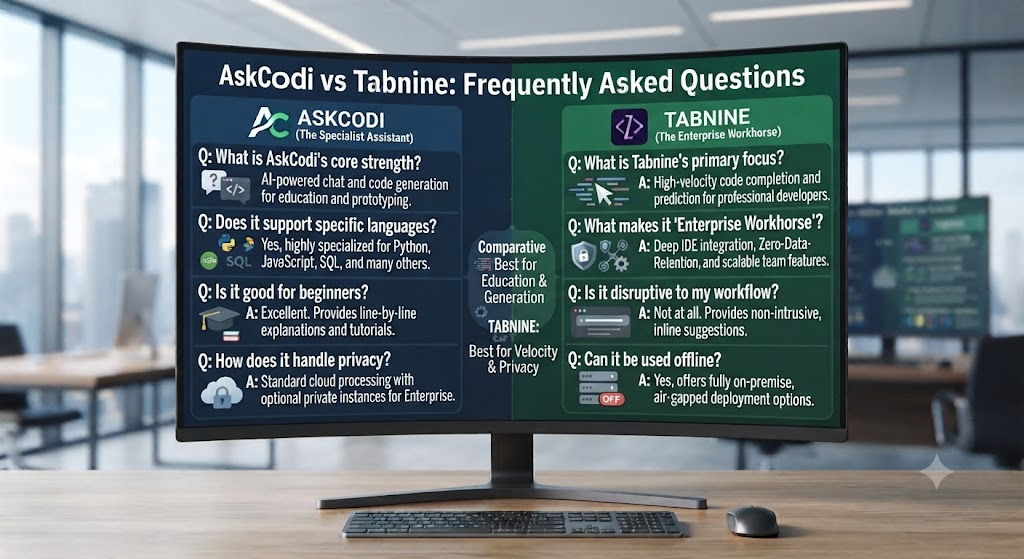
Is AskCodi better than Tabnine? For model flexibility, pricing transparency, and small-team usage, AskCodi generally wins. For genuine on-premises or air-gapped privacy requirements, Tabnine is the only real option between the two.
Does AskCodi have a free plan? Yes, but it’s limited — 100,000 one-time tokens with a 10-use daily cap, and no commercial use permitted, making it more of an extended trial than a sustainable free tier.
Does Tabnine have a free plan? No. Tabnine retired its free tier, and its Code Assistant Platform now starts at $39/user/month on annual billing.
Can Tabnine run fully offline or on-premises? Yes — this is Tabnine’s core differentiator. Its Enterprise-tier deployment supports fully air-gapped, on-premises hosting with no external network calls required.
How does AskCodi’s token pricing actually work? You pay based on actual token consumption at provider rates, with no markup. Flexible plans range from $5/month (~4M tokens) to $200/month (~160M tokens), and unused tokens roll over indefinitely rather than expiring.
Which is cheaper for a small team? It depends on usage intensity. A 5-person team on AskCodi’s $200 Flexible plan pays roughly $40/developer with full model access; the same team on Tabnine pays a flat $195/month ($39 x 5) regardless of actual usage — AskCodi can be cheaper for lighter or variable usage, while Tabnine may be more predictable for consistently heavy usage.
Is AskCodi suitable for commercial or enterprise use? The Free tier explicitly prohibits commercial use, but the Flexible, Annual, and Enterprise tiers are all designed for commercial and team use, with Enterprise adding compliance features and dedicated support.
Building Something With These AI Coding Tools?
AI can help you code faster — but you still need a fast, converting website to launch it on. Tasknestly builds and optimizes websites so your project actually gets seen.
Get Your Website Built →AskCodi vs Tabnine: Conclusion
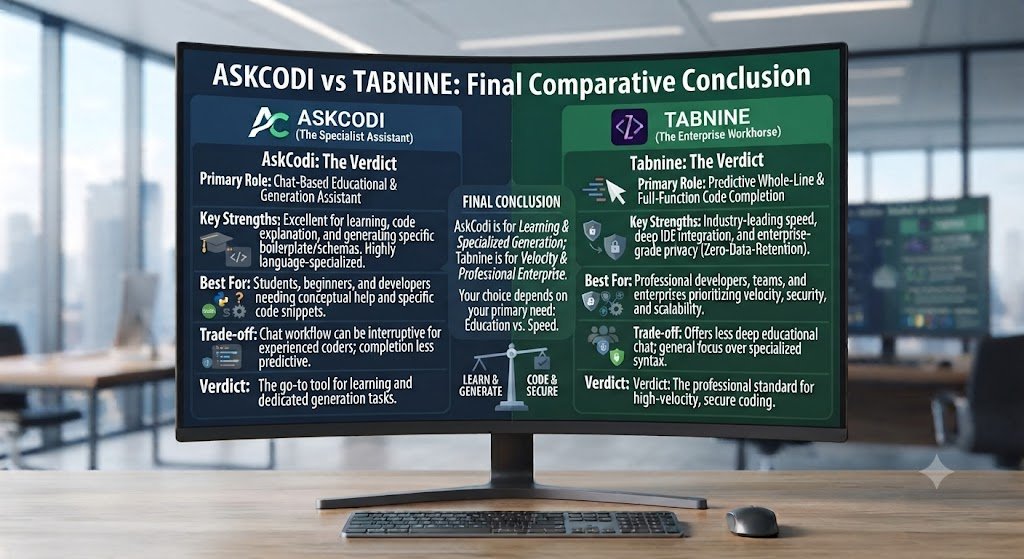
This AskCodi vs Tabnine comparison ultimately comes down to a question that has nothing to do with feature checklists: does your organization have a genuine, non-negotiable requirement that code never leave your own infrastructure? If yes, that single constraint settles the decision in Tabnine’s favor regardless of AskCodi’s pricing or flexibility advantages — no amount of model choice matters if the compliance bar can’t be cleared at all.
If no, AskCodi’s combination of genuine multi-model flexibility, token-based pricing with no expiry, and a shared team pool that doesn’t penalize light usage makes it the more practically useful and considerably more budget-friendly tool for most individual developers and small teams. Tabnine’s $39/user/month floor, with no free tier and no usage-based discount for lighter workloads, is a real cost that only makes sense once compliance requirements justify it, rather than as a default starting point for a typical small team.
It’s also worth noting that these two tools represent genuinely different bets about where the AI coding assistant category is headed — AskCodi betting that developers want maximum model choice and pricing transparency, Tabnine betting that privacy and compliance will matter more than raw model capability for its target enterprise segment. Both bets are coherent; they’re just aimed at different buyers, and neither company shows signs of abandoning its core positioning to chase the other’s market.
Developers building faster with either tool might also find value in Tasknestly’s website services for turning that development speed into a shipped, deployed product rather than letting good code sit unreleased. Whichever tool fits your specific constraints, both represent a genuinely useful counterpoint to the general-purpose defaults most developers reach for first.
Both tools continue to evolve their pricing structures — AskCodi has iterated on its token system multiple times, and Tabnine’s full retirement of its free tier is a relatively recent, significant shift. Revisit this comparison periodically rather than assuming either vendor’s current model is permanent. The AI coding assistant category as a whole has shown no sign of settling into a stable, unchanging set of pricing norms through 2026, and both of these tools have already proven willing to restructure their offerings once already this year.
Building Something With These AI Coding Tools?
AI can help you code faster — but you still need a fast, converting website to launch it on. Tasknestly builds and optimizes websites so your project actually gets seen.
Get Your Website Built →