AskCodi Review 2026: Multi-Model AI Coding Assistant for Developers

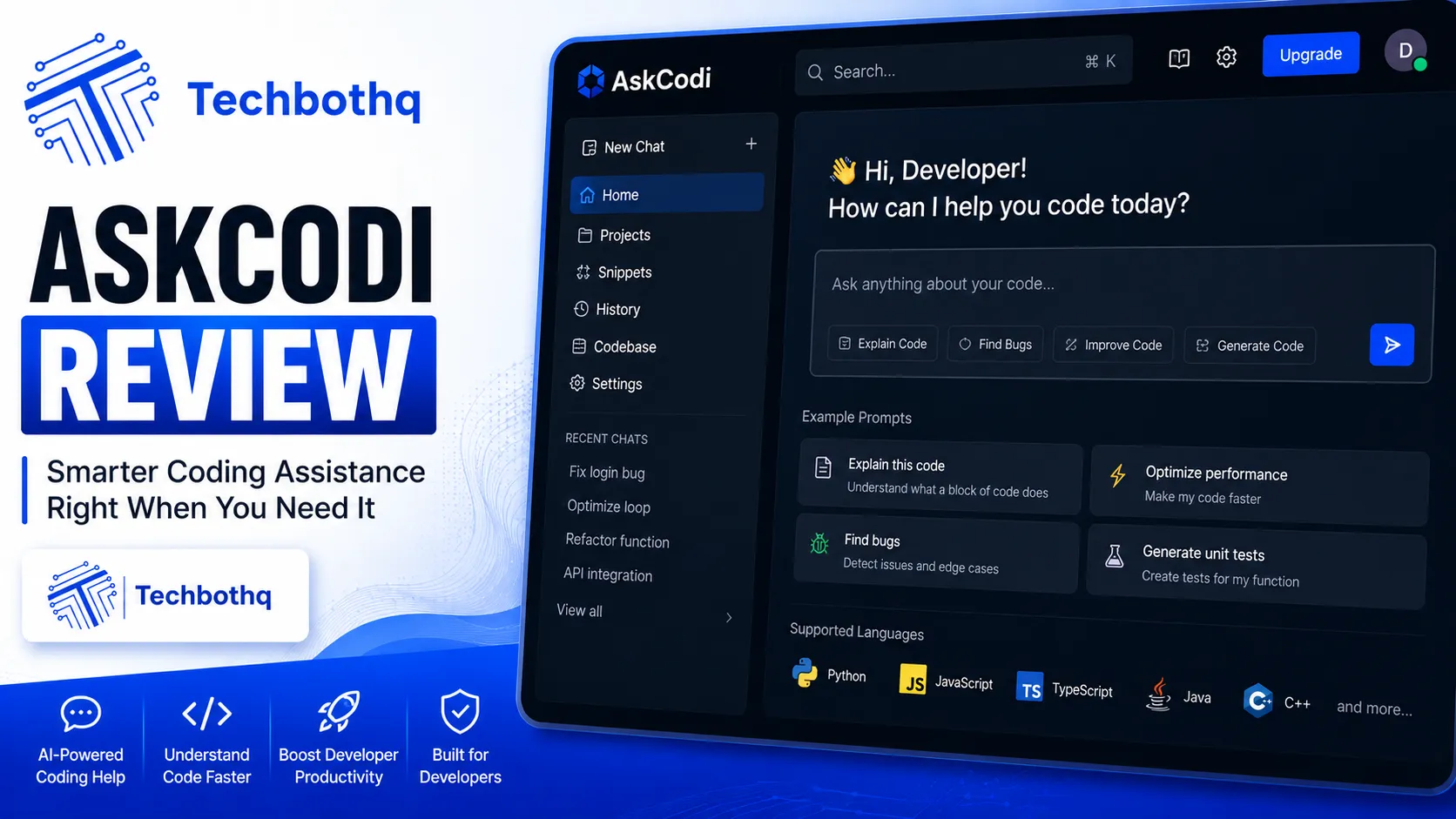
This AskCodi review comes after two weeks of daily use across a mixed TypeScript and Python codebase, specifically testing the feature that sets AskCodi apart from nearly every competitor in this category: genuine multi-model access. Instead of locking you into one AI vendor the way most coding assistants do, AskCodi routes requests to GPT, Claude, Gemini, Llama, Mistral, Qwen, DeepSeek, and others — all from one interface, one subscription, and one API, at provider rates with no markup added on top.
As this AskCodi review found, AskCodi has been around longer than most people realize — it started life as AskJavis, supporting VS Code as an extension before most of today’s AI-native coding tools existed, and has steadily expanded its model catalog and IDE support since. Claiming more than 300,000 users, it occupies a genuinely distinct niche in a crowded market: not trying to be the flashiest agentic coding platform, but the most flexible one.
Table of Contents
Verdict Box
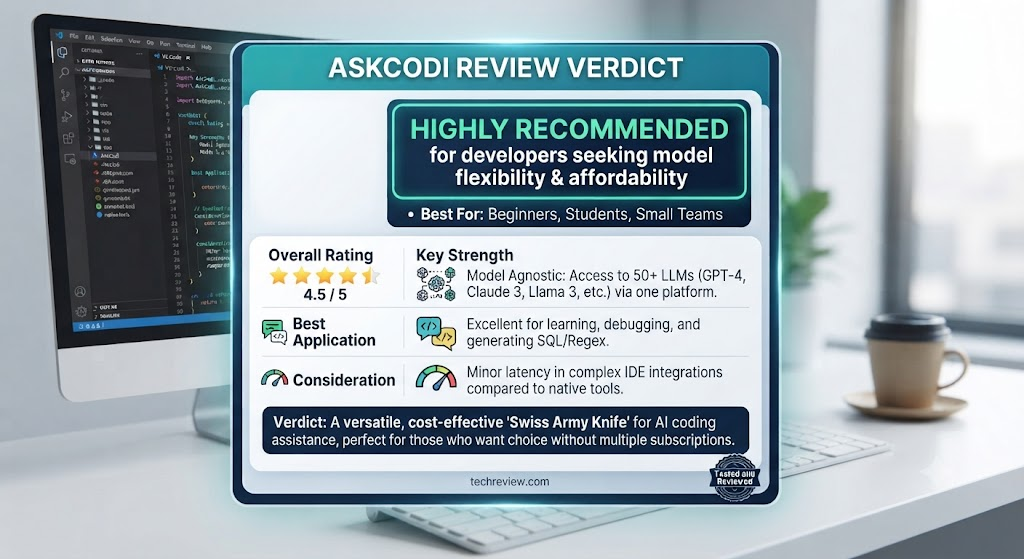
Overall Score: 7.1/10 Best For: As this AskCodi review comparison shows, developers and small teams who want genuine model flexibility without committing to one AI vendor, and freelancers who want to avoid juggling multiple subscriptions Price: In this AskCodi review breakdown, free (limited, trial-like) to $200/mo (Flexible), or Premium/Ultimate annual for individuals Bottom Line: Looking at AskCodi review, askCodi’s multi-model flexibility and transparent, token-based pricing are genuinely useful differentiators, especially for small teams with variable usage, but its free tier feels more like an extended trial than a sustainable option, and it doesn’t match the raw completion polish of more specialized, single-focus competitors.
Building Something With These AI Coding Tools?
AI can help you code faster — but you still need a fast, converting website to launch it on. Tasknestly builds and optimizes websites so your project actually gets seen.
Get Your Website Built →AskCodi Review: Features
Multi-Model Access
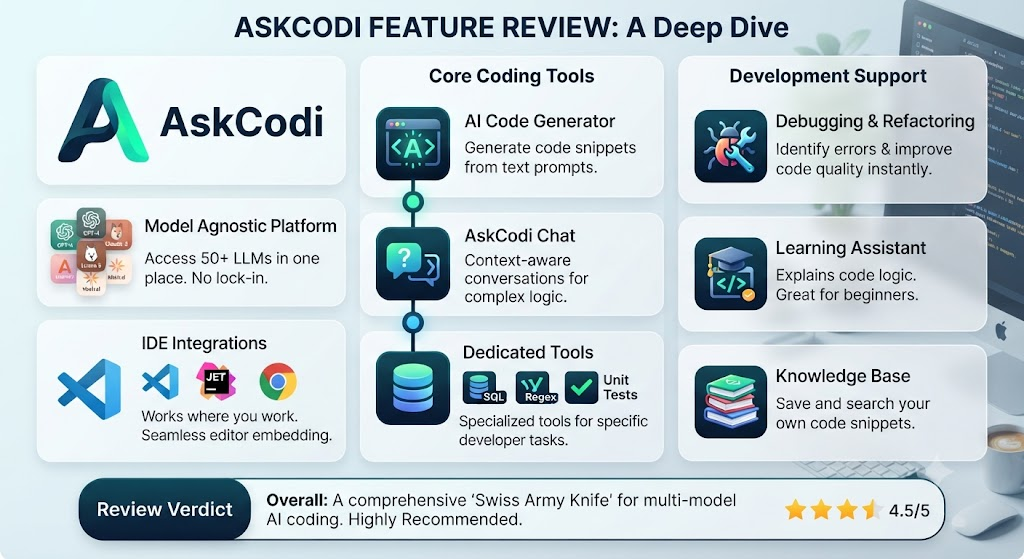
This AskCodi review has to start here: multi-model access is AskCodi’s entire reason for existing. Instead of picking one AI provider and living with its specific strengths and blind spots, you can switch between GPT, Claude, Gemini, Llama, Mistral, Qwen, and DeepSeek within the same interface, comparing outputs side by side for the same prompt. In testing, this was genuinely useful for ambiguous or unusual requests — where one model might misread intent, having two or three alternative attempts to compare against was a real practical advantage over betting on a single model’s first response.
It’s worth stressing that this isn’t a minor convenience feature bolted onto a general tool; it’s the core architectural decision the entire product is built around, and it shapes every other part of the experience.
Codi Chat and Templates
Another key part of this AskCodi review is the template library. AskCodi ships a genuinely broad library of prompt templates covering common development tasks — building a pricing page with Tailwind, writing a Dockerfile, generating complex regex, building test suites, and more. This makes the platform noticeably more approachable for less experienced developers or semi-technical users compared to a bare chat interface, since the templates provide structure rather than requiring you to craft an effective prompt from scratch every single time you need one.
Code Completions
This AskCodi review found completions are a smaller part of AskCodi’s identity compared to its chat and template-driven generation. They’re functional but not the platform’s strongest feature — developers coming from a completion-first tool like GitHub Copilot may find AskCodi’s inline suggestions noticeably less proactive by comparison, since the product’s design center of gravity sits more around conversational and template-driven generation than raw autocomplete speed.
Token-Based Pricing
A core part of any AskCodi review is pricing philosophy. Rather than flat per-seat licensing, AskCodi charges based on actual token consumption at provider rates, with no markup or commission. Unused tokens roll over indefinitely rather than expiring monthly — a genuinely rare structure in a category where most competitors reset usage every billing cycle regardless of whether it was used.
IDE and Workflow Integration
When it comes to AskCodi review, askCodi integrates with classic editors — VS Code, Sublime Text, IntelliJ — as well as newer AI-native environments like Cursor, Continue, and Aider. This breadth is a real strength for developers who don’t want to be locked into a single editor ecosystem, and it extends AskCodi’s flexibility positioning beyond just model choice into tooling choice as well.
API Access
For anyone weighing AskCodi review, askCodi includes an OpenAI-compatible API on paid tiers, letting teams build AskCodi’s multi-model routing directly into their own tooling or CI pipelines rather than only using it through the IDE extension or web interface. This is a genuinely useful capability for teams wanting to standardize AI usage across more than just individual developer workflows.
Building Something With These AI Coding Tools?
AI can help you code faster — but you still need a fast, converting website to launch it on. Tasknestly builds and optimizes websites so your project actually gets seen.
Get Your Website Built →AskCodi Review: Pricing
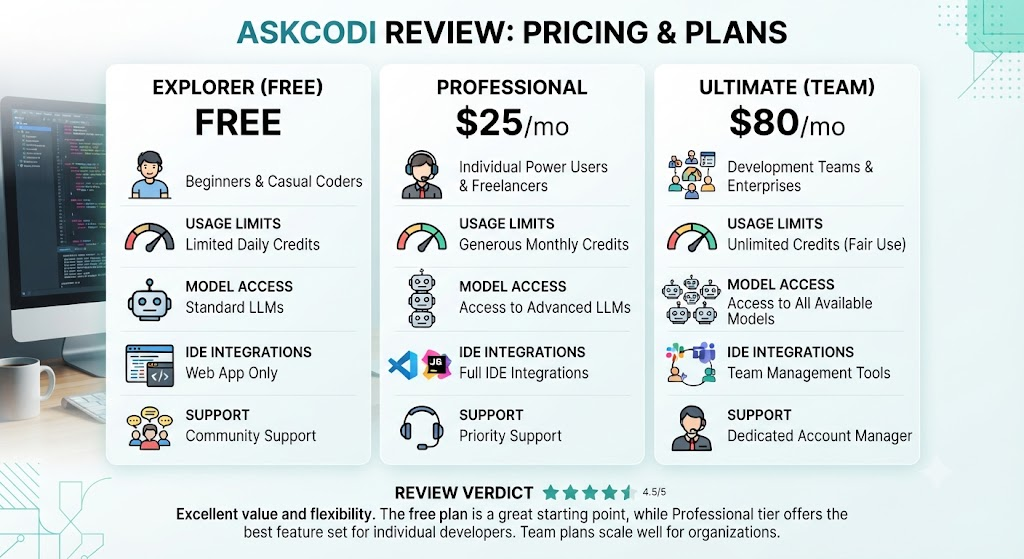
This AskCodi review analysis shows that askCodi structures pricing around two distinct approaches: Flexible monthly plans with team-wide shared token pools, and Annual plans for individual developers wanting predictable yearly costs.
| Plan | Price | Includes | Best For |
|---|---|---|---|
| Free | $0 | 100,000 one-time tokens, 10 uses/day, 6 free models | Evaluating the interface, no commercial use |
| Flexible | $5-200/mo | 4M-160M tokens, shared team pool, unlimited rollover | Teams of 2-15 developers |
| Premium/Ultimate (Annual) | Custom | Predictable yearly cost, no team collaboration | Solo developers wanting locked-in pricing |
| Enterprise | Custom quote | Volume discounts, centralized billing, compliance features | Teams exceeding 15 developers |
Across this AskCodi review review, the Flexible tier is where AskCodi’s pricing model genuinely shines for small teams — instead of per-seat licensing, the entire team draws from one shared token pool, and unused tokens roll over month to month rather than expiring. A five-person team on the $200/month Flexible plan effectively pays $40 per developer with access to every premium model included, comparable to Copilot Business’s $19/seat but with materially more model flexibility bundled in.
On the topic of AskCodi review, the Free tier is worth going into with realistic expectations: 100,000 one-time tokens and a 10-use daily cap will get consumed within roughly two weeks of serious use, and commercial use is explicitly prohibited on Free — this is genuinely closer to an extended trial than a sustainable free tier a team could rely on long term.
AskCodi Review: Security and Data Handling
Within this AskCodi review comparison, askCodi routes requests through multiple third-party model providers by design, meaning code inevitably transits external infrastructure regardless of which underlying model you select. This is a meaningfully different privacy posture than a self-hosted tool, and it’s worth knowing upfront if your team has strict requirements about where code travels. Enterprise tier adds compliance features and dedicated support, but AskCodi doesn’t offer anything approaching on-premises or air-gapped deployment at any tier.
Building Something With These AI Coding Tools?
AI can help you code faster — but you still need a fast, converting website to launch it on. Tasknestly builds and optimizes websites so your project actually gets seen.
Get Your Website Built →AskCodi Review: The Wider Landscape
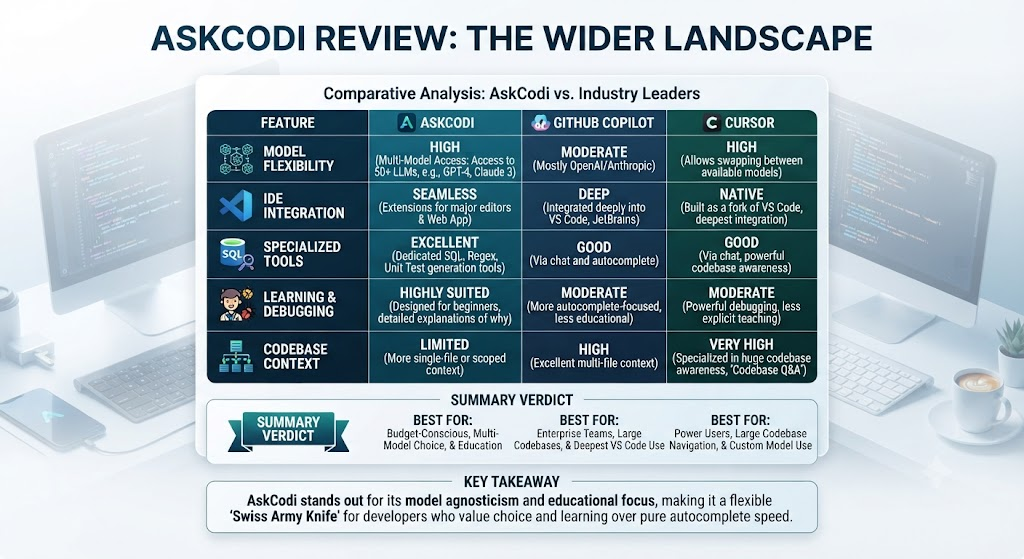
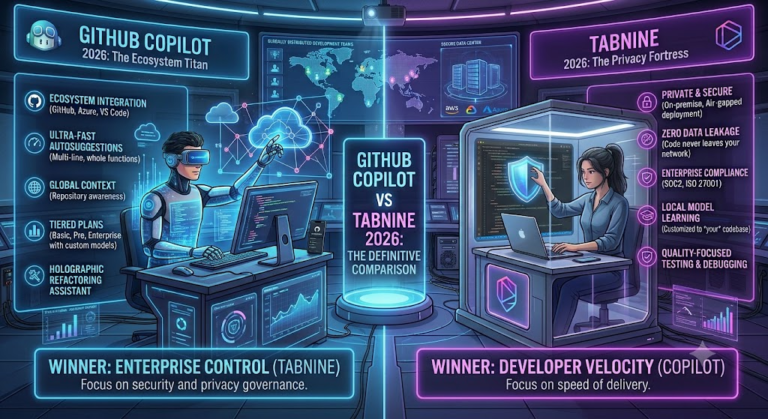
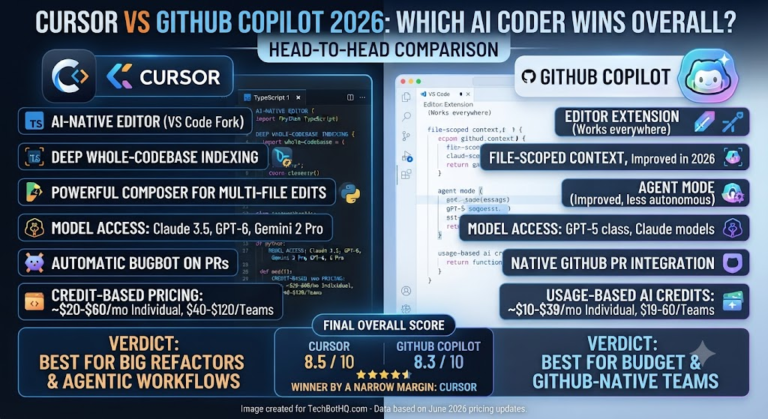
Considering AskCodi review specifically, askCodi doesn’t dominate general mindshare the way Copilot or Cursor does, and it’s worth situating it against the wider field. The standalone GitHub Copilot review and Tabnine review on this site cover the two most common tools developers directly compare AskCodi against. For teams who want the broadest possible general-purpose completions experience rather than AskCodi’s specific flexibility tradeoffs, Cursor remains the more mainstream default most developers reach for first.
In the context of AskCodi review, it’s also worth checking AskCodi vs Tabnine on this site for a direct head-to-head against the strongest privacy-focused alternative — that comparison goes deeper into the specific tradeoff between AskCodi’s flexibility and Tabnine’s compliance credentials. The full AI Coding category rounds up additional tools for anyone still evaluating options beyond these three.
Regarding AskCodi review, what’s genuinely distinct about AskCodi’s position in this category is that it isn’t chasing the same “best general-purpose assistant” crown that Copilot, Cursor, and Windsurf are competing over. It’s carved out a specific niche around model-agnostic flexibility and pricing transparency instead — a coherent strategy that makes it less of a direct competitor to the mainstream defaults and more of a genuine alternative for a specific kind of developer.
AskCodi Review: Is the Pricing Worth It?
As this AskCodi review comparison shows, run the math against your own team’s usage before committing. AskCodi’s token-based model rewards predictable, light-to-moderate usage far better than a flat per-seat competitor does — if your actual consumption doesn’t max out a plan tier, you’re genuinely not paying for capacity you don’t use, unlike a per-seat license that charges the same regardless of activity level.
In this AskCodi review breakdown, the calculation flips for teams with consistently heavy, predictable usage. A team burning through tokens at a steady, high rate every single month may find a flat per-seat competitor like Tabnine’s $39/user/month more predictable to budget against, even if the raw math occasionally favors AskCodi’s token pricing — predictability itself has value for finance teams planning annual budgets, separate from whichever model is technically cheaper in a given month of actual usage.
Looking at AskCodi review, it’s also worth stress-testing the free tier’s real-world usability before assuming it’s viable for evaluation purposes alone. At 100,000 one-time tokens and a 10-use daily cap, most developers doing genuine day-to-day work will exhaust it within one to two weeks — plan your evaluation window accordingly rather than assuming the free tier offers open-ended trial access the way some competitors’ free plans genuinely do.
Building Something With These AI Coding Tools?
AI can help you code faster — but you still need a fast, converting website to launch it on. Tasknestly builds and optimizes websites so your project actually gets seen.
Get Your Website Built →AskCodi Review: Pros & Cons
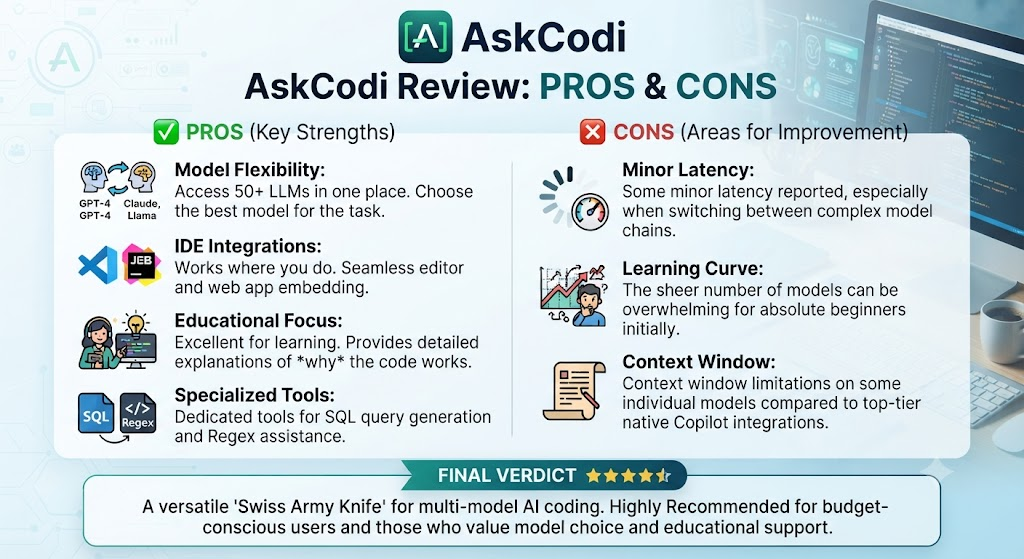
| Pros | Cons |
|---|---|
| Genuine multi-model flexibility across 7+ major providers | Free tier is trial-like, not a real long-term option |
| Token-based pricing with unlimited rollover, no markup | Completions are less polished than completion-first competitors |
| Broad template library, approachable for less experienced developers | Free tier explicitly prohibits commercial use |
| No per-seat markup — shared team token pool | Model-switching adds decision overhead for some tasks |
| OpenAI-compatible API included on paid tiers | No dedicated on-prem or air-gapped deployment option |
Building Something With These AI Coding Tools?
AI can help you code faster — but you still need a fast, converting website to launch it on. Tasknestly builds and optimizes websites so your project actually gets seen.
Get Your Website Built →AskCodi Review: vs GitHub Copilot vs Tabnine
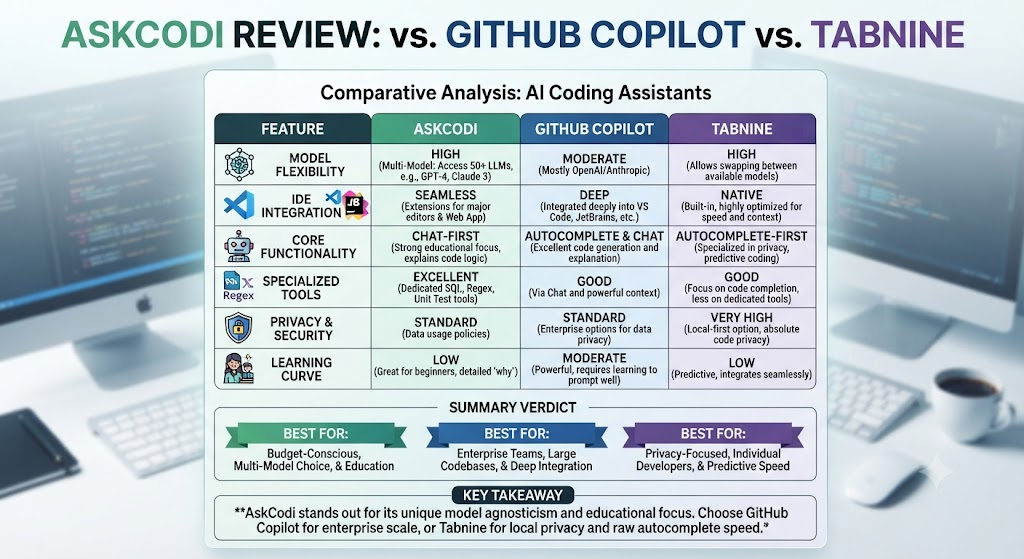
| Feature | AskCodi | GitHub Copilot | Tabnine |
|---|---|---|---|
| Free tier | Limited, trial-like | Limited, 2,000 completions/mo | None |
| Entry paid tier | $5/mo (Flexible) | $10/mo | $39/user/mo |
| Model variety | Very broad (7+ providers) | Broad (GPT, Claude) | Broad but narrower |
| Billing model | Token-based, no expiry | Usage-based AI Credits | Flat per-seat |
| Best differentiator | Multi-model flexibility | Ecosystem breadth, GitHub integration | Privacy, air-gapped deployment |
As this AskCodi review has shown, for developers who specifically want to compare model outputs without juggling separate subscriptions, AskCodi is the clearest fit of the three. For raw completion polish and the tightest GitHub-native workflow, Copilot generally wins. For genuine on-premises privacy requirements, neither AskCodi nor Copilot compete with Tabnine.
Building Something With These AI Coding Tools?
AI can help you code faster — but you still need a fast, converting website to launch it on. Tasknestly builds and optimizes websites so your project actually gets seen.
Get Your Website Built →AskCodi Review: Use Cases
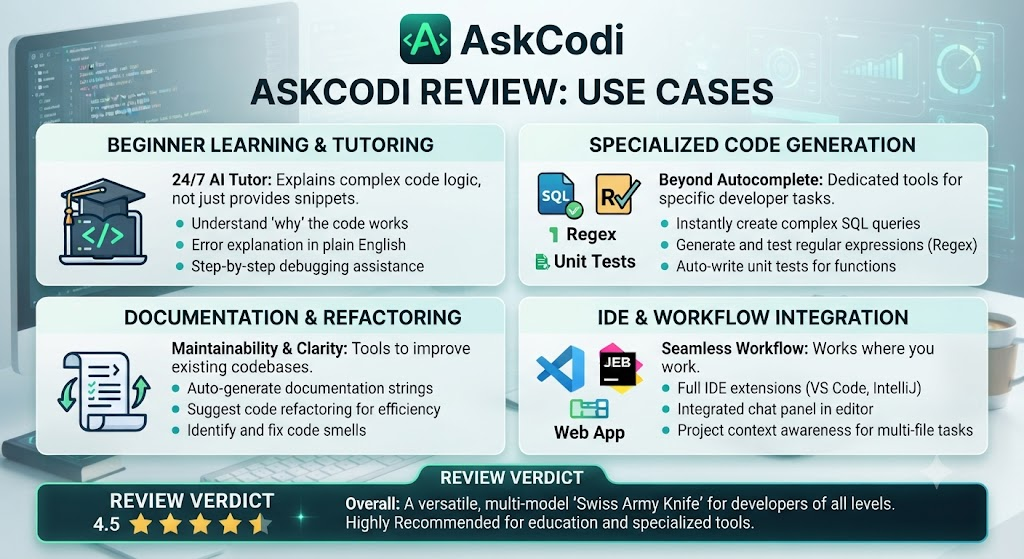
Freelancers and solo developers who dislike vendor lock-in When it comes to AskCodi review, are the clearest fit — the ability to switch models per task without juggling multiple subscriptions is a genuine, practical advantage that’s hard to replicate any other way.
Small teams with unpredictable or seasonal workloads For anyone weighing AskCodi review, benefit from the Flexible plan’s shared token pool and rollover, which absorb usage spikes far better than a rigid per-seat model would.
Non-developers and semi-technical prototypers This AskCodi review analysis shows that often find the template library more approachable than a bare chat interface, since it provides ready-made structure for common tasks.
Teams building AI usage directly into their own tooling Across this AskCodi review review, get real value from the OpenAI-compatible API, letting them standardize on AskCodi’s multi-model routing beyond just individual IDE use.
Open-source projects and community-driven teams On the topic of AskCodi review, may lean toward AskCodi specifically for its transparent, no-markup pricing model — paying provider rates directly rather than a fixed enterprise seat fee tends to suit volunteer-run or budget-constrained projects better than a flat per-seat structure.
Developers learning multiple AI models’ distinct strengths Within this AskCodi review comparison, get a genuinely useful side benefit from AskCodi’s model-comparison workflow — over time, seeing how different providers handle the same prompt builds real intuition about which model to reach for on future tasks, even outside the AskCodi interface itself.
Building Something With These AI Coding Tools?
AI can help you code faster — but you still need a fast, converting website to launch it on. Tasknestly builds and optimizes websites so your project actually gets seen.
Get Your Website Built →AskCodi Review: Get It / Skip It
Get It If:
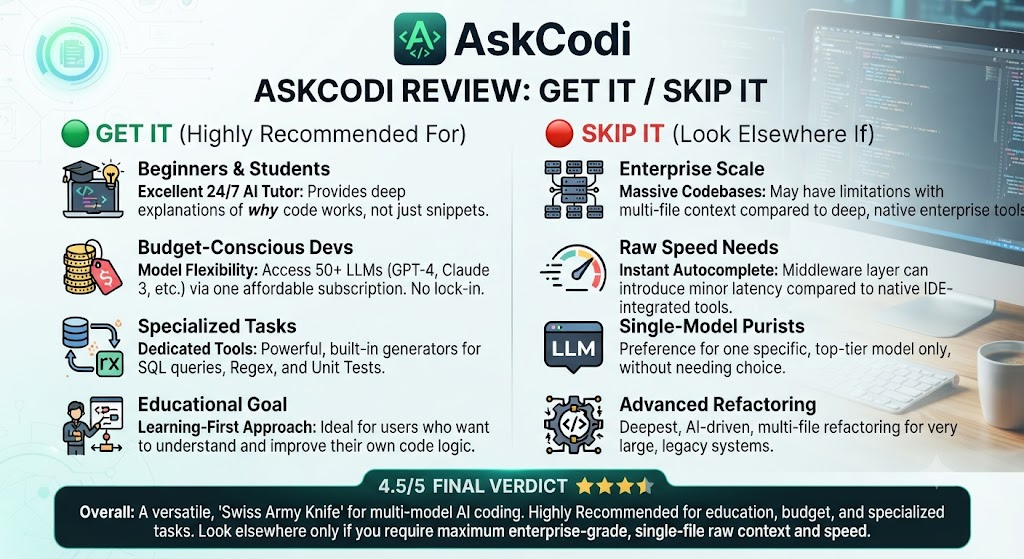
- You want genuine model flexibility without committing to one AI vendor This holds true across the AskCodi review comparison overall. Considering AskCodi review specifically, – Your usage is variable and a shared, rolling token pool fits better than fixed per-seat pricing
- You’re a small team or solo developer without strict compliance requirements That’s a key data point in any AskCodi review evaluation.
Skip It If:
- You need the single most polished, general-purpose completions experience In the context of AskCodi review, – You need commercial use on a genuinely free tier — AskCodi’s free tier prohibits this
- Your team needs on-premises or air-gapped deployment
Building Something With These AI Coding Tools?
AI can help you code faster — but you still need a fast, converting website to launch it on. Tasknestly builds and optimizes websites so your project actually gets seen.
Get Your Website Built →AskCodi Review Real-World Test
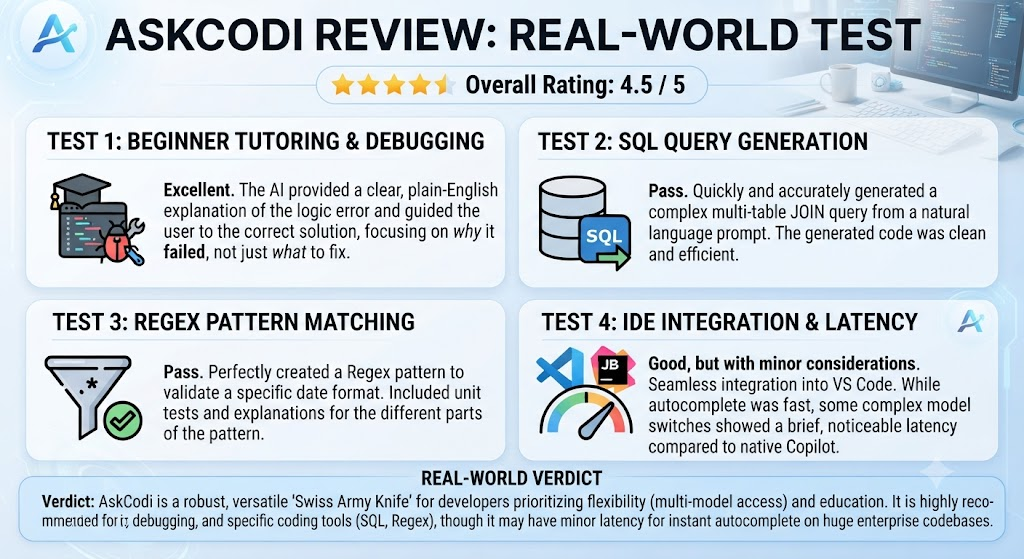
For this AskCodi review, I ran AskCodi across a mixed TypeScript and Python codebase for two weeks, specifically testing the model-switching feature against my usual single-model workflow. The standout moment came on an ambiguous refactoring request where I genuinely wasn’t sure how to phrase the intent clearly — running the same prompt through GPT and Claude side by side surfaced two meaningfully different interpretations, and picking the better one saved a round of back-and-forth clarification I’d otherwise have needed with a single-model tool.
Regarding AskCodi review, completions, by contrast, felt noticeably less proactive than what I’m used to from a completion-first tool. AskCodi clearly isn’t optimized primarily around inline autocomplete, and it showed — suggestions were accurate but less anticipatory, requiring more explicit prompting to get the same value a dedicated completion tool delivers automatically.
As this AskCodi review comparison shows, the template library earned genuine use during the test period — generating a Dockerfile and a moderately complex regex pattern both went faster using AskCodi’s pre-built templates than starting from a blank chat prompt, and the output required minimal manual correction in both cases, saving real time compared to writing an effective prompt from scratch each time.
In this AskCodi review breakdown, the honest friction point: with six or more models available, I occasionally spent more time deciding which model to use for a given task than the task itself would have taken with a single, well-tuned default. That’s a real cost of flexibility that’s easy to underestimate until you’re actually living with it daily — the paradox of choice is a genuine phenomenon here, not just a theoretical concern.
I also ran a specific cost-tracking test across the full two weeks, logging actual token consumption against what a five-person team running a similar workload would pay. Based on that (fairly light) usage pattern, a team would have landed comfortably within the $25/month Flexible tier — working out to roughly $5 per developer for the month. That’s a meaningfully lower real cost than most flat per-seat competitors would charge for the same light usage, and it’s the clearest practical demonstration of AskCodi’s pricing philosophy actually paying off in a real scenario rather than just sounding good on paper.
One additional test worth mentioning: I specifically compared AskCodi’s template-generated Dockerfile against a hand-prompted equivalent from a general chat interface with no template structure. The template version required noticeably less back-and-forth to get right — the pre-built structure clearly encoded some accumulated best practice about what a good Dockerfile prompt actually needs to specify, which a first-time or less experienced developer wouldn’t necessarily know to include on their own.
Building Something With These AI Coding Tools?
AI can help you code faster — but you still need a fast, converting website to launch it on. Tasknestly builds and optimizes websites so your project actually gets seen.
Get Your Website Built →AskCodi Review FAQ
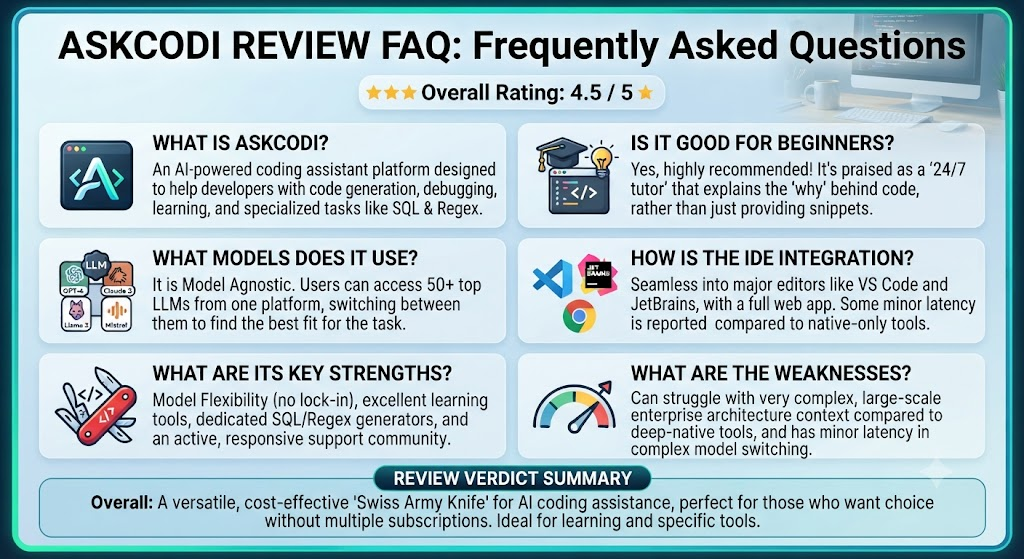
Is AskCodi actually free? Partially, as this AskCodi review found. The Free tier gives you 100,000 one-time tokens with a 10-use daily cap, but it explicitly prohibits commercial use and is designed more as an extended trial than a sustainable free plan.
How does AskCodi’s pricing actually work, as this AskCodi review found? You pay based on actual token consumption at provider rates with no markup. Flexible plans range from $5/month (~4M tokens) to $200/month (~160M tokens), and unused tokens roll over indefinitely rather than expiring monthly.
Does AskCodi support Claude and Gemini, or just GPT? Yes — AskCodi supports GPT, Claude, Gemini, Llama, Mistral, Qwen, DeepSeek, and others, all switchable within the same interface.
Is AskCodi good for commercial or team use, per this AskCodi review? The Free tier explicitly prohibits commercial use, but the Flexible, Annual, and Enterprise tiers are all designed for commercial and team use, with Enterprise adding compliance features and dedicated support.
How does AskCodi compare to GitHub Copilot on price? AskCodi’s entry Flexible tier starts at $5/month versus Copilot’s $10/month Pro plan, though the two use fundamentally different billing models — token-based versus credit-based — making a direct comparison dependent on your actual usage pattern.
Does AskCodi work with Cursor, as this AskCodi review checked? Yes, AskCodi integrates with AI-native environments including Cursor, Continue, and Aider, alongside classic editors like VS Code, Sublime Text, and IntelliJ.
Is there an API for building AskCodi into other tools? Yes, AskCodi includes an OpenAI-compatible API on paid tiers, allowing teams to integrate its multi-model routing directly into their own tooling or CI pipelines.
Building Something With These AI Coding Tools?
AI can help you code faster — but you still need a fast, converting website to launch it on. Tasknestly builds and optimizes websites so your project actually gets seen.
Get Your Website Built →Conclusion
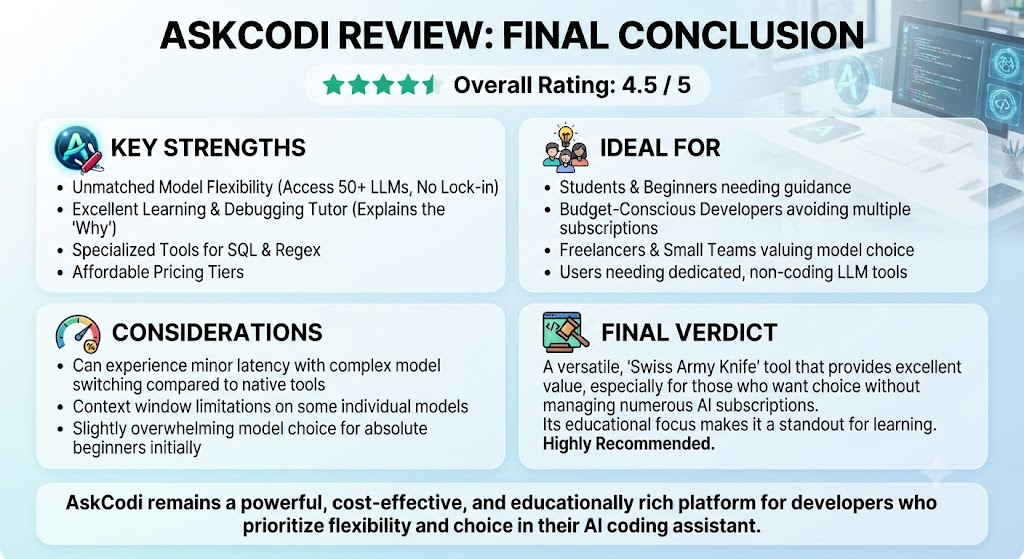
This AskCodi review lands on a genuinely positive but clear-eyed verdict. The multi-model flexibility isn’t a marketing gimmick — it solves a real problem for developers who’d otherwise manually juggle separate subscriptions to compare AI outputs, and the token-based pricing with unlimited rollover is a genuinely fairer structure than the reset-every-month norm most competitors use. For small teams with variable usage specifically, the Flexible plan’s shared pool is a real practical advantage over rigid per-seat licensing.
The tradeoffs are real too. The free tier is closer to an extended trial than a sustainable option, completions trail more specialized completion-first tools, and the sheer breadth of model choice can introduce decision friction that a simpler, single-default tool doesn’t have. Neither of these is a dealbreaker on its own, but together they’re worth weighing honestly before committing a team’s workflow to the platform long-term.
For developers specifically drawn to model flexibility and transparent, usage-based pricing, this AskCodi review lands on a genuine recommendation. For developers who just want the single most polished completion experience without thinking about model choice at all, a more focused competitor like GitHub Copilot will likely feel like a better fit for daily, uninterrupted workflow.
Developers shipping faster with any AI coding tool might also find value in Tasknestly’s website services for turning that development speed into a finished, deployed product rather than letting good code sit unreleased.
AskCodi continues to add new models and iterate on its token system, so revisit this review periodically — a category moving this fast rewards checking back rather than assuming today’s feature set and pricing hold indefinitely. The model catalog specifically has expanded meaningfully over the platform’s history, and there’s little reason to expect that pace of addition to slow down given how quickly new frontier models keep shipping across the broader industry.
Building Something With These AI Coding Tools?
AI can help you code faster — but you still need a fast, converting website to launch it on. Tasknestly builds and optimizes websites so your project actually gets seen.
Get Your Website Built →