Leonardo AI Review 2026: Brutally Honest Features, Pricing & Verdict

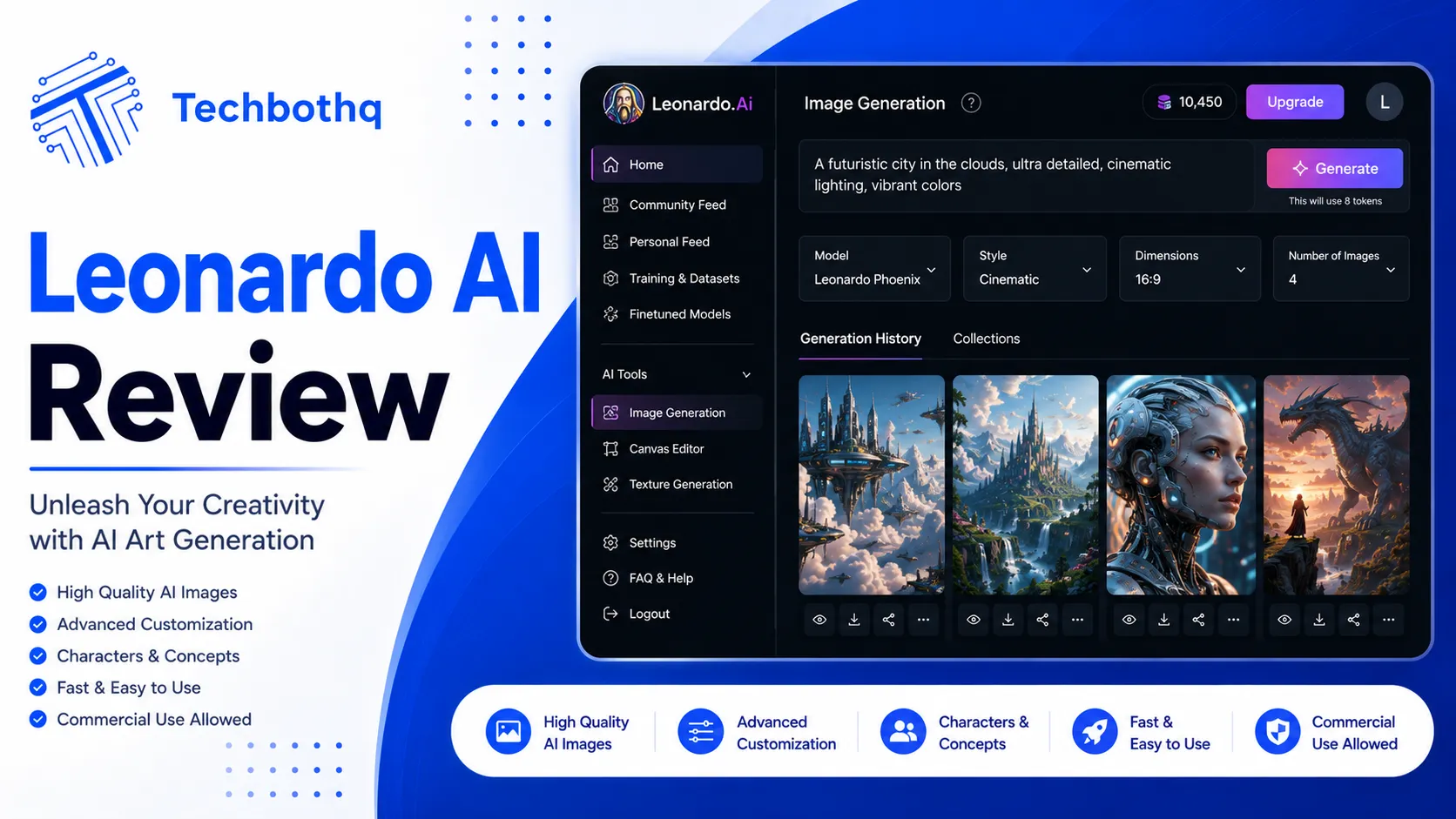
| ⚡ TechBotHQ Verdict This Leonardo AI review gives the platform a strong 4.4 out of 5 for game developers, digital artists, and creators who need consistent AI image generation with fine-tuning capabilities. Leonardo AI has built one of the most powerful and versatile AI image platforms in 2026 — particularly for users who need to maintain consistent characters across multiple generated images, train custom models on their own datasets, and generate high volumes of images affordably. The free tier with 150 tokens per day is the most generous in the AI image generation market. And the Canva acquisition validation — Canva chose Leonardo’s Phoenix model to power Dream Lab for 150 million users — is the strongest possible third-party endorsement of the model quality. Rating: 4.4/5 | Best For: Game developers, digital artists, illustrators, and creators needing consistent character generation, custom model fine-tuning, and high-volume AI image production |
Table of Contents
Leonardo AI Review 2026: What You Need to Know First

This Leonardo AI review starts with the news that defines the platform’s 2026 standing: Canva acquired Leonardo AI in 2025 and chose its Phoenix model as the engine powering Dream Lab — Canva’s AI image generation feature serving 150 million monthly users. That acquisition is the most significant validation of Leonardo AI’s model quality that any Leonardo AI review can cite, and it changes how seriously you should take the platform’s photorealistic capabilities.
But the Canva acquisition is not why most readers come to a Leonardo AI review. Most people evaluating Leonardo AI are game developers who need consistent character assets, digital artists who want fine-tuning control over their AI generation style, or indie creators who want high-volume image generation on a free or low-cost plan. This Leonardo AI review covers all three use cases in depth — because Leonardo AI is genuinely outstanding for each of them in different ways.
The Leonardo AI review verdict for the free tier is particularly noteworthy: 150 tokens per day — roughly 500 or more image generations per month depending on the model and settings you use — with access to most core features including the Phoenix model. No other mainstream AI image generator offers a free tier this generous, which makes this Leonardo AI review relevant even to users who are not ready to pay for anything.
Our Leonardo AI review tested the platform across game asset generation, character consistency workflows, Phoenix model photorealistic output, and custom fine-tuning setup. Here is the complete honest picture after extensive real-world testing.
Whether you are a game developer evaluating AI tools for character and asset production, a digital artist looking for fine-tuning control that generic AI generators do not offer, or a creator exploring the best free AI image generation tier available — this Leonardo AI review has the complete honest answer.
Love What These AI Design Tools Can Do?
Great AI-generated visuals still need a cohesive brand identity holding them together. Let Tasknestly build your full branding — logo, guidelines, and visual system.
Explore Branding Services →1. What Is Leonardo AI? A Plain-English Overview
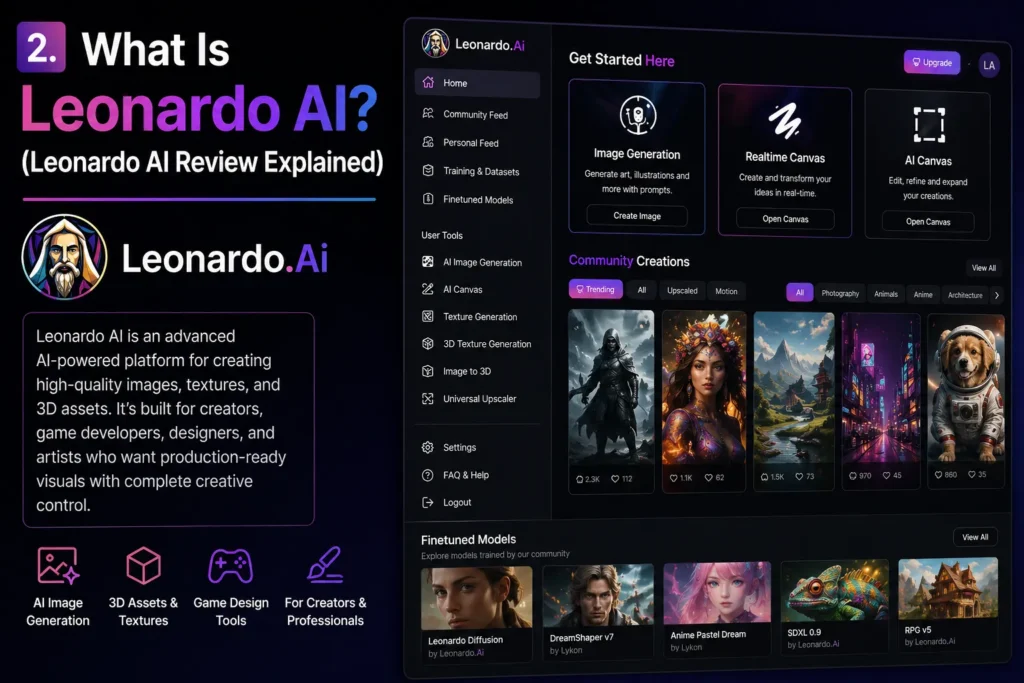
Leonardo AI is an AI image generation platform with particular strengths in game asset production, character design, digital art, and product visualization. It offers a web interface, iOS and Android apps, and an API for integration into creative pipelines. Founded in 2022 and acquired by Canva in 2025, Leonardo AI now operates within the Canva ecosystem while maintaining its own standalone platform for users who want the full feature set beyond what is available in Canva’s Dream Lab integration.
What makes this Leonardo AI review distinct from reviews of Midjourney or Adobe Firefly is the platform’s specific technical strengths. Leonardo AI’s character consistency tools maintain the visual appearance of a specific character across multiple generated images — a technically challenging capability that most general-purpose AI image generators handle poorly. Custom fine-tuning lets you train Leonardo AI on your own image dataset to generate images that consistently match a specific visual style, character design, or product aesthetic. And the model library goes beyond a single generation approach to offer specialized community models for different styles and applications.
The Phoenix model — Leonardo AI’s flagship in this Leonardo AI review — produces photorealistic output that earned Canva’s trust as the engine behind Dream Lab. For photorealistic portrait generation, product visualization, and high-quality commercial imagery, Phoenix performs at a level that justifies the Canva acquisition premium.
Love What These AI Design Tools Can Do?
Great AI-generated visuals still need a cohesive brand identity holding them together. Let Tasknestly build your full branding — logo, guidelines, and visual system.
Explore Branding Services →2. How Leonardo AI Works: Key Features
Phoenix Model — Flagship Generation
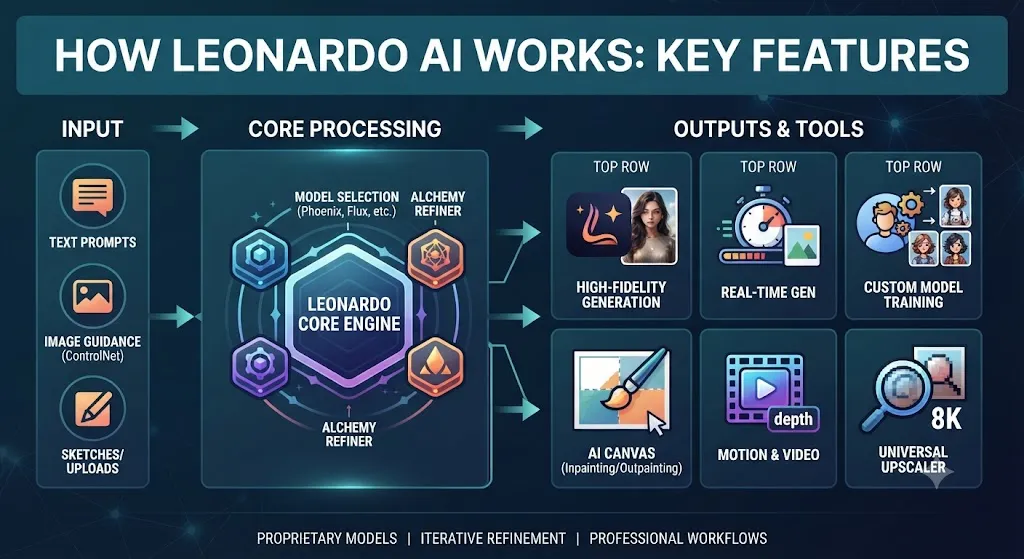
Phoenix is the model that defines this Leonardo AI review. Photorealistic quality validated by Canva’s selection for Dream Lab, with strong performance across portrait photography, product imagery, architectural visualization, and detailed scene generation. In direct testing for this Leonardo AI review, Phoenix produced consistently professional-quality output across a range of commercial use cases — competing directly with dedicated photorealistic generators at the same quality tier.
💡 Pro tip: Use Phoenix for photorealistic output and switch to community-trained models for specific styles like anime, concept art, or game assets. The model selection is Leonardo AI’s biggest practical advantage over tools locked to a single model — learn which models serve which use cases and your productivity increases significantly.
Character Consistency Tools
Character consistency is the Leonardo AI review feature that matters most for game developers and illustrators. Leonardo AI maintains the visual appearance of a character — face, body type, clothing, distinctive features — across multiple generated images in different scenes, poses, and lighting conditions. This is technically among the hardest problems in AI image generation and Leonardo AI handles it better than any competitor at its price point. For game developers who need the same character across 50 different asset shots, this capability alone justifies the Leonardo AI subscription.
Custom Model Fine-Tuning
Fine-tuning lets you train Leonardo AI on your own image dataset — 10 to 20 images of a specific character, art style, product, or visual concept — and then generate new images that consistently reflect that training. This Leonardo AI feature takes approximately 20 minutes to train and produces significantly more consistent output than prompt engineering alone. In our Leonardo AI review testing, a fine-tuned model trained on 15 product images produced commercial product photography that would have required professional shooting setups to replicate without AI.
Community Model Library
Beyond the flagship Phoenix model, Leonardo AI maintains a library of community-contributed specialized models covering anime, photography, 3D rendering, concept art, architectural visualization, game assets, and more. The library is large but quality is inconsistent across community models — experienced users learn which models to trust and which to avoid. This Leonardo AI review recommends using the Phoenix model as your default and treating the community library as a supplement for specific style needs rather than a starting point.
AI Canvas and Inpainting
Leonardo AI’s browser-based Canvas tool provides image editing and inpainting for refining generated images. Select any area of a generated image, describe what you want changed, and Leonardo AI regenerates that section while preserving the rest. For iterative generation workflows — generating a base image and then refining specific elements — this makes Leonardo AI a more complete production tool than platforms that only offer generation.
Real-Time Generation
Real-Time Generation produces images as you type your prompt — updating the output with each keystroke for instant visual feedback on prompt changes. In our Leonardo AI review testing, this feature dramatically accelerated prompt development for users who prefer visual iteration to written refinement. It is not the highest quality output mode, but for exploring prompt directions quickly it is a genuinely useful Leonardo AI capability.
Love What These AI Design Tools Can Do?
Great AI-generated visuals still need a cohesive brand identity holding them together. Let Tasknestly build your full branding — logo, guidelines, and visual system.
Explore Branding Services →3. Key Leonardo AI Features in 2026
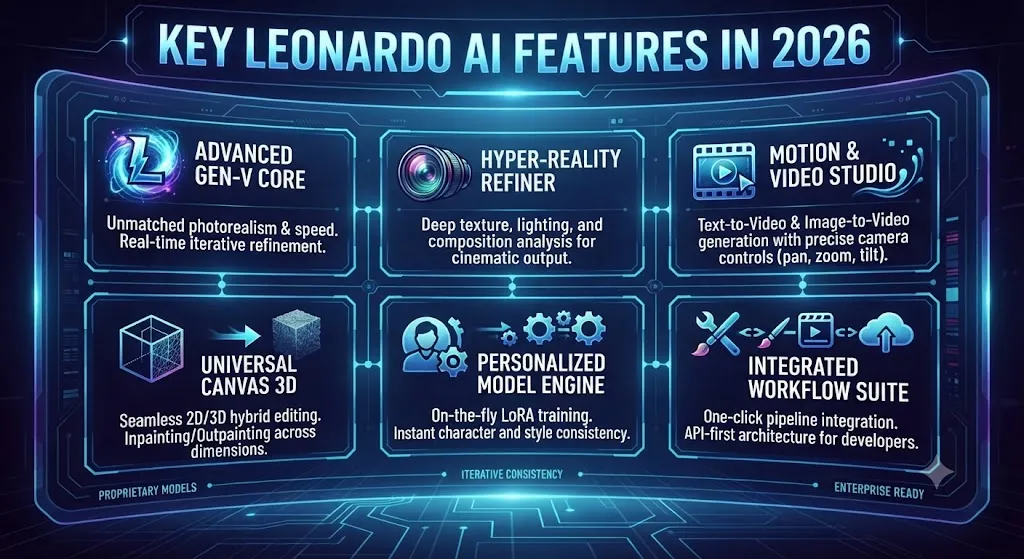
- Phoenix Model: Flagship photorealistic generation model — Canva acquisition validated quality, strong across portrait, product, and architectural imagery.
- Character Consistency: Maintain visual coherence of a character across multiple generated images — the best character consistency tools in any mainstream AI image platform.
- Custom Fine-Tuning: Train models on 10 to 20 of your own images to generate consistently matching output — available from Artisan plan.
- Community Model Library: Access to hundreds of specialized community-trained models for anime, concept art, game assets, photography, and more.
- AI Canvas: Browser-based image editing and inpainting for iterative refinement of generated images.
- Real-Time Generation: Instant visual output as you type prompts — useful for rapid prompt exploration and iteration.
- Motion Generation: Convert still generated images into short animated clips for social media and game asset use.
- Style Reference: Guide generation style using uploaded reference images — maintaining visual consistency without fine-tuning.
- Character Reference: Upload a character image and maintain that character’s appearance across generated scenes.
- Generous Free Tier: 150 tokens per day with access to most core features including Phoenix — the most useful free plan in AI image generation.
- API Access: Available on paid plans for integration into creative pipelines, game engines, and production workflows.
- iOS and Android Apps: Mobile generation available across iPhone, iPad, and Android devices.
Love What These AI Design Tools Can Do?
Great AI-generated visuals still need a cohesive brand identity holding them together. Let Tasknestly build your full branding — logo, guidelines, and visual system.
Explore Branding Services →4. Leonardo AI Review: Pricing Breakdown
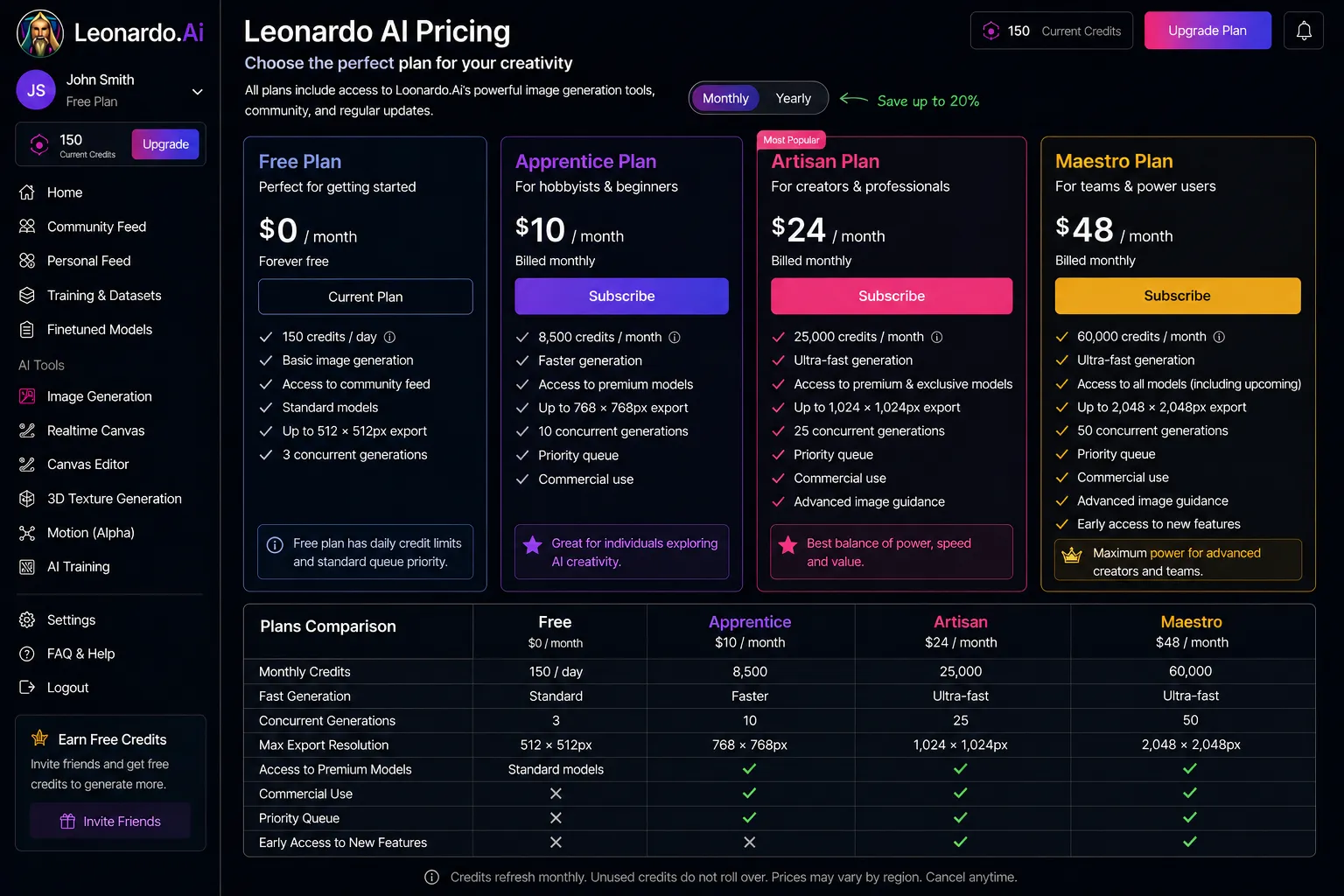
Leonardo AI pricing is token-based with a free tier that is genuinely the most generous in the AI image generation market. This Leonardo AI review breaks down exactly what each tier provides.
| Plan | Price | Daily Tokens / Key Features |
|---|---|---|
| Free | $0 | 150 tokens/day (~500 images/month), Phoenix access, character tools, Canvas, community models |
| Apprentice | $12/month (annual) | 8,500 tokens/month, priority generation, API access, faster queue |
| Artisan | $30/month (annual) | 25,000 tokens/month, custom fine-tuning, faster generation, advanced models |
| Maestro | $60/month (annual) | 60,000 tokens/month, highest priority queue, advanced fine-tuning, maximum throughput |
- Free tier is genuinely exceptional: 150 tokens per day with Phoenix model access is not a token free tier designed to frustrate you into paying — it is a real working allocation for light to moderate creative use. This Leonardo AI review found the free plan genuinely useful for evaluation, portfolio work, and casual creative generation.
- Apprentice at $12/month is the best value entry: API access and priority queue at $12 per month is well-positioned for indie developers and hobbyists who need consistent throughput without fine-tuning.
- Artisan at $30/month unlocks fine-tuning: Custom model training on your own images is the feature that most serious Leonardo AI users come for. If fine-tuning is your primary reason for evaluating Leonardo AI, Artisan is the minimum plan you need.
- Token costs vary by model and settings: Phoenix at high quality settings costs more tokens per image than lighter models. Heavy use of the highest quality settings can exhaust daily allocations faster than expected — monitor your consumption in the first week.
💰 Honest take: Start on the free tier and evaluate seriously. 150 tokens per day is enough to test character consistency, Phoenix quality, and community models properly before committing to a paid plan. If the free tier meets your needs — and for many casual users it does — Leonardo AI is the only serious AI image generator that lets you create indefinitely at no cost.
Love What These AI Design Tools Can Do?
Great AI-generated visuals still need a cohesive brand identity holding them together. Let Tasknestly build your full branding — logo, guidelines, and visual system.
Explore Branding Services →5. Leonardo AI Review: Honest Pros and Cons
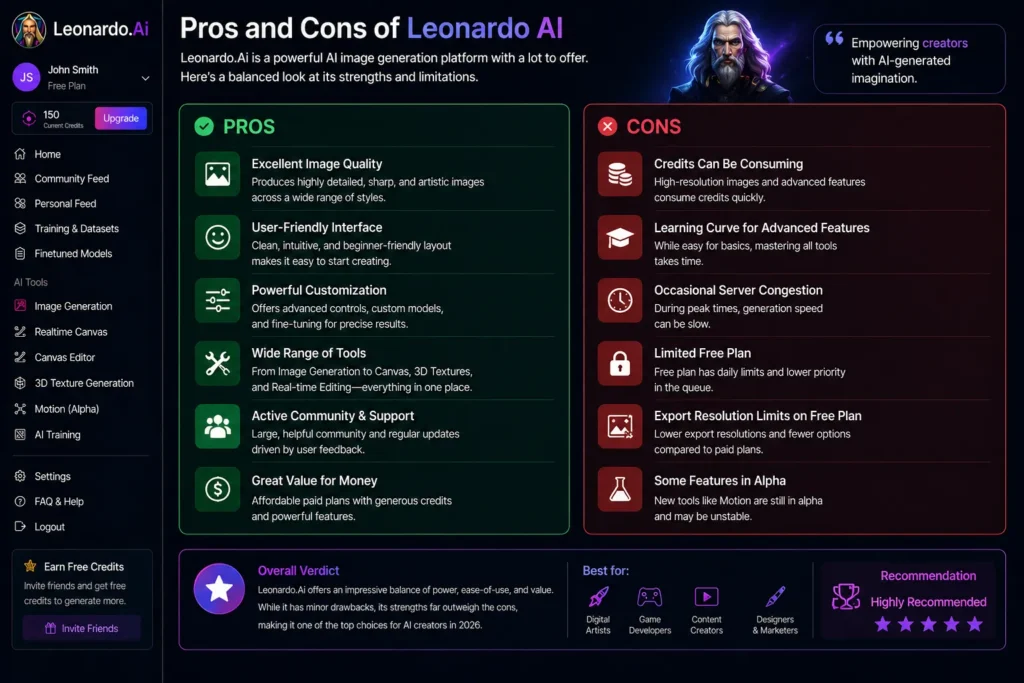
Every honest Leonardo AI review needs both sides clearly stated. Here is what genuinely distinguishes Leonardo AI and where its limitations show up in real use.
What Leonardo AI Gets Right
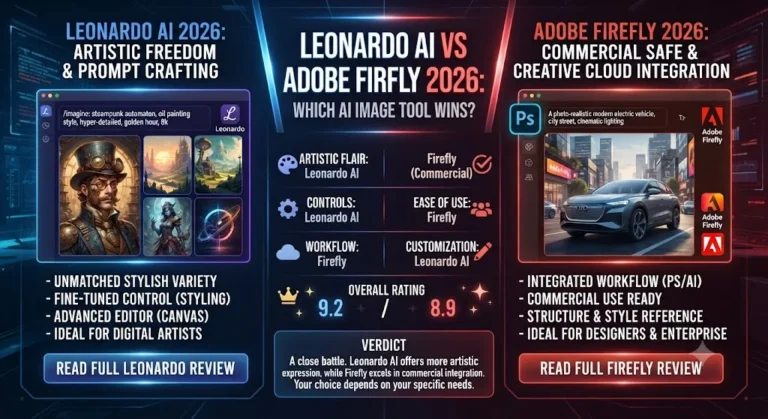
- Character consistency is the best available at any price: Maintaining a character’s visual appearance across multiple generated images is the technical challenge that defines game asset production and character-based illustration. Leonardo AI handles this better than Midjourney, Adobe Firefly, and Canva AI — making it the default choice for this specific use case in this Leonardo AI review.
- Phoenix model quality is Canva-validated: The Canva acquisition and Phoenix integration into Dream Lab for 150 million users is the strongest possible independent validation of image quality. This Leonardo AI review found Phoenix output competitive with the best photorealistic generators available.
- Custom fine-tuning produces consistently superior output: Training Leonardo AI on your own 15 to 20 images produces generation that reflects your specific style, character, or product aesthetic in ways that prompt engineering alone cannot reliably achieve. This is a genuine professional capability.
- Free tier is the most generous in the category: 150 tokens per day with Phoenix access is not matched by any serious competitor. This Leonardo AI review considers the free tier a meaningful competitive advantage that makes Leonardo AI accessible to creators at every budget level.
- Model variety serves diverse creative styles: The combination of Phoenix for photorealism, community models for specific styles, and custom fine-tuning for unique needs makes Leonardo AI more versatile than platforms locked to a single model approach.
Where Leonardo AI Falls Short
- Less intuitive than Midjourney for beginners: Midjourney’s prompt-first simplicity makes it more accessible to new users. Leonardo AI’s model selection, token system, Canvas tools, and fine-tuning configuration require more technical comfort to use effectively. This Leonardo AI review recommends allowing two to three weeks to reach proficiency.
- Community model quality is inconsistent: The model library is large but not all community models are high quality. Inexperienced users can waste significant tokens on poor community models before finding the ones that work for their use case.
- Token system requires active management: Different models and quality settings consume tokens at different rates. Heavy use of Phoenix at maximum quality settings can exhaust daily allocations significantly faster than lower-quality models. Budget your tokens actively in the first week.
- Commercial safety below Adobe Firefly: Community-trained models have unclear licensing and training data provenance. For commercial content requiring IP indemnification, Adobe Firefly is the safer enterprise choice. This Leonardo AI review is clear about that distinction.
Love What These AI Design Tools Can Do?
Great AI-generated visuals still need a cohesive brand identity holding them together. Let Tasknestly build your full branding — logo, guidelines, and visual system.
Explore Branding Services →6. Who Should Use Leonardo AI?
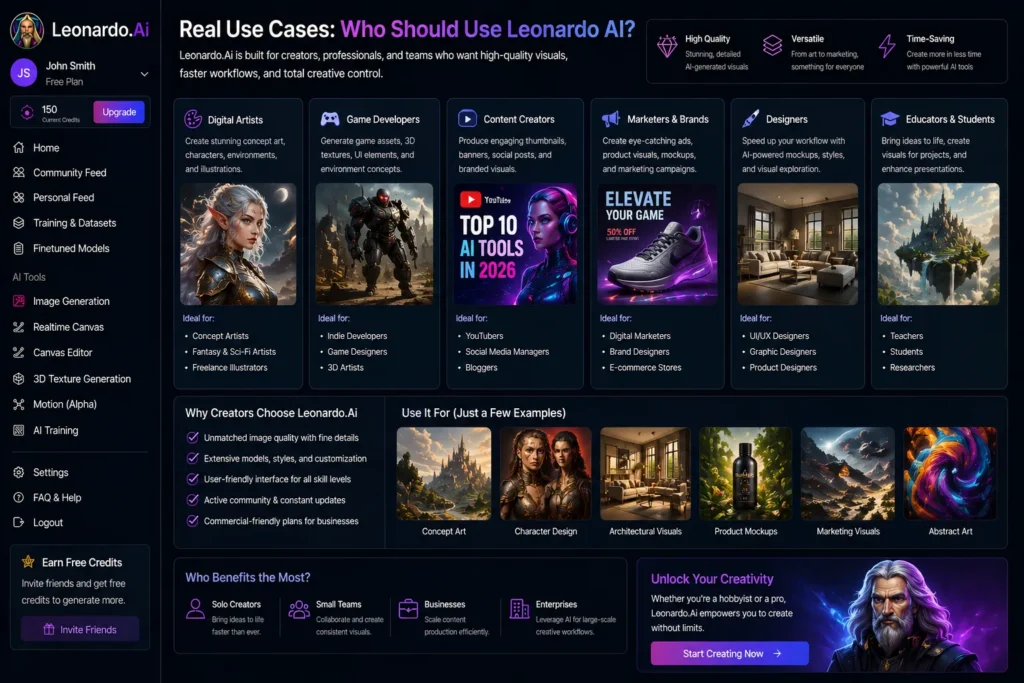
Our Leonardo AI review is specific about who benefits most from the platform’s particular strengths.
Leonardo AI Is a Great Fit If You Are:
- A game developer needing consistent character and asset generation across multiple images — character consistency is Leonardo AI’s most distinctive capability in this Leonardo AI review.
- A digital artist or illustrator who wants fine-tuning control over AI generation to match your specific style or client requirements.
- A creator who wants the most generous free AI image generation tier available — 150 tokens per day with Phoenix access is not matched anywhere else.
- A developer or creative professional needing API integration for AI image generation in a production pipeline or game engine.
- A high-volume creator who needs cost-efficient generation at scale — Leonardo AI’s token pricing is more efficient than most competitors at equivalent quality levels.
Leonardo AI Is Probably Not Right If You Are:
- Someone wanting the simplest, most intuitive image generation experience — Midjourney’s prompt-first approach is significantly more accessible for beginners.
- An agency needing IP indemnification for commercial client work — Adobe Firefly provides the stronger commercial safety story.
- A social media creator primarily needing quick design workflow integration — Canva AI Pro provides better all-in-one value for this use case.
- Someone who needs text accurately and legibly rendered within images — Ideogram handles this significantly better than Leonardo AI.
Love What These AI Design Tools Can Do?
Great AI-generated visuals still need a cohesive brand identity holding them together. Let Tasknestly build your full branding — logo, guidelines, and visual system.
Explore Branding Services →7. Leonardo AI Review: How It Compares
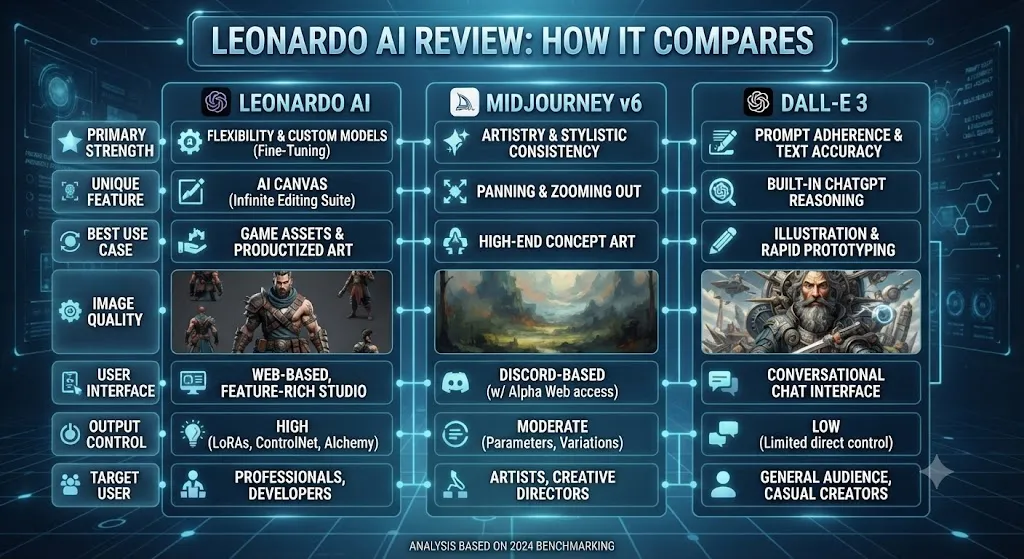
| Tool | Price | Key Strength | Best For |
|---|---|---|---|
| Leonardo AI | Free/$12/month | Character consistency, fine-tuning, best free tier | Game devs, digital artists, high-volume creators |
| Midjourney | $10/month | Best artistic quality, most intuitive interface | Artists, concept designers, creative directors |
| Adobe Firefly | $9.99/month | Commercial safety, Photoshop integration, IP indemnification | Agencies, enterprise, commercial production |
| Ideogram | Free/$8/month | Best text rendering in images, typography control | Marketers needing text graphics |
Love What These AI Design Tools Can Do?
Great AI-generated visuals still need a cohesive brand identity holding them together. Let Tasknestly build your full branding — logo, guidelines, and visual system.
Explore Branding Services →8. What Real Users Say About Leonardo AI
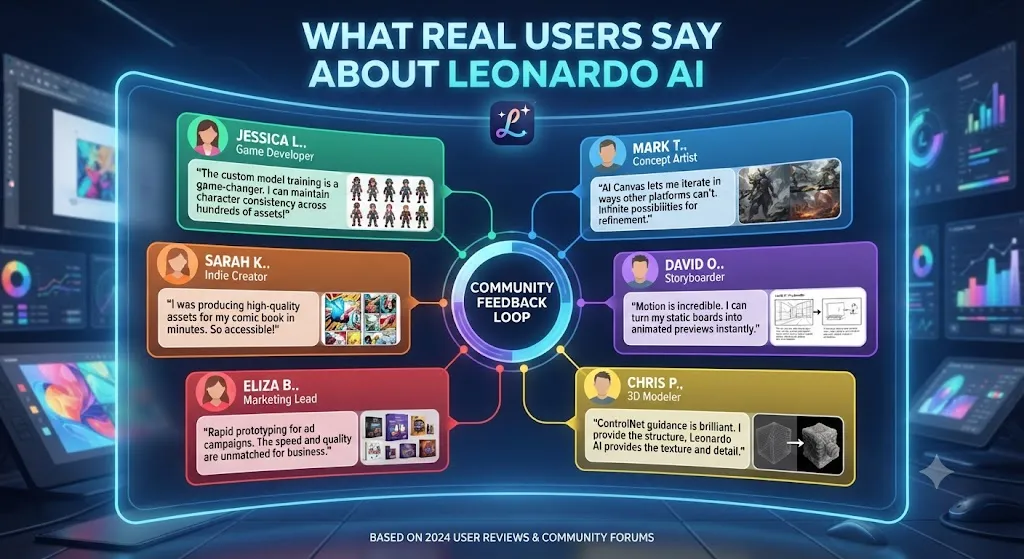
Verified user feedback in Leonardo AI review research across G2, Reddit’s r/StableDiffusion, and Discord communities tells a clear story by user type. Game developers and character-focused illustrators are the most consistently enthusiastic users, repeatedly citing character consistency as the feature that made Leonardo AI their primary tool. Multiple reviewers describe trying Midjourney, Adobe Firefly, and other generators for character work and finding none of them match Leonardo AI’s ability to maintain a character’s appearance across multiple scenes and poses.
The fine-tuning capability generates specific enthusiasm from commercial photographers and product marketers in Leonardo AI review research. Users who have trained models on their own product photography describe generating consistent on-brand product imagery at a fraction of the cost and time of professional photoshoots — particularly useful for e-commerce businesses that need multiple product shots in different contexts.
The most consistent criticism in Leonardo AI review feedback relates to the learning curve and community model quality variance. New users who expect Midjourney’s prompt-first simplicity find Leonardo AI’s options and settings overwhelming. And users who try community models without guidance report inconsistent results that waste tokens on poor-quality outputs. The platform rewards investment in learning — users who persist through the initial complexity consistently report strong satisfaction, while users who give up early often underrate Leonardo AI’s actual capabilities.
Love What These AI Design Tools Can Do?
Great AI-generated visuals still need a cohesive brand identity holding them together. Let Tasknestly build your full branding — logo, guidelines, and visual system.
Explore Branding Services →9. Our Leonardo AI Review Rating Breakdown
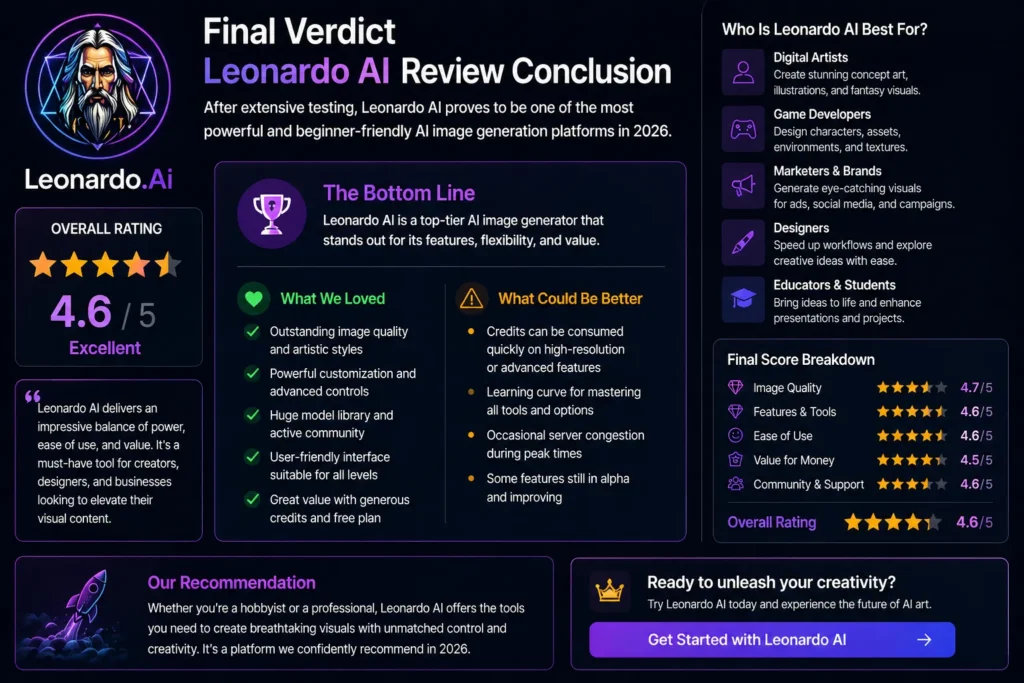
| Category | Score | Notes |
|---|---|---|
| Image Quality (Phoenix) | 4.7 / 5 | Canva acquisition validates quality — photorealistic at high settings |
| Character Consistency | 4.9 / 5 | The strongest character consistency tools in any mainstream AI image platform |
| Custom Fine-Tuning | 4.6 / 5 | Model training on your own images is a genuine professional power feature |
| Free Tier Value | 4.8 / 5 | 150 tokens/day is the most generous free plan in AI image generation |
| Ease of Use | 3.8 / 5 | More complex than Midjourney — rewarding but requires real learning investment |
| Commercial Safety | 3.5 / 5 | Community models have unclear licensing — less safe than Firefly for agencies |
| Pricing Value | 4.5 / 5 | $12/month Apprentice with API access is excellent value for indie developers |
| Model Variety | 4.6 / 5 | Phoenix + community library + custom fine-tuning covers virtually every style need |
| Overall Leonardo AI Review | 4.4 / 5 | The strongest AI image platform for game developers and digital artists in 2026 |
Love What These AI Design Tools Can Do?
Great AI-generated visuals still need a cohesive brand identity holding them together. Let Tasknestly build your full branding — logo, guidelines, and visual system.
Explore Branding Services →10. Final Leonardo AI Review Verdict
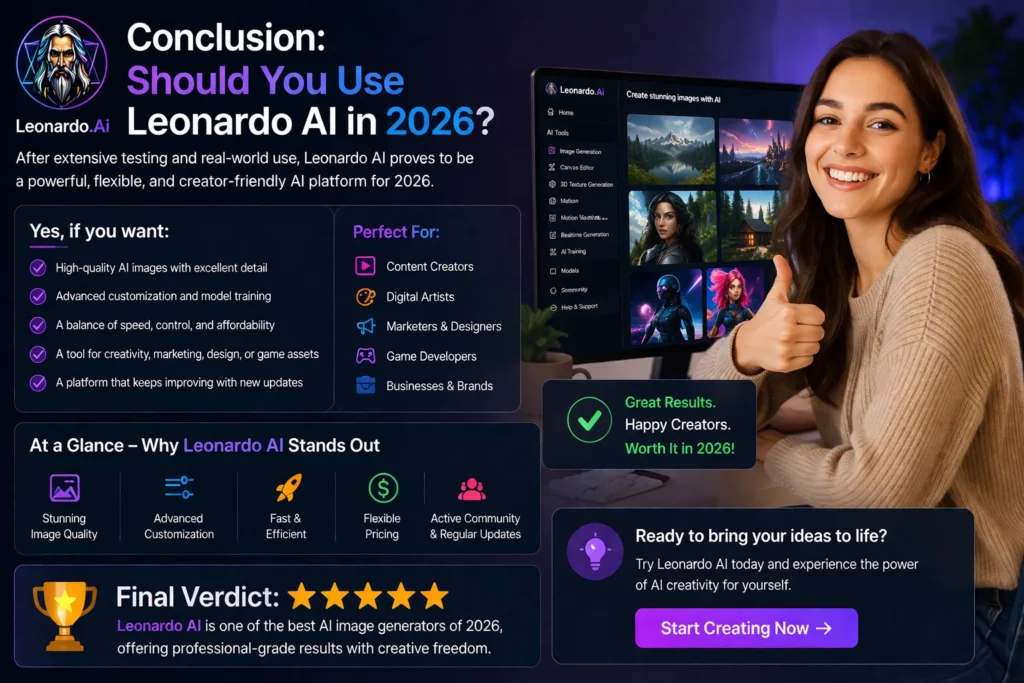
Here is the honest bottom line of this Leonardo AI review: Leonardo AI is the best AI image generation platform for game developers, digital artists, and creators who need character consistency, fine-tuning control, and high-volume generation. The Canva acquisition validates Phoenix model quality at scale. The free tier is unmatched in generosity. And the character consistency tools solve the specific problem that most other AI image generators handle poorly or not at all.
For creators who want the simplest experience, Midjourney is more accessible. For agencies needing commercial IP indemnification, Adobe Firefly is safer. But for the specific use cases this Leonardo AI review covers — game assets, character-based illustration, custom style fine-tuning, and high-volume generation on a budget — Leonardo AI is the right tool in 2026.
Our Leonardo AI review recommendation: start on the free tier today. 150 tokens per day is enough for serious evaluation. Test character consistency, Phoenix quality, and one or two community models that match your style needs. If you are producing game assets or character-based work, you will know within three days whether Leonardo AI is your tool.
| ✅ Get It If You…Develop games and need consistent character assetsAre a digital artist wanting fine-tuning control over styleWant the most generous free AI image generation tierNeed API integration for creative production pipelinesCreate at high volume and need cost-efficient generation | ⚠️ Skip It If You…Want the simplest image generation experience — try MidjourneyNeed commercial IP indemnification — try Adobe FireflyPrimarily create social media content — try Canva AINeed text accurately rendered in images — try IdeogramWant one dominant model rather than a library to navigate |
11. Leonardo AI Review: FAQ
Is Leonardo AI worth it in 2026?
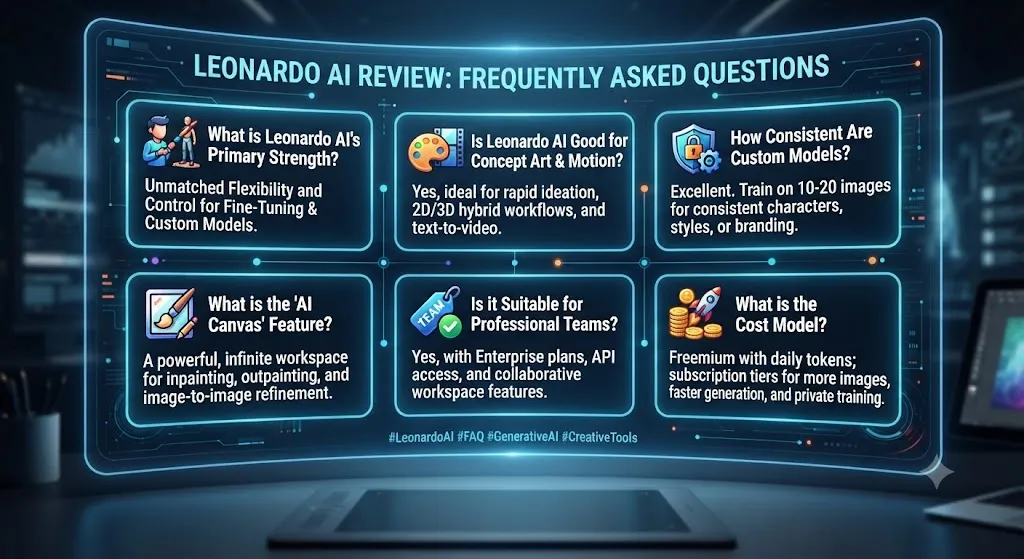
For game developers and digital artists, yes — this Leonardo AI review rates it 4.4/5. The free tier is the most generous in the category, and the character consistency and fine-tuning features are genuinely best-in-class for their specific use cases. Even if you never pay for Leonardo AI, the free tier provides more value than most paid alternatives.
What is the Phoenix model in Leonardo AI?
Phoenix is Leonardo AI’s flagship photorealistic image generation model. It was chosen by Canva as the engine powering Dream Lab for 150 million users following Canva’s 2025 acquisition of Leonardo AI — the strongest possible independent validation of its quality. As this Leonardo AI review found in testing, Phoenix produces output competitive with the best photorealistic generators available for portrait, product, and architectural imagery.
How does Leonardo AI compare to Midjourney?
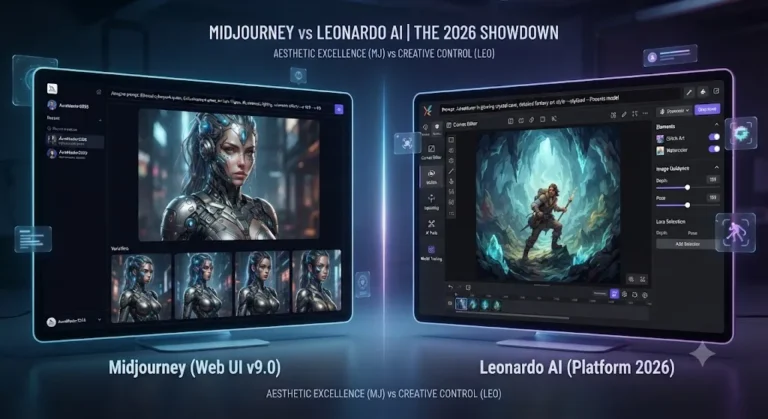
Midjourney produces more artistically distinctive and visually striking images with a simpler, more intuitive interface. Leonardo AI has stronger character consistency, custom fine-tuning capabilities, a better free tier, and API access. This Leonardo AI review recommends Leonardo AI for game developers and creators needing character consistency and style control, and Midjourney for artists and creative directors prioritizing visual quality and ease of use.
Is Leonardo AI free?
Yes — Leonardo AI’s free tier provides 150 tokens per day with access to the Phoenix model, character tools, AI Canvas, and community models. This Leonardo AI review found it genuinely the most useful free plan in AI image generation — not a token trial designed to run out immediately, but a real working allocation for light to moderate creative use.
Love What These AI Design Tools Can Do?
Great AI-generated visuals still need a cohesive brand identity holding them together. Let Tasknestly build your full branding — logo, guidelines, and visual system.
Explore Branding Services →