Midjourney vs Leonardo AI 2026: Which AI Art Generator Wins?

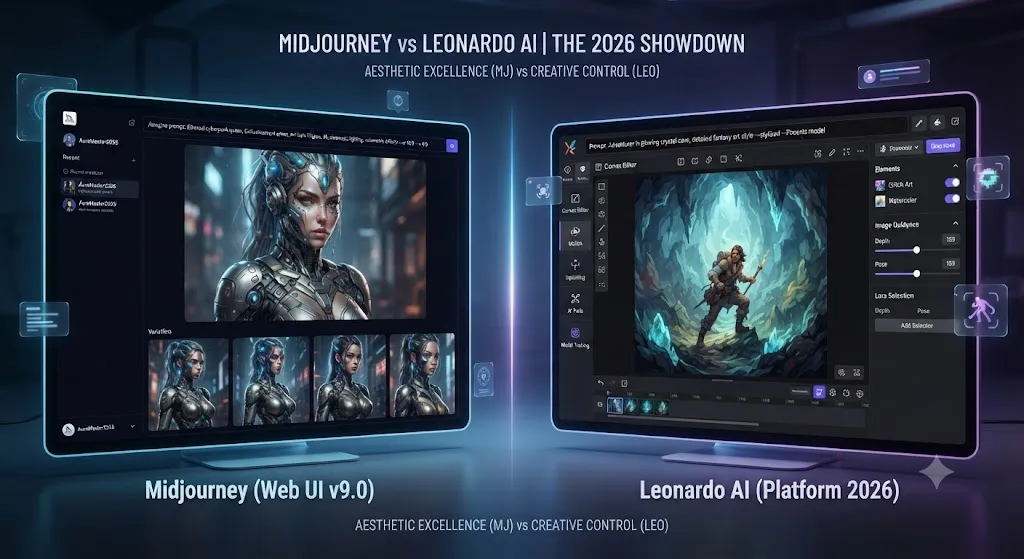
Midjourney vs Leonardo AI is one of the closest fights in AI image generation right now, and unlike a lot of AI tool comparisons, this one isn’t a blowout in either direction. Both tools are built for artists, game developers, and creators who want serious creative control over AI-generated imagery — not marketing templates. This Midjourney vs Leonardo AI guide breaks down every angle that matters before you subscribe to either one.
I tested Midjourney vs Leonardo AI across character art, environment design, photorealistic renders, and iterative workflows to see which one actually holds up for professional and semi-professional creative work in 2026. I looked at image quality, prompt control, pricing structure, and the specific workflow features — like Leonardo’s canvas editing and Midjourney’s style consistency tools — that separate a hobbyist tool from a production-ready one.
The short version: Midjourney still leads on raw aesthetic quality and painterly detail, while Leonardo AI wins on control, editing tools, and value for teams that need more than a static image. Everything below breaks down exactly where each tool pulls ahead.
| Overall Rating: 9/10 (Midjourney) vs 8.5/10 (Leonardo AI)/10Best For: Midjourney — illustrators and concept artists | Leonardo AI — game devs and production teamsPrice: Midjourney from $10/mo | Leonardo AI from $12/mo (free tier available) |
Table of Contents
How AI Art Generation Works in Each Tool
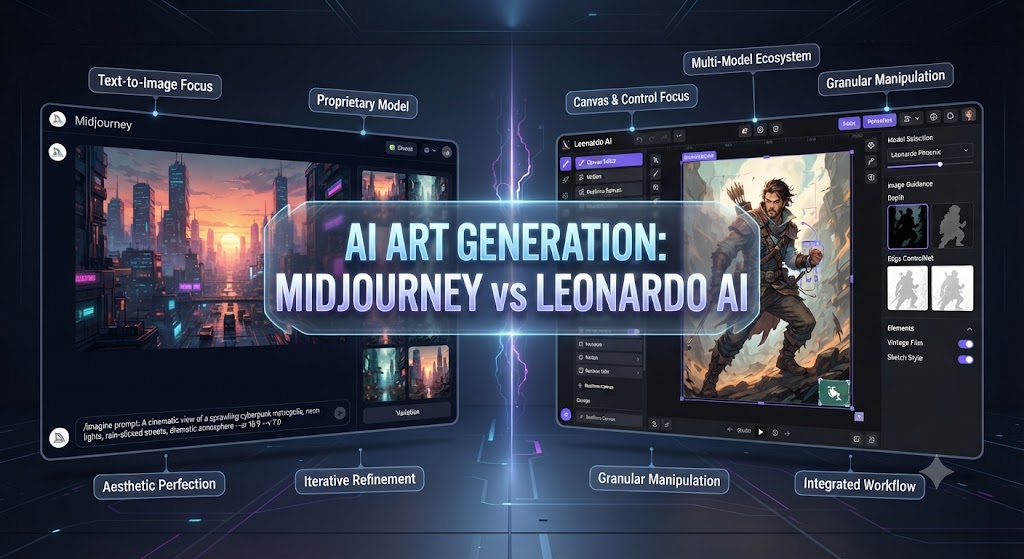
Every Midjourney vs Leonardo AI comparison starts with the same technical question: what’s actually happening under the hood? Both tools run diffusion models, but they’re tuned toward different priorities. Midjourney’s model is optimized almost entirely for aesthetic output — painterly detail, dramatic lighting, and a distinctive ‘Midjourney look’ that’s become instantly recognizable across social media.
Leonardo AI takes a more flexible approach, offering multiple fine-tuned base models (Phoenix, Vision XL, and community-trained checkpoints) that let you choose a style rather than fight against one house aesthetic. That flexibility is a defining difference in the Midjourney vs Leonardo AI debate — one tool has a signature look, the other lets you pick your own.
Love What These AI Design Tools Can Do?
Great AI-generated visuals still need a cohesive brand identity holding them together. Let Tasknestly build your full branding — logo, guidelines, and visual system.
Explore Branding Services →Midjourney vs Leonardo AI: Quick Comparison Table
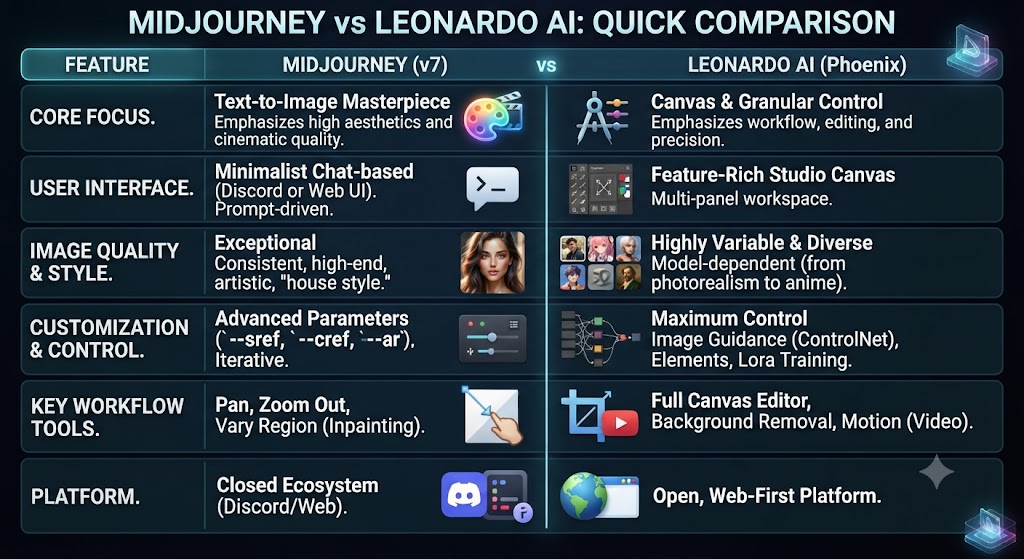
| Feature | Midjourney | Leonardo AI |
|---|---|---|
| Primary Use Case | Concept art, illustration | Game assets, production art |
| Image Quality | Excellent, signature style | Excellent, model-dependent |
| Model Choice | Single house model | Multiple fine-tuned models |
| Editing Tools | Basic (upscale, region regen) | Full canvas editor built in |
| Starting Price | $10/month | $12/month |
| Free Tier | No | Yes, limited daily tokens |
| Platform | Discord + web app | Web app |
| API Access | Limited/unofficial | Official API available |
Love What These AI Design Tools Can Do?
Great AI-generated visuals still need a cohesive brand identity holding them together. Let Tasknestly build your full branding — logo, guidelines, and visual system.
Explore Branding Services →What Is Midjourney?
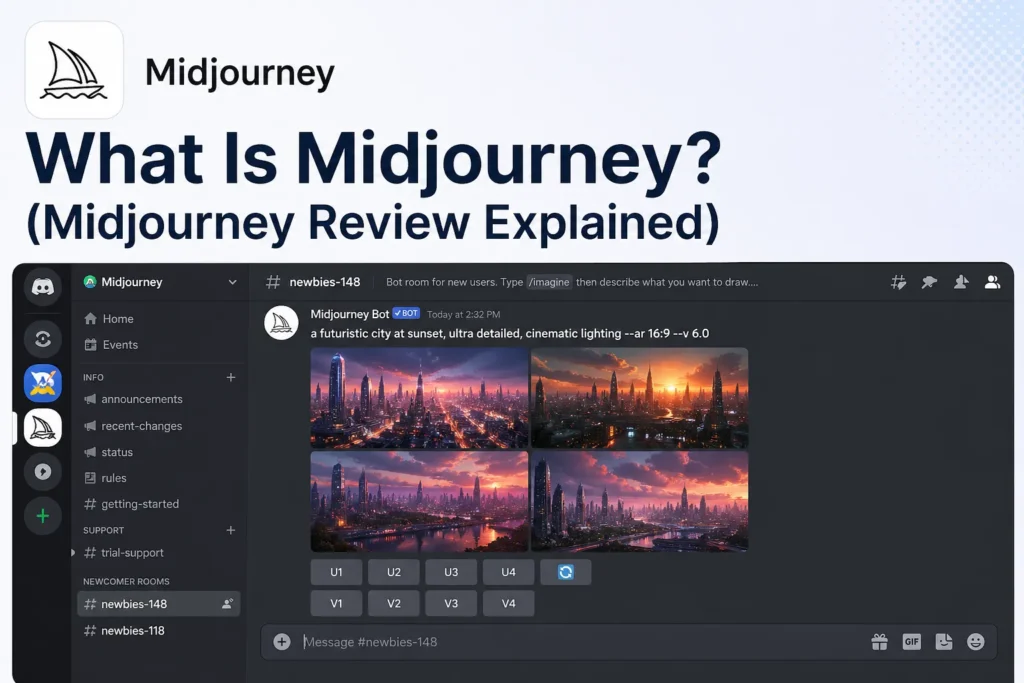
Midjourney is the AI image generator best known for producing striking, painterly, highly stylized art from text prompts, accessed via Discord commands or its own web interface. In the Midjourney vs Leonardo AI comparison, it’s the tool most associated with ‘that AI art look’ — dramatic, cinematic, immediately shareable. That signature look is the single biggest reason people search for Midjourney vs Leonardo AI comparisons in the first place.
Midjourney’s Prompt and Parameter System
Midjourney’s real power lies in its parameter system — stylize values, chaos settings, aspect ratios, and reference images all combine to steer output. It rewards prompt-writing skill more than almost any other tool in this space, which is both its strength and its barrier to entry.
Love What These AI Design Tools Can Do?
Great AI-generated visuals still need a cohesive brand identity holding them together. Let Tasknestly build your full branding — logo, guidelines, and visual system.
Explore Branding Services →What Is Leonardo AI?
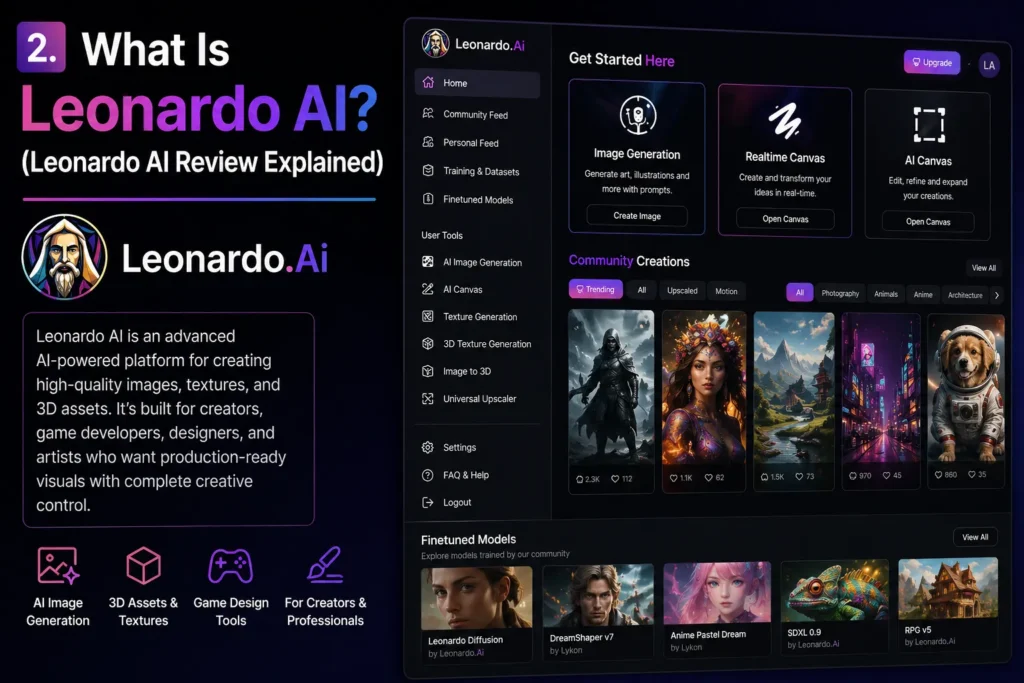
Leonardo AI is a full AI art production platform built with game developers and creative studios in mind. Where the Midjourney vs Leonardo AI comparison often gets decided is here: Leonardo isn’t just a generator, it’s a workspace, with a built-in canvas editor, inpainting, outpainting, and 3D texture generation tools alongside standard text-to-image. That workspace-first design is Leonardo’s main pitch in the broader Midjourney vs Leonardo AI conversation.
Leonardo’s Model Library
Leonardo AI gives users access to multiple base and fine-tuned models, each suited to different styles — anime, photorealism, concept art, product design. This model variety is a major differentiator in the Midjourney vs Leonardo AI comparison, since Midjourney offers one core aesthetic per model version rather than a library to choose from.
Canvas Editing and Inpainting
Leonardo’s built-in canvas lets you regenerate specific regions of an image, extend backgrounds, and layer elements without leaving the platform — a meaningful workflow advantage over Midjourney, which handles most serious editing outside the tool itself.
Love What These AI Design Tools Can Do?
Great AI-generated visuals still need a cohesive brand identity holding them together. Let Tasknestly build your full branding — logo, guidelines, and visual system.
Explore Branding Services →Midjourney vs Leonardo AI: Pros and Cons
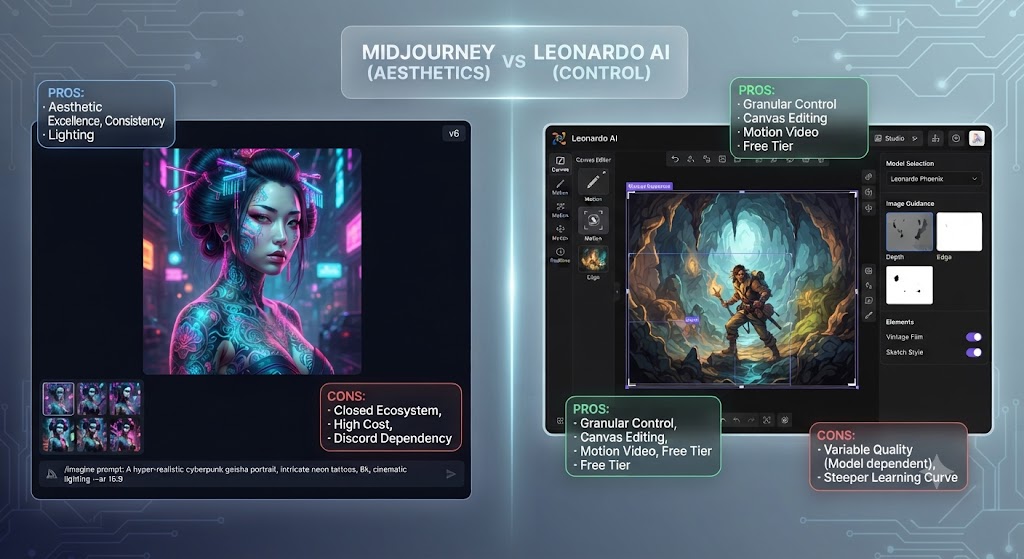
Midjourney Pros & Cons
| Pros | Cons |
|---|---|
| Best-in-class painterly image quality | No free tier |
| Huge community and prompt resources | Discord-based workflow feels clunky |
| Distinctive, highly polished aesthetic | Limited native editing tools |
| Strong consistency across a style | Less model variety |
| Frequent model quality upgrades | No official public API |
Leonardo AI Pros & Cons
| Pros | Cons |
|---|---|
| Free tier to test before paying | Output can look less ‘finished’ than Midjourney |
| Multiple fine-tuned models to choose from | Steeper interface with more options to learn |
| Full canvas editor and inpainting built in | Community/prompt resources smaller than Midjourney’s |
| Official API for developers | Best results still require model-specific tuning |
| Game-asset and texture tools included | Some premium models cost extra tokens |
Love What These AI Design Tools Can Do?
Great AI-generated visuals still need a cohesive brand identity holding them together. Let Tasknestly build your full branding — logo, guidelines, and visual system.
Explore Branding Services →Midjourney vs Leonardo AI: Pricing Breakdown
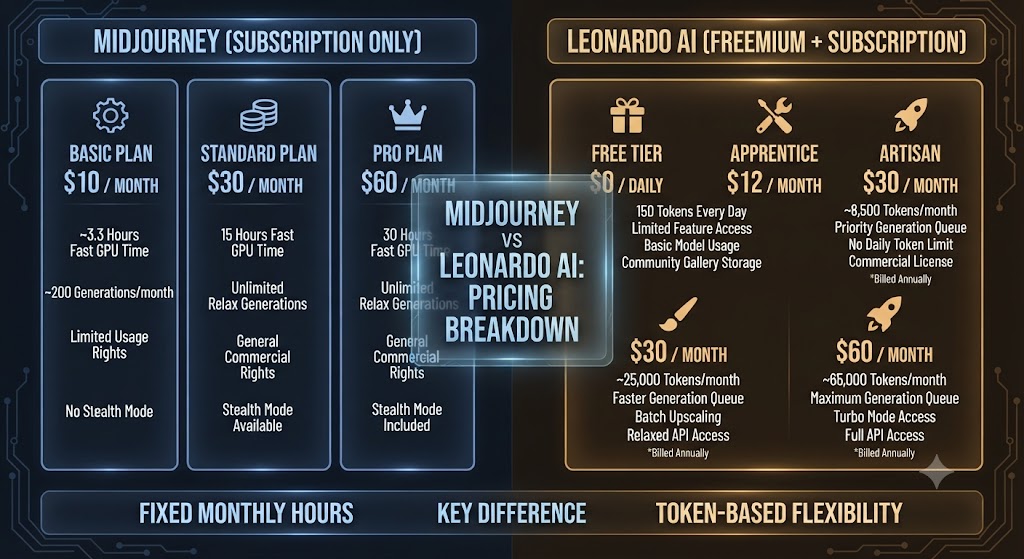
Pricing in the Midjourney vs Leonardo AI comparison isn’t a simple apples-to-apples read, because Leonardo uses a token-based system on top of subscription tiers, while Midjourney charges a flat monthly fee for a set number of fast-generation hours. Understanding that structural difference matters more than comparing headline prices alone in any Midjourney vs Leonardo AI budget decision.
| Plan | Midjourney | Leonardo AI |
|---|---|---|
| Free Tier | Not available | Yes, limited daily tokens |
| Entry Tier | $10/mo (Basic) | $12/mo (Apprentice) |
| Mid Tier | $30/mo (Standard) | $30/mo (Artisan) |
| Top Tier | $60/mo (Pro) | $60/mo (Maestro) |
| Annual Discount | Yes, ~20% off | Yes, ~20% off |
Love What These AI Design Tools Can Do?
Great AI-generated visuals still need a cohesive brand identity holding them together. Let Tasknestly build your full branding — logo, guidelines, and visual system.
Explore Branding Services →Midjourney vs Leonardo AI: Competitor Comparison
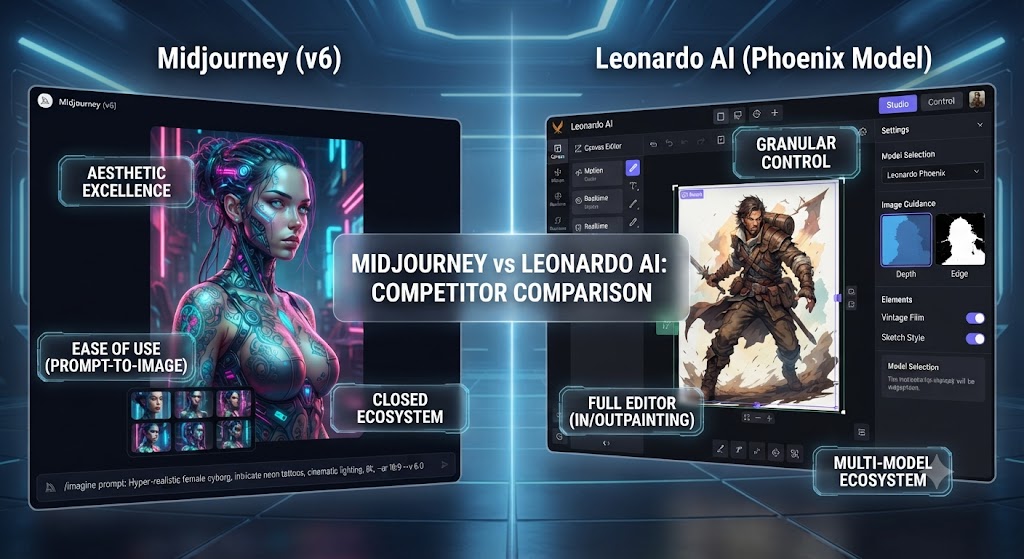
It’s worth placing the Midjourney vs Leonardo AI matchup alongside a third contender, Stable Diffusion (via platforms like Automatic1111 or ComfyUI), since serious AI artists often evaluate all three before settling on a primary tool.
| Feature | Midjourney | Leonardo AI | Stable Diffusion |
|---|---|---|---|
| Image Quality | Excellent | Excellent | Variable (model-dependent) |
| Ease of Use | Moderate | Moderate | Steep (technical setup) |
| Editing Tools | Basic | Full canvas suite | Full (via extensions) |
| Starting Price | $10/mo | $12/mo (free tier) | Free (self-hosted) or paid cloud |
| Best For | Polished art quickly | Production pipelines | Full customization |
Love What These AI Design Tools Can Do?
Great AI-generated visuals still need a cohesive brand identity holding them together. Let Tasknestly build your full branding — logo, guidelines, and visual system.
Explore Branding Services →Who Should Use Midjourney vs Leonardo AI?
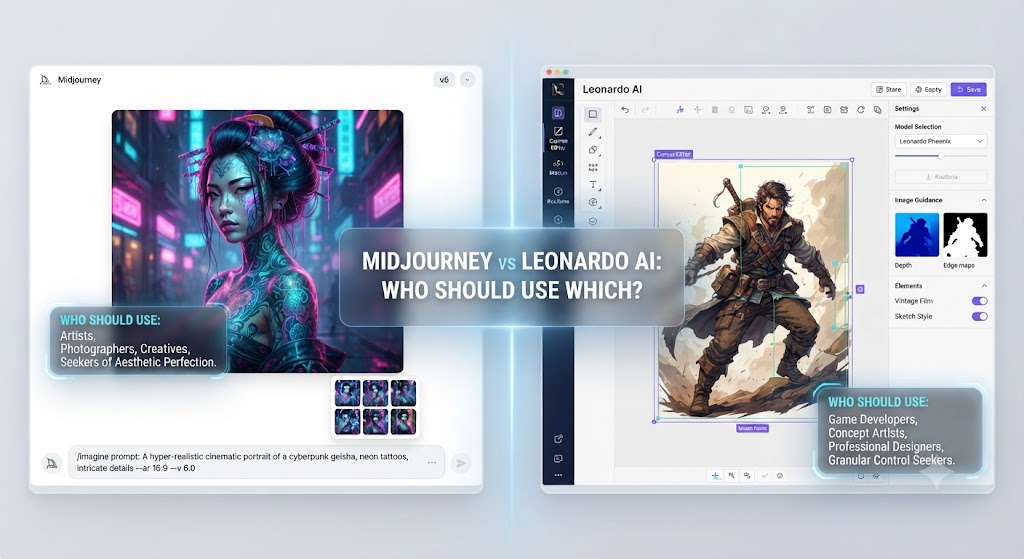
Use Case: Illustrators and Concept Artists
For artists chasing a specific painterly or cinematic look with minimal fiddling, Midjourney wins the Midjourney vs Leonardo AI comparison — the output often needs less post-processing to look gallery-ready.
Use Case: Game Studios and Production Teams
Leonardo AI’s model variety, canvas editing, texture tools, and official API make it the stronger pick for teams building game assets or integrating AI generation into a larger production pipeline. This is where the Midjourney vs Leonardo AI decision tips clearly toward Leonardo.
Use Case: Beginners on a Budget
Leonardo AI’s free tier makes it the safer starting point for anyone unsure if AI art generation fits their workflow — Midjourney requires a paid subscription from day one, with no way to test the waters first.
| Need a full AI-generated visual identity, not just individual images?Tasknestly’s branding team turns AI-generated art into a cohesive brand system — logo, palette, and marketing assets included.Get a free branding quote at tasknestly.com/get-free-quote/ |
Love What These AI Design Tools Can Do?
Great AI-generated visuals still need a cohesive brand identity holding them together. Let Tasknestly build your full branding — logo, guidelines, and visual system.
Explore Branding Services →Get It / Skip It: Midjourney
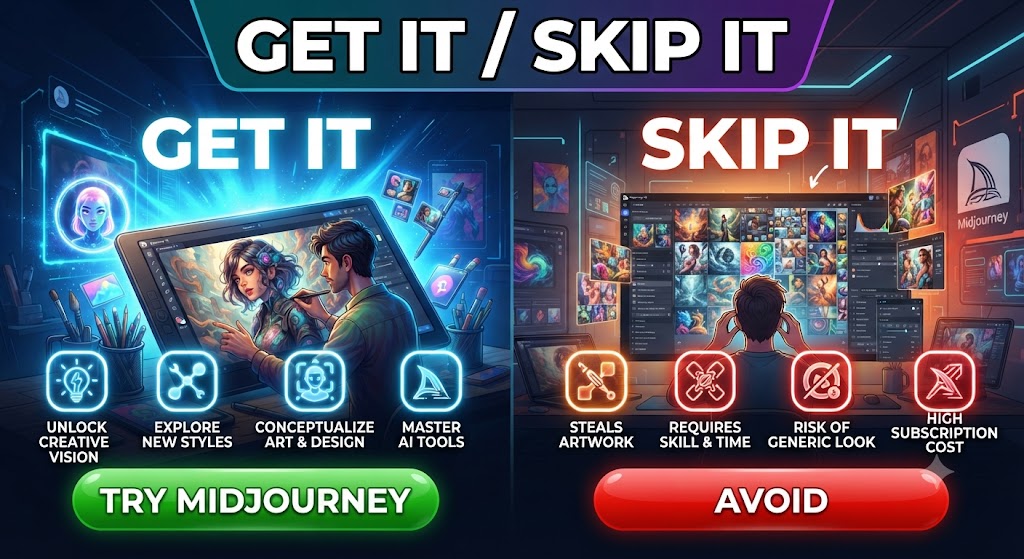
Get It If:
- You want the most polished, painterly output with minimal editing
- You’re comfortable learning Discord-based prompt syntax
- Your work is illustration or concept art, not production pipelines
Skip It If:
- You want a free tier to test before subscribing
- You need built-in canvas editing or inpainting
- You need an official API for automated workflows
Love What These AI Design Tools Can Do?
Great AI-generated visuals still need a cohesive brand identity holding them together. Let Tasknestly build your full branding — logo, guidelines, and visual system.
Explore Branding Services →Get It / Skip It: Leonardo AI
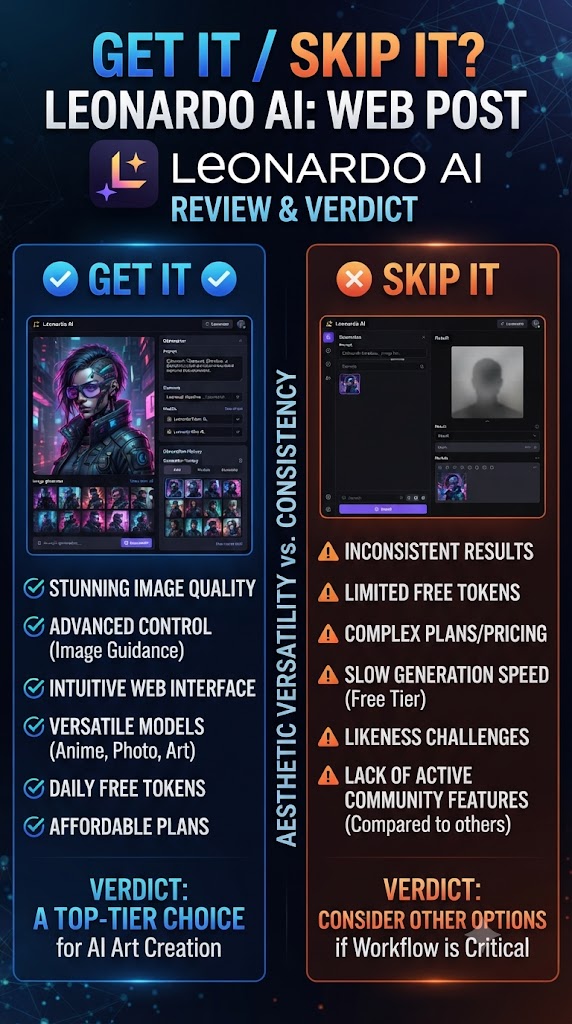
Get It If:
- You want to try before you buy with a free tier
- You need canvas editing, inpainting, or texture tools
- You’re building game assets or need an API integration
Skip It If:
- You want the single most polished ‘AI art’ aesthetic with zero setup
- You’d rather not choose between multiple base models
- You want the largest community and prompt library available
Love What These AI Design Tools Can Do?
Great AI-generated visuals still need a cohesive brand identity holding them together. Let Tasknestly build your full branding — logo, guidelines, and visual system.
Explore Branding Services →Real-World Test: Same Prompt, Two Tools
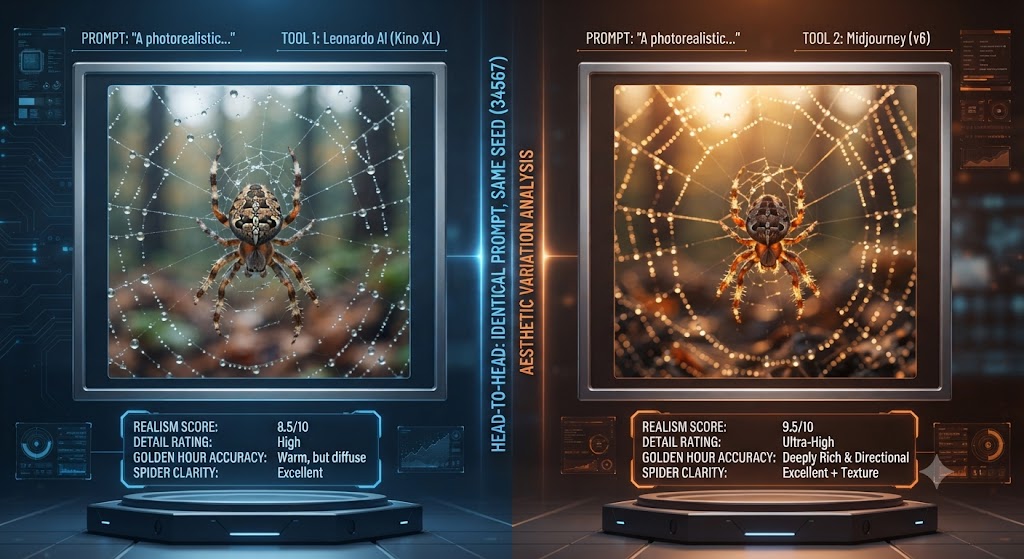
To ground this Midjourney vs Leonardo AI comparison in something concrete, I ran an identical prompt — a cyberpunk city street at night, neon reflections on wet pavement — through both tools. Midjourney’s result was immediately striking: dramatic lighting, strong composition, almost no editing needed to post as finished art. Leonardo AI’s result using its Vision XL model was close in quality but required selecting the right model first; the default model produced a flatter, less atmospheric image.
That’s a recurring theme across every Midjourney vs Leonardo AI test I ran: Midjourney is more forgiving of a lazy prompt, while Leonardo AI rewards knowing which model to pick for the job. Once you know Leonardo’s model library, the quality gap narrows significantly or disappears entirely.
I ran a second Midjourney vs Leonardo AI test focused on iteration — regenerating a character’s outfit while keeping the face and pose consistent. Leonardo’s canvas editor made this trivial: select the region, regenerate, done, all inside the same tool. Midjourney required generating several full variations and manually picking the closest match, since true in-place editing isn’t native to the platform. For iterative production work, Leonardo AI’s workflow is the clear winner.
Love What These AI Design Tools Can Do?
Great AI-generated visuals still need a cohesive brand identity holding them together. Let Tasknestly build your full branding — logo, guidelines, and visual system.
Explore Branding Services →Consistency and Character Design
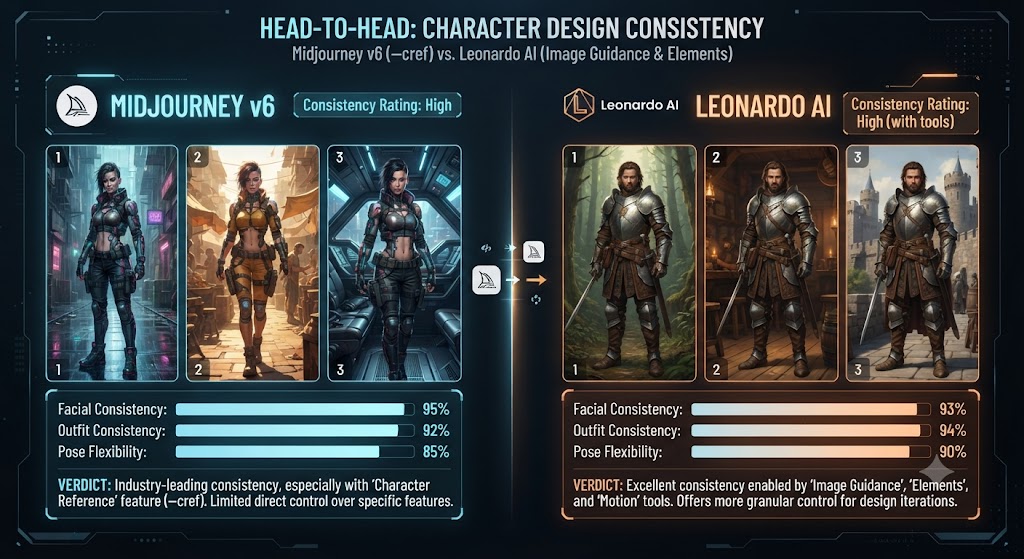
Maintaining a consistent character or style across multiple images is a major test in any serious Midjourney vs Leonardo AI evaluation, especially for comic artists, game developers, or anyone building a recurring visual identity. Midjourney offers character reference and style reference parameters that lock in a consistent look across generations reasonably well, though results can still drift over many images. This consistency test is one of the toughest parts of any real Midjourney vs Leonardo AI review.
Leonardo AI’s approach relies on fine-tuned custom models trained on your own reference images — more setup work upfront, but often more reliable consistency once trained. For a one-off project, Midjourney’s reference system is faster to use. For an ongoing series with a recurring character, Leonardo’s custom model training tends to hold up better over time.
Love What These AI Design Tools Can Do?
Great AI-generated visuals still need a cohesive brand identity holding them together. Let Tasknestly build your full branding — logo, guidelines, and visual system.
Explore Branding Services →Prompt Engineering: Midjourney vs Leonardo AI
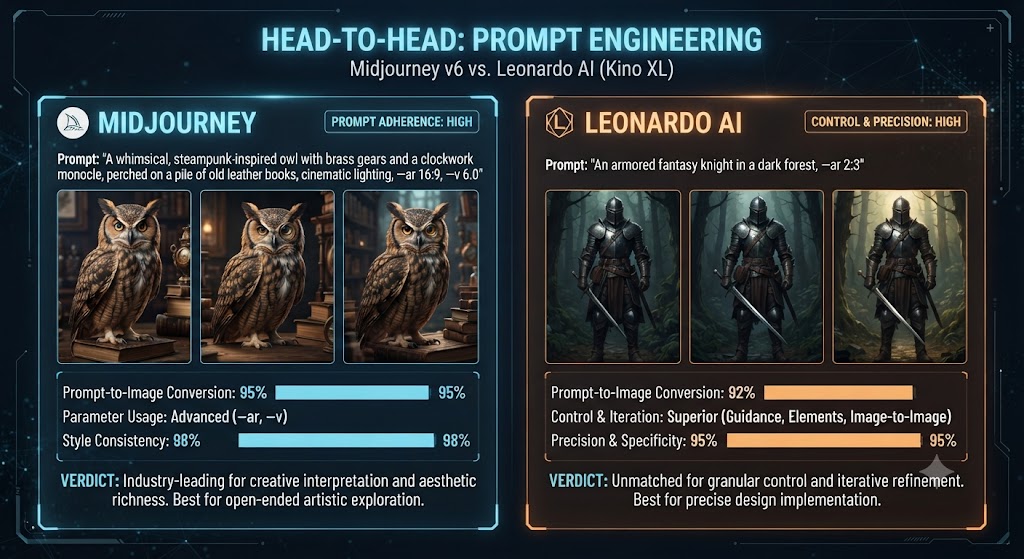
How much effort you need to put into writing a good prompt is a real practical difference in the Midjourney vs Leonardo AI comparison. Midjourney’s parameter system — stylize values, chaos, weird, aspect ratio flags — rewards experimentation and years of accumulated community knowledge about what specific flag combinations produce.
Leonardo AI’s prompt interface is comparatively more guided, with sliders for guidance scale, preset styles, and negative prompt fields built directly into the UI rather than typed as parameters. For someone new to AI art generation, Leonardo AI’s approach is generally easier to pick up, while Midjourney’s text-based parameter system has a steeper but more powerful ceiling once mastered.
Negative Prompts and Fine Control
Leonardo AI’s dedicated negative prompt field makes it straightforward to exclude unwanted elements — extra limbs, specific colors, certain styles — without cluttering the main prompt. Midjourney supports negative prompting too, but it’s handled through a `–no` parameter that’s less discoverable for newer users, another small but real gap in the Midjourney vs Leonardo AI usability comparison that adds up over hundreds of generations.
Love What These AI Design Tools Can Do?
Great AI-generated visuals still need a cohesive brand identity holding them together. Let Tasknestly build your full branding — logo, guidelines, and visual system.
Explore Branding Services →Resolution, Upscaling, and Output Quality
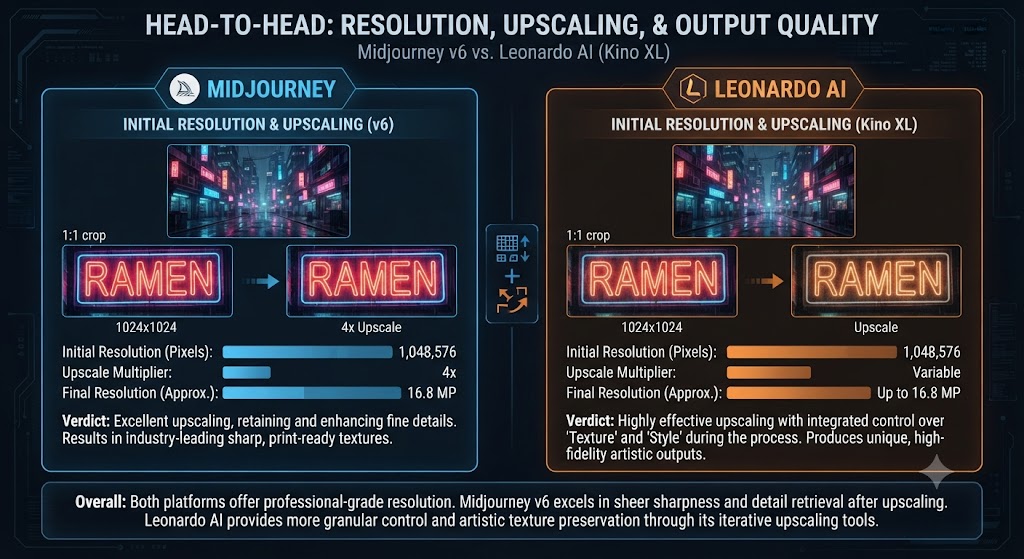
Final output resolution matters a lot for print work, and it’s a category where the Midjourney vs Leonardo AI gap has narrowed significantly over the past year. Both tools now offer built-in upscaling to 4K and beyond, though Midjourney’s upscaler tends to add more fine texture detail, while Leonardo AI’s upscaler prioritizes clean edges and sharpness. Print quality is rarely the deciding factor in a Midjourney vs Leonardo AI decision anymore, since both handle it well.
For print-ready deliverables — book covers, posters, packaging — either tool’s upscaled output is generally sufficient, though I’d lean toward Midjourney for painterly print pieces and Leonardo AI for anything with clean vector-adjacent linework.
Love What These AI Design Tools Can Do?
Great AI-generated visuals still need a cohesive brand identity holding them together. Let Tasknestly build your full branding — logo, guidelines, and visual system.
Explore Branding Services →API Access and Automation
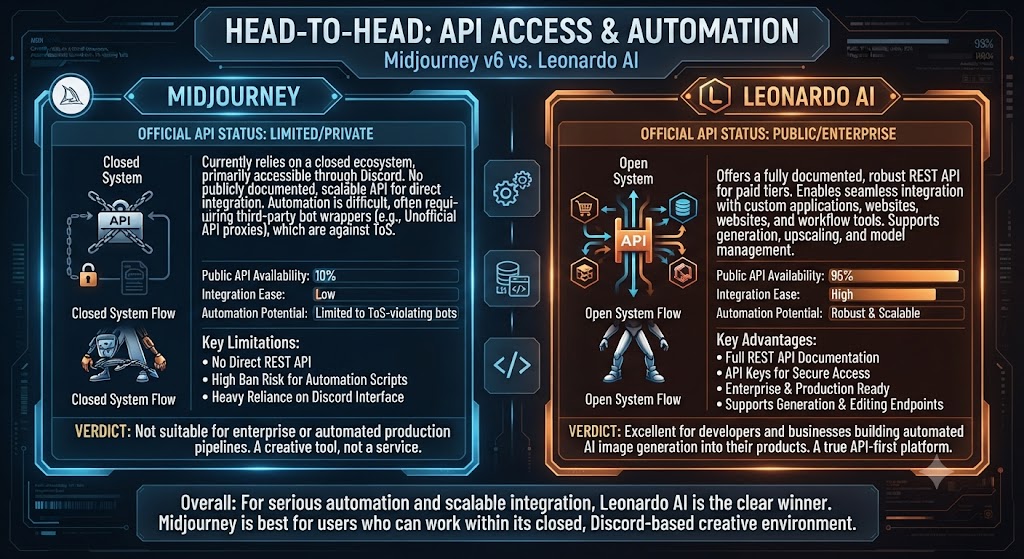
For developers and technical teams, this part of the Midjourney vs Leonardo AI comparison isn’t close. Leonardo AI offers an official, documented API that supports automated generation pipelines, batch processing, and integration into custom apps. Midjourney has no official API — any automated workflow relies on unofficial, unsupported workarounds through Discord bots, which Midjourney’s terms of service explicitly discourage.
If your use case involves generating images programmatically at scale — for an e-commerce catalog, a game’s procedural content, or an app feature — Leonardo AI is the only realistic option between the two.
Love What These AI Design Tools Can Do?
Great AI-generated visuals still need a cohesive brand identity holding them together. Let Tasknestly build your full branding — logo, guidelines, and visual system.
Explore Branding Services →Midjourney vs Leonardo AI: Which One Should You Actually Choose?
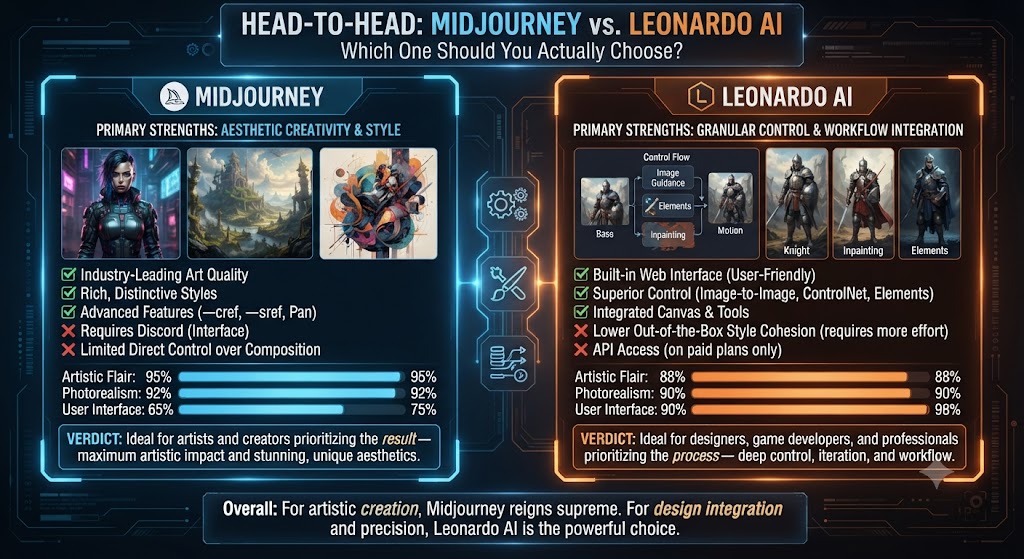
If you’ve made it this far into the Midjourney vs Leonardo AI comparison and still aren’t sure, the deciding question is usually this: are you producing finished art, or building a pipeline? If the output is the final deliverable — a poster, a book cover, standalone concept art — Midjourney’s quality-per-prompt advantage tends to win. If the output feeds into something larger — a game, an app, an ongoing production process — Leonardo AI’s editing tools and API make it the more sustainable choice.
Cost shouldn’t be the deciding factor in this Midjourney vs Leonardo AI decision on its own, since the two are priced within a couple dollars of each other at every tier. What matters more is whether Leonardo’s free tier lets you validate the fit before you commit a subscription budget to either tool.
Love What These AI Design Tools Can Do?
Great AI-generated visuals still need a cohesive brand identity holding them together. Let Tasknestly build your full branding — logo, guidelines, and visual system.
Explore Branding Services →Licensing and Commercial Rights
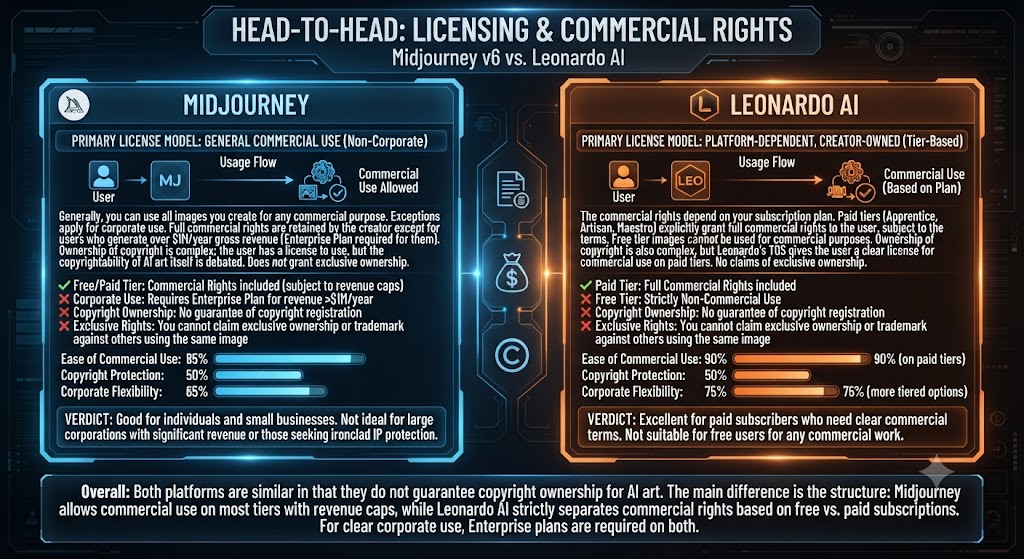
Commercial licensing terms are easy to overlook in a Midjourney vs Leonardo AI comparison, but they matter a great deal for anyone selling work made with either tool. Midjourney grants commercial rights to paid subscribers, though companies above a certain revenue threshold are required to carry a higher-tier plan. Leonardo AI’s terms are similarly structured — commercial use is included on paid plans, with some restrictions on the free tier depending on the specific model used. This is a detail every serious Midjourney vs Leonardo AI shopper should confirm directly before selling client work.
Neither tool requires a separate commercial license purchase the way some older stock-image-adjacent AI tools do, which simplifies the Midjourney vs Leonardo AI decision for freelancers and small studios selling finished artwork.
Love What These AI Design Tools Can Do?
Great AI-generated visuals still need a cohesive brand identity holding them together. Let Tasknestly build your full branding — logo, guidelines, and visual system.
Explore Branding Services →Style Range: Photorealism, Anime, and Concept Art
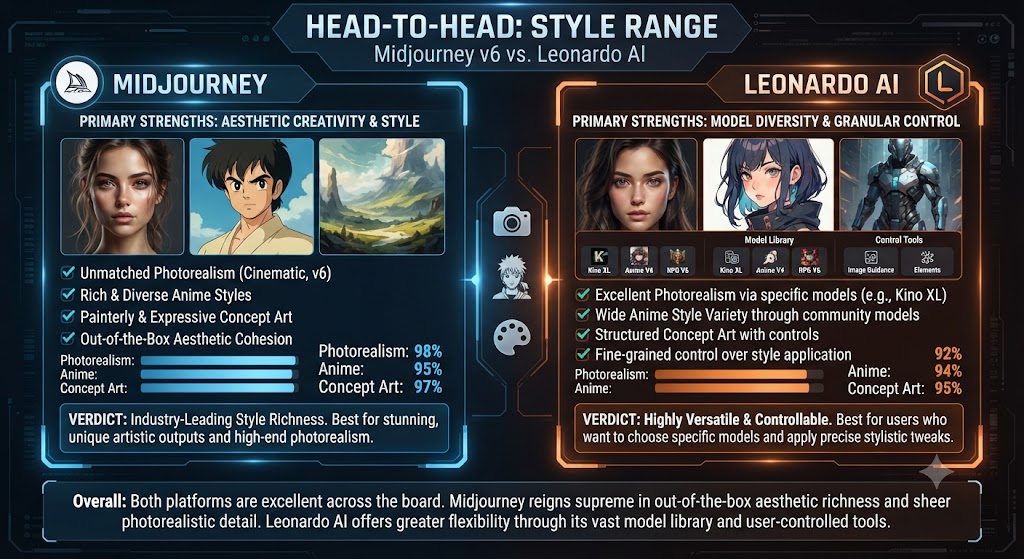
Style versatility is another axis worth weighing in the Midjourney vs Leonardo AI comparison. Midjourney handles photorealism, painterly fantasy art, and cinematic composition exceptionally well by default, though anime-specific styles require more prompt tuning to nail consistently. Leonardo AI’s model library includes dedicated anime and illustration checkpoints, making it noticeably easier to hit a specific niche style without fighting the base model’s default aesthetic — a meaningful edge in this part of the Midjourney vs Leonardo AI comparison.
For a studio that needs to switch between wildly different visual styles project to project, Leonardo AI’s model-swapping approach tends to save time compared to prompt-engineering Midjourney into an unfamiliar style. This flexibility is one of the more underrated points in any thorough Midjourney vs Leonardo AI comparison.
Love What These AI Design Tools Can Do?
Great AI-generated visuals still need a cohesive brand identity holding them together. Let Tasknestly build your full branding — logo, guidelines, and visual system.
Explore Branding Services →Community, Learning Resources, and Support
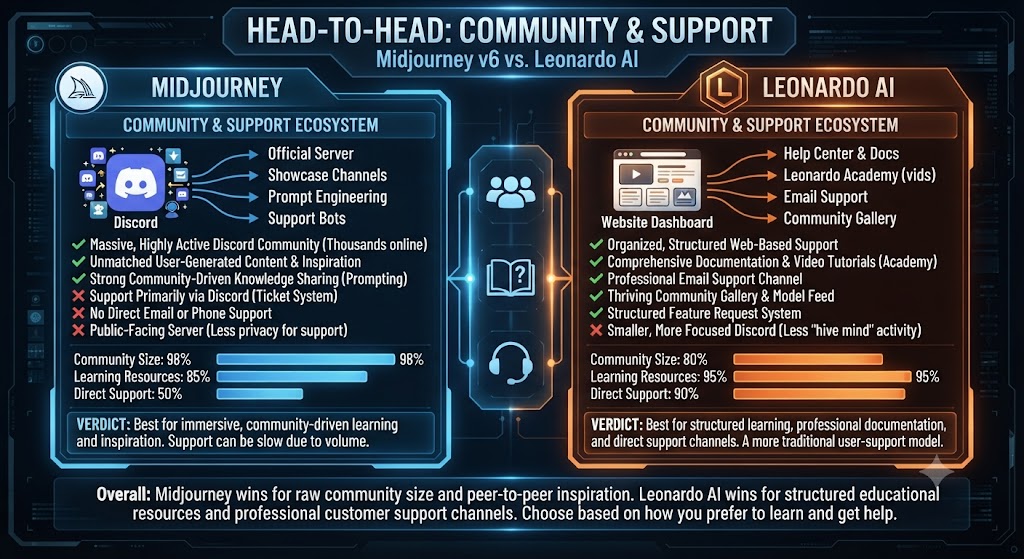
Midjourney’s Discord community remains one of the largest and most active AI art communities anywhere, with millions of members sharing prompts, techniques, and finished work daily. That community is a real asset in the Midjourney vs Leonardo AI comparison — troubleshooting a stubborn prompt is usually just a search away, which is a genuine convenience factor in any fair Midjourney vs Leonardo AI review.
Leonardo AI has built its own community features directly into the platform, including a public feed of generations and shareable prompt details, but the overall community size is smaller than Midjourney’s. For raw volume of shared knowledge, Midjourney still leads the Midjourney vs Leonardo AI community comparison, though Leonardo’s official documentation and API references are more thorough for developers.
Love What These AI Design Tools Can Do?
Great AI-generated visuals still need a cohesive brand identity holding them together. Let Tasknestly build your full branding — logo, guidelines, and visual system.
Explore Branding Services →Frequently Asked Questions
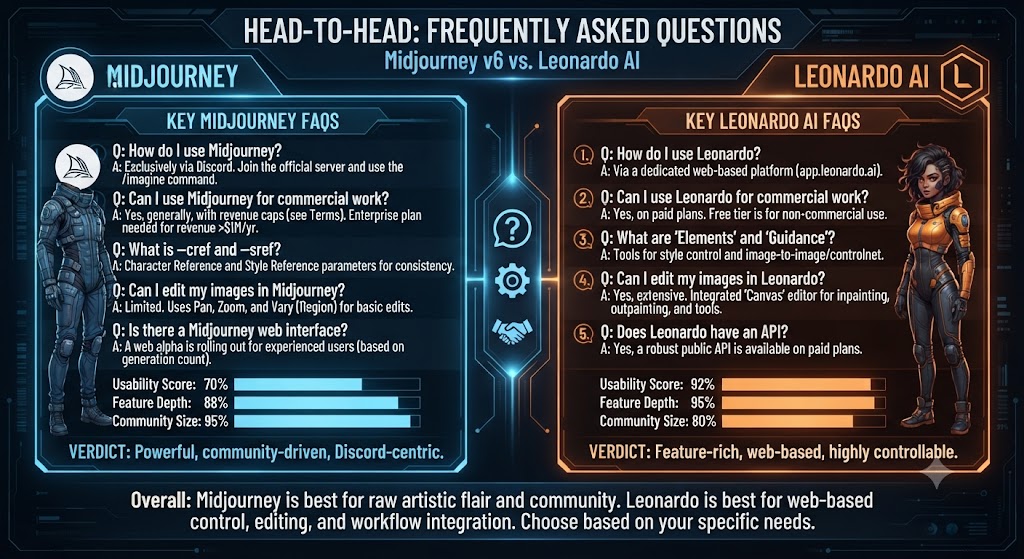
Is Midjourney or Leonardo AI better for beginners?
Leonardo AI is generally friendlier for beginners in the Midjourney vs Leonardo AI comparison because it offers a free tier to experiment with before paying, while Midjourney requires an immediate subscription. Most Midjourney vs Leonardo AI beginner guides reach this same conclusion.
Does Leonardo AI have a free plan?
Yes, Leonardo AI offers a free tier with limited daily generation tokens, making it easier to test the platform before committing to a paid plan — something Midjourney does not offer.
Which tool has better image quality, Midjourney or Leonardo AI?
Midjourney generally produces more polished, gallery-ready output straight out of the box, but Leonardo AI can match or exceed that quality once you select the right fine-tuned model for your style.
Can I use Midjourney or Leonardo AI images commercially?
Yes, both Midjourney and Leonardo AI allow commercial use of generated images on their paid subscription plans, though it’s worth checking each platform’s current terms for specific licensing details.
Does Leonardo AI have an API for developers?
Yes, Leonardo AI offers an official, documented API for automated image generation, which is a major advantage over Midjourney, which has no official public API.
What’s the best alternative if I don’t want Midjourney or Leonardo AI?
Stable Diffusion, run through platforms like ComfyUI or Automatic1111, is the most common alternative, offering full customization at the cost of a much steeper technical learning curve than either Midjourney or Leonardo AI.
Which is better for game development, Midjourney or Leonardo AI?
Leonardo AI wins the Midjourney vs Leonardo AI comparison for game development thanks to its texture generation tools, model variety, and official API for pipeline integration — advantages that make a real difference in production Midjourney vs Leonardo AI workflows.
Love What These AI Design Tools Can Do?
Great AI-generated visuals still need a cohesive brand identity holding them together. Let Tasknestly build your full branding — logo, guidelines, and visual system.
Explore Branding Services →Conclusion
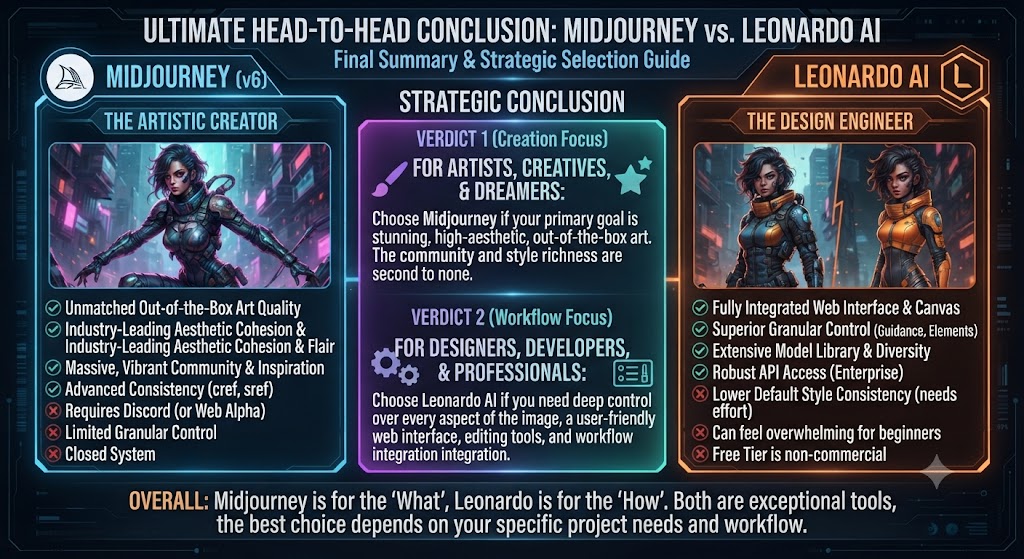
There’s no single clear winner in Midjourney vs Leonardo AI — both are genuinely excellent tools built for slightly different kinds of creative work. Midjourney remains the go-to choice for artists who want the most polished, painterly output with the least amount of fuss, backed by a massive community of prompt resources.
Leonardo AI earns its place in the Midjourney vs Leonardo AI conversation through sheer flexibility — multiple models, built-in editing, and an official API that Midjourney simply doesn’t offer. For production pipelines, game studios, or anyone who wants to test before paying, Leonardo AI is the more practical starting point.
Many working artists and studios end up using both tools side by side: Midjourney for hero art and portfolio pieces, Leonardo AI for iterative production work and anything that needs API access. If you can only commit to one right now, let the nature of your output — finished piece versus production pipeline — make the Midjourney vs Leonardo AI decision for you.
Whichever way you lean, revisit this Midjourney vs Leonardo AI comparison periodically. Both platforms ship new models and features regularly, and a gap that feels decisive today can close within a couple of release cycles — the smartest move is testing Leonardo’s free tier now and keeping an eye on Midjourney’s next model update.
| Ready to see the difference for yourself? Leonardo AI’s free tier lets you generate and edit real production-quality art today —Start creating with Leonardo AI’s free tier now. |
Love What These AI Design Tools Can Do?
Great AI-generated visuals still need a cohesive brand identity holding them together. Let Tasknestly build your full branding — logo, guidelines, and visual system.
Explore Branding Services →