DALL-E Review 2026: OpenAI’s AI Image Generator (Now GPT Image 1.5)

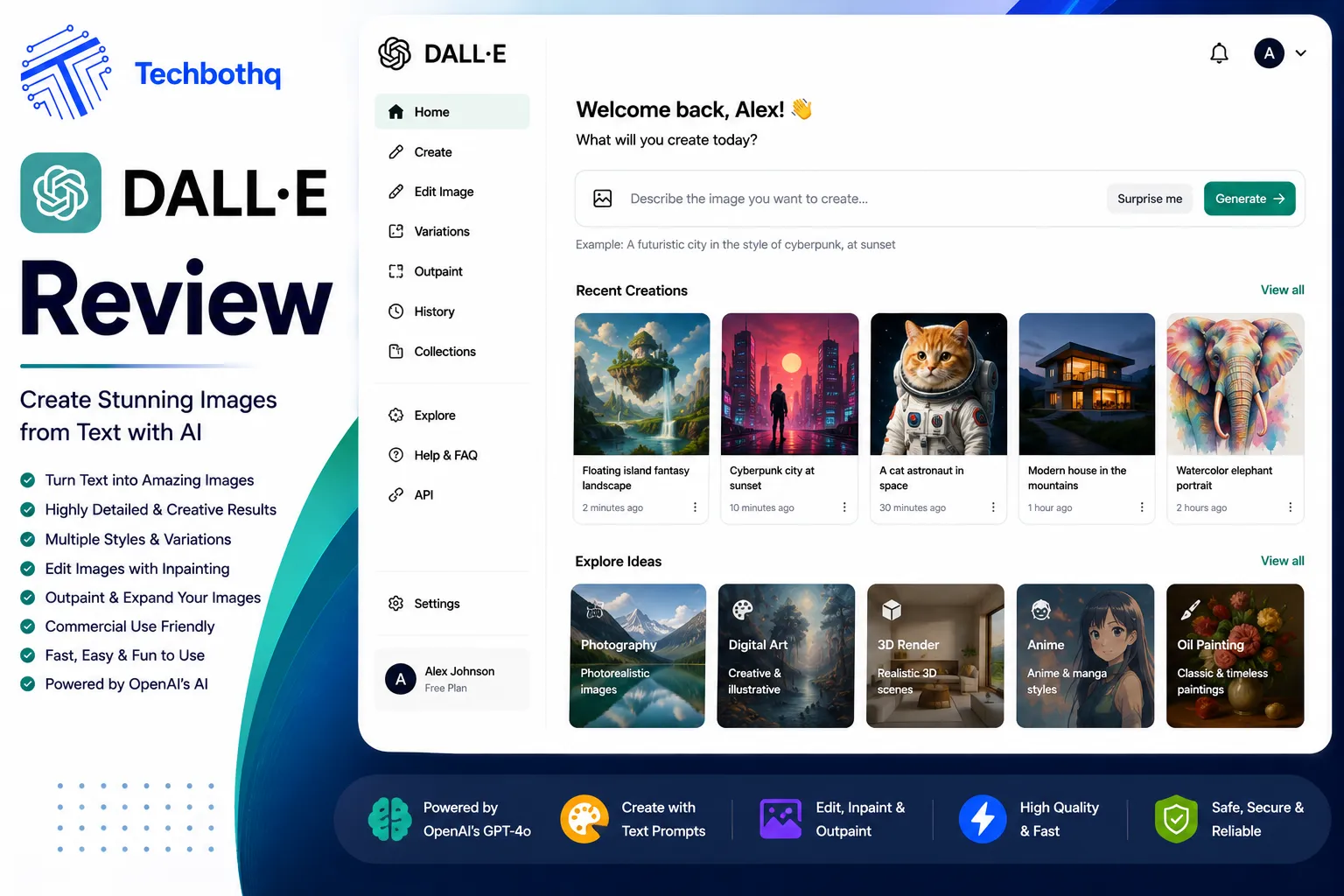
In this DALL-E review, if you’re reading this to decide whether to use DALL-E, there’s something important to know upfront: DALL-E 3 was officially retired on May 12, 2026.
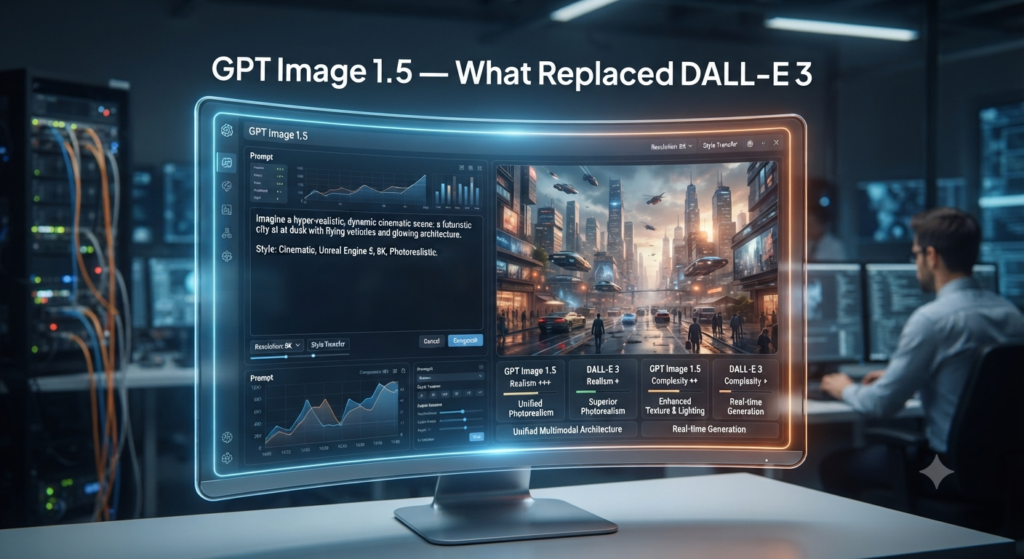
Looking at DALL-E review details, OpenAI replaced it with GPT Image 1.5 — a fundamentally different model architecture with better image quality, faster generation, improved text rendering, and deeper conversational editing capabilities. If you open ChatGPT today and ask it to generate an image, you’re using GPT Image 1.5, not DALL-E 3.
When it comes to this tool, this DALL-E review found that this review covers both: what DALL-E 3 delivered during its run, what GPT Image 1.5 is and how it differs, how OpenAI’s image generation compares to Midjourney and Adobe Firefly in 2026, and exactly who should be using it.
Table of Contents
What Was DALL-E? A Brief History
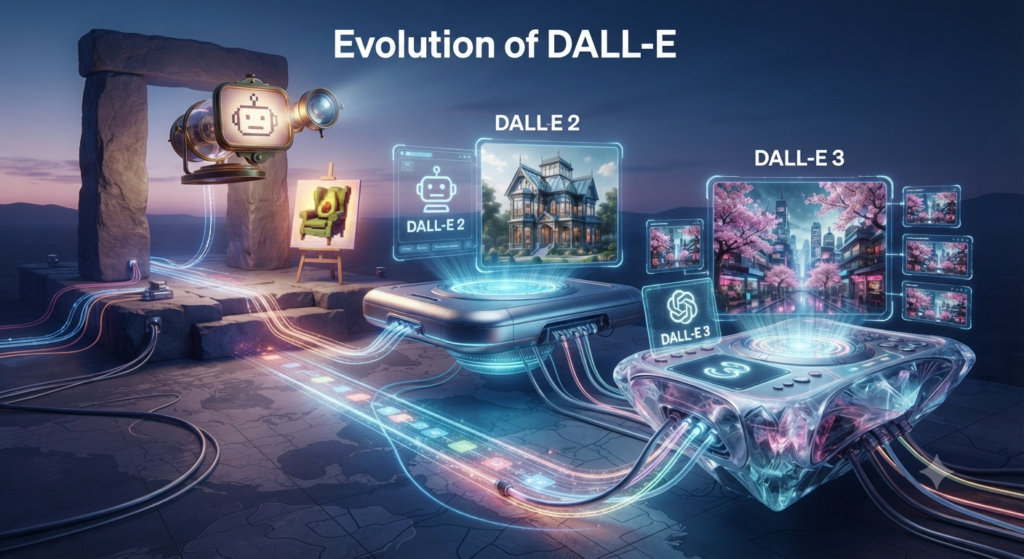
For anyone reading this DALL-E review, DALL-E (named as a portmanteau of Salvador Dalí and WALL·E) was OpenAI’s flagship text-to-image model series. DALL-E 2 launched in 2022 and was the first widely accessible AI image generator to produce reliably usable results. DALL-E 3 launched in late 2023 with a significant architectural improvement: deep integration with ChatGPT for conversational prompting, dramatically better prompt adherence, and meaningfully better text rendering in generated images.
This DALL-E review found that DALL-E 3’s biggest innovation wasn’t image quality alone — it was the ChatGPT integration. Instead of needing to learn complex prompt syntax like Midjourney’s /imagine commands, users could simply describe what they wanted in plain English, and ChatGPT would expand and refine the description into a detailed generation prompt automatically. Iterative editing happened through conversation: “make the background darker,” “add a second figure on the left,” “change the color of the jacket to navy.” This conversational workflow made DALL-E 3 the most accessible AI image generator for mainstream users who didn’t want to become prompt engineers.
Across this DALL-E review, DALL-E 3 introduced C2PA metadata watermarking on all outputs — an important step toward content provenance transparency that competing tools were slower to adopt.
By late 2025, OpenAI had already quietly transitioned ChatGPT users from DALL-E 3 to GPT Image 1.5 as the default image generation model. Most users didn’t notice — the interface stayed the same, but the underlying model changed. The API deprecation notice went out in early 2026, with May 12, 2026 set as the final shutdown date for both DALL-E 2 and DALL-E 3 API endpoints.
Love What These AI Design Tools Can Do?
Great AI-generated visuals still need a cohesive brand identity holding them together. Let Tasknestly build your full branding — logo, guidelines, and visual system.
Explore Branding Services →GPT Image 1.5 — What Replaced DALL-E 3
Architecture Shift
Within this DALL-E review, DALL-E 3 was a diffusion-based model — the dominant architecture for AI image generation that produces images by iteratively denoising from random noise toward a target. GPT Image 1.5 uses a fundamentally different approach: native multimodal token prediction, treating both images and text as the same type of data — tokens to be predicted and completed — rather than running them through separate model architectures.
This isn’t just technical trivia. The architectural difference directly impacts editing capability, consistency, and instruction-following. A diffusion model treats each generation as a fresh process. A multimodal token model treats image generation as a natural extension of text — the same mechanism that lets a language model understand and continue a story can understand and continue a visual composition.
Key Improvements Over DALL-E 3
Speed: GPT Image 1.5 generates images up to 4x faster than DALL-E 3. Typical completion times range from 10 to 30 seconds depending on complexity. For workflows involving rapid iteration — generating multiple concepts quickly, testing variations — this speed difference changes the practical feel of the tool significantly.
Image editing: This is the most significant advancement. GPT Image 1.5 supports “add, subtract, combine, and blend” operations on uploaded images while preserving elements you want to keep constant — lighting direction, composition, subject likeness. DALL-E 3 could generate new images but had limited precise editing capability. GPT Image 1.5 enables genuine iterative visual refinement: upload a product photo, ask it to place the product in a different environment, change the background without touching the product, adjust lighting, add text overlays accurately.
Text rendering: GPT Image 1.5 achieves approximately 95% text accuracy in generated images — among the best in the market. DALL-E 3 was already the leader in this category over Midjourney (which handles text poorly) and Stable Diffusion. GPT Image 1.5 has extended this lead. For any generated image requiring legible text — social media graphics with copy, poster designs, UI mockups, product packaging concepts — GPT Image 1.5 is the correct choice.
Prompt adherence: Better instruction-following than DALL-E 3 already was. Complex, multi-element prompts are interpreted more accurately and consistently.
API cost: Approximately 20% cheaper than previous OpenAI image models. Standard quality square images are approximately $0.01 per image; higher quality outputs approximately $0.04; premium quality approximately $0.17.
Conversation memory: GPT Image 1.5 in ChatGPT remembers previous images and prompts within the same conversation. You can reference “the previous image” or “the blue jacket version” and the model maintains continuity without re-describing everything from scratch. This conversational workflow — already DALL-E 3’s strongest differentiator — is significantly more capable in GPT Image 1.5.
Love What These AI Design Tools Can Do?
Great AI-generated visuals still need a cohesive brand identity holding them together. Let Tasknestly build your full branding — logo, guidelines, and visual system.
Explore Branding Services →How to Access OpenAI’s Image Generation in 2026
Via ChatGPT (Recommended for Most Users)
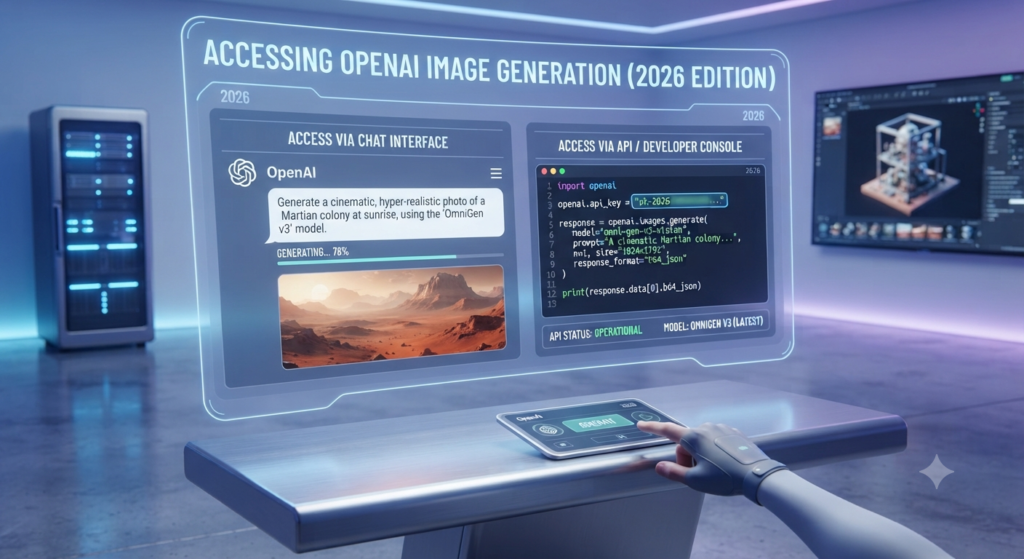
For anyone reading this DALL-E review, the simplest access point. If you have a ChatGPT account, image generation is available:
- Free tier: Limited image generations available, GPT Image 1.5 model
- ChatGPT Plus ($20/month): Full image generation access, priority processing, GPT Image 1.5
- ChatGPT Pro ($200/month): Extended limits, fastest processing, all features
- ChatGPT Team: Collaborative workspace for teams
On this point, this DALL-E review notes that for most users evaluating OpenAI’s image generation, the recommendation is straightforward: start a ChatGPT Plus trial and generate images through ChatGPT. The conversational workflow — describing what you want, refining through conversation, editing via natural language — is available immediately without API setup.
Via API (For Developers and Businesses)
The API uses the model identifier gpt-image-1.5. Pricing is per image:
- Standard quality: ~$0.01 per image (1024×1024)
- High quality: ~$0.04 per image
- Premium quality: ~$0.17 per image
Within this DALL-E review, the API supports programmatic image generation and editing — feeding it images, instructing modifications, and receiving outputs automatically. For e-commerce platforms, content management systems, or any application requiring automated image generation at volume, the API provides a scalable, predictable-cost integration.
Commercial rights are included by default for all paid tier users. Images generated through ChatGPT Plus and the API can be used in commercial projects without additional licensing.
Via Microsoft Copilot
OpenAI’s partnership with Microsoft means GPT Image 1.5 is also available through Microsoft Copilot (formerly Bing Image Creator), integrated into Windows and Microsoft 365 products. For users in enterprise Microsoft environments, this provides access to OpenAI image generation without a separate ChatGPT subscription.
Love What These AI Design Tools Can Do?
Great AI-generated visuals still need a cohesive brand identity holding them together. Let Tasknestly build your full branding — logo, guidelines, and visual system.
Explore Branding Services →What OpenAI’s Image Generation Does Best
Conversational Prompting — The Defining Advantage
Per this DALL-E review, the integration with ChatGPT remains the single most important differentiator for OpenAI’s image generation versus competitors. You don’t need to learn prompt engineering syntax. You don’t need to use Discord commands. You describe what you want in plain English, and ChatGPT both understands your intent and expands your description into a detailed, high-quality generation prompt automatically.
As this DALL-E review shows, the iterative refinement workflow is where this advantage compounds. After generating an initial image, you continue the conversation: “make the lighting more dramatic,” “the background should be more abstract,” “the subject looks too young, age them by about 15 years.” Each refinement happens within the same conversational context — the model understands what you’re referencing and modifies accordingly.
In this DALL-E review, for marketers, writers, educators, and other professionals who need AI-generated images but don’t want to develop prompt engineering as a skill, this conversational interface removes the primary barrier to getting good results. The learning curve is near-zero compared to Midjourney.
Text Rendering in Images
Looking at DALL-E review details, approximately 95% text accuracy in generated images makes GPT Image 1.5 the best-in-class choice for any image requiring legible text. Social media graphics with copy, poster designs, marketing banners, product packaging mockups, UI wireframe illustrations — any use case where text accuracy in the visual matters — GPT Image 1.5 is the correct tool.
When it comes to this tool, this DALL-E review found that Midjourney V7, for all its aesthetic quality, handles text poorly and typically produces distorted or garbled characters. Adobe Firefly handles basic text adequately. Stable Diffusion has improved but still trails significantly. For the specific job of generating images with accurate text, GPT Image 1.5 is the clear market leader.
Prompt Accuracy for Complex Briefs
For anyone reading this DALL-E review, when you need an image to contain multiple specific elements — “a CEO presenting to a board room, three people visible, modern glass office building through the window, laptop open on the table showing a bar chart” — GPT Image 1.5’s instruction-following accuracy is among the best available. Complex, multi-element compositions are interpreted more reliably than most competing models.
Image Editing and Inpainting
This DALL-E review found that the editing capabilities in GPT Image 1.5 represent a significant advancement over DALL-E 3. Upload an existing image and instruct modifications through natural language: change the background, add an element, remove an object, alter lighting, adjust colors, place a subject in a new environment. The model preserves elements you want to keep constant while modifying what you instruct.
Across this DALL-E review, for marketers who need to adapt existing creative assets — placing a product in different contexts, generating variations with different backgrounds, testing different visual treatments — this editing capability creates a genuinely useful production workflow.
Developer Integration
On this point, this DALL-E review notes that the API’s combination of quality, speed, and competitive pricing makes it the most practical choice for developers building image generation into products. The 20% cost reduction over previous OpenAI models combined with 4x faster generation improves both economics and user experience for API-based applications.
Love What These AI Design Tools Can Do?
Great AI-generated visuals still need a cohesive brand identity holding them together. Let Tasknestly build your full branding — logo, guidelines, and visual system.
Explore Branding Services →Where OpenAI’s Image Generation Falls Short
Artistic Quality Versus Midjourney
Within this DALL-E review, Midjourney V7 produces images with a level of cinematic quality, artistic direction, and aesthetic sophistication that GPT Image 1.5 doesn’t consistently match for purely creative work. For concept art, campaign imagery evaluated on visual impact, editorial illustrations, and any work where aesthetic excellence is the primary criterion, Midjourney produces more impressive results.
GPT Image 1.5 excels at accurate, technically correct image generation. Midjourney excels at beautiful image generation. These are different strengths serving different use cases, and the gap between them in the “which looks more stunning” category remains real in 2026.
No Commercial Indemnification
Adobe Firefly is the only major AI image generator that offers contractual IP indemnification for commercial use — Adobe trains exclusively on licensed Adobe Stock, openly licensed work, and public domain material, and legally accepts responsibility for copyright claims on Firefly outputs on qualifying enterprise plans.
Per this DALL-E review, OpenAI grants commercial use rights on paid tiers but does not explicitly indemnify users against third-party copyright claims. For enterprise clients whose legal teams scrutinize AI-generated assets, this distinction is significant. For most individual and small business users, the practical difference is minimal, but for regulated industries, agencies working with enterprise clients, or any context where IP defensibility matters, Adobe Firefly’s indemnification makes it the safer choice.
Generation Limits on Free and Plus Tiers
The free tier and ChatGPT Plus ($20/month) provide image generation access but with usage limits that heavy users will encounter. Exact limits are not always published transparently and can change. For high-volume image generation needs, the API’s pay-per-image model is more predictable and scalable than subscription tier limits.
Style Consistency Across Multiple Generations
In this DALL-E review, maintaining exact visual consistency across a series of related images — consistent character appearance, consistent brand aesthetic across multiple compositions — remains challenging for all AI image generators including GPT Image 1.5. While the model’s conversational memory within a session helps, producing a genuinely cohesive visual series for brand campaigns or illustrated narratives still requires significant manual direction and selection.
Looking at DALL-E review details, Midjourney’s newer “Omni Reference” feature addresses character consistency more directly. For projects requiring strict visual continuity, Midjourney or specialized tools may produce more consistent results.
Love What These AI Design Tools Can Do?
Great AI-generated visuals still need a cohesive brand identity holding them together. Let Tasknestly build your full branding — logo, guidelines, and visual system.
Explore Branding Services →Pros and Cons
Advantages
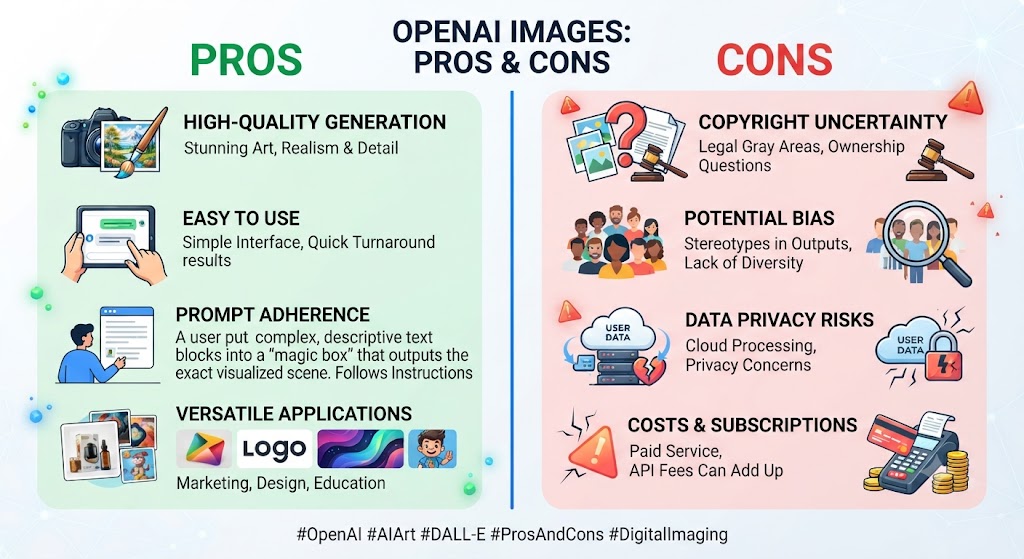
Most accessible AI image generator available. When it comes to this tool, this DALL-E review found that conversational prompting via ChatGPT removes the prompt engineering requirement that limits accessibility of competing tools. No Discord commands, no complex syntax, no specialized knowledge required to get good results.
Best text rendering in images. For anyone reading this DALL-E review, ~95% text accuracy is the market benchmark. For any image requiring legible text, GPT Image 1.5 is the unambiguous best choice.
Included with ChatGPT Plus. This DALL-E review found that at $20/month for ChatGPT Plus, you get access to one of the best AI assistants available plus high-quality image generation. If you’re already a ChatGPT Plus subscriber, image generation is effectively free.
Advanced editing capabilities. Across this DALL-E review, the ability to modify specific elements of existing images through natural language instruction is one of the most practically useful features for professional content workflows.
4x faster than DALL-E 3. On this point, this DALL-E review notes that 10-30 second generation times change the feel of creative iteration from waiting to flowing.
API is cost-effective and scalable. Within this DALL-E review, developer-friendly pricing with 20% cost reduction and predictable per-image costs make it practical for API-integrated applications at scale.
C2PA provenance metadata. All outputs include content provenance metadata — an important transparency feature in an AI-content-saturated landscape.
Commercial use included. All paid tier users can use generated images in commercial projects with no additional licensing.
Drawbacks
Artistic quality trails Midjourney for creative work. Per this DALL-E review, for concept art, campaign imagery, and visually evaluated creative output, Midjourney’s aesthetic quality is distinctly stronger. GPT Image 1.5 is technically accurate; Midjourney is more visually compelling for purely artistic use.
No IP indemnification. Adobe Firefly provides contractual legal protection for commercial outputs. OpenAI grants commercial rights but doesn’t indemnify against copyright claims — a meaningful distinction for enterprise and agency use.
Generation and editing limits can be hit. In this DALL-E review, subscription tier limits on free and Plus plans can constrain high-volume workflows. API usage is more predictable but requires development setup.
Style consistency across sessions. Maintaining exact visual continuity across multiple separate sessions requires significant manual guidance and selection.
Free tier is limited. When it comes to this tool, this DALL-E review found that unlike some competitors, the free tier doesn’t provide unlimited full-quality generations. Meaningful use requires a paid subscription.
Love What These AI Design Tools Can Do?
Great AI-generated visuals still need a cohesive brand identity holding them together. Let Tasknestly build your full branding — logo, guidelines, and visual system.
Explore Branding Services →Pricing Overview
Pricing is verified as of June 2026. Always confirm current rates at openai.com.
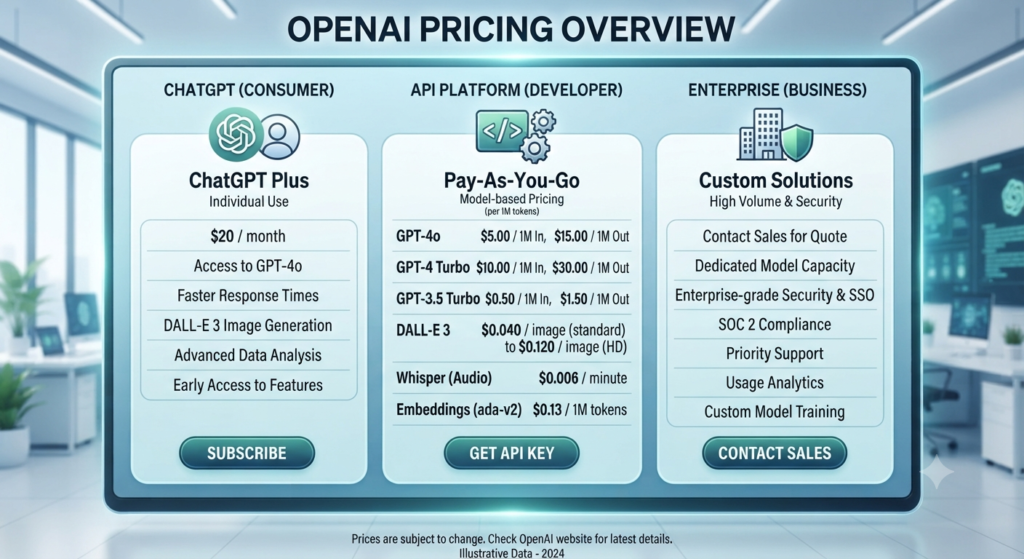
ChatGPT Free — $0
- Limited image generation access
- GPT Image 1.5 model
- Suitable for occasional testing
ChatGPT Plus — $20/month
- Full image generation access
- GPT Image 1.5 model
- Priority processing
- All ChatGPT features including GPT-4o, browsing, file analysis
For anyone reading this DALL-E review, the strongest value proposition: if you’re evaluating ChatGPT Plus for AI assistance generally, image generation is bundled in at no extra cost.
ChatGPT Pro — $200/month
- Extended generation limits
- Fastest processing
- All Plus features plus advanced model access
API Pricing — Pay per image
- Standard quality (~1024×1024): ~$0.01/image
- High quality: ~$0.04/image
- Premium quality: ~$0.17/image
This DALL-E review found that API pricing is the right model for developers and businesses generating images at volume — predictable costs, no monthly commitment overhead, scales with actual usage.
Love What These AI Design Tools Can Do?
Great AI-generated visuals still need a cohesive brand identity holding them together. Let Tasknestly build your full branding — logo, guidelines, and visual system.
Explore Branding Services →Alternatives
Midjourney V7 — Best for Artistic Quality
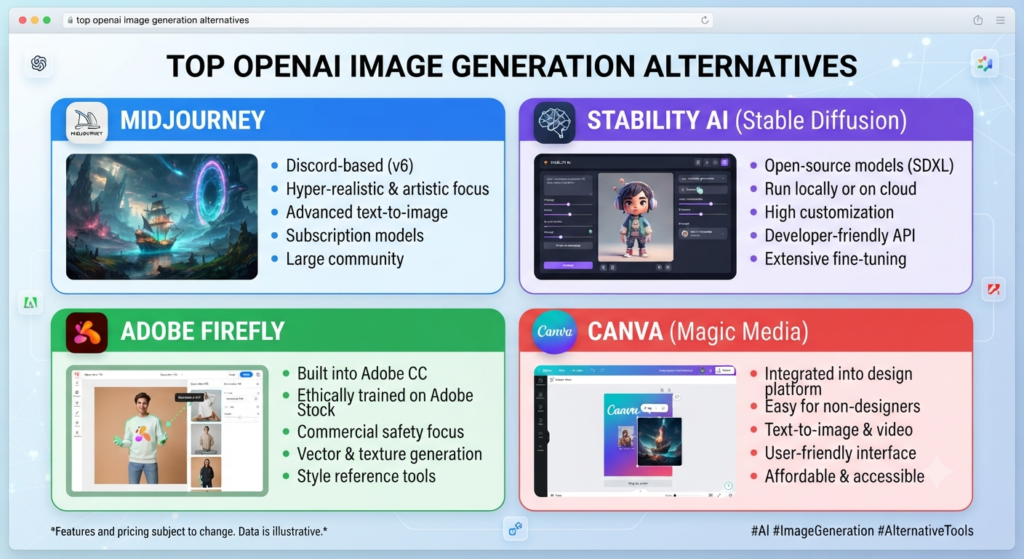
Across this DALL-E review, Midjourney remains the aesthetic quality benchmark for AI-generated imagery in 2026. V7 added Omni Reference for character consistency; V8.1 (April 30, 2026) added HD 2K output and Raw mode for photographers. The output for concept art, campaign imagery, and editorial illustration is distinctly more cinematic and visually sophisticated than GPT Image 1.5.
On this point, this DALL-E review notes that the trade-offs are real: no free tier, Discord-centric workflow (though a web interface now exists), images default to public on Basic and Standard plans, and text in images is handled poorly.
Within this DALL-E review, best for: Designers, creative directors, and agencies whose output is evaluated on aesthetic quality. Standard plan at $30/month.
Read our full coverage: Best AI Design Tools 2026 — Midjourney section
Adobe Firefly — Best for Commercial Safety
Considering the data, this DALL-E review shows Adobe Firefly is trained exclusively on licensed Adobe Stock and public domain content with contractual IP indemnification on qualifying enterprise plans — the only AI image generator that legally accepts responsibility for copyright claims on its outputs. For agencies, enterprise clients, and regulated industries where IP defensibility matters, Firefly is the safest commercial choice.
Premium at $19.99/month standalone, or included in most Creative Cloud subscriptions. The quality gap versus GPT Image 1.5 for photorealistic and product imagery is minimal. For artistic or cinematic work, Midjourney leads both.
Best for: Commercial and enterprise work where IP documentation is required, Creative Cloud users.
Stable Diffusion — Best for Maximum Control
Stable Diffusion is open source, free to run locally, and supports extensive customization through fine-tuning and LoRA models. For developers who need maximum control over generation, custom model training, or privacy (local execution with no cloud dependency), Stable Diffusion is the correct tool.
The trade-off: technical setup is significant, and out-of-the-box quality without model fine-tuning is below GPT Image 1.5 and Midjourney for most use cases.
Best for: Developers, researchers, and technically sophisticated users who need local execution or custom model control.
Recraft V3 — Best for Vectors and Brand Assets
Recraft’s unique capability is native SVG vector generation — true paths and shapes, not raster images traced into pseudo-vectors. For logo design, icon sets, and scalable brand assets, Recraft’s specialization produces results that no raster image generator can match.
Best for: Brand designers, product designers, and anyone whose primary need is scalable vector asset generation. Basic at $10/month annual.
Love What These AI Design Tools Can Do?
Great AI-generated visuals still need a cohesive brand identity holding them together. Let Tasknestly build your full branding — logo, guidelines, and visual system.
Explore Branding Services →The Full Comparison: OpenAI vs Alternatives
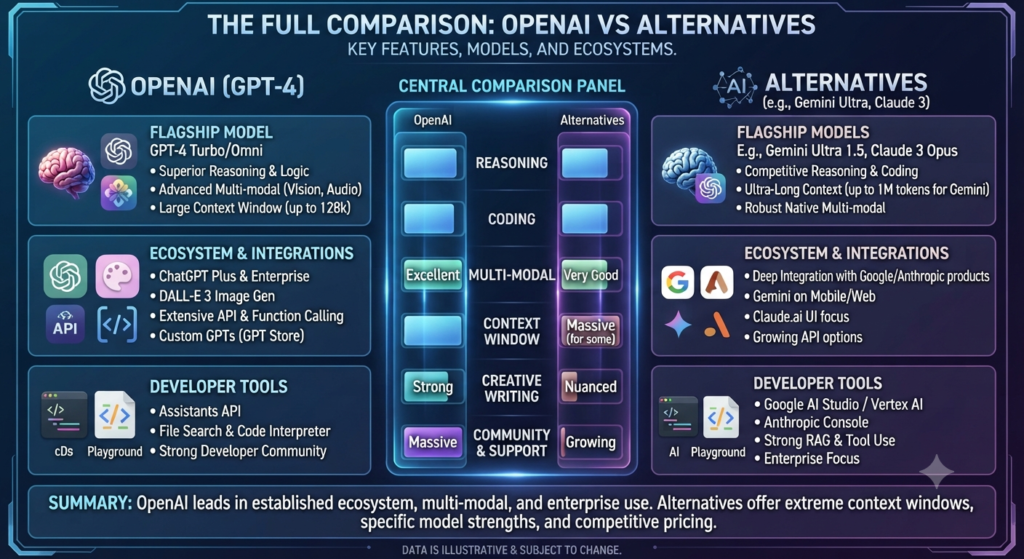
| Feature | GPT Image 1.5 (ChatGPT Plus) | Midjourney Standard | Adobe Firefly Premium |
|---|---|---|---|
| Price | $20/mo (ChatGPT Plus) | $30/mo | $19.99/mo |
| Free tier | ✅ Limited | ❌ None | ✅ 25 credits |
| Image quality | ✅ Very high | ✅ Best artistic | ✅ High |
| Text in images | ✅ ~95% accuracy | ❌ Poor | ✅ Adequate |
| Prompt adherence | ✅ Best-in-class | ⚠️ Good | ✅ Good |
| Conversational editing | ✅ Via ChatGPT | ❌ | ❌ |
| IP indemnification | ❌ | ❌ | ✅ Enterprise |
| Image editing | ✅ Advanced | ⚠️ Limited | ✅ Good |
| API available | ✅ | ❌ | ✅ |
| Generation speed | ✅ 10-30 seconds | ✅ Fast | ✅ Fast |
| Commercial use | ✅ Paid tiers | ✅ Paid tiers | ✅ All tiers |
| Learning curve | ✅ Very low | ⚠️ Moderate | ✅ Low |
Love What These AI Design Tools Can Do?
Great AI-generated visuals still need a cohesive brand identity holding them together. Let Tasknestly build your full branding — logo, guidelines, and visual system.
Explore Branding Services →Final Verdict
Is OpenAI’s Image Generation Worth It?
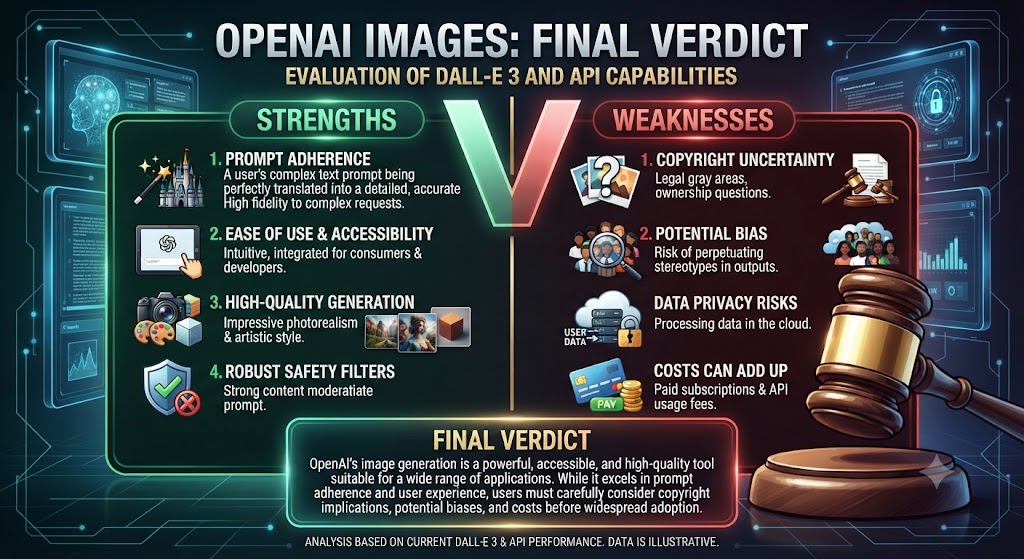
Yes — especially if you’re already a ChatGPT Plus subscriber, where image generation is effectively a free addition to a subscription you’re likely already paying for.
GPT Image 1.5 is the best AI image generator for:
- Accessibility — no learning curve, conversational prompting
- Text in images — ~95% accuracy, best in market
- Complex prompt accuracy — multi-element compositions interpreted correctly
- Integration with AI workflows — using generated images alongside ChatGPT’s research, writing, and analysis capabilities
GPT Image 1.5 is not the best for:
- Artistic/cinematic quality — Midjourney leads here clearly
- Commercial IP safety — Adobe Firefly with indemnification
- Vector/brand assets — Recraft’s native SVG is specialized for this
- Maximum customization and local execution — Stable Diffusion
The realistic user profile for whom GPT Image 1.5 / ChatGPT Plus is the correct choice: a marketer, content creator, educator, writer, or business professional who needs reliable AI-generated visuals for social media, presentations, blog content, and marketing materials without investing time in learning specialized tools. The conversational workflow, strong text rendering, and inclusion in a subscription they’re likely already paying for makes it the practical default.
For designers and creative professionals who evaluate output on aesthetic quality, Midjourney deserves the subscription alongside or instead.
Best Use Cases
GPT Image 1.5 via ChatGPT Plus is the right choice for:
- Marketers and content creators needing social media graphics, banner images, and marketing visuals
- Writers and bloggers who need blog illustrations and featured images
- Educators creating visual content for courses and presentations
- Product teams building product mockups and UI concept illustrations
- Developers integrating scalable image generation via API
- Anyone already paying for ChatGPT Plus who needs images occasionally to frequently
- Any use case requiring legible text in generated images
Look at alternatives if you:
- Need maximum artistic quality for creative campaigns → Midjourney Standard ($30/month)
- Need IP indemnification for enterprise/agency commercial work → Adobe Firefly
- Need native vector/SVG output for brand assets → Recraft ($10/month annual)
- Need local execution, privacy, or maximum customization → Stable Diffusion
Rating: 8.4/10
Best for: Marketers, content creators, and professionals who want accessible, high-quality AI image generation with the best text rendering available, integrated with ChatGPT’s broader capabilities.
Price: Free (limited) — ChatGPT Plus $20/month — API from ~$0.01/image
Note: DALL-E 3 was retired May 12, 2026. All current OpenAI image generation is powered by GPT Image 1.5. Pricing and model availability change frequently — verify current details at openai.com.
Love What These AI Design Tools Can Do?
Great AI-generated visuals still need a cohesive brand identity holding them together. Let Tasknestly build your full branding — logo, guidelines, and visual system.
Explore Branding Services →