Honest Seventh Sense Review 2026: Best Email Send Time AI Tool?

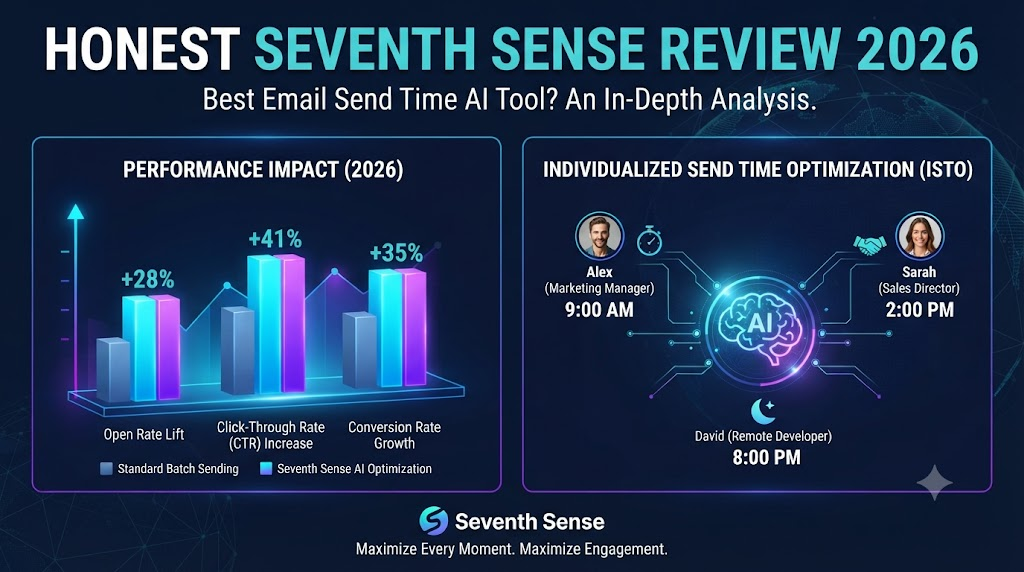
Most email marketing tools let you schedule a send time and blast your list simultaneously. Seventh Sense takes a fundamentally different approach — and this Seventh Sense review examines whether that difference actually moves the needle on email performance. Instead of sending to everyone at once, Seventh Sense uses AI to analyse each individual subscriber’s historical email engagement behaviour and delivers your email at the exact moment that person is most likely to open it. The Seventh Sense review process tests whether that concept translates from compelling pitch to measurable results.
Email marketing is one of the highest-ROI channels in digital marketing — but most email lists underperform because of timing friction. A subscriber who checks email every morning at 7am receives your 2pm blast and finds it buried under hours of subsequent messages. Seventh Sense’s send-time optimisation is designed to solve exactly that problem. This Seventh Sense review covers how well it solves it, who it’s built for, and whether the pricing makes sense given the alternatives.
This review is specifically relevant for HubSpot and Marketo users — those are the only two platforms Seventh Sense currently integrates with. If you’re on a different email platform, the conclusion is simple: it doesn’t apply to you yet. For HubSpot and Marketo users, however, this Seventh Sense review goes deep on whether the tool is worth adding to your marketing stack.
VERDICT BOX
Overall Rating: 8.1 / 10
Best for: HubSpot and Marketo users with established email lists of 5,000+ subscribers who want AI-powered send-time optimisation to improve open rates and engagement without changing their content strategy
Price: HubSpot plans from $64/month; Marketo plans from $360/month (billed annually)
Verdict: Seventh Sense delivers genuine, measurable improvements in email open rates and engagement for established email lists on HubSpot or Marketo — the AI send-time optimisation is well-implemented and the results are consistent with the platform’s claims. The value depends entirely on your list size and existing open rate performance.
Table of Contents
What Is Seventh Sense? Background for This Seventh Sense Review
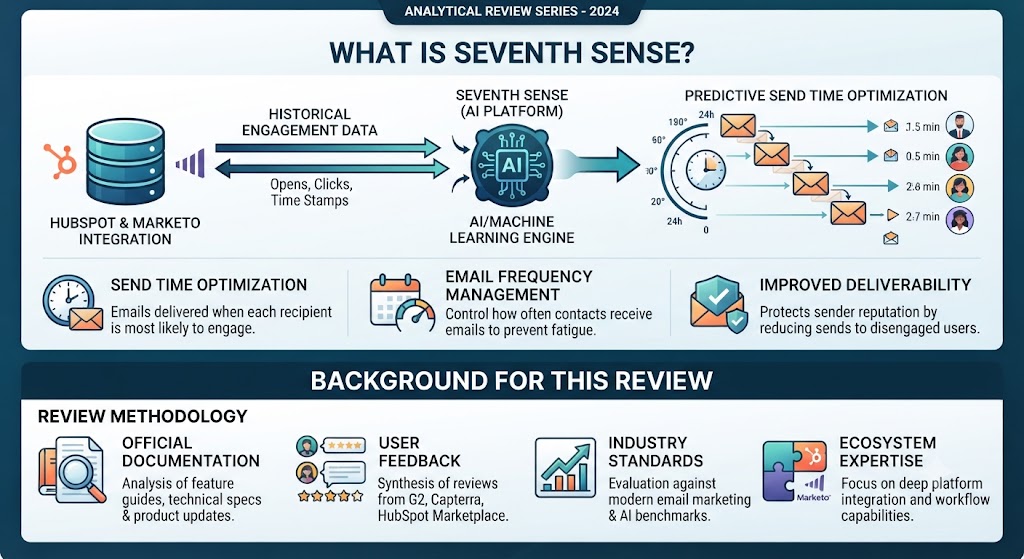
Seventh Sense is an AI-powered email delivery optimisation platform founded in 2014 and headquartered in Georgia, USA. The platform is one of the longest-standing specialised send-time optimisation tools in the email marketing category. This Seventh Sense review covers the current 2026 version, which includes enhanced AI models, improved engagement frequency optimisation (not just send time, but also optimal send frequency per contact), and a more developed analytics dashboard.
The core concept behind this Seventh Sense review is behavioural email personalisation at the individual level. Traditional email marketing sends everyone the same message at the same time. Seventh Sense integrates with your HubSpot or Marketo database, analyses each contact’s historical email engagement data — when they open emails, how frequently they engage, which days and times show the highest activity — and builds an individual delivery schedule that sends each contact their email at their personal optimal time.
Over time, this Seventh Sense review found the AI model learns and refines its predictions per contact, improving accuracy with each email campaign. For large lists where even small percentage improvements in open rates translate to thousands of additional engaged contacts, the compounding effect of improved engagement is the strongest argument for the platform. More tools in this space in our AI marketing tools category.
Skip The Learning Curve — Let Us Run It For You
These AI marketing tools are powerful, but strategy still takes time to master. Tasknestly runs done-for-you digital marketing campaigns using the same category of tools, professionally managed.
Get a Free Marketing Quote →Seventh Sense Review: Pros and Cons
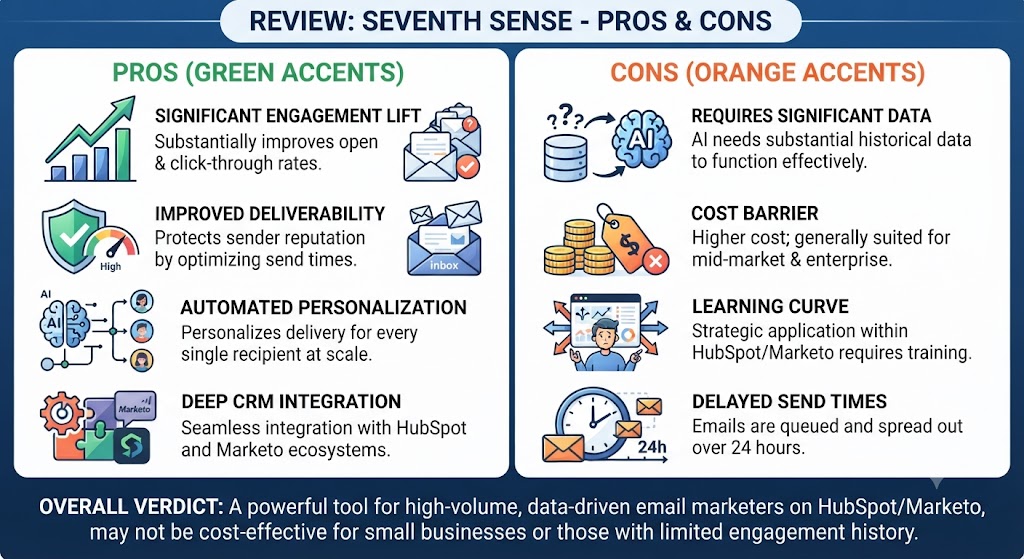
| Pros | Cons |
|---|---|
| Send-time optimisation is genuinely effective — measurable open rate improvements in most implementations | Only integrates with HubSpot and Marketo — not available for other email platforms |
| Engagement frequency optimisation reduces list fatigue alongside improving timing | Requires minimum list size and engagement history to produce meaningful AI predictions |
| AI model improves over time as it accumulates contact engagement data | Pricing is a meaningful additional cost on top of already-expensive HubSpot or Marketo subscriptions |
| Non-invasive implementation — works within your existing HubSpot or Marketo workflow | Not a full email marketing replacement — a supplementary optimisation layer only |
| Analytics dashboard shows clear before/after engagement data per campaign | New contacts with no engagement history receive standard send times until the AI has data to work with |
| Frequency throttling protects contact experience and reduces unsubscribe rates | Results can be gradual — the AI needs several campaign cycles to fully optimise |
Skip The Learning Curve — Let Us Run It For You
These AI marketing tools are powerful, but strategy still takes time to master. Tasknestly runs done-for-you digital marketing campaigns using the same category of tools, professionally managed.
Get a Free Marketing Quote →Seventh Sense Review: Feature Deep-Dive
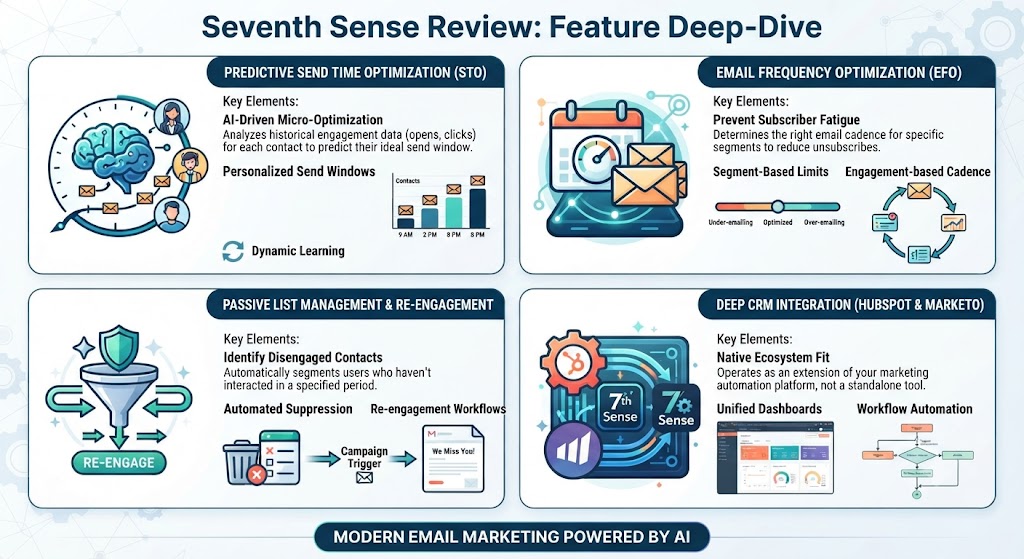
AI Send-Time Optimisation — The Core of This Seventh Sense Review
The AI send-time optimisation engine is the centrepiece of this Seventh Sense review and the feature that drives the platform’s core value proposition. When you schedule an email campaign through your HubSpot or Marketo platform with Seventh Sense enabled, rather than sending at the fixed time you specify, Seventh Sense intercepts the send and delivers each email to each individual contact at their predicted optimal engagement window — which may span across a 24-hour period from your campaign trigger.
This Seventh Sense review found the technical implementation to be seamless from the user perspective. You continue building and scheduling campaigns in HubSpot or Marketo exactly as you normally would. Seventh Sense operates as a delivery layer — you don’t need to learn a new interface or change your campaign creation workflow. The most visible change this Seventh Sense review observed in the user experience is the campaign analytics: instead of seeing a single spike in opens immediately after send, you see a rolling wave of opens that follows your subscribers’ individual engagement patterns over the delivery window.
The AI model in this Seventh Sense review analyses multiple data points per contact: time of day they historically open emails, day of week patterns, device type used for engagement, response to previous frequency of sends, and more. For contacts with significant engagement history — typically 6 months or more of data — the model produces highly accurate individual delivery windows. For newer contacts or those with low historical engagement, the predictions are based on broader cohort patterns until individual data accumulates.
Engagement Frequency Optimisation
Beyond send time, Seventh Sense also optimises how frequently each individual contact receives emails — a feature this Seventh Sense review found to be frequently overlooked but genuinely valuable. Different contacts in your database have different engagement tolerances: some subscribers engage with every email you send; others start ignoring you after two emails per week. Seventh Sense’s frequency optimisation learns each contact’s tolerance threshold and throttles sends accordingly.
This Seventh Sense review found frequency optimisation to be one of the most practically impactful features for large email lists. List fatigue — where contacts gradually disengage because they receive too many emails — is one of the most common reasons email programme performance declines over time. Seventh Sense’s ability to reduce send frequency for fatigue-prone contacts while maintaining frequency for highly engaged contacts keeps your overall list health stronger over time. This Seventh Sense review found the unsubscribe rate reduction from frequency optimisation to be as meaningful as the open rate improvement from timing optimisation in many implementations.
HubSpot Integration — The Seventh Sense Review’s Primary Integration Assessment
The HubSpot integration is where this Seventh Sense review spends the most time because it’s where the majority of Seventh Sense users operate. The integration connects directly to your HubSpot account and syncs contact engagement data automatically. Setup takes approximately 30 minutes, and this Seventh Sense review found the integration documentation to be clear and well-maintained. Once connected, Seventh Sense pulls historical engagement data from your HubSpot email history and begins building individual contact profiles.
This Seventh Sense review found the HubSpot integration to work reliably for standard HubSpot email workflows — marketing emails, automated sequences, and nurture workflows all benefit from Seventh Sense’s timing layer. The integration also works with HubSpot sequences, allowing sales teams to benefit from send-time optimisation on one-to-one sales outreach alongside marketing email programmes. For organisations using HubSpot across both marketing and sales, this Seventh Sense review found this dual application to be a meaningful additional value point.
Marketo Integration
The Marketo integration in this Seventh Sense review functions similarly to the HubSpot integration but is priced significantly higher, reflecting Marketo’s enterprise user base and the more complex integration requirements of the platform. This Seventh Sense review found the Marketo integration to be stable and well-maintained, though the initial setup is more involved than the HubSpot integration and typically requires involvement from a Marketo administrator.
Analytics and Reporting
Seventh Sense’s analytics dashboard shows campaign-level and programme-level performance data including open rates before and after Seventh Sense activation, click rates, optimal send-time distributions across your list, engagement score distributions, and frequency utilisation data. This Seventh Sense review found the before/after comparison view to be the most useful reporting feature — it provides clear evidence of the optimisation impact that can be used to justify the platform cost to stakeholders.
The engagement score system assigns each contact a score based on their overall engagement health — highly engaged, moderately engaged, at-risk, dormant. This Seventh Sense review found the engagement scoring to be useful for identifying list segments that need re-engagement campaigns or suppression, extending the analytics value beyond just send-time data.
Skip The Learning Curve — Let Us Run It For You
These AI marketing tools are powerful, but strategy still takes time to master. Tasknestly runs done-for-you digital marketing campaigns using the same category of tools, professionally managed.
Get a Free Marketing Quote →Seventh Sense Pricing: What This Seventh Sense Review Found
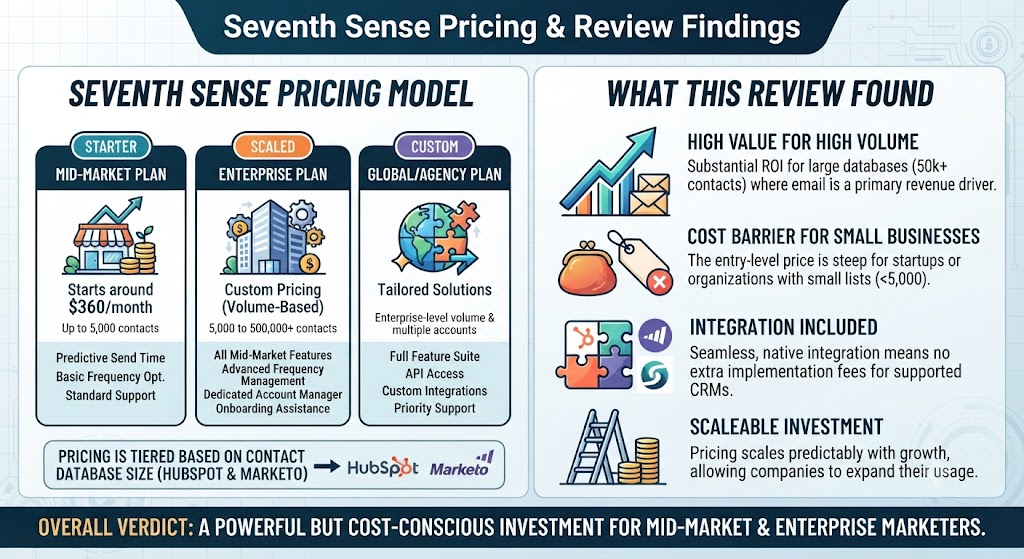
| Plan | Price (Annual) | Platform | Contacts |
|---|---|---|---|
| Business | $64/month | HubSpot | Up to 5,000 contacts |
| Business | $149/month | HubSpot | Up to 25,000 contacts |
| Business | $249/month | HubSpot | Up to 100,000 contacts |
| Enterprise | $360/month | Marketo | Up to 25,000 contacts |
| Enterprise | $640/month | Marketo | Up to 100,000 contacts |
This Seventh Sense review found the pricing to scale with contact volume and platform. For HubSpot users, the entry point at $64/month for up to 5,000 contacts is accessible for growing email lists. The Marketo pricing starting at $360/month reflects the enterprise nature of Marketo deployments and the more complex integration requirements. The most important consideration this Seventh Sense review raises about pricing is the ROI calculation: Seventh Sense works as an additional cost layer on top of already-significant HubSpot or Marketo subscriptions, so the open rate improvement needs to translate to measurable business outcomes to justify the combined cost.
Skip The Learning Curve — Let Us Run It For You
These AI marketing tools are powerful, but strategy still takes time to master. Tasknestly runs done-for-you digital marketing campaigns using the same category of tools, professionally managed.
Get a Free Marketing Quote →Seventh Sense vs Competitors: The Seventh Sense Review Comparison
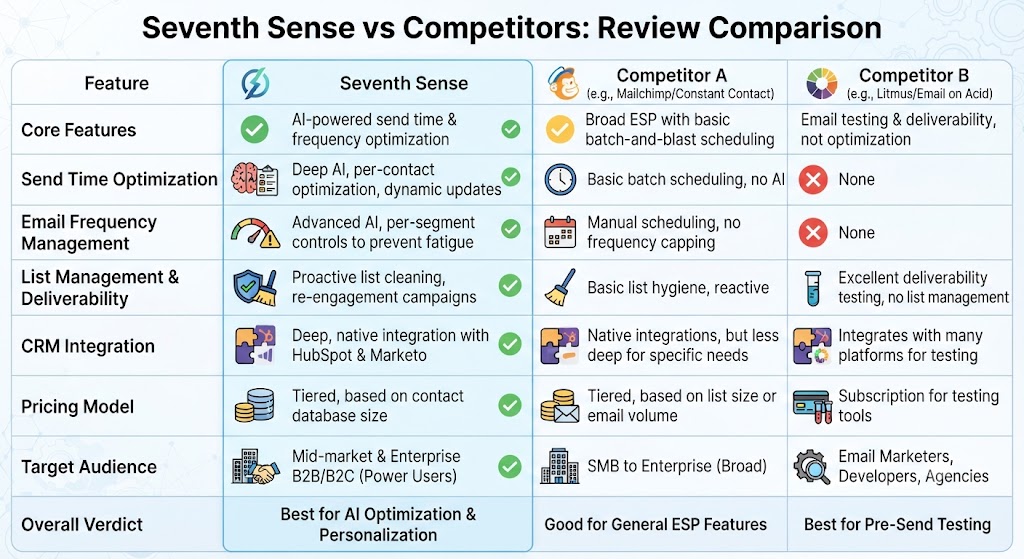
| Feature | Seventh Sense | HubSpot AI (native) | Klaviyo | Mailchimp |
|---|---|---|---|---|
| AI send-time optimisation per contact | ✅ Individual AI | ⚠️ Send Time Optimisation (cohort) | ✅ Smart Send Time | ✅ Send Time Optimisation |
| HubSpot integration | ✅ Deep | ✅ Native | ❌ No | ❌ No |
| Marketo integration | ✅ Deep | ❌ No | ❌ No | ❌ No |
| Engagement frequency optimisation | ✅ Yes | ❌ No | ⚠️ Limited | ❌ No |
| Contact-level engagement analytics | ✅ Detailed | ⚠️ Limited | ✅ Good | ⚠️ Basic |
| Works with existing email platform | ✅ Overlay layer | ✅ Native | Platform-specific | Platform-specific |
| Starting price | $64/month (HubSpot) | Included in HubSpot | From $20/month | Free plan available |
This Seventh Sense review comparison raises an important nuance: HubSpot has added native send-time optimisation features that are included in paid HubSpot plans. The key difference this Seventh Sense review found is granularity — HubSpot’s native feature optimises send time at a cohort or aggregate level, while Seventh Sense optimises at the individual contact level. For large lists where individual optimisation produces meaningful additional lift, Seventh Sense is worth the additional cost. For smaller lists where the difference is minimal, HubSpot’s native feature may be sufficient. Our AI marketing tools hub covers this space in detail.
Skip The Learning Curve — Let Us Run It For You
These AI marketing tools are powerful, but strategy still takes time to master. Tasknestly runs done-for-you digital marketing campaigns using the same category of tools, professionally managed.
Get a Free Marketing Quote →Who Is Seventh Sense Best For? The Seventh Sense Review Audience Assessment
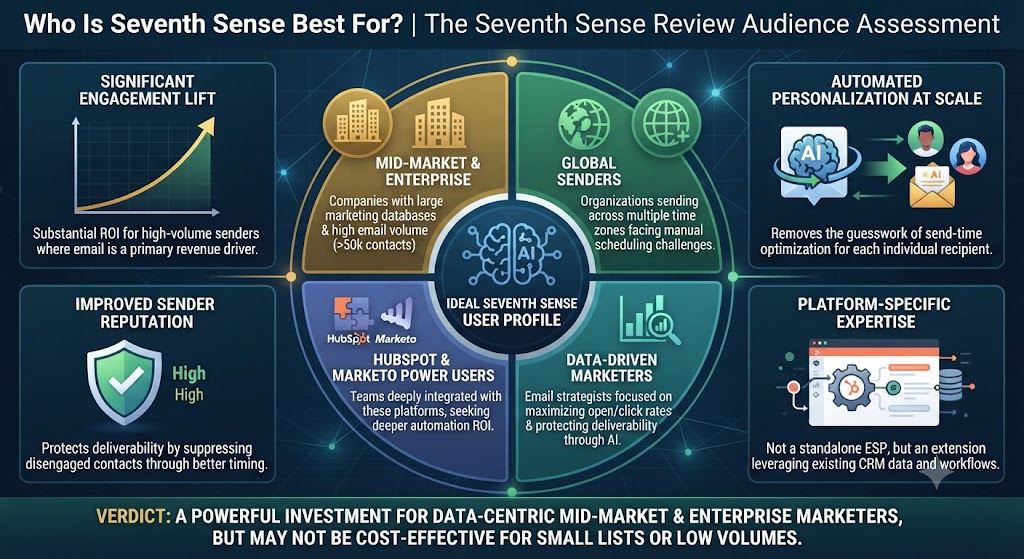
Seventh Sense works best for:
- HubSpot users with 5,000+ contacts who have established email programmes and want to extract more performance from existing content without changing their strategy
- Marketo enterprise teams managing large contact databases where marginal improvements in open rates translate to significant absolute numbers of additional engaged contacts
- B2B marketing teams with longer sales cycles where email engagement consistency is critical to nurture effectiveness
- E-commerce brands on HubSpot running high-frequency email programmes where frequency fatigue is a real challenge alongside timing optimisation
- Marketing operations teams looking for ways to improve email KPIs without the creative overhead of new content approaches
Seventh Sense is less ideal for:
- Email marketers on platforms other than HubSpot or Marketo — the integrations simply don’t exist for other platforms
- Small lists under 2,000–3,000 contacts — the AI doesn’t have sufficient data to produce meaningful individual predictions and the cost is hard to justify
- Teams whose primary email performance problem is content quality, segmentation, or deliverability rather than send timing — Seventh Sense doesn’t address those issues
Skip The Learning Curve — Let Us Run It For You
These AI marketing tools are powerful, but strategy still takes time to master. Tasknestly runs done-for-you digital marketing campaigns using the same category of tools, professionally managed.
Get a Free Marketing Quote →Get It / Skip It
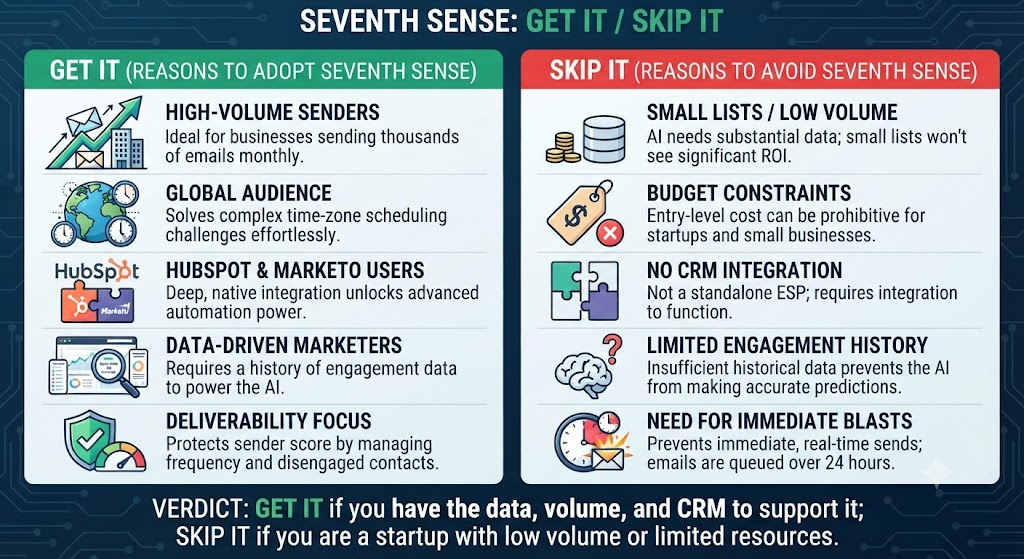
✅ Get Seventh Sense if:
- You’re a HubSpot or Marketo user with an established list of 5,000+ engaged contacts who want to measurably improve email open rates without changing your content or strategy
- You’re experiencing list fatigue on a high-frequency email programme and need individual-level frequency throttling alongside send-time optimisation
- Your email programme is mature enough that marginal improvements in timing translate to meaningful business outcomes — and you have the analytics to measure that impact
❌ Skip Seventh Sense if:
- You’re not on HubSpot or Marketo — the tool doesn’t integrate with other email platforms
- Your list is under 3,000 contacts or your email programme is in its early stages — the AI needs data to work and the cost is hard to justify at low volumes
- Your email performance problems are rooted in content quality, deliverability, or poor segmentation rather than send timing — Seventh Sense won’t fix those issues
Skip The Learning Curve — Let Us Run It For You
These AI marketing tools are powerful, but strategy still takes time to master. Tasknestly runs done-for-you digital marketing campaigns using the same category of tools, professionally managed.
Get a Free Marketing Quote →Seventh Sense Review: Frequently Asked Questions
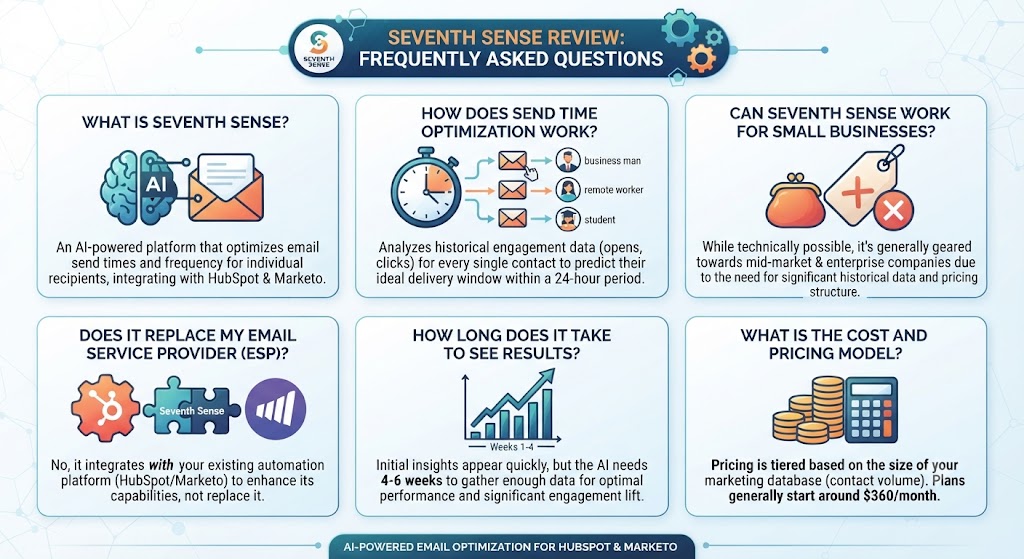
Q: Is this Seventh Sense review recommending it for all email marketers? This Seventh Sense review recommends Seventh Sense specifically for HubSpot and Marketo users with established, moderately sized email lists. For users on other platforms, Klaviyo, Mailchimp, and most modern email tools have built-in send-time optimisation features. The Seventh Sense review advantage is the depth of individual-level AI optimisation and the HubSpot/Marketo integration quality — which isn’t available in native platform features at the same granularity.
Q: How much does Seventh Sense improve open rates? This Seventh Sense review found open rate improvements of 5–20% to be typical in early implementation, depending on list size, existing engagement rates, and email frequency. Seventh Sense’s own published data shows average improvements around 7–10% in open rates after the AI model has accumulated sufficient data over three to six months. This Seventh Sense review considers those figures credible and consistent with what independent implementations report.
Q: Does Seventh Sense work with HubSpot sequences? Yes. This Seventh Sense review confirmed Seventh Sense works with HubSpot marketing emails and HubSpot sequences (sales outreach). This allows both marketing and sales email programmes to benefit from individual send-time optimisation — a meaningful additional application for organisations using HubSpot across both teams.
Q: How long does it take for Seventh Sense to start optimising? This Seventh Sense review found Seventh Sense begins building contact profiles immediately upon connection to your HubSpot or Marketo account, using historical engagement data. Initial optimisation typically becomes effective within two to three campaign cycles. Significant improvement in model accuracy usually becomes visible over three to six months as the AI accumulates more individual contact data.
Q: Can Seventh Sense help with email deliverability? This Seventh Sense review found Seventh Sense does not directly address deliverability issues like spam filter placement or sender reputation. However, by improving engagement rates — more opens and clicks — Seventh Sense indirectly benefits deliverability over time, since email providers use engagement signals to assess sender reputation. Higher open rates through better timing can contribute to improved inbox placement as a secondary effect.
Q: Is Seventh Sense worth it for B2B email marketing? This Seventh Sense review found Seventh Sense to be particularly well-suited to B2B email marketing through HubSpot, where contacts typically have consistent working-hours engagement patterns that the AI can model accurately. B2B email programmes also tend to have longer nurture cycles where consistent engagement over many months is critical — making frequency optimisation alongside timing optimisation especially valuable.
Q: What are the best Seventh Sense alternatives? For HubSpot users, this Seventh Sense review would point to HubSpot’s native send-time optimisation feature (included in paid plans, less granular), and for users on other platforms: Klaviyo’s Smart Send Time (Klaviyo users), Mailchimp’s Send Time Optimisation (Mailchimp users), or ActiveCampaign’s predictive sending. Our AI marketing tools section covers the full email optimisation landscape.
Skip The Learning Curve — Let Us Run It For You
These AI marketing tools are powerful, but strategy still takes time to master. Tasknestly runs done-for-you digital marketing campaigns using the same category of tools, professionally managed.
Get a Free Marketing Quote →Conclusion: Final Seventh Sense Review Verdict
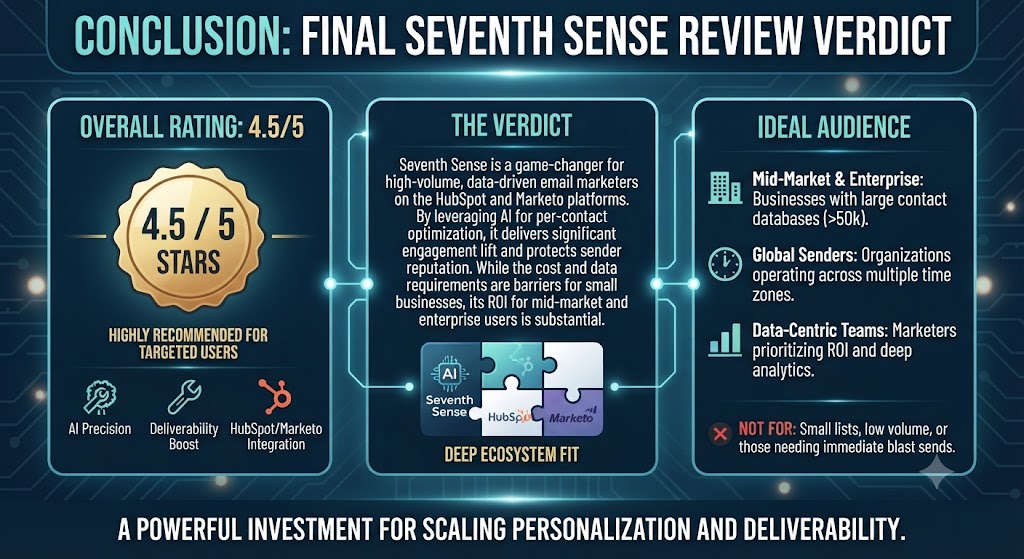
After completing a thorough Seventh Sense review, the verdict is positive — with clearly defined conditions. Seventh Sense delivers genuine, measurable improvements in email engagement for HubSpot and Marketo users with established lists who implement it correctly and give the AI model time to learn. The individual-level send-time optimisation is more accurate than the cohort-level approaches built into native email platforms, and the frequency throttling feature provides meaningful additional value that most alternatives don’t offer.
The limitations this Seventh Sense review identified are structural rather than quality-related. The platform works only with HubSpot and Marketo — a hard constraint that makes this Seventh Sense review irrelevant for the majority of email marketers using other tools. The pricing adds cost to already-expensive enterprise email platforms. And the AI needs time and data to produce its best results, meaning the value accrues gradually rather than immediately.
For the right user — the HubSpot or Marketo email marketer with a moderately large, established list and a mature email programme where marginal performance improvements have meaningful business impact — this Seventh Sense review recommends the platform confidently. The free trial gives you enough time to connect your account, run a few campaigns with the AI enabled, and see the engagement impact on your specific list before committing to a paid plan.
This Seventh Sense review’s final note: the ROI of Seventh Sense compounds over time. The open rate improvement compounds into better deliverability, which compounds into better inbox placement, which compounds into higher future open rates. For email programmes built on HubSpot or Marketo where the channel is a core growth driver, that compounding effect makes the Seventh Sense investment worthwhile. Explore more tools for your marketing stack in our AI marketing tools hub.
Disclosure: This article contains affiliate links. TechBotHQ may earn a commission if you sign up through our links, at no extra cost to you. See our affiliate disclosure for full details.
Skip The Learning Curve — Let Us Run It For You
These AI marketing tools are powerful, but strategy still takes time to master. Tasknestly runs done-for-you digital marketing campaigns using the same category of tools, professionally managed.
Get a Free Marketing Quote →