Pathmatics Review: Powerful Ad Intelligence — But Is It Worth the Price?

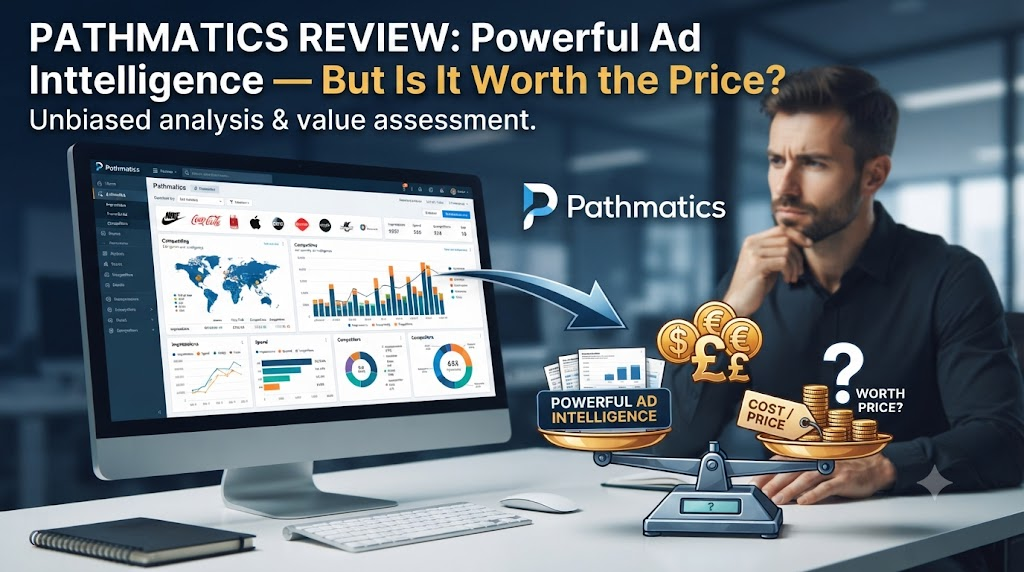
If you’ve ever wondered where your competitors are spending their advertising budgets, which creatives are running across which channels, and how their digital media strategy has evolved over time, Pathmatics review searches bring you to one of the most comprehensive ad intelligence platforms on the market. Built for brands, agencies, and media teams that need to go beyond gut instinct, Pathmatics (now part of the Sensor Tower family) aggregates digital ad data across display, social, mobile, video, and streaming channels to give you an edge before you spend a single dollar.
But comprehensive rarely means affordable — or easy. Pathmatics sits firmly in the enterprise tier, and that immediately raises the question every marketer reading this needs to answer: does the depth of insight justify the investment? In this Pathmatics review, we break down every feature, compare it against the closest alternatives, and give you a straight verdict on who should buy it and who should walk away.
We tested Pathmatics across its core use cases — competitive research, creative intelligence, media planning, and trend analysis — so this Pathmatics review reflects real-world usage rather than a product brochure walkthrough. Whether you are a brand strategist, a media buyer, or a performance marketer trying to reverse-engineer what is working for rivals, this guide has you covered. This Pathmatics review also covers how the platform compares against Adbeat, SimilarWeb, and SpyFu so you can make an informed buying decision without sitting through four separate demo calls.
VERDICT AT A GLANCE
Overall Rating: 8.2 / 10
Best For: Enterprise brands, agencies, and media teams doing competitive ad research
Starting Price: Custom pricing (typically $1,000+ / month)
Bottom Line: Pathmatics delivers unmatched ad intelligence depth across channels — but only makes financial sense for teams that run active competitive analysis at scale.
Ready to see exactly where your competitors are advertising?
Table of Contents
Pathmatics Review: Pros and Cons
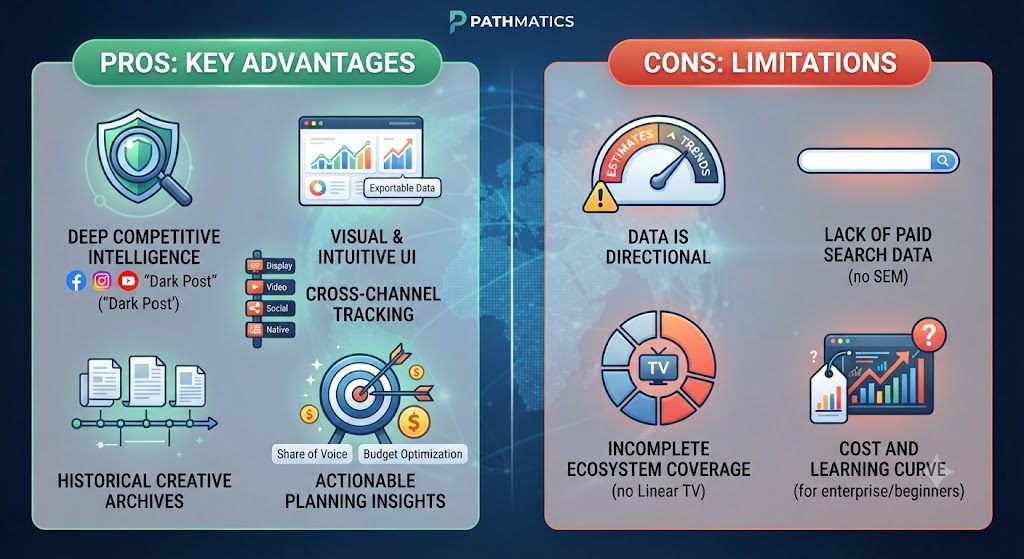
| PROS | CONS |
|---|---|
| Cross-channel coverage: display, social, mobile, video, CTV/OTTCreative-level data — see exact ad creatives, not just spend estimatesDeep competitor spend tracking with historical trend dataAudience intelligence reveals who competitors are targetingClean, visual UI that makes complex data digestibleSensor Tower integration adds mobile app and ASO intelligence | Enterprise pricing puts it out of reach for small and mid-size teamsNo self-serve free trial — requires a sales demo to accessData freshness can lag by 24–48 hours depending on the channelLimited search advertising (PPC/SEM) coverage compared to specialised toolsSteep learning curve for users new to ad intelligence platformsSome geographic markets have thinner data coverage outside the US |
Skip The Learning Curve — Let Us Run It For You
These AI marketing tools are powerful, but strategy still takes time to master. Tasknestly runs done-for-you digital marketing campaigns using the same category of tools, professionally managed.
Get a Free Marketing Quote →What Is Pathmatics and Who Is It For?
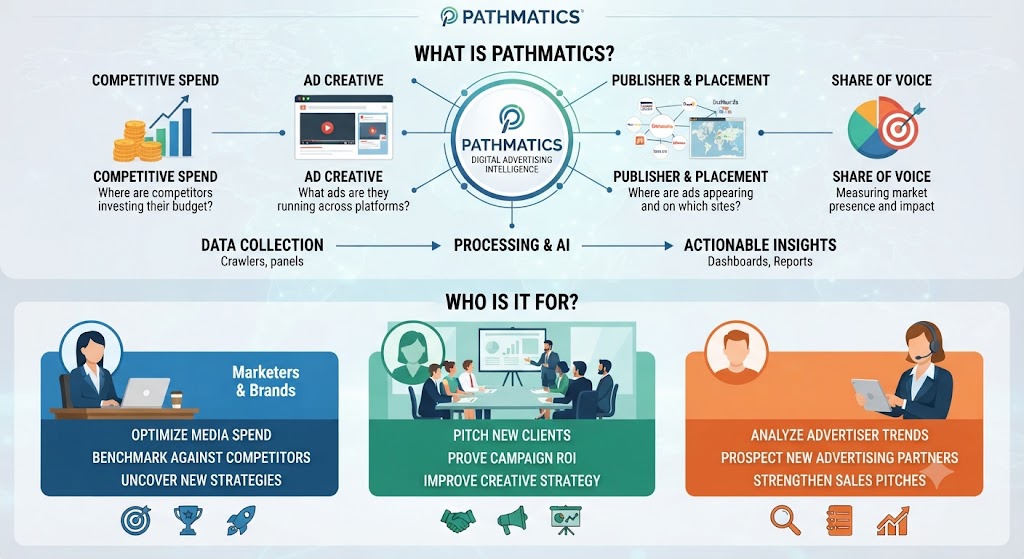
Pathmatics is a digital advertising intelligence platform that collects, processes, and visualises competitive ad data from across the open web and major social platforms. Originally founded in 2011 and acquired by Sensor Tower in 2021, it has evolved from a display-focused tool into a multi-channel intelligence suite covering Facebook, Instagram, Twitter/X, YouTube, TikTok, programmatic display, mobile apps, and connected TV. This Pathmatics review will cover every layer of that suite.
At its core, this Pathmatics review shows the platform answers three questions that brand strategists and media teams ask constantly: where are my competitors advertising, how much are they spending, and what creative is converting for them? Those three answers, backed by machine-learning models and first-party publisher data, form the foundation of every feature on the platform.
Primary User Profiles
- Enterprise brand teams managing multi-channel media budgets of $500K or more annually
- Media agencies running competitive intelligence as a core service for clients
- Strategic marketing consultants benchmarking category spend and creative trends
- Digital marketers scaling campaigns across AI marketing channels who need rival-level insights before committing budget
What makes this Pathmatics review particularly valuable for buyers is that the platform does not just show you that a competitor is advertising — it shows you the actual creative assets they are running, the publishers they are buying from, the estimated impressions generated, and a modelled spend estimate derived from real auction and placement data. That granularity is rare, and it is the main reason enterprise teams pay a premium for it.
Skip The Learning Curve — Let Us Run It For You
These AI marketing tools are powerful, but strategy still takes time to master. Tasknestly runs done-for-you digital marketing campaigns using the same category of tools, professionally managed.
Get a Free Marketing Quote →Pathmatics Review: Core Features Breakdown
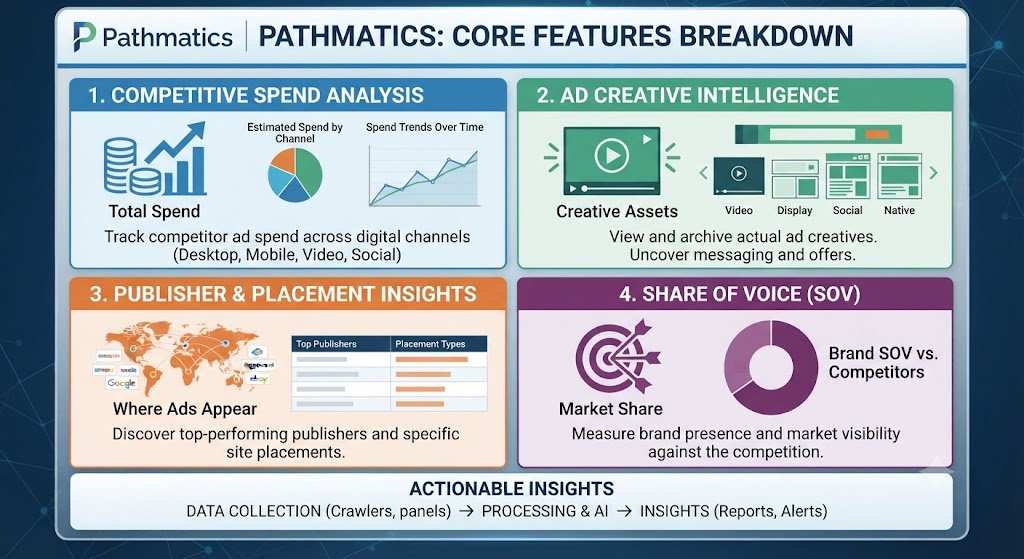
Pathmatics packages its intelligence into several functional modules. Here is how each performs in practice — and how the feature set holds up against the price point that defines every Pathmatics review conversation.
Competitive Ad Intelligence
The flagship feature of any Pathmatics review. Enter any brand or domain and Pathmatics surfaces every digital ad it has tracked from that advertiser — sorted by channel, date range, estimated spend, and creative format. You can filter down to specific platforms, device types, or publisher categories to understand where a competitor concentrates its budget. The historical data spans years for major advertisers, which means you can identify seasonal patterns, product launch cycles, and creative refresh cadences that would otherwise take months of manual monitoring to spot.
The spend estimates are modelled rather than exact — Pathmatics is transparent about this — but they are accurate enough to directionally guide media planning decisions and agency pitch decks. For brands tracking three to five key competitors across six or more channels, this module alone can pay for itself. It is one of the standout capabilities highlighted in every credible Pathmatics review.
Creative Intelligence
Every ad unit tracked by Pathmatics is stored as an actual creative asset — banners, videos, carousels, stories — with metadata attached: dimensions, placement type, first seen date, last seen date, and estimated impressions. This is not a screenshot graveyard. The platform surfaces top-performing creatives ranked by estimated spend and impression volume, giving creative teams a data-backed starting point for concept development.
One standout use case highlighted throughout this Pathmatics review: before launching a new product campaign, a creative director can pull the top 20 highest-spend display ads from the category over the past 90 days, identify which visual patterns and messaging themes are dominant, and brief the team to either align with proven conventions or intentionally break from them. That kind of briefing used to require a junior team member spending two weeks manually crawling publisher pages.
Cross-Channel Coverage
Pathmatics covers display, video (YouTube and programmatic pre-roll), social (Facebook, Instagram, Twitter/X, TikTok), mobile web and app advertising, OTT/CTV streaming, and email. The breadth is genuinely impressive and sets it apart from single-channel tools in this Pathmatics review. That said, coverage depth varies by channel — display and social data is richest, while CTV and email intelligence is growing but still thinner than the core channels.
Marketers running multi-channel campaigns who already use AI marketing tools reviewed on TechBotHQ will find Pathmatics complementary rather than redundant — it answers competitive questions that performance platforms have no visibility into.
Audience Intelligence
Beyond spend and creative, this Pathmatics review found the audience targeting intelligence to be a genuinely useful differentiator — inferring what demographic and interest segments a competitor appears to be targeting based on the publishers and placements where their ads appear. This is modelled data, but it is useful for understanding whether a rival is skewing toward a younger demographic, doubling down on premium content environments, or running cost-efficient long-tail buys.
Trend Analysis and Market Intelligence
Category-level and industry-level reports let you zoom out from individual competitor tracking to understand macro advertising trends. This layer of the Pathmatics review is particularly relevant for agency teams building quarterly strategy decks or brand managers preparing board-level marketing reviews. Which categories are increasing digital spend? Which publishers are gaining or losing budget from automotive or CPG advertisers? Pathmatics answers those questions with data, not assumption.
Sensor Tower Integration
Since the 2021 acquisition, Pathmatics has been integrated with Sensor Tower’s mobile intelligence data. For brands with app presence, this means you can layer mobile app download trends, ASO data, and mobile ad activity into a single view — a genuinely unique capability that no standalone ad intelligence tool offers. For brands without an app focus, this integration is largely invisible to day-to-day usage but represents significant long-term product value.
Publisher Intelligence
One underrated dimension of this Pathmatics review is the platform’s publisher-level data. Beyond tracking what competitors advertise, Pathmatics reveals where they advertise — which specific domains, apps, and streaming services carry their placements. This publisher intelligence is enormously useful for media buyers who want to identify high-performing environments before committing to placements, or for brand safety teams auditing where category competitors accept adjacency risk.
Publisher-level breakdowns in this Pathmatics review also surface interesting buy patterns. Some brands cluster spend heavily on premium publishers; others spread widely across long-tail programmatic inventory. Understanding that distinction informs both your direct buy strategy and your programmatic targeting logic in ways that campaign analytics platforms simply cannot replicate because they only show your own data.
Skip The Learning Curve — Let Us Run It For You
These AI marketing tools are powerful, but strategy still takes time to master. Tasknestly runs done-for-you digital marketing campaigns using the same category of tools, professionally managed.
Get a Free Marketing Quote →Pathmatics Pricing: What Does It Cost?
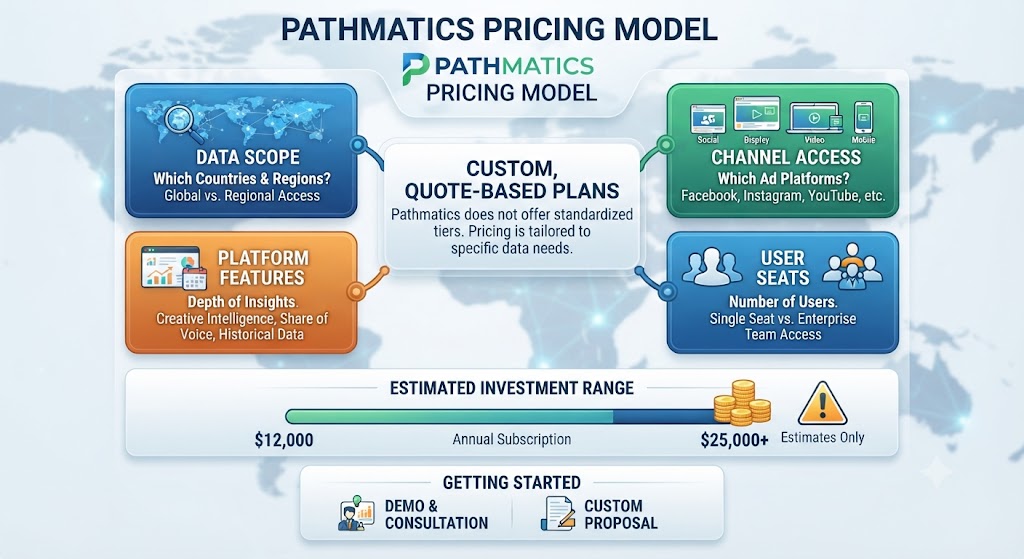
No Pathmatics review would be complete without addressing the elephant in the room: pricing. Pathmatics does not publish pricing publicly, which is standard practice for enterprise intelligence platforms. All access requires a sales conversation, and pricing is determined by the number of markets, channels, users, and data depth required.
Based on publicly available information and industry reporting, this Pathmatics review has collated the following approximate ranges from users who have gone through the sales process:
| Plan / Tier | Estimated Starting Price | What’s Included |
|---|---|---|
| Mid-Market | ~$1,000 – $2,000/month | 1–2 channels, core competitors, limited users |
| Agency / Brand Pro | ~$2,500 – $5,000/month | Multi-channel, broader competitor set, team access |
| Enterprise | Custom (often $10K+/month) | Full channel suite, unlimited markets, API access, dedicated CSM |
| Free Trial | Not available | Demo only — no self-serve access |
The lack of a free trial or self-serve tier is a legitimate complaint that comes up in almost every Pathmatics review, especially for marketing teams that want to evaluate the data quality before committing to a sales cycle. That said, Pathmatics does offer demo sessions that can be surprisingly comprehensive — push the sales team to show you live data for your actual category and competitors, not just a pre-built slide deck.
Want Competitive Intelligence Applied to Your Own Ad Strategy?
Understanding what rivals spend is only half the picture. Tasknestly’s digital marketing team turns competitive insights into campaigns that actually convert — done for you.
Skip The Learning Curve — Let Us Run It For You
These AI marketing tools are powerful, but strategy still takes time to master. Tasknestly runs done-for-you digital marketing campaigns using the same category of tools, professionally managed.
Get a Free Marketing Quote →Pathmatics vs Competitors: How Does It Stack Up?
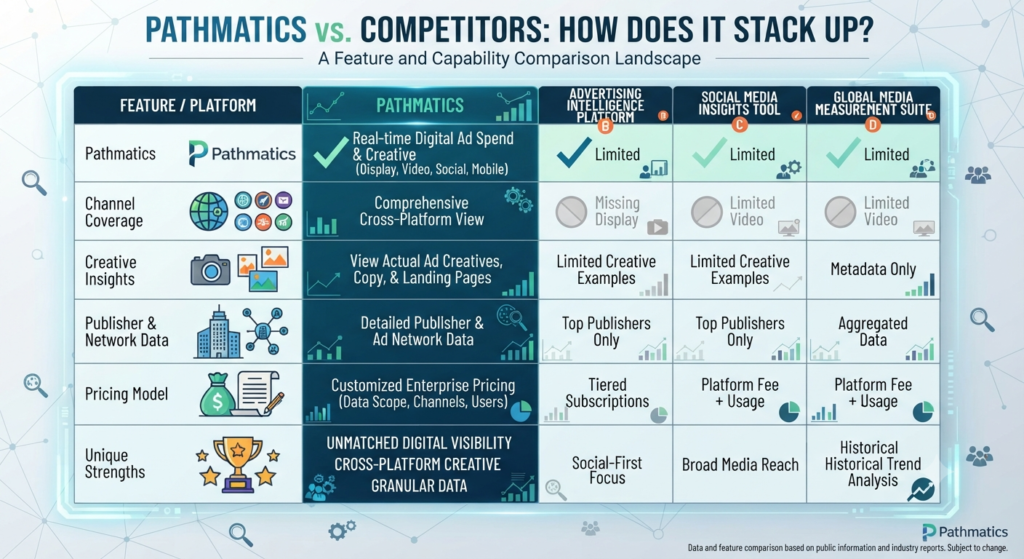
The ad intelligence space has several credible players. Here is how Pathmatics compares against its three main alternatives — a comparison that every serious Pathmatics review needs to include given the platform’s premium price point:
| Feature | Pathmatics | Adbeat | SimilarWeb | SpyFu |
|---|---|---|---|---|
| Display Ad Intelligence | Excellent | Excellent | Good | Limited |
| Social Ad Intelligence | Excellent | Good | Moderate | None |
| CTV / OTT Coverage | Good | Limited | None | None |
| Creative Asset Access | Full creatives | Full creatives | Limited | None |
| Mobile App Intelligence | Yes (via Sensor Tower) | No | Yes | No |
| PPC / SEM Data | Limited | No | Good | Excellent |
| Pricing | Enterprise ($$$) | Mid-market ($$) | Mid-market ($$) | SMB ($) |
| Free Trial | Demo only | Demo only | Free tier | Free tier |
| Best For | Enterprise brands & agencies | Mid-market advertisers | Web traffic + ads combo | SMB PPC research |
Pathmatics vs Adbeat
Adbeat is the closest like-for-like competitor covered in this Pathmatics review. Both platforms focus on display ad intelligence and provide creative-level data. Pathmatics edges ahead on social and CTV coverage and benefits enormously from the Sensor Tower integration for mobile intelligence. Adbeat tends to be cheaper and is a genuine alternative for teams that primarily need display intelligence and do not require the full enterprise feature set.
Pathmatics vs SimilarWeb
SimilarWeb is a broader digital intelligence platform covering web traffic, audience behaviour, and advertising data. Its ad intelligence module is decent but not as deep as Pathmatics for creative-level analysis — a consistent finding across this Pathmatics review testing period. However, SimilarWeb wins on SEO and web traffic intelligence, making it more versatile for teams that need traffic research alongside ad competitive data. Many enterprise teams use both.
Pathmatics vs SpyFu
SpyFu is built for PPC research and is excellent at Google Ads competitor intelligence. If your primary need is understanding competitor keyword bidding, search ad copy, and paid search spend, SpyFu is more cost-effective and purpose-built. For broader digital advertising intelligence beyond search, Pathmatics has no rival at the enterprise level. Explore our coverage of the best AI marketing tools to see how these platforms fit into the wider marketing tech stack.
Skip The Learning Curve — Let Us Run It For You
These AI marketing tools are powerful, but strategy still takes time to master. Tasknestly runs done-for-you digital marketing campaigns using the same category of tools, professionally managed.
Get a Free Marketing Quote →Who Should Use Pathmatics? A Pathmatics Review Breakdown
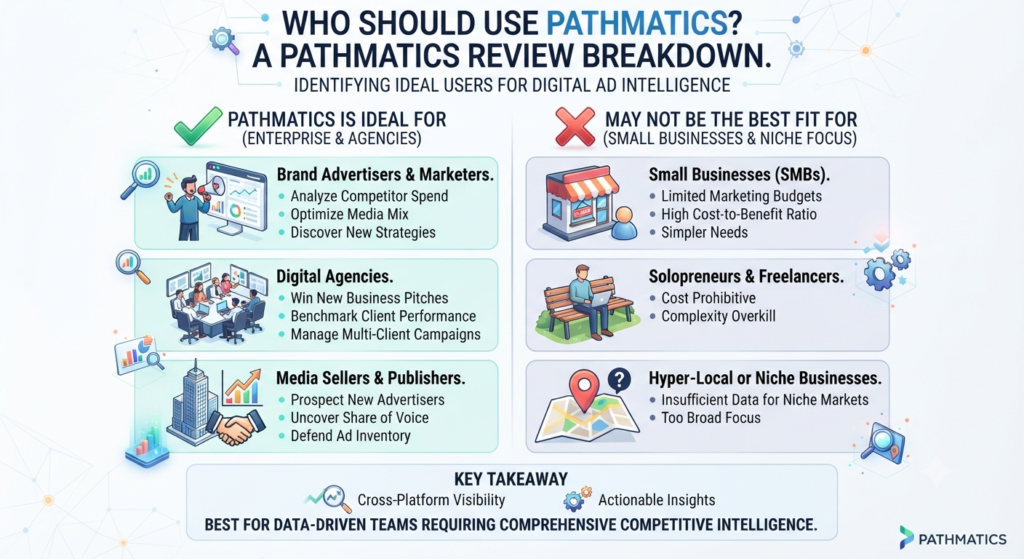
Pathmatics earns its price tag for a specific type of user. Understanding whether you fit that profile is more important than any individual feature comparison, and it is a question this Pathmatics review takes seriously rather than glossing over with vague use case descriptions. The Pathmatics review process for evaluating fit comes down to three criteria: channel scope, team size, and the frequency of competitive intelligence work.
Best Suited For
- Enterprise brands spending $1M+ annually on digital advertising who need to benchmark category spend and identify competitive white space
- Full-service media agencies that include competitive intelligence as a core deliverable for retainer clients and need defensible, data-backed media recommendations
- Strategic brand marketers preparing annual media plans who need historical trend data to justify channel allocation decisions to executive stakeholders
- Market research and strategy teams that need creative trend analysis to inform campaign briefs and agency briefing documents
Not the Right Fit For
- SMBs and startups with marketing budgets under $100K — the data depth does not provide proportionate ROI at that scale
- Teams focused primarily on SEO, organic social, or content marketing who have limited paid media budget to benchmark against
- E-commerce businesses whose primary competitive intelligence need is Google Shopping and PPC — SpyFu or SEMrush serves that use case better at a fraction of the cost
Skip The Learning Curve — Let Us Run It For You
These AI marketing tools are powerful, but strategy still takes time to master. Tasknestly runs done-for-you digital marketing campaigns using the same category of tools, professionally managed.
Get a Free Marketing Quote →Get It or Skip It?
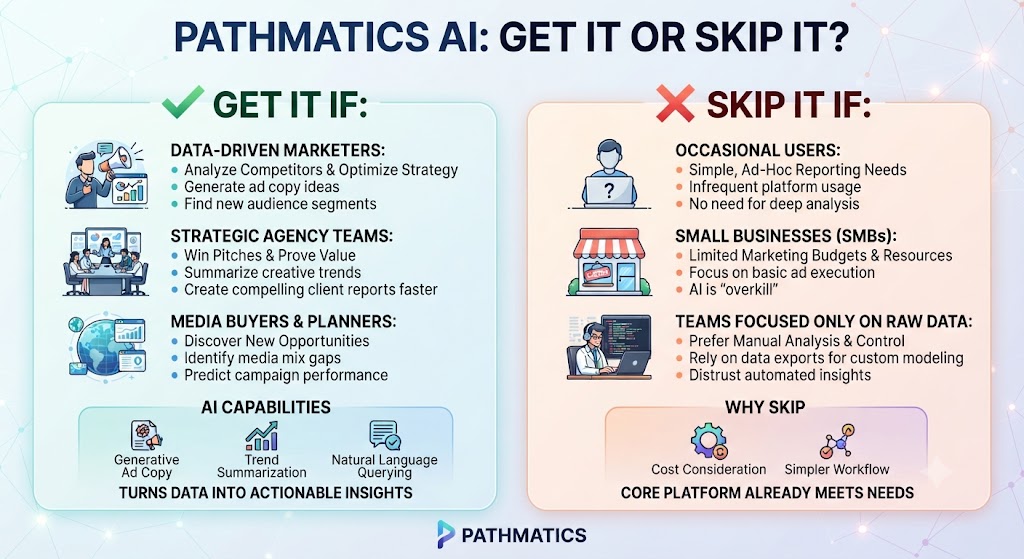
| GET IT IF… | SKIP IT IF… |
|---|---|
| You run multi-channel campaigns across display, social, and video and need to understand competitor creative strategy before each planning cycleYou are a media agency that needs to justify channel recommendations to clients with data that goes beyond gut instinct and anecdotal researchYour team benchmarks competitor ad spend quarterly and needs historical trend data to build reliable seasonal and annual media plans | Your entire competitive research need is Google Ads and PPC keywords — SpyFu does that job at under $40/monthYou need a free trial before committing — Pathmatics requires a sales process with no self-serve optionYour ad budget is under $250K/year — the intelligence Pathmatics provides is not proportionate to the cost at smaller scale |
Skip The Learning Curve — Let Us Run It For You
These AI marketing tools are powerful, but strategy still takes time to master. Tasknestly runs done-for-you digital marketing campaigns using the same category of tools, professionally managed.
Get a Free Marketing Quote →Pathmatics Review: Real-World Performance Notes
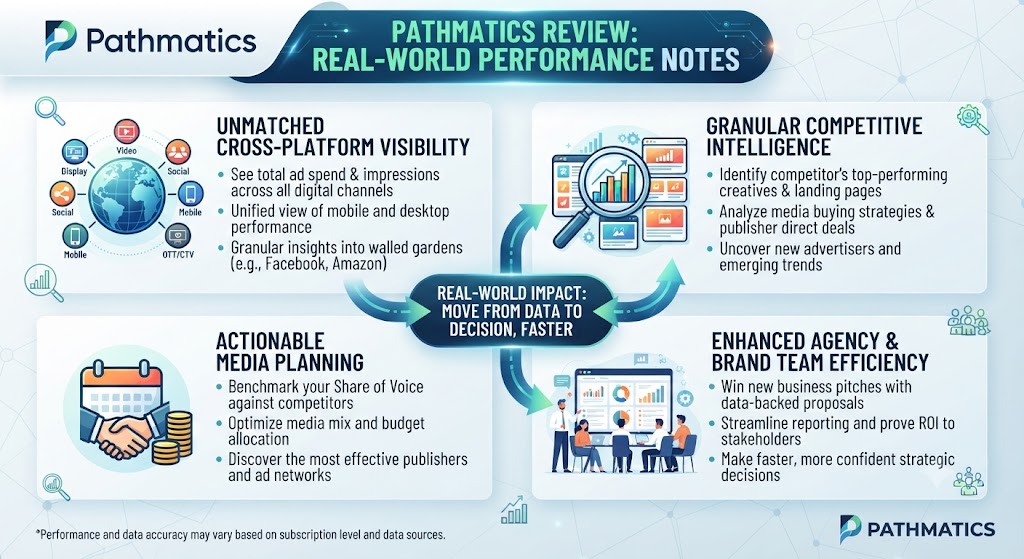
Several performance characteristics distinguish Pathmatics from competitors in day-to-day usage that do not show up in feature comparison tables. These are the details that separate a surface-level Pathmatics review from one based on actual platform usage.
Data Freshness and Accuracy
Pathmatics updates most channels within 24–48 hours, which is fast enough for strategic planning but not for real-time campaign monitoring. If you are trying to catch a competitor’s flash sale campaign and pivot within hours, this Pathmatics review notes that the platform is not designed for that use case. For weekly and monthly analysis cycles — which is where most brand-side teams operate — the refresh rate is entirely adequate.
The spend estimates come with appropriate caveats. Pathmatics is clear that these are modelled figures based on impression volume, known CPM benchmarks, and publisher rate card data. In our testing, the directional accuracy was strong — the relative spend rankings between competitors held up consistently — but exact dollar figures should be treated as ranges rather than precise numbers.
Reporting and Export Capabilities
Pathmatics provides clean visual dashboards with export functionality for slide decks and executive reports. Creative assets can be downloaded directly, which is a significant workflow improvement over manually screenshotting competitor ads — a practical advantage that stands out in any hands-on Pathmatics review. The scheduled reporting feature allows teams to automate weekly competitive snapshots and deliver them to stakeholders who are not logging into the platform directly.
Customer Success and Onboarding
Enterprise accounts include dedicated customer success managers, and the onboarding experience in this Pathmatics review testing was genuinely good. Pathmatics runs structured training sessions and provides playbooks for common use cases like category benchmarking, agency pitch preparation, and creative trend reporting. This matters more than it sounds — ad intelligence platforms are only valuable if the team actually uses them consistently, and good onboarding dramatically increases adoption rates.
Skip The Learning Curve — Let Us Run It For You
These AI marketing tools are powerful, but strategy still takes time to master. Tasknestly runs done-for-you digital marketing campaigns using the same category of tools, professionally managed.
Get a Free Marketing Quote →Pathmatics Review: Frequently Asked Questions
What is Pathmatics used for?
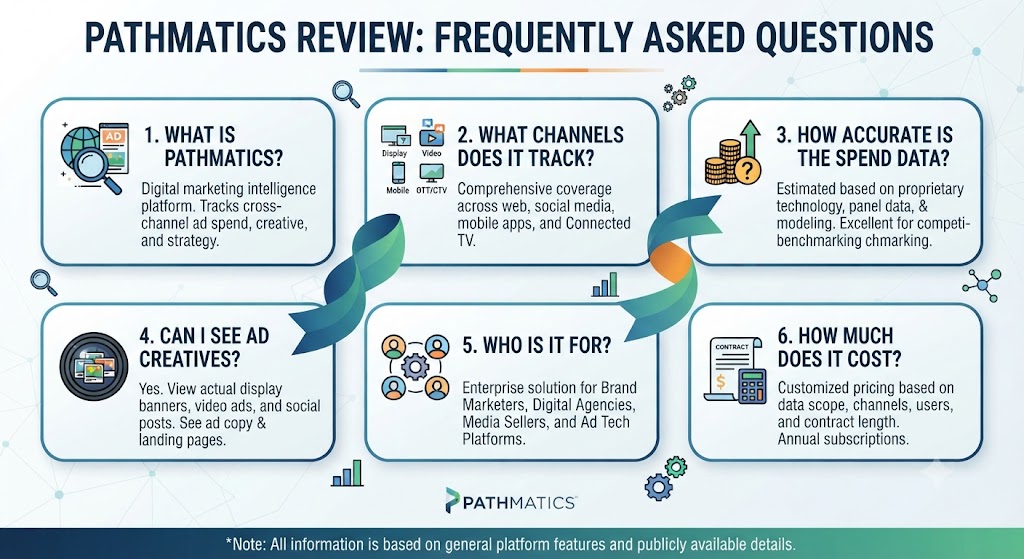
Pathmatics is a competitive ad intelligence platform used to track where competitors are advertising, what creatives they are running, how much they are estimated to be spending, and which audiences they appear to be targeting. As this Pathmatics review explains, it covers display, social, video, mobile, and CTV channels with creative-level data that is rare in the market. The Pathmatics review process involves requesting a demo through the sales team since no public trial is available.
How much does Pathmatics cost?
Pathmatics does not publish public pricing. Based on industry reporting and user accounts referenced in this Pathmatics review, starting plans for mid-market teams range from approximately $1,000 to $2,000 per month, with enterprise plans typically running significantly higher. All pricing is negotiated through a sales process.
Does Pathmatics offer a free trial?
No. Pathmatics does not offer a self-serve free trial. Access requires a demo scheduled through the sales team. During the demo, you can request that Pathmatics show live data for your specific competitors and category, which provides a meaningful evaluation opportunity before committing. This Pathmatics review recommends going into that demo with a prepared list of your top 3 competitors and requesting a Pathmatics review of their creative activity from the past 6 months.
How does this Pathmatics review compare it to Adbeat?
Adbeat is the closest competitor. Both provide display ad creative intelligence at a similar depth. Pathmatics is stronger for social and CTV coverage and benefits from the Sensor Tower mobile intelligence integration. Adbeat is generally more affordable and a solid alternative for teams primarily focused on display advertising who find the full Pathmatics review pricing excessive for their scale.
Is Pathmatics suitable for small businesses?
Not typically. As this Pathmatics review makes clear, Pathmatics is priced and designed for enterprise brands and agencies managing large digital advertising budgets. Small businesses would find tools like SpyFu, SimilarWeb, or even the Facebook Ad Library and Google Ads Transparency Center sufficient for their competitive research needs at a fraction of the Pathmatics review price point.
What channels does Pathmatics cover?
Pathmatics covers display advertising, Facebook and Instagram, Twitter/X, YouTube, TikTok, programmatic video, mobile web and app advertising, connected TV and OTT streaming, and email advertising. Coverage depth is strongest for display and social, with CTV and email intelligence still developing — a point worth noting in any balanced Pathmatics review. For full channel details, this Pathmatics review recommends requesting a demo focused on the specific channels most relevant to your business.
Is Pathmatics accurate in its ad spend estimates?
Pathmatics spend estimates are modelled figures based on impression data, publisher CPM benchmarks, and auction data — not exact reported figures. The directional accuracy is strong and reliable for competitive benchmarking. Treat the numbers as informed estimates rather than precise financial reporting, which is the position this Pathmatics review takes throughout. Teams using this Pathmatics review as a buying guide should verify spend figures directionally rather than treating them as audited data.
Skip The Learning Curve — Let Us Run It For You
These AI marketing tools are powerful, but strategy still takes time to master. Tasknestly runs done-for-you digital marketing campaigns using the same category of tools, professionally managed.
Get a Free Marketing Quote →Final Verdict: Is Pathmatics Worth It?
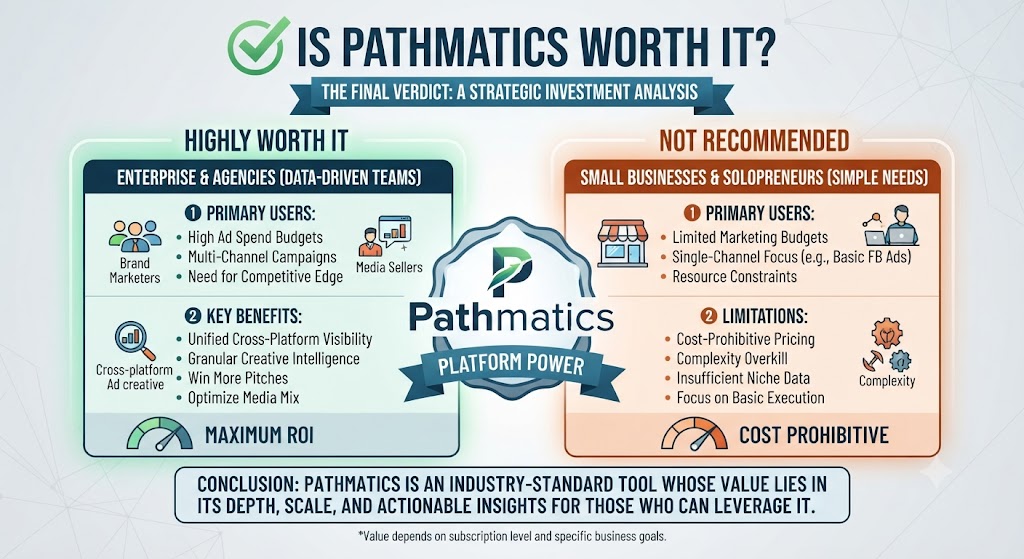
After a thorough Pathmatics review, the answer comes down to one question: is your team’s competitive intelligence need deep enough to justify an enterprise budget? If you are running multi-channel campaigns across display, social, and video, managing a media plan in a competitive category, or advising brand clients on strategic media allocation, Pathmatics delivers intelligence that is genuinely difficult to replicate through any other means. The creative-level data, the cross-channel spend visibility, and the Sensor Tower mobile integration make it the most complete ad intelligence platform currently available at the enterprise tier — and the strongest finding of this Pathmatics review overall.
The limitations are real. Enterprise-only pricing, no free trial, limited PPC coverage, and variable data freshness across channels mean it is not the right fit for every team. Smaller marketing operations should look at Adbeat, SimilarWeb, or SpyFu depending on their primary channel focus. But for brands and agencies operating at scale, this Pathmatics review awards a score of 8.2 out of 10. It will change how your team approaches competitive strategy — if you give it the chance. You can explore more tools in the AI Marketing category on TechBotHQ for a broader view of what the market offers.
The bottom line from this Pathmatics review: if competitive intelligence is a core function of your marketing operation rather than an occasional check-in, Pathmatics is the benchmark. Request a demo, push the sales team to show you data for your actual category, and evaluate it against your current workflow. The data quality will make the decision obvious. For teams that are not ready to commit to an enterprise platform but still need professional digital marketing execution, Tasknestly’s digital marketing services offer a done-for-you alternative that brings strategy and execution under one roof.
Stop flying blind on competitor ad strategy.
Pathmatics gives your team creative-level visibility across every major digital channel — so you plan smarter, spend sharper, and brief better.
Skip The Learning Curve — Let Us Run It For You
These AI marketing tools are powerful, but strategy still takes time to master. Tasknestly runs done-for-you digital marketing campaigns using the same category of tools, professionally managed.
Get a Free Marketing Quote →