D-ID Review 2026: Is This AI Avatar Video Generator Worth Using?

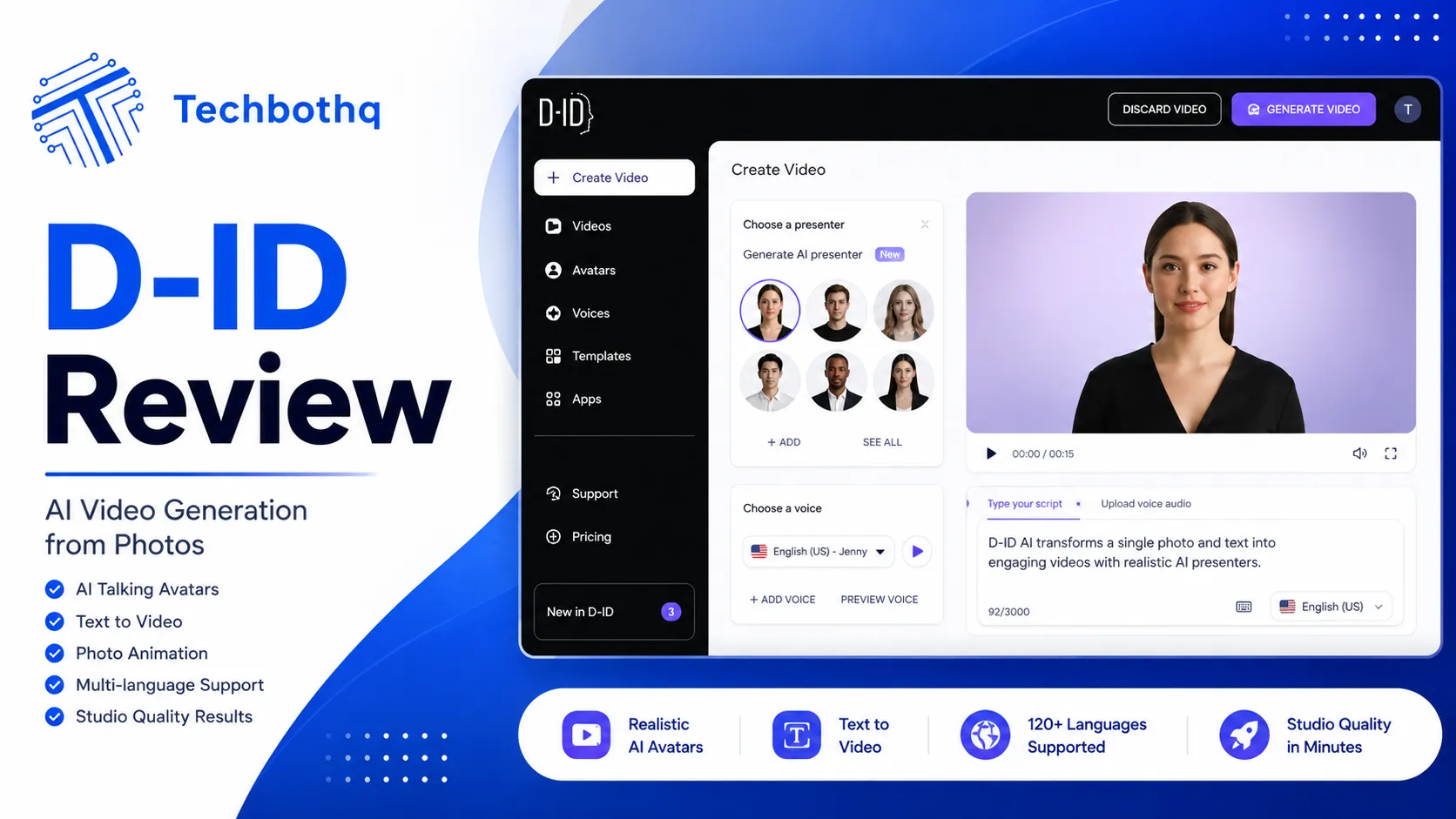
As this D-ID review shows, creating professional-looking video content has always required either significant budget, on-camera confidence, or both. D-ID promises to change that by letting anyone generate a talking-head video with a realistic AI avatar from nothing more than a script and a photograph. No camera. No studio. No presenter required.
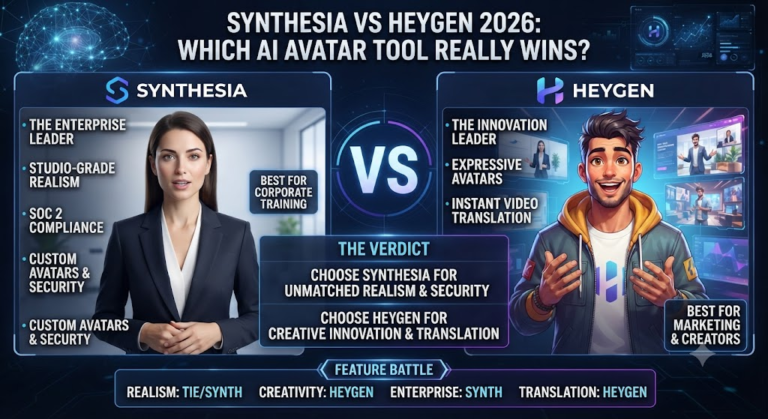
It sounds compelling — and for a growing number of use cases, it genuinely is. But D-ID is not the only tool making this promise in 2026. HeyGen has emerged as a powerful competitor, and the gap between the two platforms has narrowed considerably — see our full HeyGen vs D-ID comparison for a side-by-side breakdown. This D-ID review goes deep on what the tool actually delivers: the quality of avatar video generation, the realism of lip sync and facial expressions, what the pricing structure looks like at scale, and how it holds up against HeyGen and other alternatives.
In this D-ID review, whether you are a course creator, a corporate trainer, a marketer producing explainer videos, or a solo creator who wants to appear on camera without actually appearing on camera, this review covers everything you need to make an informed decision.
Table of Contents
What Is D-ID?
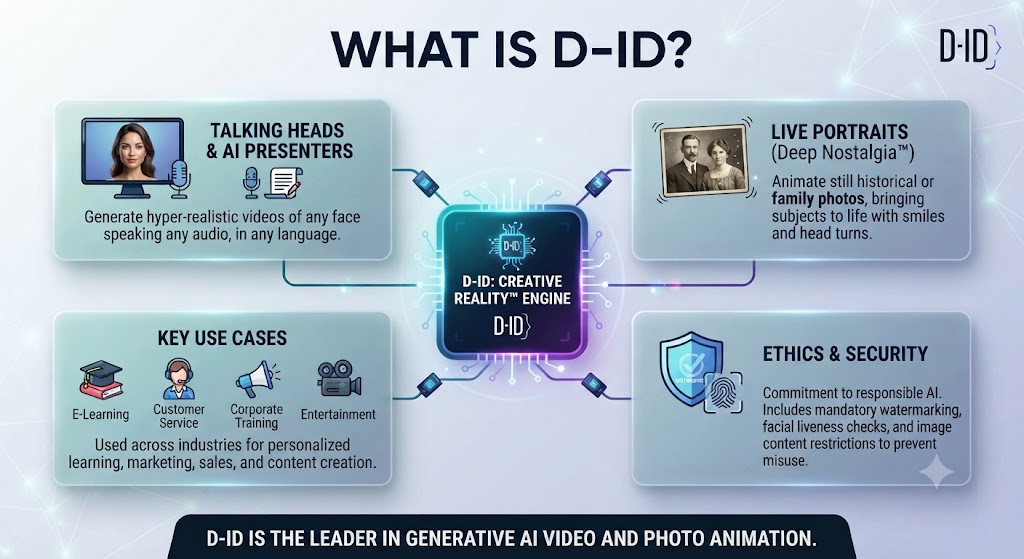
Looking at D-ID review details, d-ID is an Israeli AI technology company founded in 2017, originally focused on photo anonymization for privacy protection — the technology that blurs or alters faces in images to protect subject identity. The company pivoted toward generative AI video in 2021 with the launch of its Creative Reality Studio, which uses diffusion models and neural rendering to animate still photographs into realistic talking-head videos.
When it comes to this tool, this D-ID review found that the Creative Reality Studio — commonly referred to simply as D-ID — allows users to upload a photo of a person (real or AI-generated), input a text script or upload an audio file, select from a library of AI voices or clone their own voice, and generate a video of that person speaking the script with synchronized lip movement, facial expressions, and natural head motion.
For anyone reading this D-ID review, d-ID serves a broad range of use cases: corporate training and e-learning, marketing explainer videos, social media content, customer service video messages, multilingual content localization, and digital human experiences for websites and applications. The platform offers both a web application for individual use and an API for developers building avatar video into their own products.
This D-ID review found that d-ID has processed over 100 million video creations since launch and has partnerships with major content creation platforms. Recent updates have included improved lip sync accuracy, more natural facial expressions, enhanced voice cloning, and an interactive AI avatar feature that allows real-time conversation with AI presenters.
These Tools Help You Create. We Help You Go Viral.
Making the video is only half the battle — getting it seen is the other. Tasknestly’s viral video service handles strategy, editing, and distribution.
See Viral Video Services →D-ID Core Features
1. AI Presenter — Talking Head Video from Photo
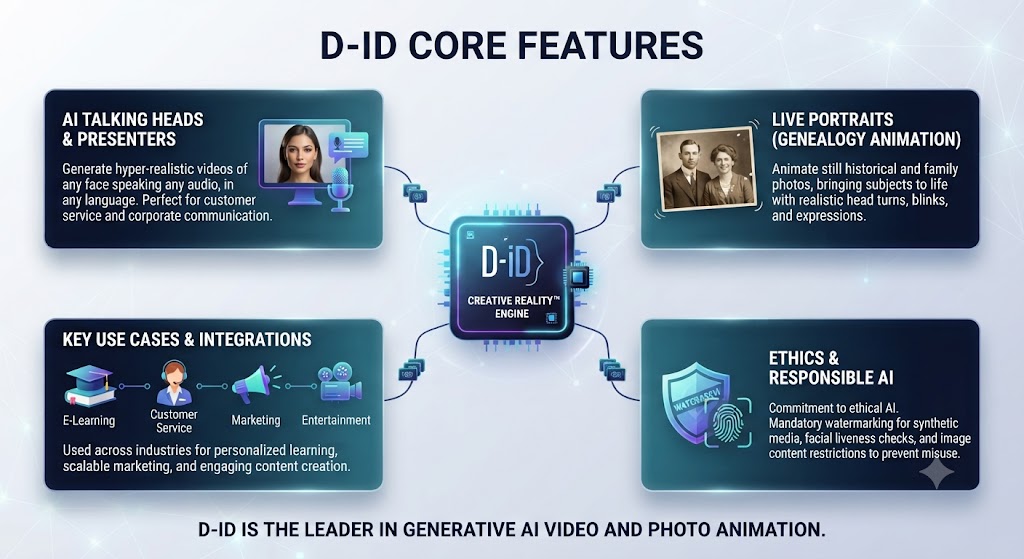
Across this D-ID review, the core feature. Upload a photo of a person — a stock photo, an AI-generated portrait, or a real headshot — write your script, select a voice, and D-ID generates a video of that person speaking your content. The output is a realistic talking-head video with synchronized lip movement and natural facial animation.
On this point, this D-ID review notes that photo quality significantly impacts output quality. Clean, well-lit, front-facing photos with a neutral expression produce the best results. Profile shots, photos with unusual angles, or poor lighting produce noticeably worse outputs. When working with a good source photo and a well-paced script, D-ID’s presenter videos are convincing and professional-looking — comfortably above the uncanny valley for most business use cases.
Within this D-ID review, the platform supports photos of real people and AI-generated avatar images. D-ID also provides a library of pre-built AI avatars that users can select without uploading their own photos — useful for getting started quickly or for use cases where a specific branded avatar is not required.
2. Voice Selection and Text-to-Speech
Considering the data, this D-ID review shows d-ID integrates with multiple text-to-speech providers including ElevenLabs, Microsoft Azure, and Amazon Polly to offer an extensive library of AI voices. The library covers hundreds of voices across more than 100 languages and accents, ranging from natural conversational tones to formal presentation styles.
In the context of pricing, this D-ID review notes voice quality varies by provider and voice selection. ElevenLabs voices — available on higher plans — are noticeably more natural and expressive than standard TTS voices. For professional video content, selecting a high-quality ElevenLabs voice makes a meaningful difference in how polished the final output sounds.
Per this D-ID review, users can also upload their own audio files — recorded narration, podcast excerpts, or custom voice-over — rather than using text-to-speech. This gives full control over vocal performance and is the recommended approach for high-stakes content where voice naturalness is critical.
3. Voice Cloning
As this D-ID review shows, d-ID offers voice cloning on Professional and higher plans. You provide a sample of your voice — typically 30 seconds to a few minutes of clean recorded audio — and D-ID creates a synthetic version of your voice that can narrate any text. The cloned voice can then drive avatar videos, creating a digital version of yourself speaking content without recording new audio for each piece.
In this D-ID review, voice cloning quality is good but not perfect. The cloned voice captures the general tone, cadence, and character of the original, but subtle nuances and emotional range can be flattened in the synthesis. For most business and educational content, the quality is sufficient. For emotionally expressive content or high-profile brand representation, the quality may require supplementing with actual recorded audio for key segments.
4. Agents — Interactive AI Avatars
Looking at D-ID review details, d-ID’s Agents feature allows you to create interactive AI avatars that users can have real-time conversations with. You connect a language model backend, configure the avatar’s knowledge base and persona, and deploy an avatar that can listen, respond, and speak in real time.
When it comes to this tool, this D-ID review found that applications include website customer service avatars, interactive product demo guides, training simulations, and virtual brand representatives. The quality of interaction depends heavily on the underlying language model and the quality of the knowledge base configuration, but the video presentation layer — the talking avatar — adds a compelling human dimension that text chatbots cannot replicate.
For anyone reading this D-ID review, for businesses exploring AI customer experience without the cost of human agents, D-ID Agents represents a genuinely novel capability. It is not a turnkey solution — setup requires technical configuration — but for development teams building immersive AI experiences, the SDK and API access make it a realistic production option.
5. Slides to Video
This D-ID review found that d-ID’s Slides to Video feature converts presentation slides into narrated video content. You upload a PowerPoint or similar slide file, input a script (or generate one with AI), select an avatar and voice, and D-ID produces a narrated video with the avatar presenting each slide. The output resembles a recording of a live presentation but is generated entirely without a camera or presenter.
Across this D-ID review, this feature is particularly valuable for corporate training teams, e-learning content producers, and sales enablement teams who need to convert existing slide decks into video format at scale. Converting a 20-slide presentation into a professional-looking video takes minutes rather than the hours a traditional screen recording and voiceover workflow would require.
6. Multilingual Video Localization
On this point, this D-ID review notes that d-ID can generate the same avatar video in multiple languages from a single source script. Using the platform’s multilingual TTS library, a training video or marketing explainer can be produced in English, Spanish, French, German, Mandarin, Arabic, and dozens of other languages without re-recording or re-filming anything. The avatar’s lip sync adapts to each language’s phonetic patterns, producing localized content that is far more engaging than subtitle-only alternatives.
Within this D-ID review, for businesses with global audiences, the cost and time savings of AI-powered video localization compared to traditional dubbing or re-filming are significant. What would typically require language-specific voiceover artists and post-production for each language can be compressed into a single workflow that scales across as many languages as needed.
These Tools Help You Create. We Help You Go Viral.
Making the video is only half the battle — getting it seen is the other. Tasknestly’s viral video service handles strategy, editing, and distribution.
See Viral Video Services →D-ID Pricing
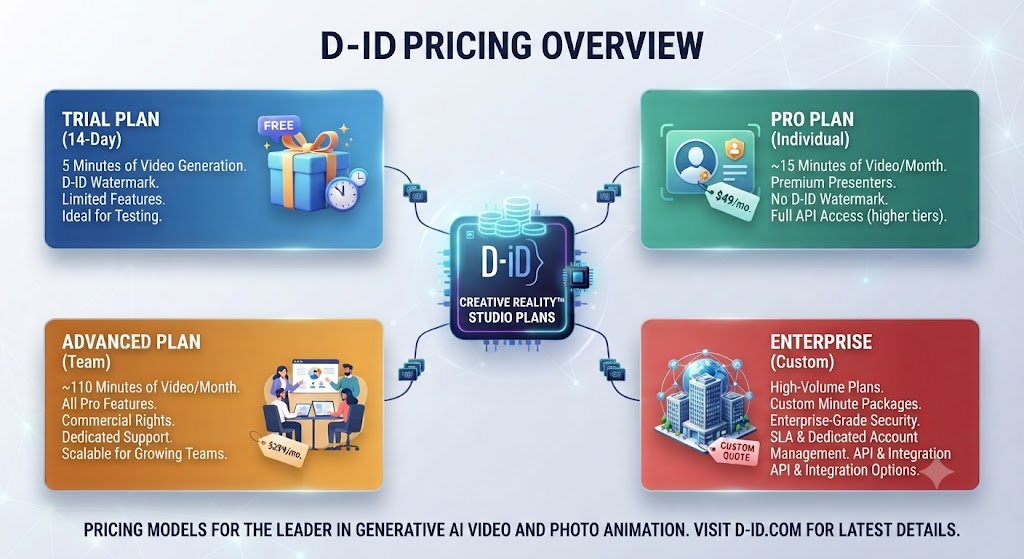
| Plan | Price/Month | Credits | Video Length | Best For |
|---|---|---|---|---|
| Free/Trial | $0 | 20 credits | Up to 5 min total | Evaluation |
| Lite | $5.99 | 10 credits/mo | Limited | Very light use |
| Pro | $24.99 | 100 credits/mo | Up to 5 min/video | Individuals |
| Advanced | $99.99 | 400 credits/mo | Up to 15 min/video | Power users |
| Enterprise | Custom | Custom | Custom | Large teams |
Considering the data, this D-ID review shows d-ID’s credit system charges based on video duration — longer videos consume more credits per generation. On the Pro plan, 100 credits gives you roughly 10 minutes of generated video per month at standard quality settings, which is sufficient for regular content production at moderate volume.
In the context of pricing, this D-ID review notes compared to HeyGen, which starts its paid plans at $29 per month for Creator and $89 per month for Business, D-ID’s Pro plan at $24.99 is slightly more affordable at entry level. However, HeyGen’s credit allocations at comparable price points tend to be more generous, making the value comparison more nuanced than the headline prices suggest.
These Tools Help You Create. We Help You Go Viral.
Making the video is only half the battle — getting it seen is the other. Tasknestly’s viral video service handles strategy, editing, and distribution.
See Viral Video Services →D-ID vs HeyGen: Honest Comparison
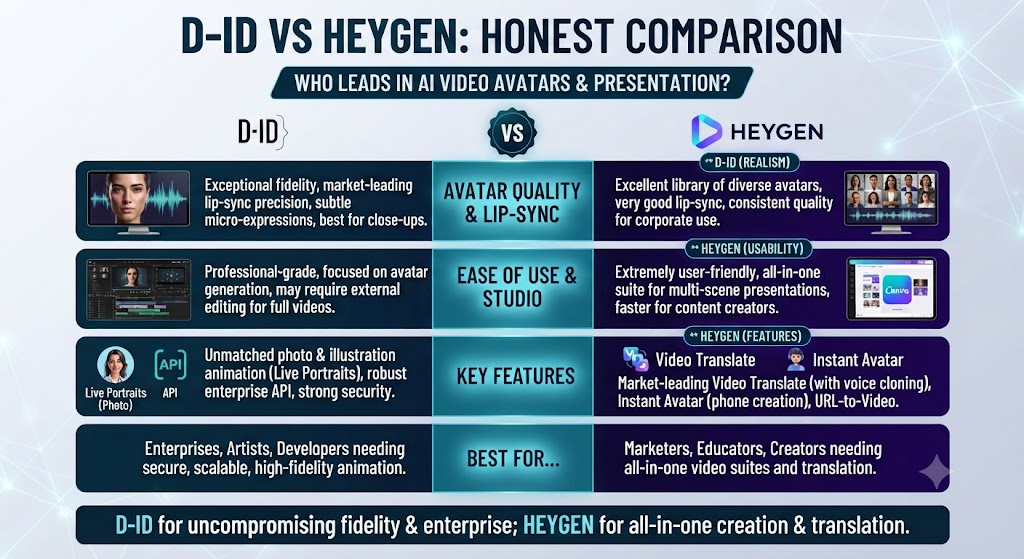
| Criteria | D-ID | HeyGen |
|---|---|---|
| Talking Head Quality | Very good | Excellent — industry leading |
| Lip Sync Accuracy | Good | Outstanding |
| Facial Expression Range | Good | More expressive |
| Voice Library | Extensive — 100+ languages | Extensive — 100+ languages |
| Voice Cloning | Yes — Pro+ | Yes — all paid plans |
| Avatar Library | Good | Excellent — wider selection |
| Interactive Avatars | Yes — Agents feature | Yes — Interactive Avatars |
| Video Templates | Moderate | Extensive |
| Slides to Video | Yes | Yes |
| Starting Paid Price | $5.99/month | $29/month |
| API Access | Yes | Yes |
| Best For | Budget-conscious creators, API users | Premium quality, marketing teams |
Per this D-ID review, heyGen has a quality edge over D-ID in several key areas — particularly lip sync accuracy, facial expression range, and the overall realism of the avatar video output. If you prioritize the highest available quality for professional video content, HeyGen is currently the stronger platform.
As this D-ID review shows, d-ID’s advantages are a more accessible entry price point, a strong API for developer integrations, and the Agents interactive avatar feature which is well-suited to customer experience and interactive applications. For developers building avatar video into their own products, D-ID’s API documentation and pricing structure are often more developer-friendly than HeyGen’s.
These Tools Help You Create. We Help You Go Viral.
Making the video is only half the battle — getting it seen is the other. Tasknestly’s viral video service handles strategy, editing, and distribution.
See Viral Video Services →Video Quality: Detailed Assessment
What D-ID Does Well
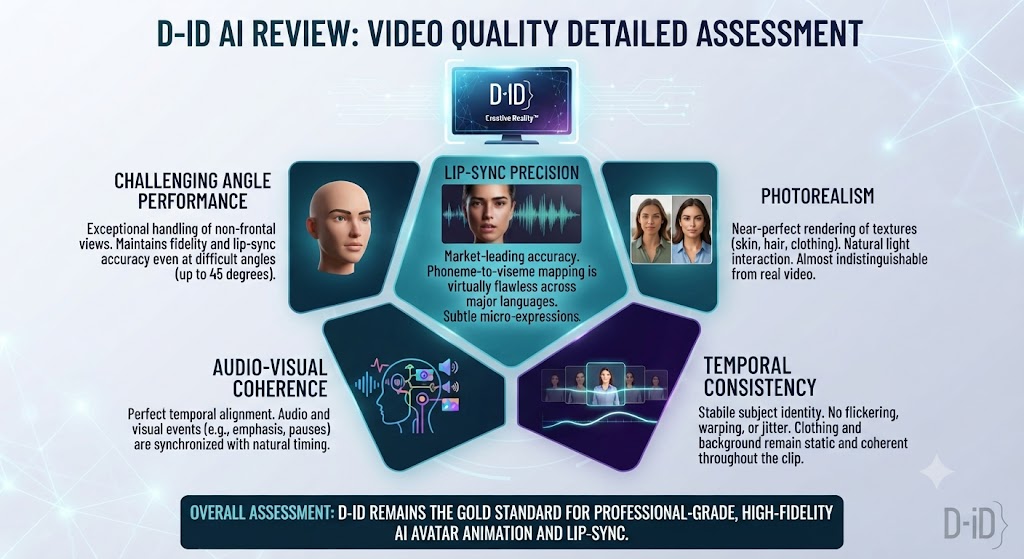
- In this D-ID review, photo-to-video animation quality is convincing for business and educational content with good source photos
- Lip sync is accurate for standard English narration and most major languages That’s a key point in this D-ID review.
- Looking at D-ID review details, multilingual support is genuinely broad — over 100 languages with adapted phonetic lip sync When it comes to this tool, this D-ID review found that – Slides to Video conversion is fast and produces professional-looking educational content
- API integration is well-documented and reliable for developer use cases This holds up throughout the D-ID review.
- Interactive Agents feature enables novel customer experience applications Keep that in mind from this D-ID review.
Where D-ID Has Limitations
- For anyone reading this D-ID review, facial expression range is more limited than HeyGen — avatars can look slightly stiff on longer videos This D-ID review found that – Photo quality is a significant dependency — poor input photos produce noticeably worse outputs
- Across this D-ID review, generated video can show subtle artifacts on complex movements and camera-close facial sequences On this point, this D-ID review notes that – Voice cloning quality, while functional, does not always capture full vocal character
- Within this D-ID review, credit allocations at mid-tier pricing are limited for high-volume content production needs
These Tools Help You Create. We Help You Go Viral.
Making the video is only half the battle — getting it seen is the other. Tasknestly’s viral video service handles strategy, editing, and distribution.
See Viral Video Services →Best Use Cases for D-ID
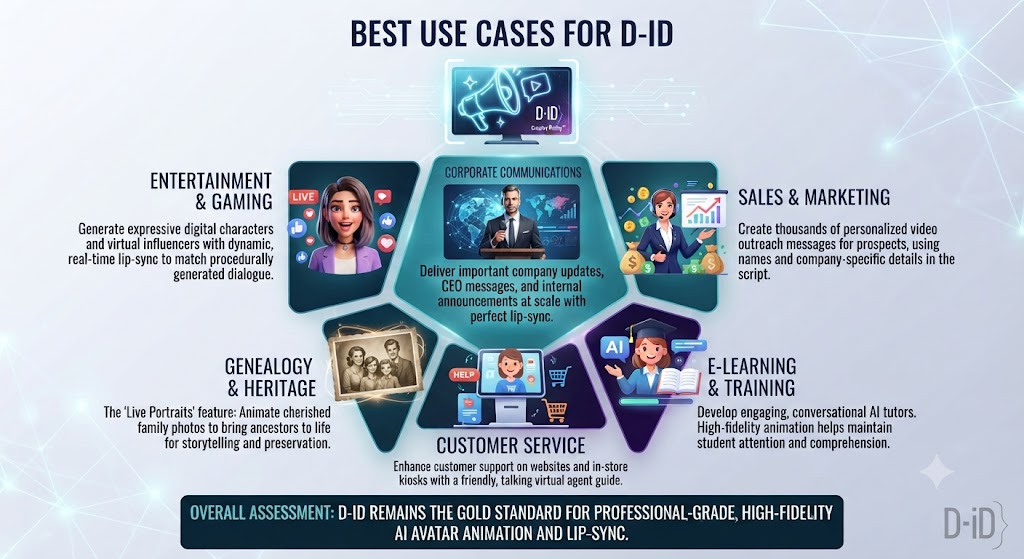
Considering the data, this D-ID review shows – Corporate training and e-learning video production without on-camera presenters
- Marketing explainer videos with AI avatar presenters That’s a key point in this D-ID review.
- Converting presentation slide decks into narrated video content at scale This holds up throughout the D-ID review.
- Multilingual video localization for global content distribution Keep that in mind from this D-ID review.
- Internal company communications and video announcements
- Social media video content for brands that want a consistent AI presenter
- Interactive website avatars and AI-powered customer service experiences
- Product demo videos with narrated avatar presenters In the context of pricing, this D-ID review notes – Developer integrations — building avatar video generation into SaaS products and apps
These Tools Help You Create. We Help You Go Viral.
Making the video is only half the battle — getting it seen is the other. Tasknestly’s viral video service handles strategy, editing, and distribution.
See Viral Video Services →Who Is D-ID Best Suited For?
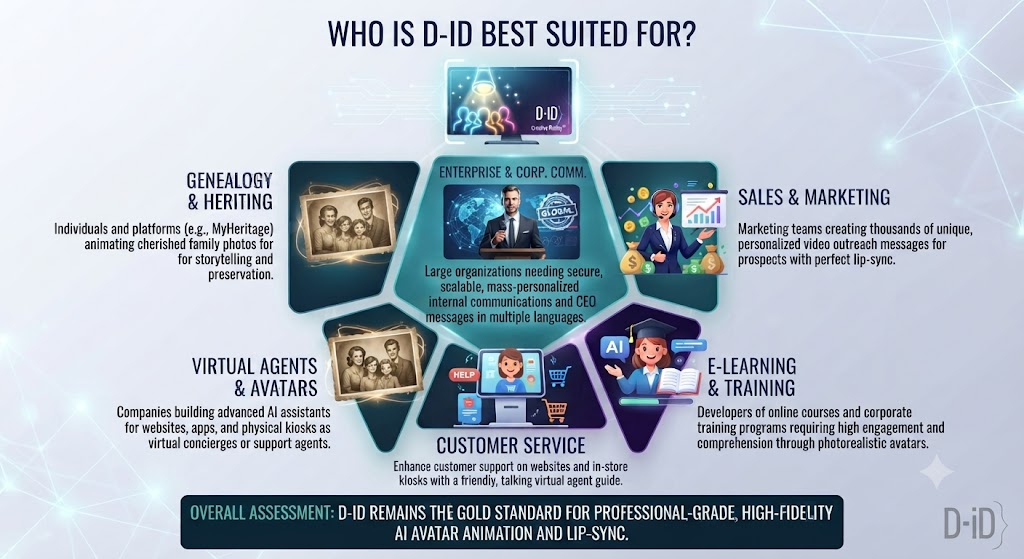
D-ID is the right tool for:
- Per this D-ID review, course creators and e-learning professionals who produce training content at scale
- As this D-ID review shows, marketing teams that need regular explainer and product video content without a film crew
- In this D-ID review, businesses with global audiences who need multilingual video content efficiently
- Looking at D-ID review details, developers building avatar video features into their own applications via the D-ID API When it comes to this tool, this D-ID review found that – Corporate communications teams converting slide-based content into video format
- For anyone reading this D-ID review, solo creators who want to produce on-camera-style content without being on camera
D-ID is less suitable for:
This D-ID review found that – Creators who need the absolute highest quality talking-head video — HeyGen has a quality edge
- Across this D-ID review, high-volume video producers who will quickly exhaust credit allocations at mid-tier pricing On this point, this D-ID review notes that – Use cases that require complex scene settings, background variety, or cinematic production value
These Tools Help You Create. We Help You Go Viral.
Making the video is only half the battle — getting it seen is the other. Tasknestly’s viral video service handles strategy, editing, and distribution.
See Viral Video Services →Getting Started with D-ID
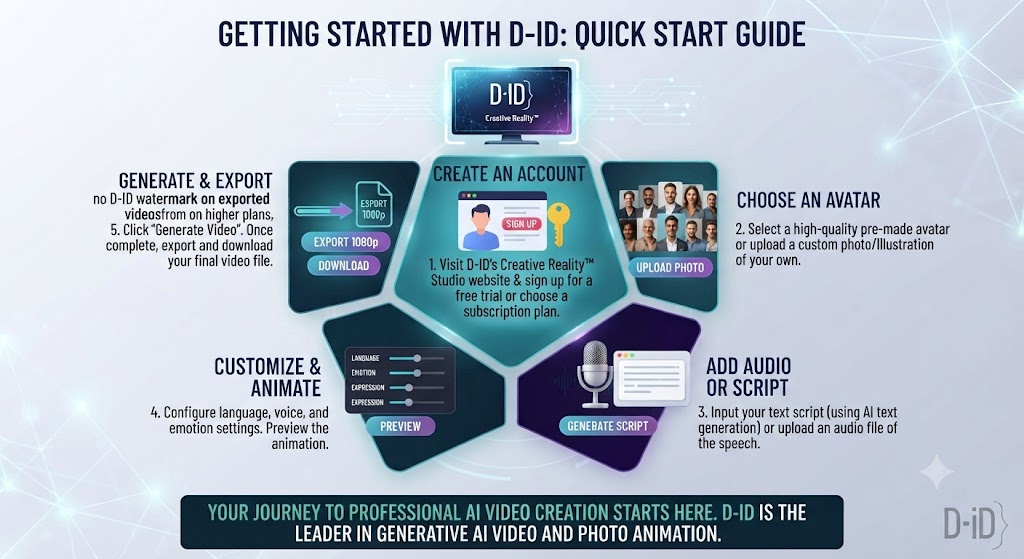
Within this D-ID review, 1. Visit studio.d-id.com and create a free account — no credit card required for trial access Considering the data, this D-ID review shows 2. Select ‘Create Video’ and choose between using a pre-built avatar or uploading your own photo In the context of pricing, this D-ID review notes 3. Write or paste your script in the text field, or upload a pre-recorded audio file Per this D-ID review, 4. Select a voice from the TTS library — ElevenLabs voices are recommended for best quality on paid plans 5. Preview the generation and adjust script pacing or voice selection if needed 6. Download the final video in MP4 format for use across your platforms
As this D-ID review shows, the free trial provides 20 credits — enough to generate several short test videos and properly evaluate the quality and workflow before deciding on a paid plan. Most users can complete a meaningful quality evaluation within a single session.
These Tools Help You Create. We Help You Go Viral.
Making the video is only half the battle — getting it seen is the other. Tasknestly’s viral video service handles strategy, editing, and distribution.
See Viral Video Services →D-ID for Different Business and Creator Profiles
E-Learning and Course Creators
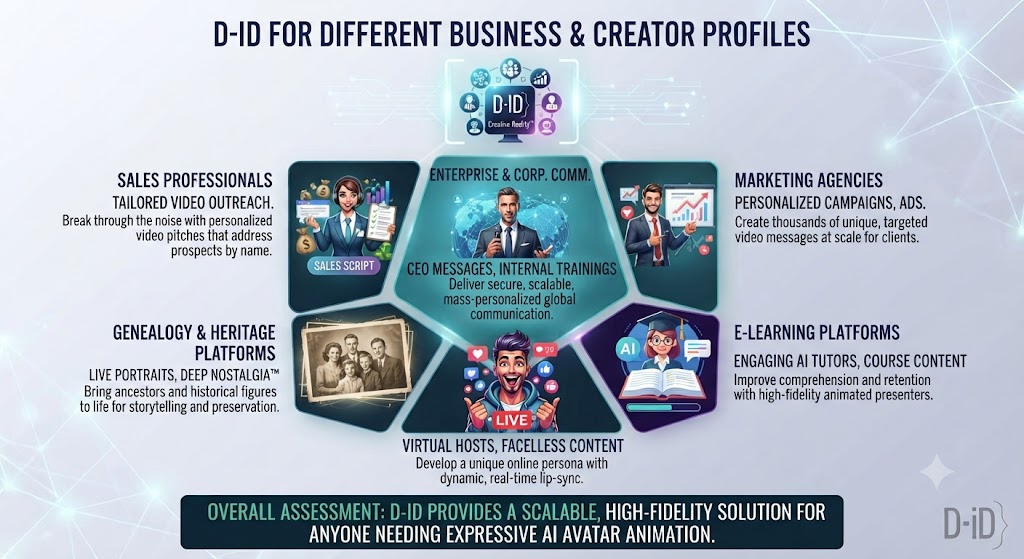
In this D-ID review, the e-learning industry has been one of D-ID’s fastest-growing user segments, and it is easy to understand why. Course creators who want to present content on camera face real challenges: on-camera anxiety, the cost of recording setups, the time required to re-record when scripts change, and the difficulty of maintaining visual consistency across a long course recorded over many months. D-ID addresses all of these at once. A consistent AI avatar presents every lesson with professional quality, scripts can be updated and regenerated without a single frame of new filming, and the production workflow reduces from a day of recording and editing to an hour of scripting and generation.
Looking at D-ID review details, for multilingual course distribution, D-ID is particularly powerful. A course recorded once in English can be localized into Spanish, French, German, Mandarin, and Arabic in a fraction of the time and cost of traditional dubbing, with the avatar’s lip sync adapting to each language’s phonetic patterns.
Marketing Teams and Agencies
When it comes to this tool, this D-ID review found that marketing teams use D-ID to produce explainer videos, product announcement content, and personalized video messages at scale. The ability to generate a presenter video from a script in minutes — rather than booking a studio, hiring a presenter, and managing a production crew — compresses video production timelines dramatically. For agencies managing video content for multiple clients, D-ID’s API enables automated video production workflows that would be impossible at comparable human resource costs.
Enterprise Internal Communications
For anyone reading this D-ID review, internal video communication — HR announcements, leadership messages, training updates, policy communications — is a use case where D-ID often delivers strong ROI. Organizations that need to produce regular video updates from consistent presenters without the logistical overhead of filming real people find that D-ID’s AI presenters provide a practical, professional-looking alternative that employees respond to better than text-only communications.
These Tools Help You Create. We Help You Go Viral.
Making the video is only half the battle — getting it seen is the other. Tasknestly’s viral video service handles strategy, editing, and distribution.
See Viral Video Services →Tips for Getting the Best Results from D-ID
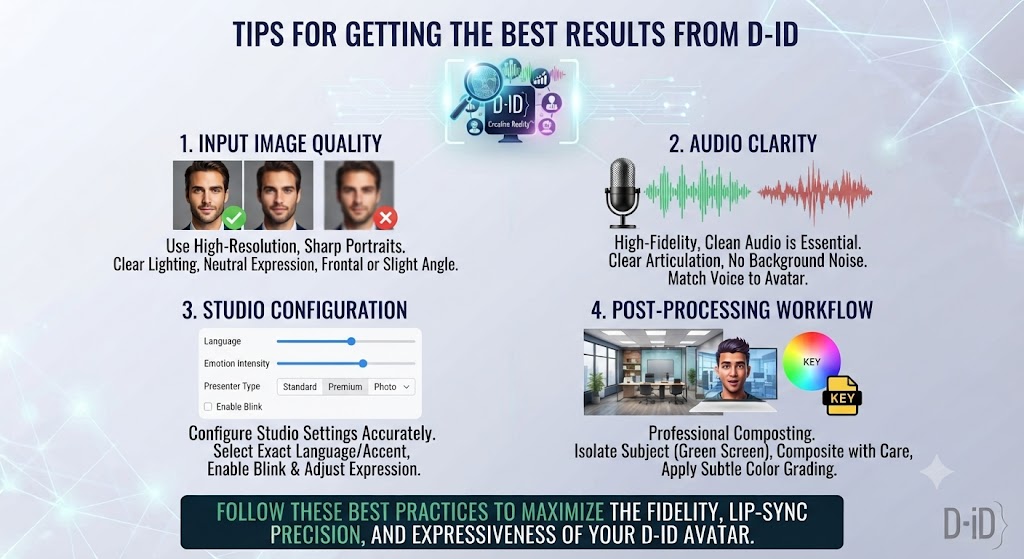
This D-ID review found that – Use a clean, well-lit, front-facing photo with a neutral or slight smile expression for best avatar quality
- Write scripts with natural pauses using punctuation — commas and periods create natural breathing rhythm in the generated speech
- For professional content, choose ElevenLabs voices over standard TTS — the quality difference is noticeable and worth the plan upgrade
- Keep individual video segments under two minutes for best consistency — longer segments can show subtle quality variations
- For multilingual content, have a native speaker review translated scripts before generation to catch any translation issues before video production
- Use uploaded audio files rather than TTS for any emotionally expressive content where vocal performance matters
These Tools Help You Create. We Help You Go Viral.
Making the video is only half the battle — getting it seen is the other. Tasknestly’s viral video service handles strategy, editing, and distribution.
See Viral Video Services →Verdict Box
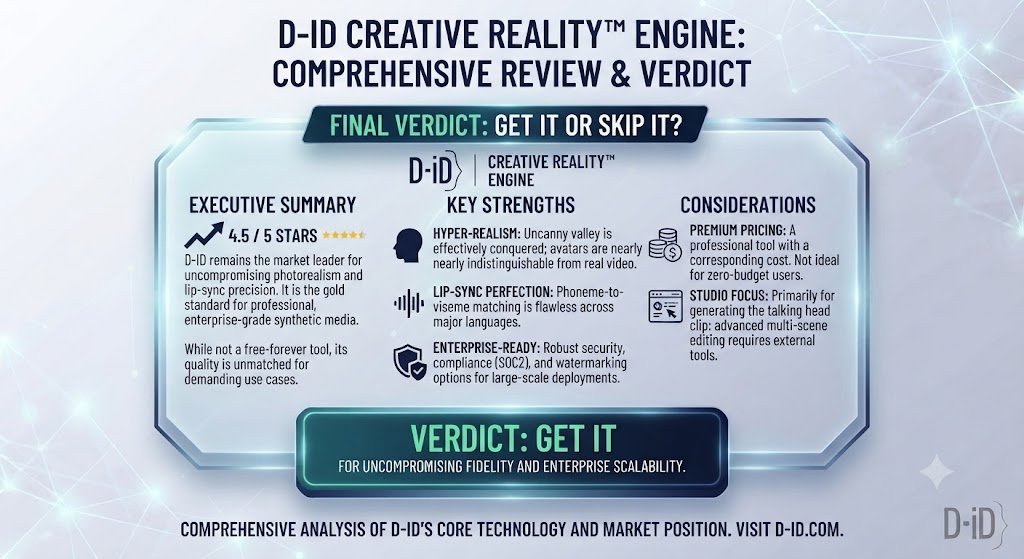
| Category | Score |
|---|---|
| Avatar Video Quality | 8/10 |
| Lip Sync Accuracy | 7.5/10 |
| Voice Library | 8.5/10 |
| Voice Cloning | 7.5/10 |
| Multilingual Support | 9/10 |
| Interactive Agents | 8/10 |
| Pricing & Value | 7.5/10 |
| API & Developer Experience | 8.5/10 |
| Overall Rating | 8/10 |
GET IT or SKIP IT?
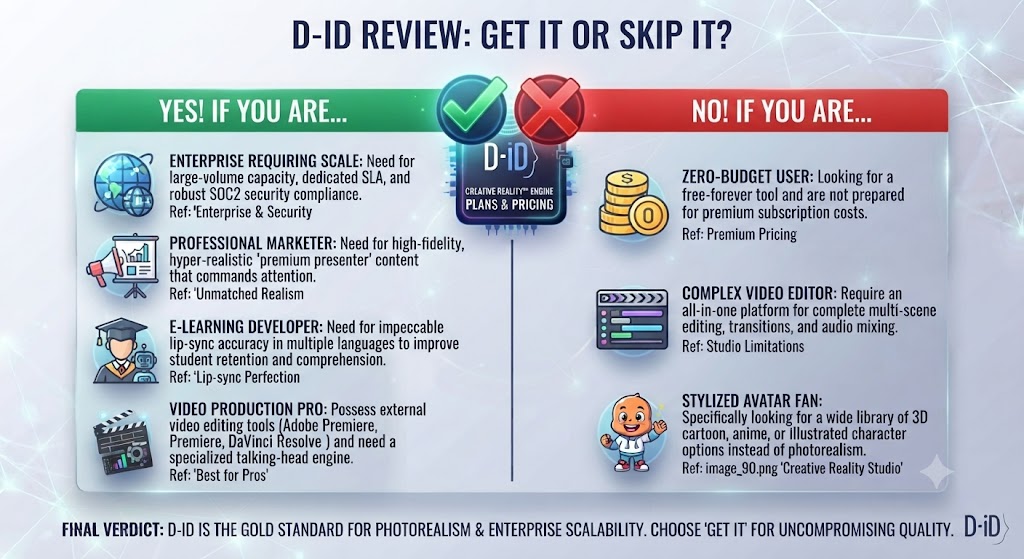
GET IT ✅ — D-ID is a capable, accessible AI avatar video platform that genuinely delivers on its promise of professional presenter videos without a camera. Strong multilingual support, a solid API, and the interactive Agents feature make it particularly valuable for e-learning teams, global marketers, and developers building avatar video into their own products.
SKIP IT ❌ — if you need the absolute best available talking-head video quality. HeyGen currently leads on lip sync accuracy and facial expression realism. If video quality is your primary decision criterion and budget allows, HeyGen is worth the higher price. D-ID is the better choice when API access, multilingual scale, or interactive avatar applications are the priority.
These Tools Help You Create. We Help You Go Viral.
Making the video is only half the battle — getting it seen is the other. Tasknestly’s viral video service handles strategy, editing, and distribution.
See Viral Video Services →Frequently Asked Questions
Is D-ID free to use?
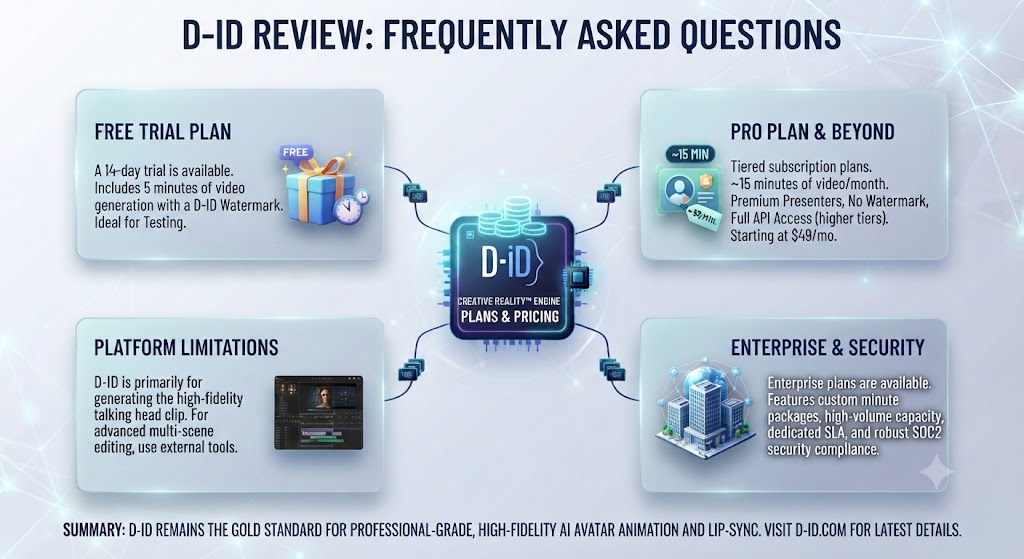
D-ID offers a free trial with 20 credits — enough to generate several short videos and evaluate the quality. The trial does not require a credit card. After credits are exhausted, a paid plan starting at $5.99 per month is required for continued use.
How realistic are D-ID avatar videos?
D-ID avatar videos are convincing for business and educational content with high-quality source photos. Lip sync is accurate for most major languages, and facial animation is natural enough for professional use. They are not indistinguishable from real filmed video on close inspection but are comfortably above the threshold for corporate training, marketing, and educational content.
How does D-ID compare to HeyGen?
HeyGen has a quality edge in lip sync accuracy and facial expression range. D-ID is more affordable at entry price points, has stronger API documentation for developer integrations, and offers the Agents interactive avatar feature which is well-suited to customer experience applications. For pure video quality, HeyGen wins; for API use and multilingual scale, D-ID is competitive.
Can D-ID clone my voice?
Yes. D-ID offers voice cloning on Professional and higher plans. You provide a voice sample and D-ID creates a synthetic version of your voice for use in avatar videos. Quality captures general tone and cadence well but may not replicate full emotional range.
What languages does D-ID support?
D-ID supports over 100 languages through its text-to-speech integration with providers including ElevenLabs, Microsoft Azure, and Amazon Polly. Lip sync adapts to the phonetic patterns of each language, making multilingual content localization one of the platform’s practical strengths.
Does D-ID have an API?
Yes. D-ID provides a comprehensive REST API that allows programmatic video generation — submitting source images, scripts, voice selections, and generation parameters via API calls. The API is used by developers building avatar video features into their own SaaS products, e-learning platforms, and customer service applications.
These Tools Help You Create. We Help You Go Viral.
Making the video is only half the battle — getting it seen is the other. Tasknestly’s viral video service handles strategy, editing, and distribution.
See Viral Video Services →Final Thoughts on D-ID
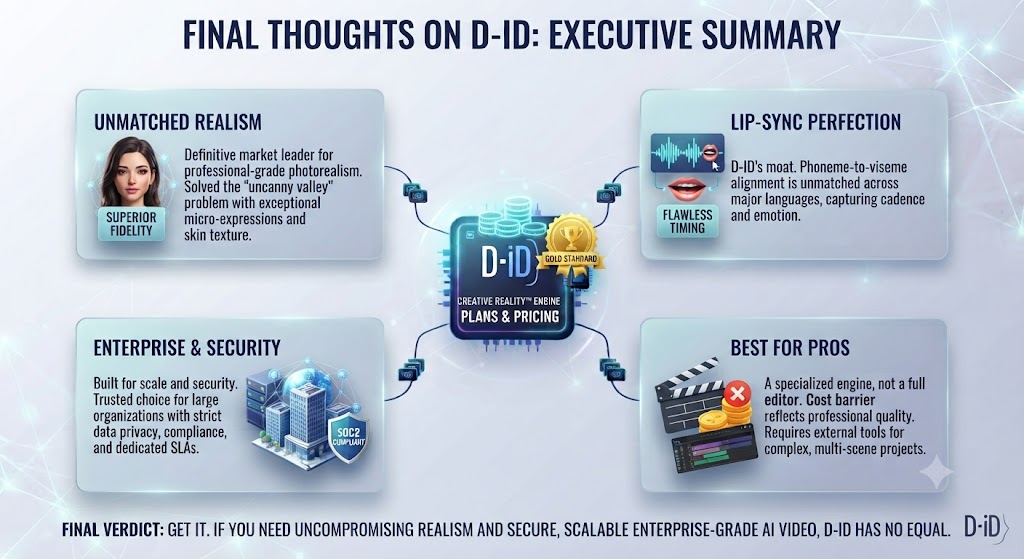
D-ID is a mature, capable AI avatar video platform that has delivered on its core promise: making professional-looking presenter video accessible to anyone with a photo and a script. For e-learning teams, corporate communicators, global marketers, and developers building AI video into their own products, it offers a strong combination of video quality, multilingual capability, and API accessibility.
The quality gap between D-ID and HeyGen is real but not decisive for all use cases. If you are producing corporate training content, converting slides to video, or building a multilingual content library, D-ID’s quality is more than sufficient and its pricing is compelling. If you are producing premium marketing video where every detail of realism matters, HeyGen’s quality edge may justify the higher cost.
Start with the free trial — 20 credits is enough to generate several test videos across different use cases and determine whether D-ID’s quality meets your specific standards. For most business content creation workflows, it will.
Try D-ID free at studio.d-id.com — 20 trial credits with no credit card required.
These Tools Help You Create. We Help You Go Viral.
Making the video is only half the battle — getting it seen is the other. Tasknestly’s viral video service handles strategy, editing, and distribution.
See Viral Video Services →