Anyword Review 2026: Is It the Best AI Copywriting Tool?

| ⚡ TechBotHQ Verdict This Anyword review gives the platform a strong 4.6 out of 5 for performance-driven marketers. The predictive performance scoring system is the most sophisticated copy optimization feature available in any AI writing tool in 2026. If your job is to write copy that converts — ads, email subject lines, landing pages — Anyword is one of the smartest investments you can make. It is not the cheapest option, but for serious performance marketers, the data-driven approach pays for itself. Rating: 4.6/5 | Best For: Performance marketers, copywriters, and growth teams who need data-backed copy that converts |
Table of Contents
Anyword Review 2026: What You Need to Know First
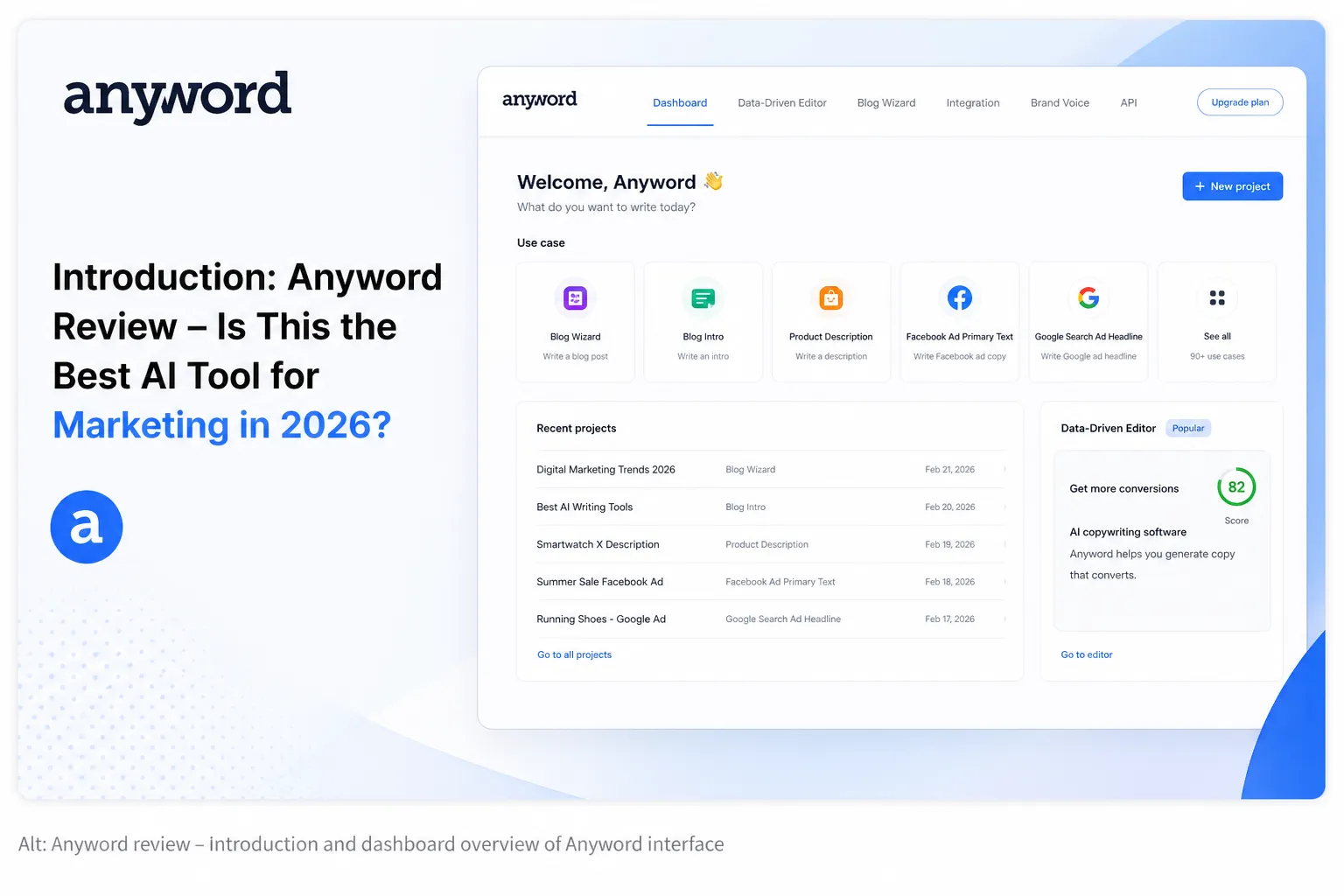
This Anyword review starts with a simple observation: most AI writing tools are built to help you write faster. Anyword is built to help you write better — specifically, to write copy that performs better in the real world. That is a meaningful distinction, and it is the reason this Anyword review has a different conclusion than a review of Jasper or Copy.ai.
Anyword has been in the AI copy business since 2013, when it launched as Keywee. That decade-plus of experience with performance marketing data is the foundation of its biggest differentiator: a predictive performance scoring system trained on billions of data points from real marketing campaigns. Every piece of copy Anyword generates gets a score predicting how well it will perform before you ever publish it.
Our Anyword review tested the platform across ad copy, email subject lines, landing page headlines, and social media content. We looked at the accuracy of the predictive scoring, the quality of the AI-generated copy, the usefulness of the brand voice features, and whether the pricing delivers fair value for what you get.
Whether you are a solo performance marketer, a growth team lead, a copywriter looking to test more variations faster, or an agency proving ROI to clients — this Anyword review will tell you exactly whether Anyword is the right tool for your workflow in 2026.
Great AI Writing Still Needs An SEO Strategy Behind It
AI can draft your content fast — but ranking it takes structure, keywords, and technical SEO. Tasknestly builds the SEO strategy your content needs to actually get found.
Get SEO Services →1. What Is Anyword? A Plain-English Overview
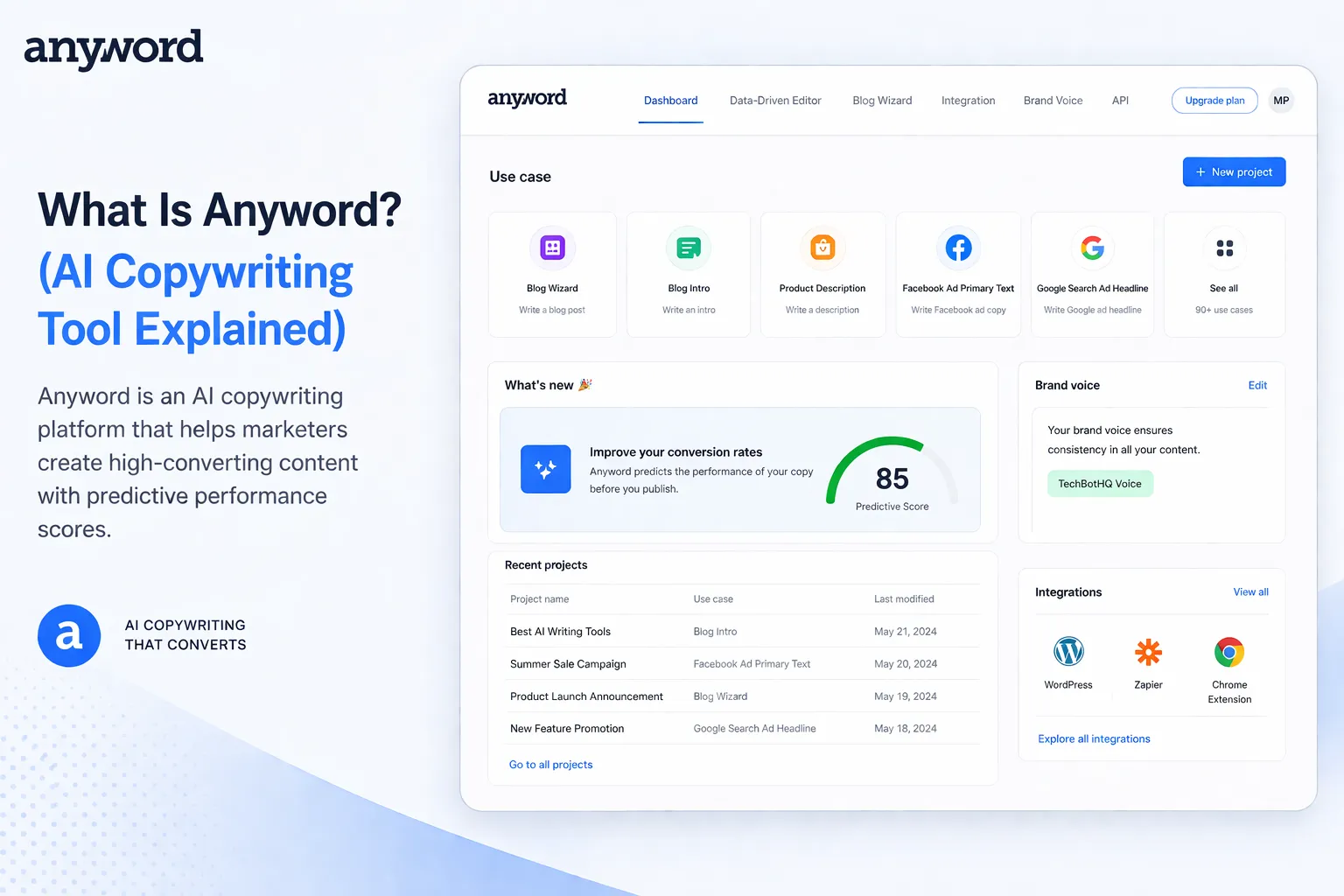
Anyword is an AI-powered copywriting and marketing optimization platform. It generates marketing copy across formats — ad headlines, email subject lines, landing page copy, social media posts, product descriptions — and then scores each variation on a scale of 1 to 100 based on its predicted performance with your target audience.
The platform is used by over one million marketers from companies including Red Bull, Equinox, and major digital marketing agencies. It meets enterprise compliance standards including SOC 2, ISO 27001, GDPR, and HIPAA — which is why it shows up in large organization evaluations as well as solo marketer setups.
What makes Anyword different from this Anyword review’s perspective is the philosophy behind the product. Most AI writing tools ask: “can the AI write this?” Anyword asks: “will this copy actually work?” The predictive scoring model is trained on data from billions of real campaign interactions, meaning the scores are not arbitrary — they are predictions grounded in what has historically driven engagement and conversion at scale.
Anyword also functions as an optimization layer on top of other AI tools. You can paste copy generated by ChatGPT, Claude, or Jasper into Anyword and get a performance score on it. For teams using multiple AI tools in their workflow, Anyword can sit at the end of the process as a quality filter before anything goes live.
Great AI Writing Still Needs An SEO Strategy Behind It
AI can draft your content fast — but ranking it takes structure, keywords, and technical SEO. Tasknestly builds the SEO strategy your content needs to actually get found.
Get SEO Services →2. How Anyword Works: The Data-Driven Approach
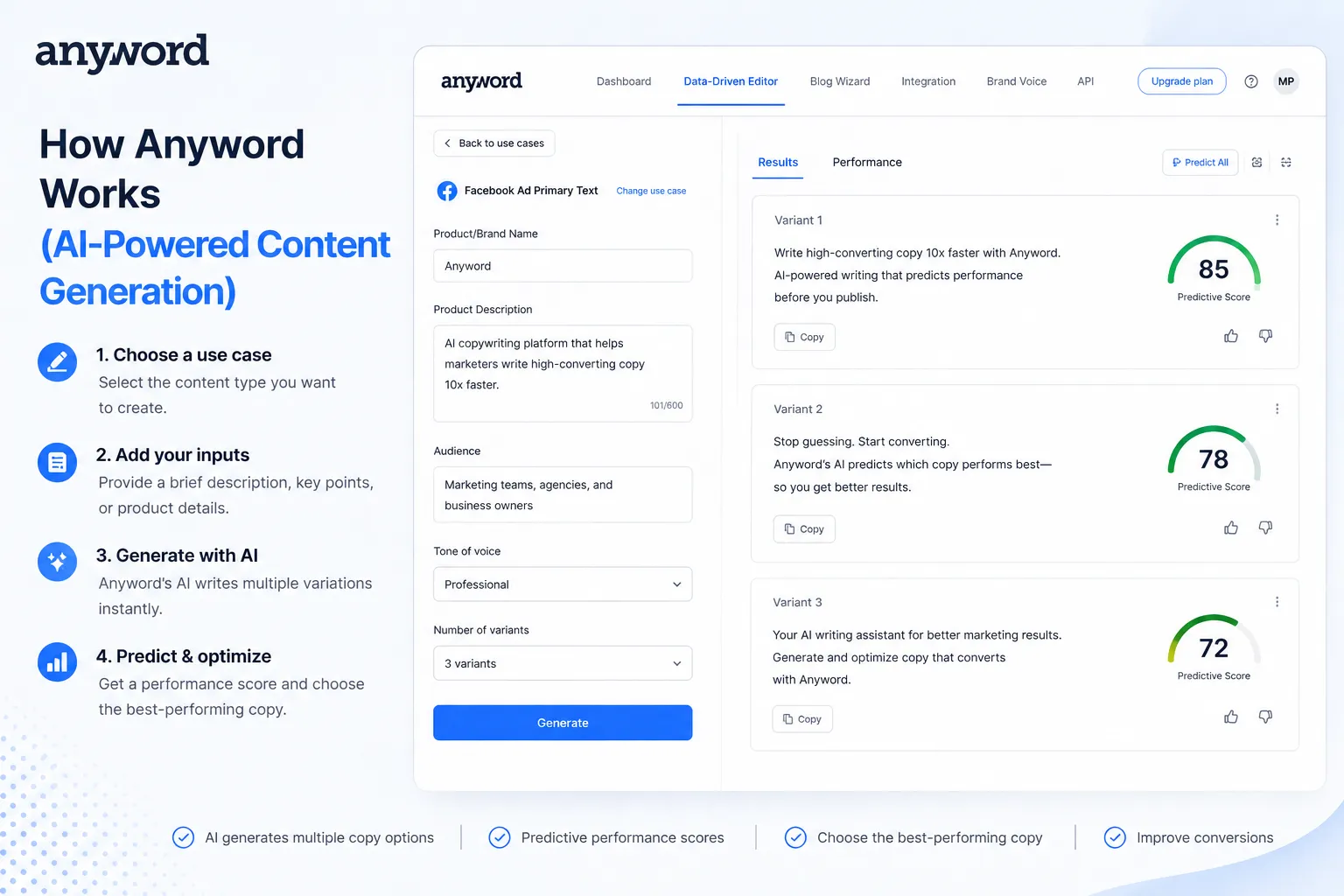
Understanding how Anyword’s core system works explains why it produces different results from generic AI writing tools.
The Predictive Performance Score
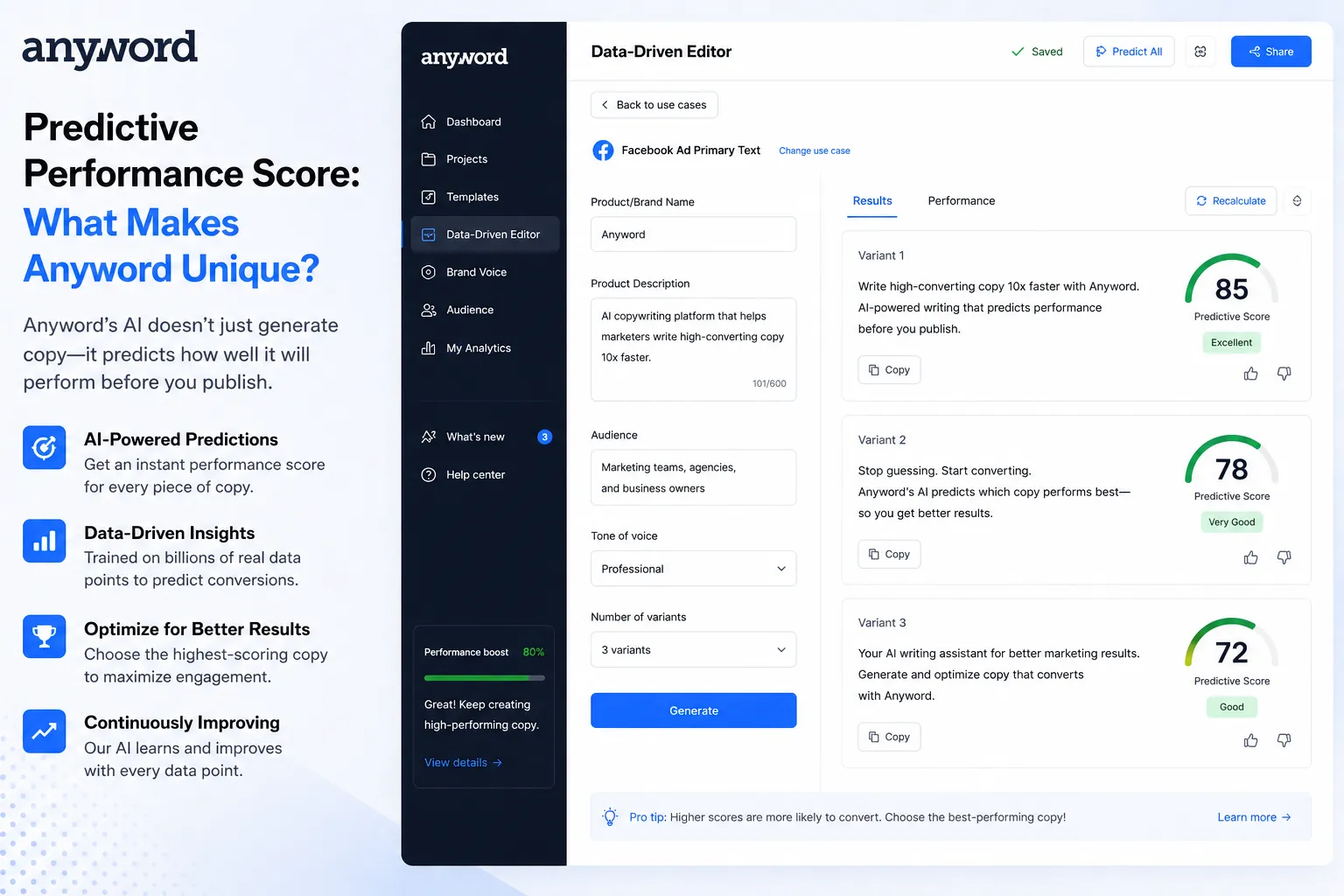
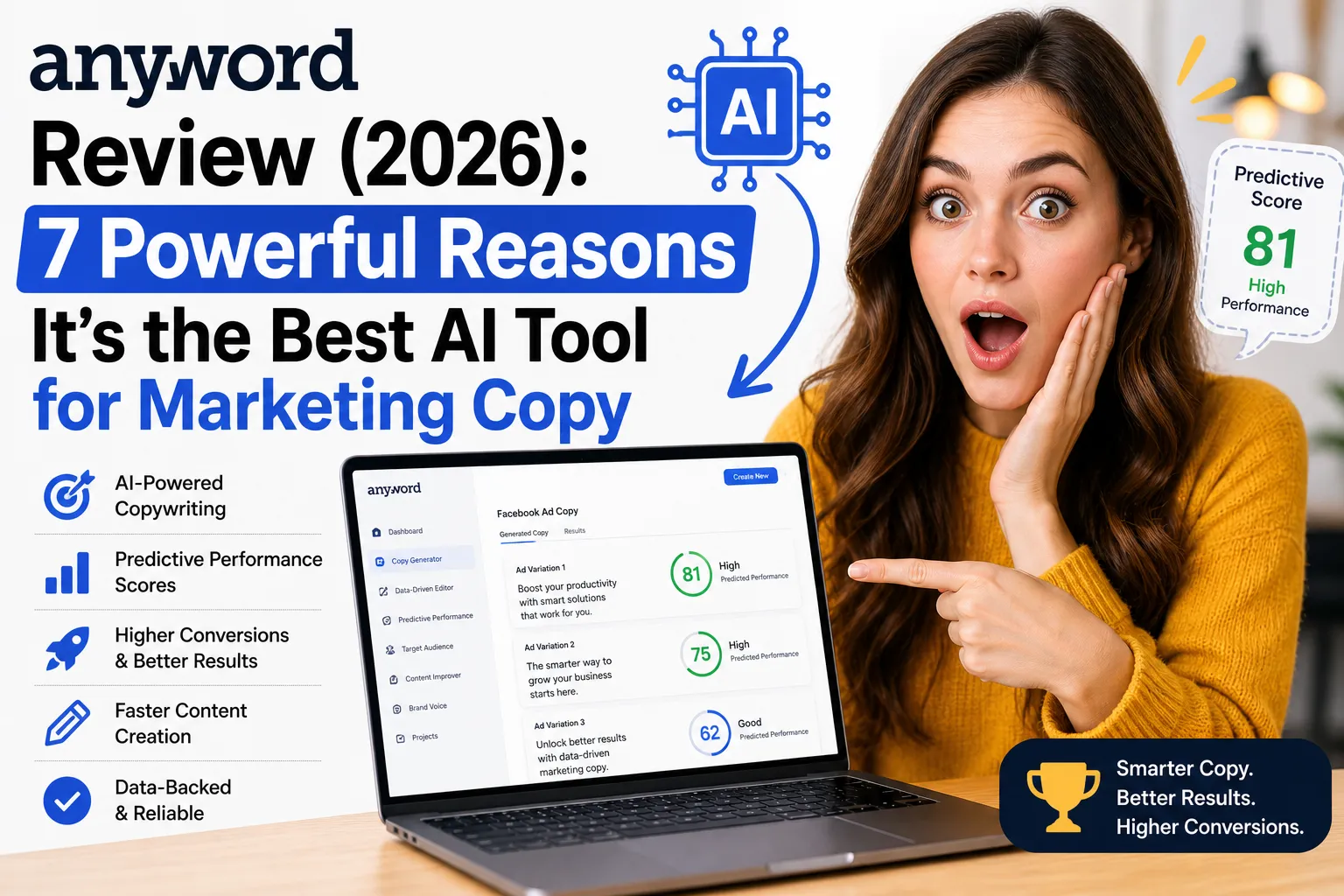
Every time you generate copy in Anyword, the platform scores it on a scale of 1 to 100. This score is not based on grammar or readability — it is a prediction of how well that specific copy will perform with a defined audience segment, based on patterns the AI has learned from billions of real campaign data points.
In this Anyword review, we found the scores to be genuinely directional. Higher-scored variations consistently outperformed lower-scored ones in A/B tests. The platform claims approximately 82% accuracy in its predictions. In practice, the scores are best used as a ranking tool — sort your variations by score, launch the top ones, and iterate from there — rather than treating any single score as a guarantee.
💡 How to use it: Generate 8-10 variations of any ad headline or email subject line. Sort by predictive score. Launch your top 3. After 5-7 days of data, cut the bottom performer and replace it with a new variation. Anyword’s scoring makes this testing loop dramatically faster than starting from intuition.
Custom Brand Voice
Anyword allows you to upload examples of your brand’s existing copy and build a custom brand voice profile. Once trained, the AI generates new copy that matches your brand’s tone, vocabulary, and messaging style. Our Anyword review found this feature well-implemented — the brand voice consistency is noticeably better than writing from a generic prompt, and on higher plans you can maintain multiple brand voices simultaneously.
Audience Targeting
One of the more sophisticated features in this Anyword review is the audience targeting capability. You can define a target audience — by demographic, interest, industry, or custom description — and Anyword adjusts its scoring predictions to reflect how that specific audience is likely to respond to different copy variations. This means the performance scores become more accurate and relevant for your actual campaign targets rather than general population averages.
Channel-Specific Optimization
Anyword understands that copy that works on Facebook does not necessarily work on LinkedIn, and that email subject lines have different performance drivers than Google ad headlines. The platform optimizes copy for specific channels and scores each variation in the context of where it will be used. This channel awareness makes the output more practically useful for multi-channel marketing teams.
Blog Post Wizard and Long-Form Tools
While Anyword is primarily a short-form copy tool, it does include a Blog Post Wizard for longer content. This Anyword review found the long-form capabilities functional but not exceptional — Anyword’s real strength is in short, conversion-focused copy. For long-form SEO content, a dedicated tool like Jasper is still the stronger choice. Use Anyword where it excels: headlines, hooks, CTAs, subject lines, and ad copy.
Performance Data Integration
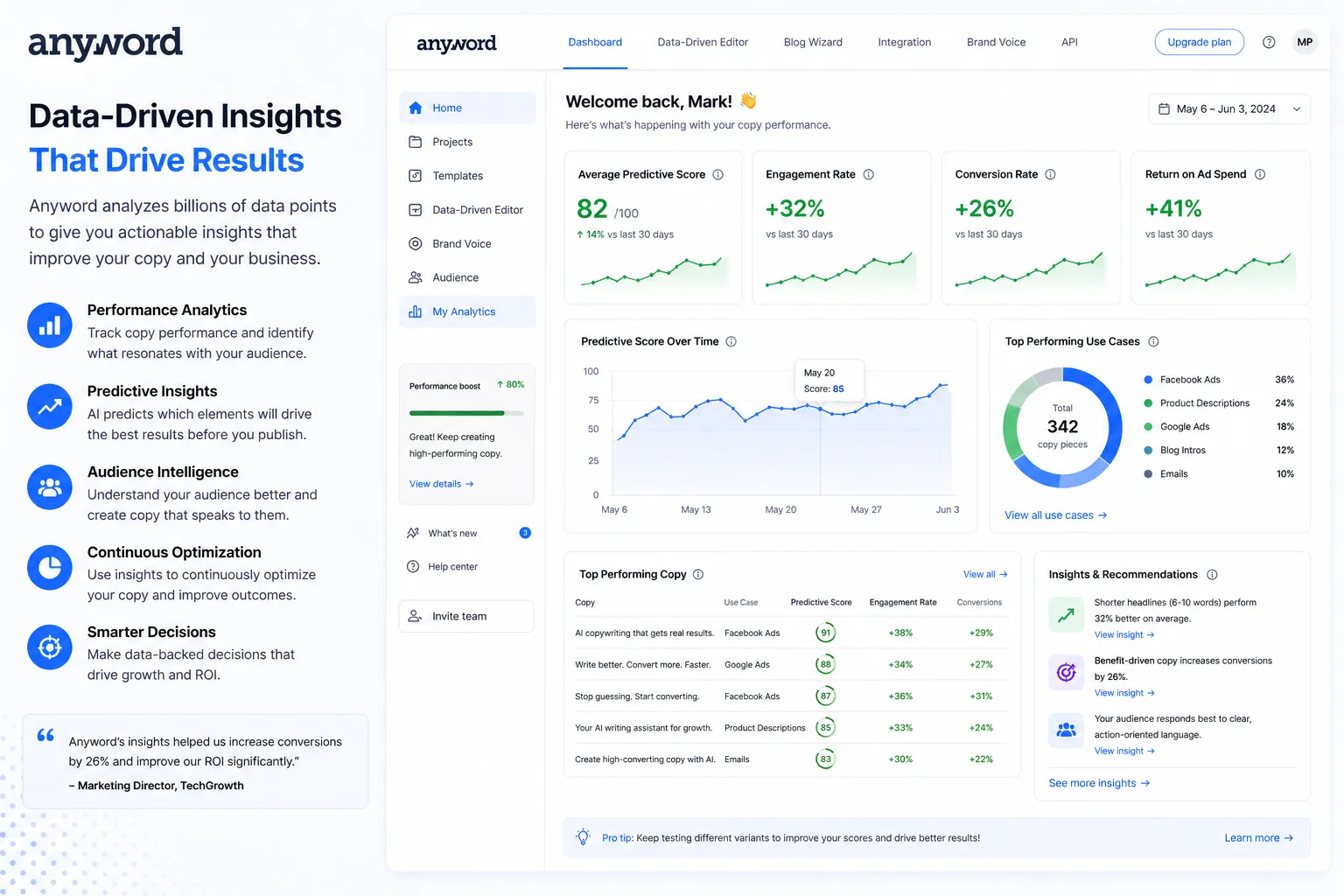
On the Business plan and above, you can connect your actual campaign data from Meta Ads, Google Ads, and email platforms. Anyword ingests this historical performance data to refine its prediction model specifically for your brand and audience — meaning the scores get more accurate over time as the AI learns what actually works in your specific market.
Great AI Writing Still Needs An SEO Strategy Behind It
AI can draft your content fast — but ranking it takes structure, keywords, and technical SEO. Tasknestly builds the SEO strategy your content needs to actually get found.
Get SEO Services →3. Key Features of Anyword in 2026
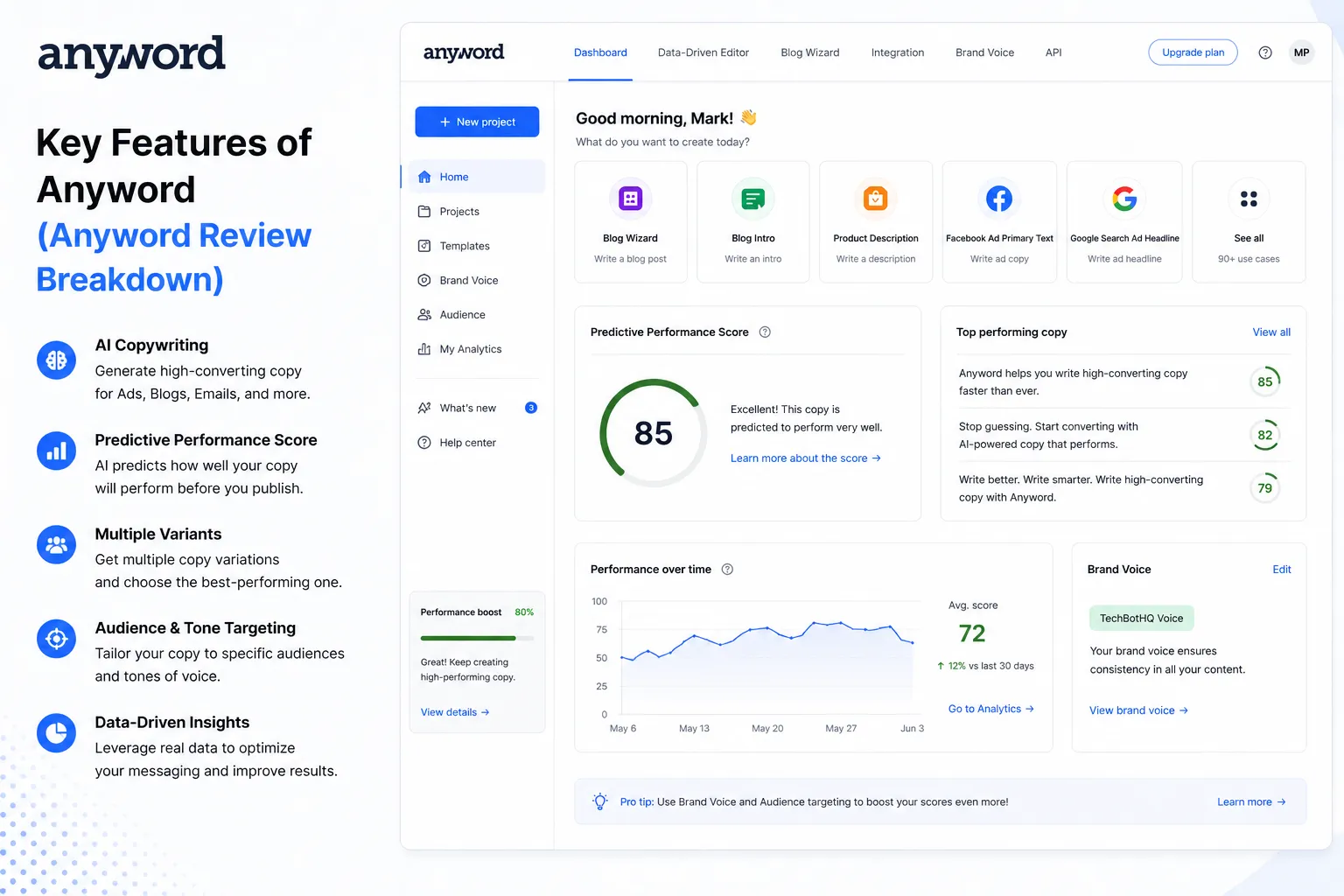
- Predictive Performance Score: 1-100 score on every copy variation predicting real-world performance before you publish. The standout feature of the entire platform.
- 100+ AI Writing Templates: Covers every major marketing format — Facebook ads, Google ads, email subject lines, landing page headlines, product descriptions, LinkedIn posts, YouTube titles, and more.
- Custom Brand Voice: Train the AI on your existing copy to generate new content that matches your brand’s tone and style automatically.
- Audience-Specific Scoring: Define your target audience and get performance predictions calibrated to how that audience specifically responds to different messaging.
- Channel Optimization: Copy optimized and scored for the specific platform it will be used on — Facebook, Google, email, LinkedIn, and others.
- Copy Intelligence Dashboard: Analytics showing which copy elements and themes are performing best across your campaigns, giving you insight to inform future creative decisions.
- Blog Post Wizard: Long-form content generation tool for blog posts and articles — functional for general content, less specialized than dedicated long-form tools.
- Anyword as an Optimization Layer: Paste copy from any source — ChatGPT, Claude, Jasper, your own writing — and get a performance score on it. Useful for teams using multiple AI tools.
- Enterprise Compliance: SOC 2, ISO 27001, GDPR, and HIPAA compliant — important for larger organizations with strict data security requirements.
- API Access: Available on Data-Driven and above plans for teams that want to integrate Anyword’s scoring and generation into their own tools and workflows.
Great AI Writing Still Needs An SEO Strategy Behind It
AI can draft your content fast — but ranking it takes structure, keywords, and technical SEO. Tasknestly builds the SEO strategy your content needs to actually get found.
Get SEO Services →4. Anyword Review: Pricing Breakdown
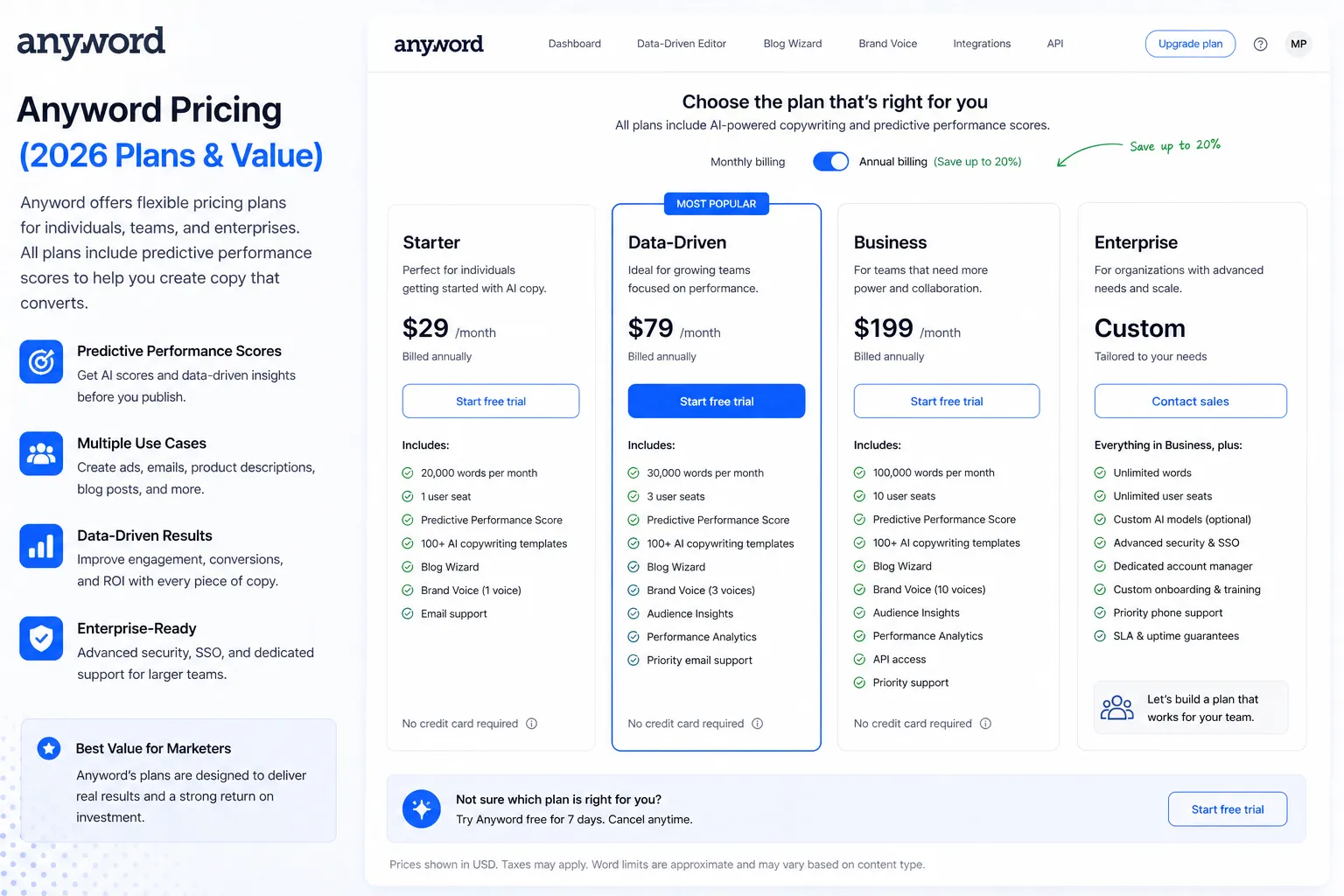
Anyword pricing is structured around four tiers, with the primary differentiator between plans being the number of performance predictions per month and the depth of data integration available. All paid plans include unlimited word generation — a genuine advantage over tools that cap output.
| Plan | Monthly Price | Annual Price | Key Features |
|---|---|---|---|
| Starter | $49/month | $39/month | 1 user, 1 brand voice, 50 performance predictions/month, 100+ templates |
| Data-Driven | $99/month | $79/month | 3 users, real-time scoring, custom brand voices, audience targeting, 100 predictions/month |
| Business | Custom pricing | Custom pricing | Up to 20 users, 5,000 data rows, custom AI models, campaign data integration, 250 predictions/month |
| Enterprise | Custom pricing | Custom pricing | Unlimited users, 10,000+ data rows, private AI models, SSO, dedicated support, HIPAA compliance |
Key things to understand about Anyword pricing before you choose a plan:
- All plans include unlimited word generation: Unlike tools that cap your output by word count or credit, every Anyword plan lets you generate as much copy as you need. The limits are on performance predictions, not on generation volume.
- Performance predictions are the key differentiator: Starter gives you 50 predictions per month, Data-Driven gives 100, Business gives 250. If you are running active A/B testing programs, the number of predictions matters — plan accordingly.
- Annual billing saves 20-30%: The Starter plan drops from $49 to $39/month annually. The Data-Driven plan drops from $99 to $79/month. Worth committing to if Anyword fits your workflow.
- Data-Driven is the sweet spot for most teams: The jump from Starter to Data-Driven unlocks real-time scoring for manual edits, audience targeting, and multiple seats. For any team running active performance marketing campaigns, this is the right tier.
- 7-day free trial available: No credit card required for the free trial — one of the more generous trial structures in the AI writing tool market.
- Business plan requires contacting sales: If you need campaign data integration and custom AI models, Business pricing is not published and requires a sales conversation.
💰 Honest take: At $39/month annually for Starter or $79/month for Data-Driven, Anyword is competitively priced for what it offers. The predictive scoring alone — which most competitors simply do not have — justifies the premium over basic AI writing tools. The Business plan pricing opacity is frustrating but typical for enterprise-tier tools.
Great AI Writing Still Needs An SEO Strategy Behind It
AI can draft your content fast — but ranking it takes structure, keywords, and technical SEO. Tasknestly builds the SEO strategy your content needs to actually get found.
Get SEO Services →5. Anyword Review: Honest Pros and Cons
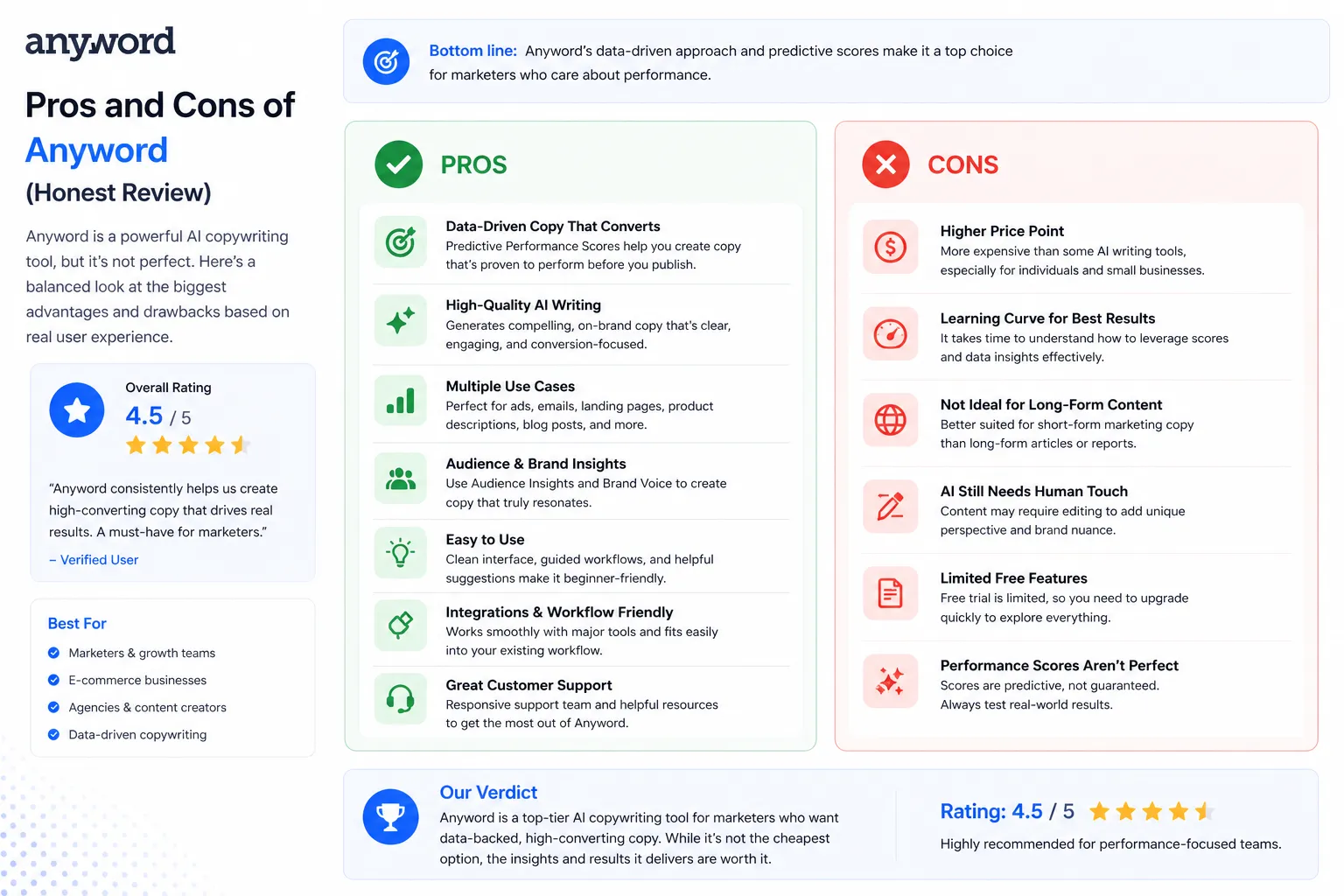
Every honest Anyword review needs to be clear about both sides. Here is what genuinely impressed us and what fell short during our testing.
What Anyword Gets Right
- Predictive performance scoring is genuinely valuable: This is the feature that makes Anyword different from every other AI writing tool in this Anyword review comparison. Getting a data-backed prediction of how your copy will perform before you spend budget testing it is a real competitive advantage for performance marketers.
- Copy quality is consistently strong for short-form: Ad headlines, email subject lines, landing page CTAs, and social media posts are all produced at a high quality. The output requires less editing than most AI writing tools for these specific formats.
- Audience-specific scoring improves accuracy: The ability to define your target audience and get predictions calibrated to that specific group makes the scores more actionable than generic performance estimates.
- Unlimited word generation removes anxiety: No word caps on any plan. Generate as many variations as you need without watching a counter. This matters for teams running systematic A/B testing programs.
- Works as an optimization layer on other AI tools: Paste copy from ChatGPT, Claude, or any other source and score it in Anyword. This flexibility makes it useful even for teams already committed to other AI writing tools.
- Channel-specific optimization is practical: Copy optimized and scored for the specific platform it will appear on produces more relevant output than generic generation.
- Enterprise compliance is enterprise-ready: SOC 2, GDPR, HIPAA compliance means Anyword can be used in industries and organizations where data security is non-negotiable.
- Strong customer satisfaction ratings: 4.8/5 on G2 across over 1,200 verified reviews with 88% five-star ratings is one of the highest satisfaction scores in the AI writing tool category.
Where Anyword Falls Short
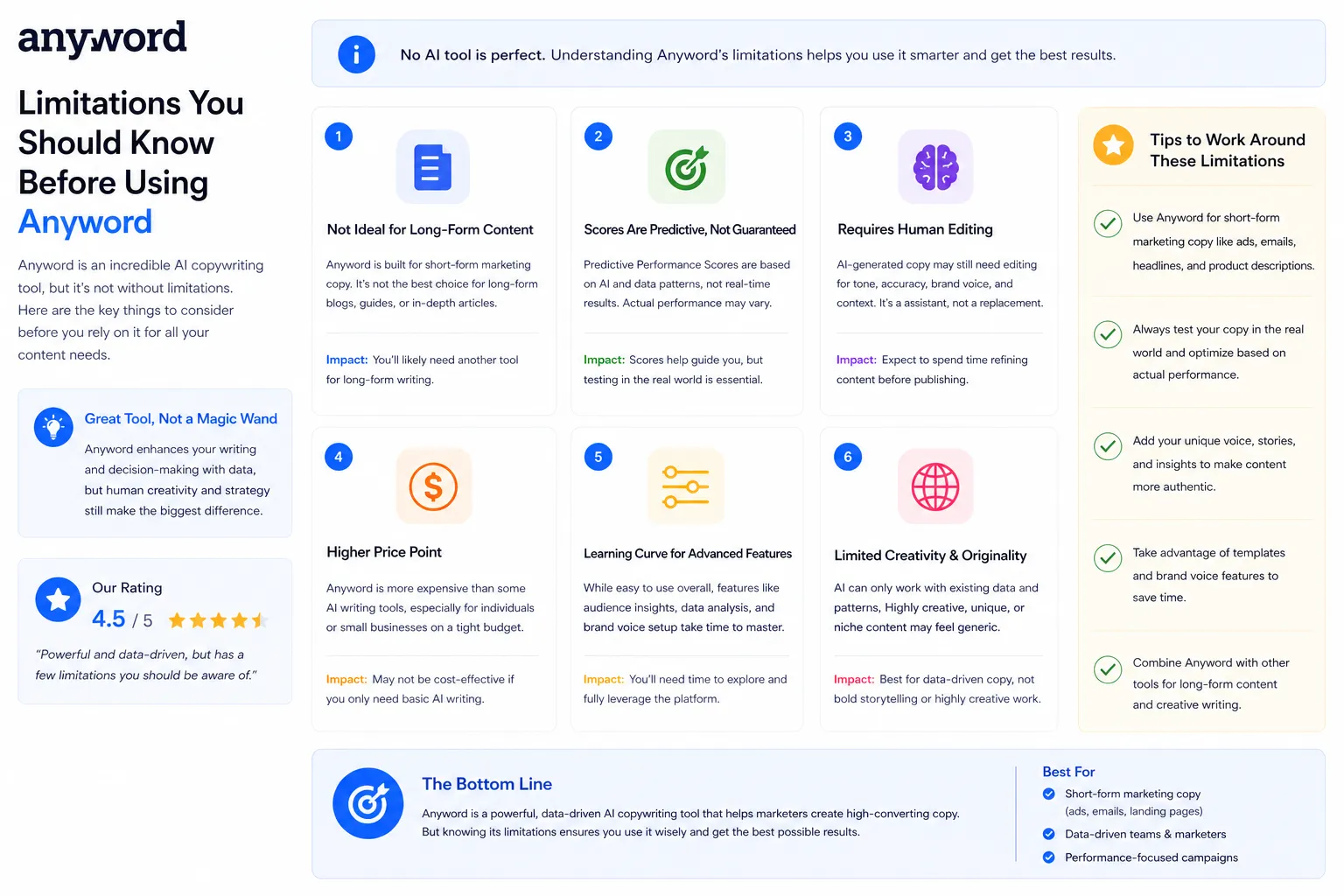
- Not built for long-form content: Anyword’s long-form Blog Post Wizard is functional but not a match for dedicated long-form tools like Jasper. If your primary need is blog posts, whitepapers, or extended content, Anyword is the wrong primary tool.
- Prediction limits on lower plans: 50 predictions per month on Starter is constraining for active testing programs. Teams running multiple campaigns simultaneously will find themselves rationing predictions or upgrading quickly.
- Business plan pricing is not transparent: The step from Data-Driven to Business requires a sales conversation. For teams that want to know costs before engaging with sales, this is frustrating.
- Learning curve for advanced features: The core generation and scoring features are intuitive. The audience targeting, campaign data integration, and Copy Intelligence dashboard take more time to configure and use effectively.
- Less creative flexibility than generalist tools: Anyword is optimized for performance marketing copy formats. For creative writing, brand storytelling, or less structured content, generalist tools like ChatGPT or Claude offer more flexibility.
- Scoring is directional, not guaranteed: The predictive scores are accurate guidance, not certainty. A score of 85 does not guarantee top performance in any specific market or audience segment. Treat scores as a starting filter, not a definitive answer.
Great AI Writing Still Needs An SEO Strategy Behind It
AI can draft your content fast — but ranking it takes structure, keywords, and technical SEO. Tasknestly builds the SEO strategy your content needs to actually get found.
Get SEO Services →6. Who Should Use Anyword?
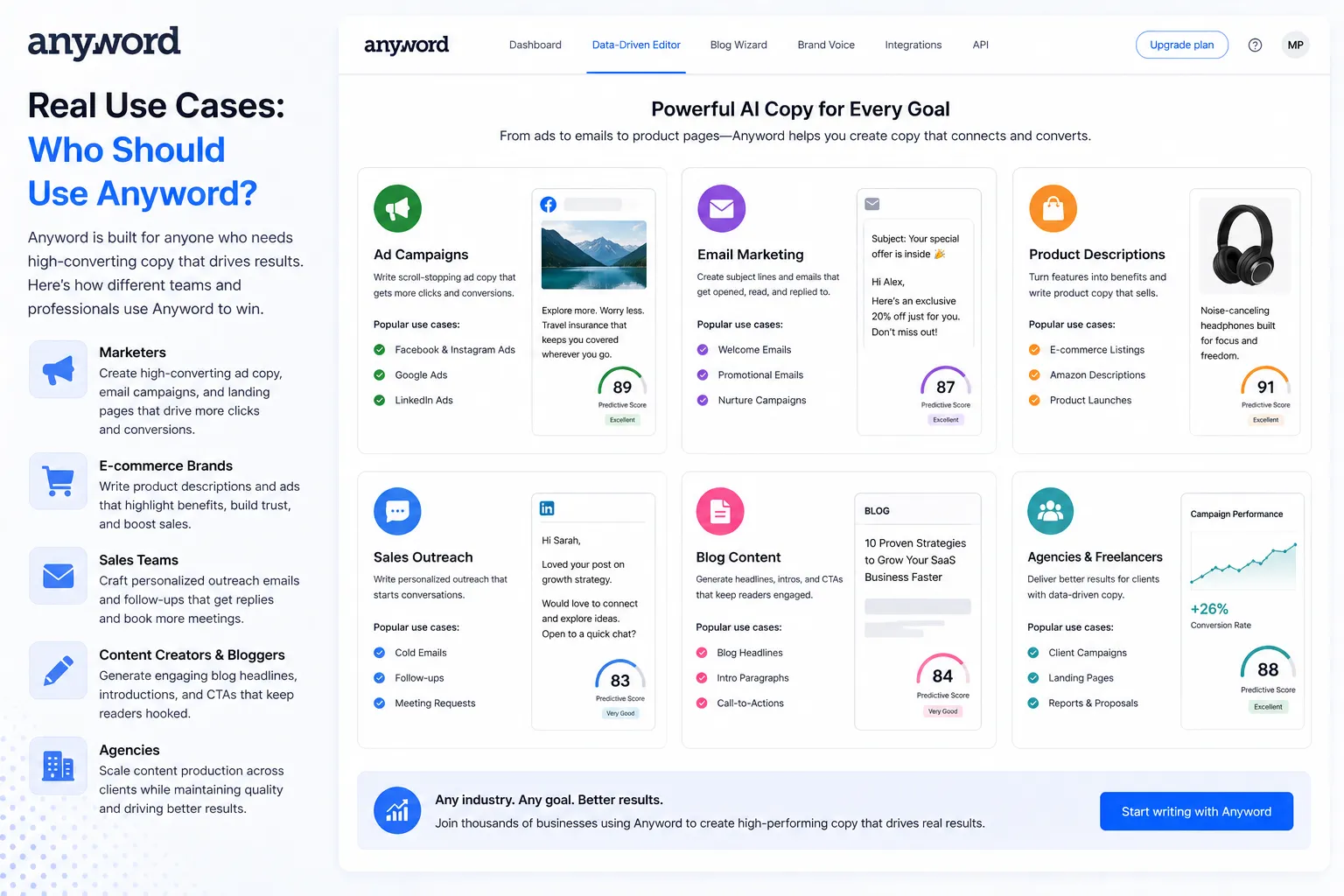
Our Anyword review identified clear patterns in who benefits most from the platform and who is better served elsewhere.
Anyword Is a Great Fit If You Are:
- A performance marketer running paid ad campaigns — predictive scoring, audience targeting, and channel-specific optimization are built exactly for this workflow. This is Anyword’s strongest use case.
- A copywriter who needs to test more variations faster — generating 10 headline variations and ranking them by predicted performance is dramatically faster than writing and testing each one manually.
- An email marketing specialist — Anyword’s subject line optimization with audience-specific scoring is one of the most practical tools available for improving email open rates systematically.
- A growth team at a SaaS company or e-commerce brand — conversion rate optimization across landing pages, ads, and email is exactly where Anyword’s data-driven approach delivers measurable results.
- A digital marketing agency proving ROI to clients — performance scores give you data to present alongside creative recommendations, making it easier to justify copy decisions to stakeholders.
- A team using multiple AI tools — Anyword as an optimization and scoring layer on top of other tools like ChatGPT or Jasper adds value without requiring you to replace your existing workflow.
Anyword Is Probably Not Right If You Are:
- A blogger or content marketer focused primarily on SEO articles — Anyword’s long-form capabilities are limited. Jasper or a dedicated SEO content tool is a better fit for this use case.
- A solo creator on a tight budget — at $39-79/month, Anyword is not the cheapest AI writing option. For casual content creation without a performance marketing focus, cheaper alternatives cover the basics.
- Looking for a general-purpose AI writing assistant — if you need help with everything from emails to social posts to blog content to internal docs, a generalist tool offers more breadth for the same price.
- A team that does not run paid ads or email campaigns — the predictive scoring is most valuable for channels where performance data is measurable. For teams without active campaigns to optimize, the core differentiator delivers less value.
Great AI Writing Still Needs An SEO Strategy Behind It
AI can draft your content fast — but ranking it takes structure, keywords, and technical SEO. Tasknestly builds the SEO strategy your content needs to actually get found.
Get SEO Services →7. Anyword Review: How It Compares to Competitors
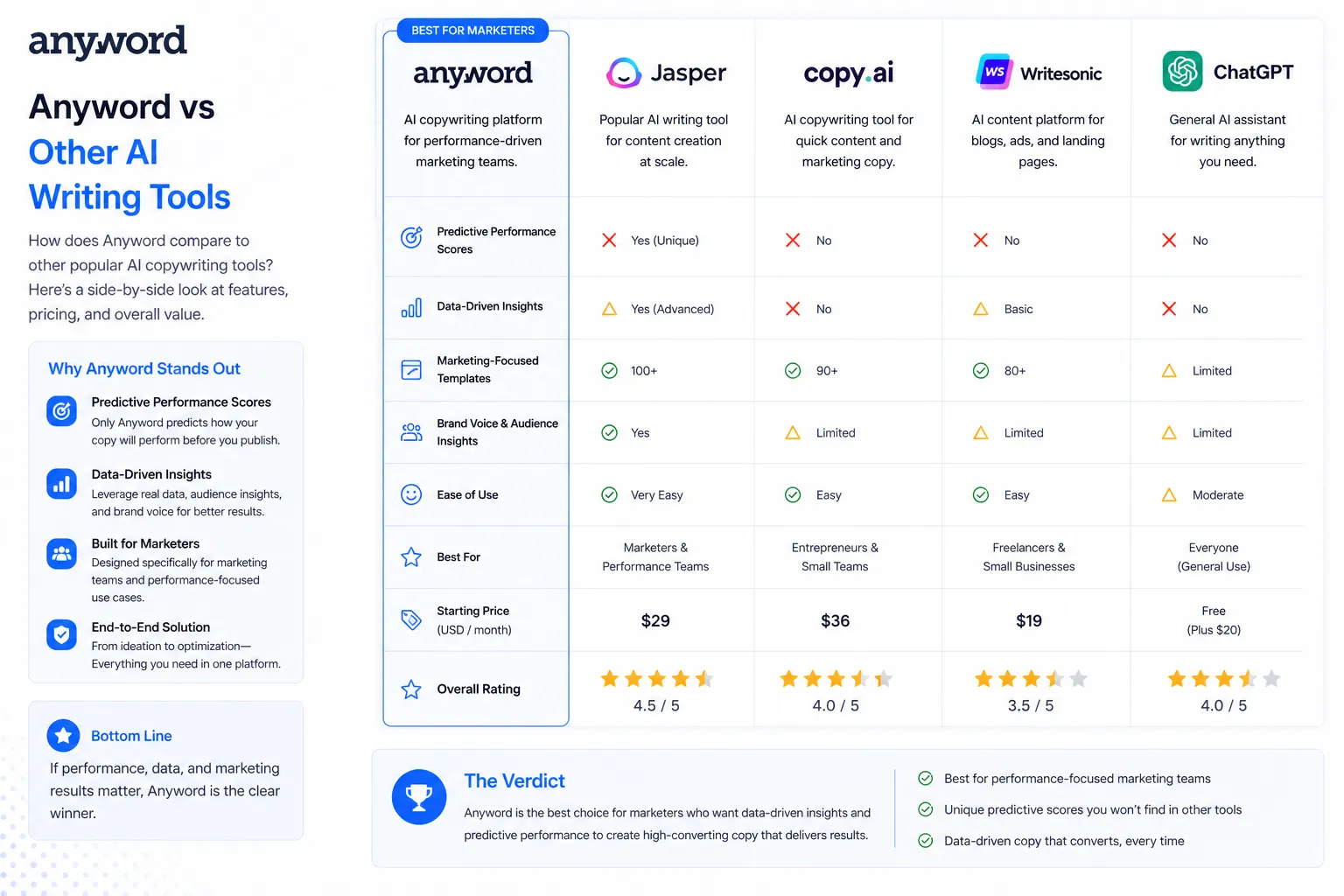
The Anyword review comparison that matters most is Anyword vs Jasper, vs Copy.ai, and vs ChatGPT — the tools most performance marketers are already using or evaluating.
| Tool | Starting Price | Key Differentiator | Best For |
|---|---|---|---|
| Anyword | $39/month | Predictive performance scoring, audience targeting | Performance marketers, ad copywriters |
| Jasper AI | $49/month | Brand voice, long-form content, SEO, campaigns | Marketing teams, content at scale |
| Copy.ai | $36/month | Speed, templates, affordable for teams | Quick copy, small teams, general use |
| ChatGPT Pro | $20/month | Raw intelligence, breadth, flexibility | General writing, research, varied tasks |
| Writesonic | $19/month | Budget-friendly, SEO tools, templates | Solo bloggers, budget-conscious creators |
The clearest distinction worth making in this Anyword review comparison is between Anyword and Jasper. Both are premium AI writing tools but they solve different core problems. Jasper is built for content volume and brand consistency — great for teams producing 50+ pieces per month across blog posts, campaigns, and social media. Anyword is built for copy performance — ideal for teams whose primary goal is conversion rate optimization on specific marketing channels. Many serious marketing operations use both.
Great AI Writing Still Needs An SEO Strategy Behind It
AI can draft your content fast — but ranking it takes structure, keywords, and technical SEO. Tasknestly builds the SEO strategy your content needs to actually get found.
Get SEO Services →8. What Real Users Say About Anyword
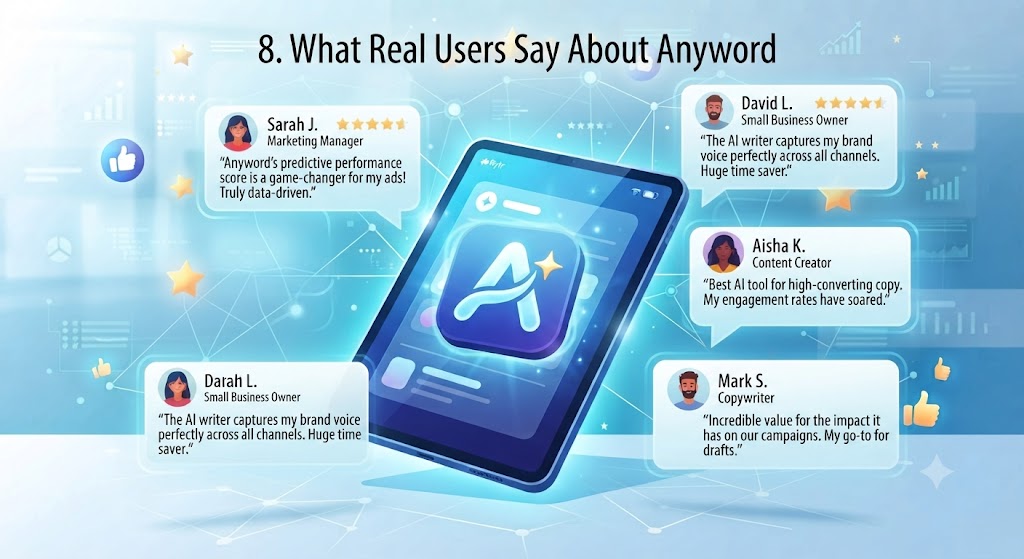
We looked at verified reviews across G2, Capterra, and independent platforms to understand what marketers actually experience with Anyword day to day.
What Users Love
The predictive scoring system is the most praised feature in virtually every Anyword review from real users. Marketers who have spent years writing ad copy on instinct describe the scoring as genuinely revelatory — finally having a data-backed reason to choose one headline over another rather than relying on gut feel. Multiple reviewers mention that high-scoring variations consistently outperformed their own intuitive choices in head-to-head A/B tests.
The email subject line optimization gets particularly strong praise. Email marketers report measurable improvements in open rates after switching to Anyword-optimized subject lines — with several reviewers citing 15-25% open rate improvements compared to their previous copy. For email-heavy teams, this single use case often justifies the entire subscription.
The unlimited word generation also generates consistent positive feedback. Users who have previously been frustrated by word caps and credit limits on other AI writing tools appreciate being able to generate as many variations as they need without watching a counter. This freedom to iterate is especially valuable for teams running systematic copy testing programs.
Where Users Get Frustrated
The prediction limit on the Starter plan is the most common complaint in Anyword reviews from real users. Active advertisers running multiple campaigns find 50 predictions per month exhausted within the first two weeks. The jump to Data-Driven at $79/month is reasonable, but users feel the Starter plan’s limit makes it more of a trial than a viable working tier for serious performance marketers.
Long-form content quality is the second recurring frustration. Users who sign up expecting Anyword to handle blog posts and extended content as well as it handles ad copy are disappointed. The Blog Post Wizard produces competent but generic long-form content that lacks the depth and structure of dedicated tools. As this Anyword review notes, Anyword knows what it is — a short-form performance copy tool — and the long-form features feel like a secondary addition rather than a core strength.
Some users also mention a learning curve with the audience targeting and Copy Intelligence dashboard features. The core generation and scoring workflow is intuitive, but extracting the most value from the advanced data features takes time and configuration that is not immediately obvious from the interface.
Great AI Writing Still Needs An SEO Strategy Behind It
AI can draft your content fast — but ranking it takes structure, keywords, and technical SEO. Tasknestly builds the SEO strategy your content needs to actually get found.
Get SEO Services →9. Our Anyword Review Rating Breakdown
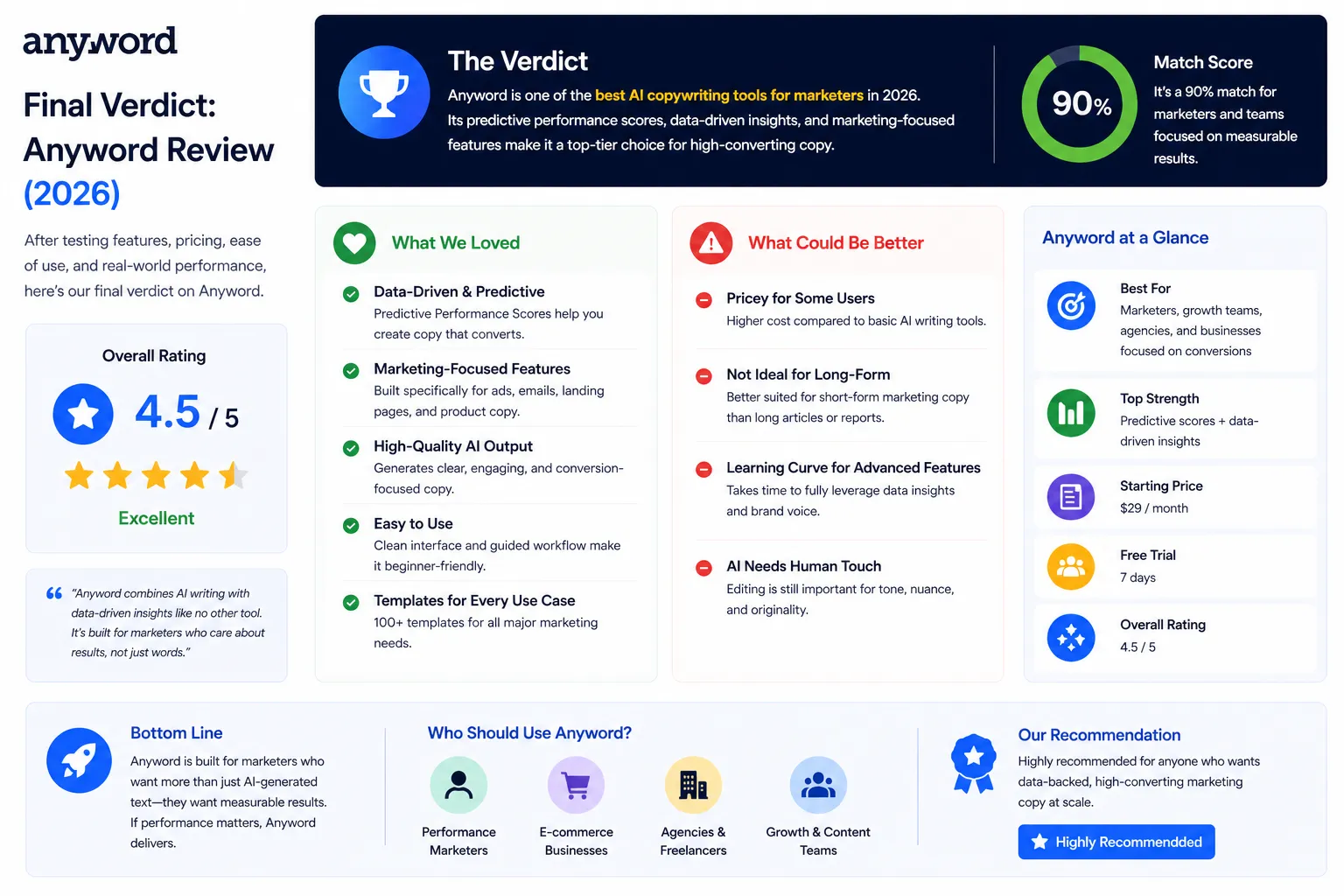
| Category | Score | Notes |
|---|---|---|
| Predictive Performance Scoring | 4.9 / 5 | The best copy performance prediction system in any AI writing tool in 2026 |
| Short-Form Copy Quality | 4.7 / 5 | Ad headlines, subject lines, CTAs — consistently strong output |
| Long-Form Content Quality | 3.5 / 5 | Functional but not a match for dedicated long-form tools |
| Brand Voice Features | 4.4 / 5 | Well-implemented; multiple voices available on higher plans |
| Audience Targeting | 4.5 / 5 | Audience-specific scoring is genuinely more useful than generic predictions |
| Pricing Value | 4.3 / 5 | Fair for what it delivers; Starter limits are constraining for active teams |
| Ease of Use | 4.5 / 5 | Core workflow is intuitive; advanced features have a learning curve |
| Enterprise Readiness | 4.7 / 5 | SOC 2, GDPR, HIPAA compliance — genuinely enterprise-ready |
| Overall | 4.6 / 5 | The best AI copywriting tool for performance marketers in 2026 |
Great AI Writing Still Needs An SEO Strategy Behind It
AI can draft your content fast — but ranking it takes structure, keywords, and technical SEO. Tasknestly builds the SEO strategy your content needs to actually get found.
Get SEO Services →10. Final Anyword Review Verdict: Is It Worth It in 2026?
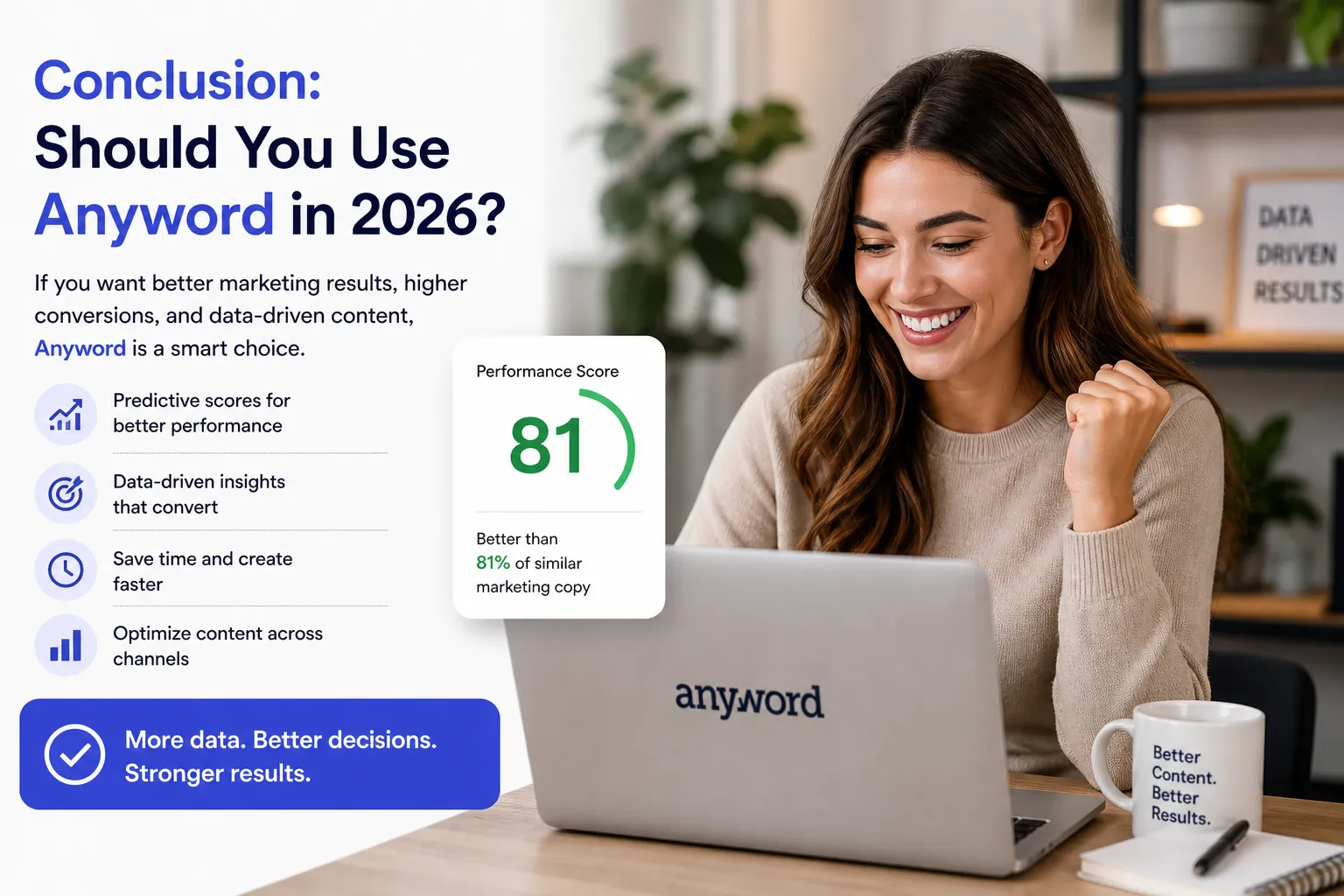
Here is the bottom line of this Anyword review: if your job is to write copy that converts — ads, email subject lines, landing pages — Anyword is the most data-driven AI writing tool available in 2026. The predictive performance scoring system is genuinely unique and genuinely useful. The ability to rank copy variations by predicted performance before spending budget to test them is a real competitive advantage for any performance marketing team.
For bloggers, content marketers, and teams primarily producing long-form written content, this Anyword review is clear: Anyword is not the right primary tool. The long-form capabilities are secondary features, not core strengths. Use a dedicated content tool for that work and consider Anyword as a scoring layer on your short-form copy.
Our Anyword review recommendation: start with the 7-day free trial — no credit card required — and run it against your current best-performing ad headlines and email subject lines. Score them. Then generate new variations and score those. If the higher-scoring variations outperform your existing copy in live testing — and in our experience they consistently do — the Data-Driven plan at $79/month is an easy decision.
| ✅ Get Anyword If You…Run paid ad campaigns on any platformWrite email subject lines regularlyNeed to test copy variations systematicallyWork in performance marketing or growthWant data-backed copy decisionsManage copy for multiple brands or clients | ⚠️ Skip Anyword If You…Primarily write long-form blog contentAre on a very tight budgetNeed a general-purpose AI writing toolDo not run paid ads or email campaignsWant the cheapest AI writing optionNeed creative or brand storytelling copy |
Great AI Writing Still Needs An SEO Strategy Behind It
AI can draft your content fast — but ranking it takes structure, keywords, and technical SEO. Tasknestly builds the SEO strategy your content needs to actually get found.
Get SEO Services →11. Anyword Review: Frequently Asked Questions
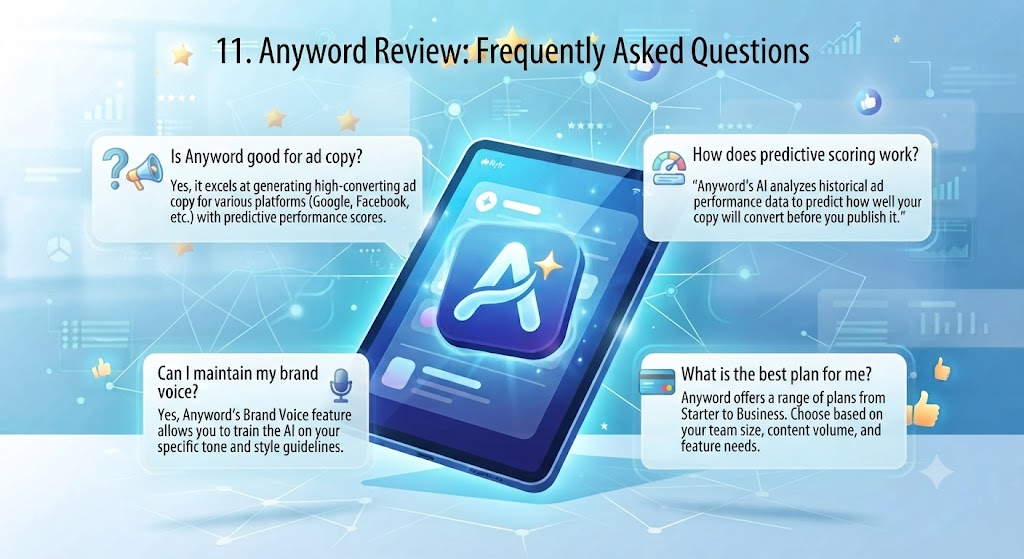
Is Anyword worth it in 2026?
For performance marketers and copywriters, yes — our Anyword review rates it 4.6/5 and considers it the best AI copywriting tool for conversion-focused marketing in 2026. The predictive scoring system delivers real value that justifies the price for teams running active paid campaigns and email programs.
What makes Anyword different from other AI writing tools?
The predictive performance scoring system is what makes Anyword unique. Every Anyword review comes back to this: no other AI writing tool gives you a data-backed prediction of how your copy will perform before you publish it. This scoring is trained on billions of real campaign data points and is accurate enough to meaningfully guide A/B testing decisions.
What is the best Anyword plan for a solo marketer?
The Starter plan at $39/month annually is the entry point, but 50 performance predictions per month is limiting for active campaigns. Most solo performance marketers find the Data-Driven plan at $79/month annually the better choice — it adds real-time scoring for manual edits, audience targeting, and 100 predictions per month. As covered in this Anyword review, the Data-Driven plan is the sweet spot for most individual users.
Does Anyword have a free trial?
Yes — Anyword offers a 7-day free trial with no credit card required. This is one of the better trial structures in the AI writing tool market and gives you enough time to genuinely test the predictive scoring against your own copy.
Is Anyword good for blog writing?
This is an important question for this Anyword review to address honestly: no, not primarily. Anyword’s Blog Post Wizard is functional for basic articles, but the platform’s real strength is short-form performance copy — ads, subject lines, headlines, CTAs. For serious blog writing and long-form SEO content, a dedicated tool like Jasper is the better choice.
Can Anyword score copy I wrote myself or generated elsewhere?
Yes — this is one of the most underused features highlighted in our Anyword review. You can paste any copy into Anyword — whether you wrote it yourself or generated it with ChatGPT, Claude, or Jasper — and get a predictive performance score on it. This makes Anyword useful as an optimization layer on top of any existing AI writing workflow.
How accurate is Anyword’s predictive scoring?
Anyword claims approximately 82% accuracy in its performance predictions. In our Anyword review testing, we found the scores consistently directional — higher-scored variations outperformed lower-scored ones more often than not. Treat the scores as a useful ranking system for prioritizing which variations to test first, not as a guarantee of specific performance outcomes in your market.
Great AI Writing Still Needs An SEO Strategy Behind It
AI can draft your content fast — but ranking it takes structure, keywords, and technical SEO. Tasknestly builds the SEO strategy your content needs to actually get found.
Get SEO Services →