Coolors AI Review 2026: Best AI Color Palette Generator for Designers

As this Coolors AI review shows, if you’ve ever stared at a blank Figma canvas and felt stuck choosing a single color, you already understand why Coolors exists. It’s the tool that millions of designers, developers, and marketers have bookmarked as their first stop when a project needs a color direction — and fast.
In this Coolors AI review, but in 2026, it’s not just a random palette generator anymore. Coolors has grown into a full AI-powered color suite with text-to-palette generation, WCAG accessibility checking, gradient tools, and deep integrations with Figma and Adobe. The question for this review is whether it still holds up as the best option in a increasingly crowded space — or whether newer tools have quietly overtaken it.
Looking at Coolors AI review details, we dug into the current features, real user feedback, pricing, and comparisons to give you a complete, honest picture. Here’s everything you need to know.
Table of Contents
What Is Coolors AI?
Platform Overview
When it comes to this tool, this Coolors AI review found that coolors is a high-speed color palette generator built for designers, developers, content creators, and anyone who works with visuals professionally or recreationally. It was created by Italian developer Fabrizio Bianchi and has grown from a simple spacebar-driven palette randomizer into one of the most comprehensive color tools available in 2026.
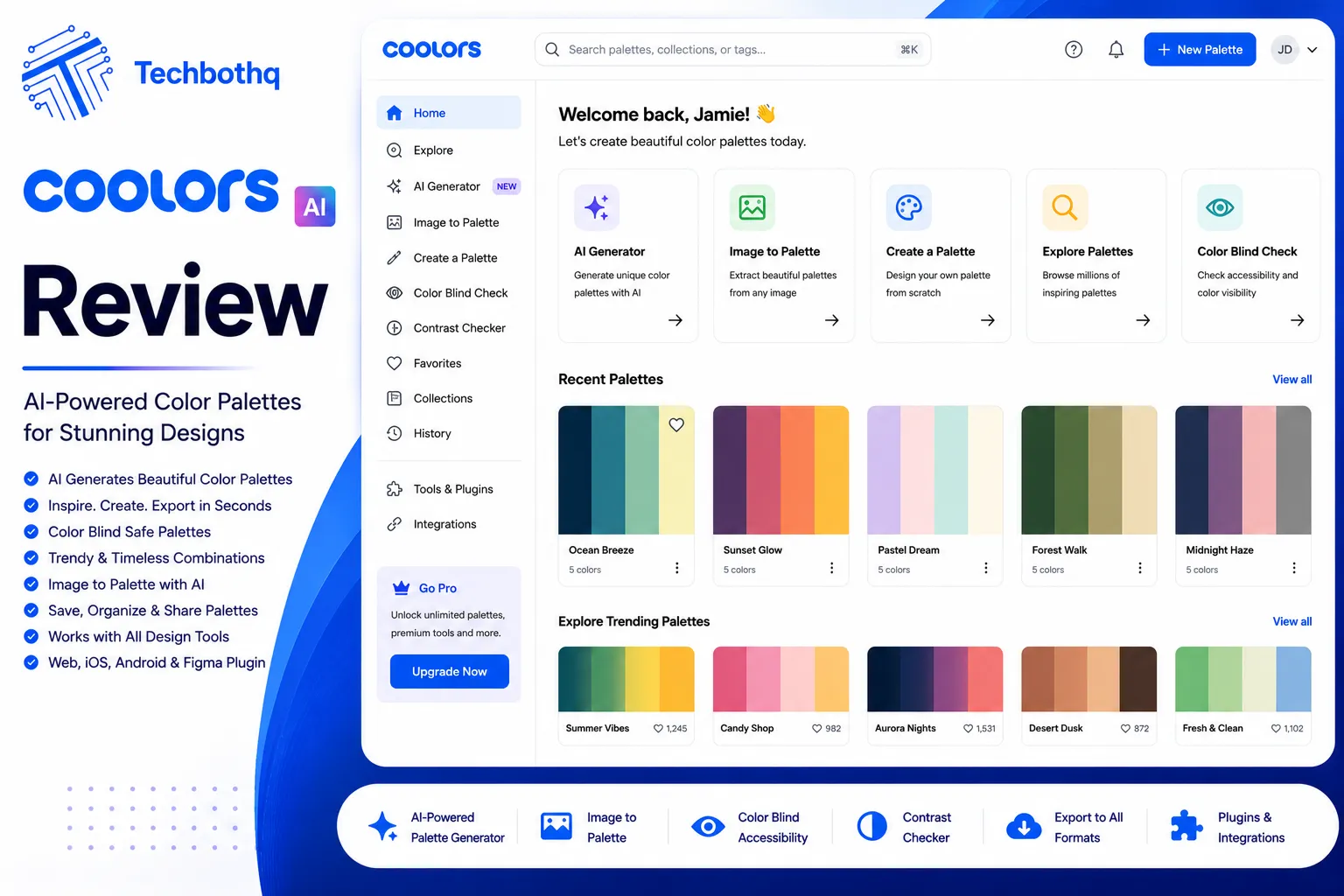
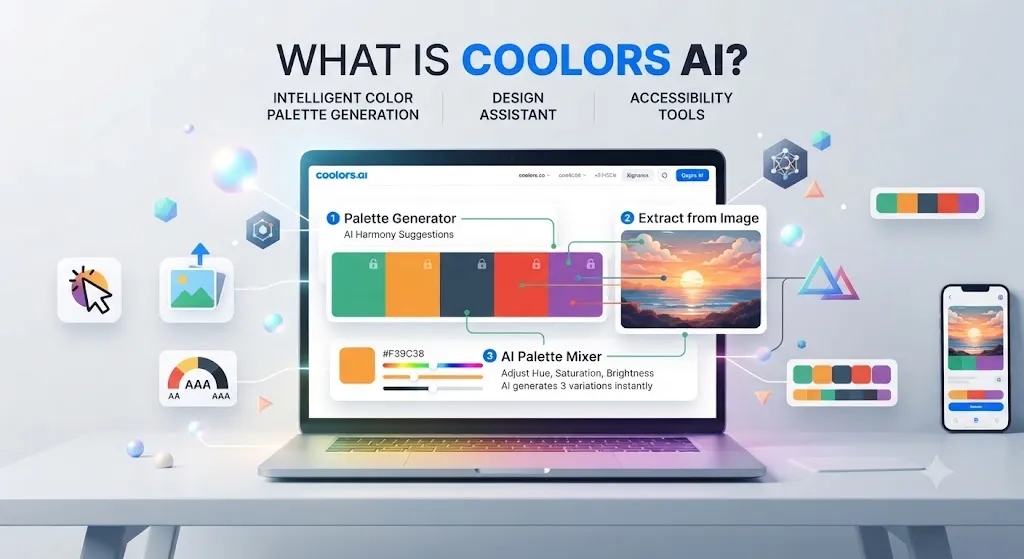
For anyone reading this Coolors AI review, at its core, Coolors lets you generate five-color palettes instantly by pressing the spacebar. You can lock colors you like, shuffle the rest, and refine combinations until you land on something that works. But that core mechanic is surrounded by a full ecosystem of supporting tools: an image color extractor, a gradient maker, a contrast checker, palette visualization on real mockups, and — most relevantly in 2026 — an AI-powered chatbot that takes text prompts and suggests color directions.
This Coolors AI review found that the platform is available on web, iOS, as a Figma plugin, an Adobe extension, and a Chrome extension. That multi-platform presence is one of Coolors’ biggest practical advantages: your palettes follow you wherever you work.
Across this Coolors AI review, with over 5 million users and plugins embedded in the most popular design ecosystems, Coolors has become what many designers consider the default tool for color exploration. The real question isn’t whether it works — it’s whether it works for your specific workflow.
Who Should Use Coolors?
Coolors is best suited for:
On this point, this Coolors AI review notes that – Freelance designers who need fast, harmonious color schemes for client projects without spending hours on color theory
- Within this Coolors AI review, branding professionals creating visual identities who need to explore many directions quickly
- Web and UI designers who need accessible, WCAG-compliant color combinations That’s a key point in this Coolors AI review. Considering the data, this Coolors AI review shows – Developers who want CSS and hex code exports they can drop directly into their codebase In the context of pricing, this Coolors AI review notes – Social media managers and content creators who need cohesive visual color themes for feeds and graphics
- Per this Coolors AI review, students and hobbyists who want a professional-quality tool without paying anything
As this Coolors AI review shows, coolors is not the best fit for designers who need deep typographic previews alongside their palettes (Khroma handles that better), or for those who require palettes synced automatically into the full Creative Cloud ecosystem (Adobe Color owns that use case).
Love What These AI Design Tools Can Do?
Great AI-generated visuals still need a cohesive brand identity holding them together. Let Tasknestly build your full branding — logo, guidelines, and visual system.
Explore Branding Services →Key Features
AI Color Palette Generator
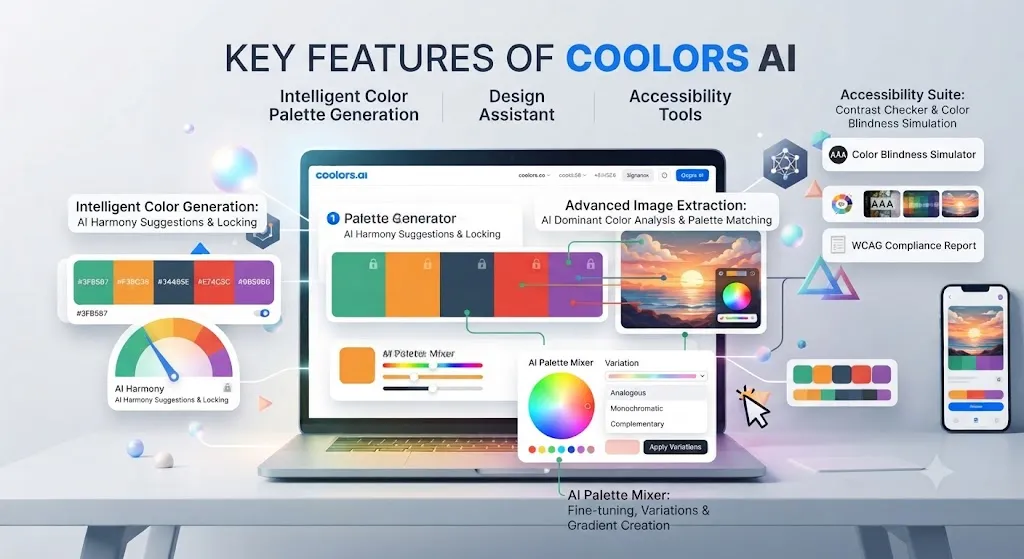
In this Coolors AI review, this is where Coolors has made its most significant 2026 upgrade. The platform now includes an AI-powered chatbot that lets you describe a project in plain language and receive color suggestions tailored to that brief.
Looking at Coolors AI review details, type something like “calm healthcare dashboard” or “bold streetwear brand targeting Gen Z” and the AI returns palette options with the reasoning behind each choice. The neural network behind this feature was trained on WCAG-compliant color pairs and extensive user preference data — meaning the palettes it suggests aren’t just aesthetically interesting, they’re built with contrast and accessibility in mind from the start.
When it comes to this tool, this Coolors AI review found that pro users receive 3,000 AI credits per month, which is more than enough for even active daily use. The text-to-palette feature works in the web interface and is locked behind the Pro plan, but at $3/month, the barrier is genuinely low.
For anyone reading this Coolors AI review, for quick ideation under a client deadline, this feature alone justifies the upgrade.
Palette Exploration
This Coolors AI review found that the spacebar generator remains the most satisfying part of the Coolors experience. Hit the spacebar, get a new five-color palette. Lock a color you want to keep, hit the spacebar again, and only the unlocked colors regenerate. It’s a mechanic that sounds trivial but maps perfectly to how designers actually think: you know what you like when you see it, and you want to iterate quickly from there.
Across this Coolors AI review, beyond random generation, Coolors hosts millions of community-created palettes that you can search by color, mood, style, or keyword. The library is vast and continuously growing. You can search for “forest greens,” “pastel minimalism,” or “neon cyberpunk” and find curated palettes other designers have created and published.
On this point, this Coolors AI review notes that pro users can also save unlimited palettes into organized collections and projects — a significant advantage when managing multiple client color systems simultaneously. Free users are limited to saving 10 palettes total.
Accessibility Checker
Within this Coolors AI review, this is one of Coolors’ most practically valuable features, especially as accessibility requirements tighten in web and app design. The contrast checker lets you test any two colors from your palette against WCAG 2.1 standards, showing you the contrast ratio and whether the combination passes at AA or AAA level for both normal and large text.
Considering the data, this Coolors AI review shows in 2026, WCAG compliance isn’t optional for professional design work — it’s a legal requirement in many jurisdictions for digital products. Having this built directly into the palette generation workflow means you can catch and fix accessibility issues before they make it into production, rather than auditing after the fact.
In the context of pricing, this Coolors AI review notes the Color Blindness Simulator is another tool in this category worth highlighting. It shows you how your chosen palette appears to users with protanopia, deuteranopia, tritanopia, and other forms of color vision deficiency. For any design meant for a broad audience, this feature moves from “nice to have” to essential.
Gradient Generator
Per this Coolors AI review, coolors’ gradient maker lets you create smooth multi-stop gradients from your palette colors and export them in CSS format, ready to paste directly into your stylesheet. You can set gradient direction, add or remove color stops, and preview the result in real time.
As this Coolors AI review shows, for web developers and UI designers working with modern interfaces that rely heavily on gradients for depth and visual interest, this tool eliminates the manual conversion from palette swatches to CSS gradient code. The export is clean and production-ready.
In this Coolors AI review, the Gradient Palette feature extends this further — you can generate a full gradient range between two colors, which is particularly useful when building component libraries or design systems that need graduated shade values.
Brand Color Matching
Looking at Coolors AI review details, the Image Color Extractor is the feature most directly useful for branding work. Upload any image — a product photo, a reference photo, a competitor’s website screenshot, or a piece of art — and Coolors automatically identifies and extracts the dominant colors, secondary tones, and accent hues into a usable palette.
When it comes to this tool, this Coolors AI review found that this is valuable in two common scenarios. The first is brand alignment: you have an existing visual asset (a logo, a hero image, a photography style) and you need to derive a complete color system from it. The second is inspiration: you’ve found a reference image that captures the mood you want, and you need to translate that mood into workable hex codes.
For anyone reading this Coolors AI review, the extraction is accurate enough for professional use, identifying subtle tonal differences that manual sampling would miss.
Export Options
This Coolors AI review found that coolors supports export in PNG, PDF, SVG, CSS, and SCSS formats. For developers, the CSS and SCSS exports are particularly useful — they output your palette as ready-to-use variables you can drop directly into a project.
Across this Coolors AI review, pro users also get access to advanced export options, including the ability to export to JSON, which opens up integrations with design systems and component libraries. The Figma plugin and Adobe extension allow palettes to sync directly into your active design environment, eliminating the copy-paste workflow entirely.
Love What These AI Design Tools Can Do?
Great AI-generated visuals still need a cohesive brand identity holding them together. Let Tasknestly build your full branding — logo, guidelines, and visual system.
Explore Branding Services →Design Workflow Benefits
Branding Projects
On this point, this Coolors AI review notes that color is arguably the most influential single element of brand identity. Studies consistently show that color increases brand recognition by up to 80%, and consumers form a subconscious judgment about a product within 90 seconds — with color accounting for up to 90% of that initial assessment.
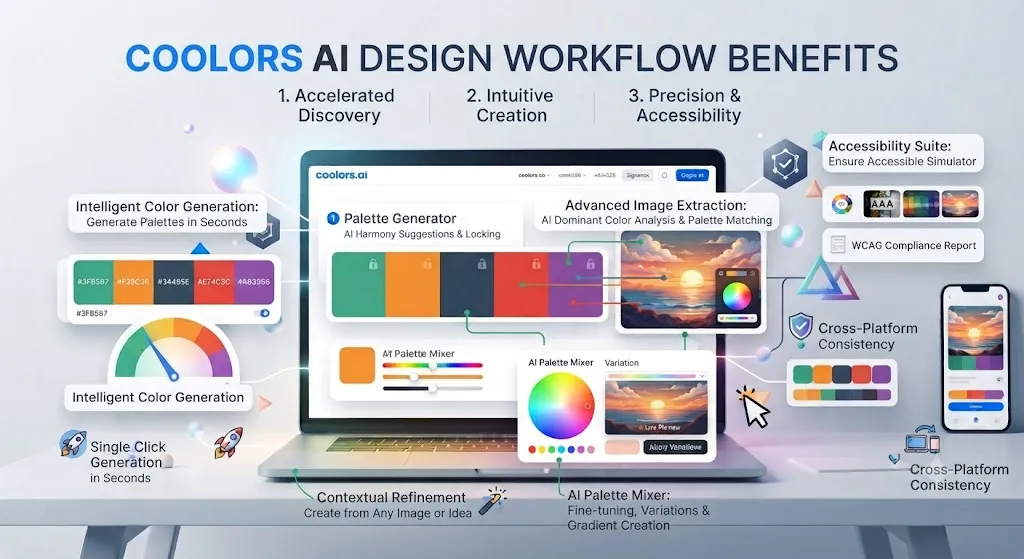
Within this Coolors AI review, for branding work, Coolors addresses the most time-consuming part of the color selection process: exploration. Rather than building palettes manually from a color wheel and testing combinations by instinct, Coolors lets a brand designer explore dozens of directions in the time it would take to carefully construct one.
Considering the data, this Coolors AI review shows the workflow for branding projects typically looks like this: start with the AI chatbot to generate initial directions based on brand keywords, use the spacebar generator to explore variations, run the top candidates through the accessibility checker, extract from any reference imagery using the Image Picker, and export the final system to Figma for presentation. That entire process, which might have taken hours manually, can happen in 20 to 30 minutes with Coolors.
Website Design
In the context of pricing, this Coolors AI review notes web design has specific color requirements that go beyond aesthetics: sufficient contrast for readability, consistent hierarchy signaling (primary actions, secondary content, error states), and compatibility with both light and dark mode if applicable.
Per this Coolors AI review, coolors addresses this with its combination of palette generation, contrast checking, and the Tailwind CSS palette preview feature — a newer addition that lets you preview your color system applied to real Tailwind UI components before you commit to it. For developers building with Tailwind, this closes a significant workflow gap between design tool and final output.
As this Coolors AI review shows, the gradient generator adds another layer of value for web designers, making it easy to create the layered, textured backgrounds that define much of contemporary web design’s aesthetic.
Social Media Graphics
In this Coolors AI review, consistent color across social media content is one of the most effective visual branding techniques available to content creators and small businesses. Coolors makes it straightforward to establish a core palette and export it in formats usable in Canva, Adobe Express, or any other graphics tool.
Looking at Coolors AI review details, the Collage Maker feature — which lets you combine photos and palette swatches into a preview layout — is particularly useful for social media work, allowing you to see how your palette interacts with the actual photography you’ll be using before you build your templates.
When it comes to this tool, this Coolors AI review found that for creators managing content calendars and brand aesthetics, having a single saved palette to reference across all content creation tools creates the consistency that makes feeds look intentional rather than random.
Love What These AI Design Tools Can Do?
Great AI-generated visuals still need a cohesive brand identity holding them together. Let Tasknestly build your full branding — logo, guidelines, and visual system.
Explore Branding Services →Pros and Cons
Advantages
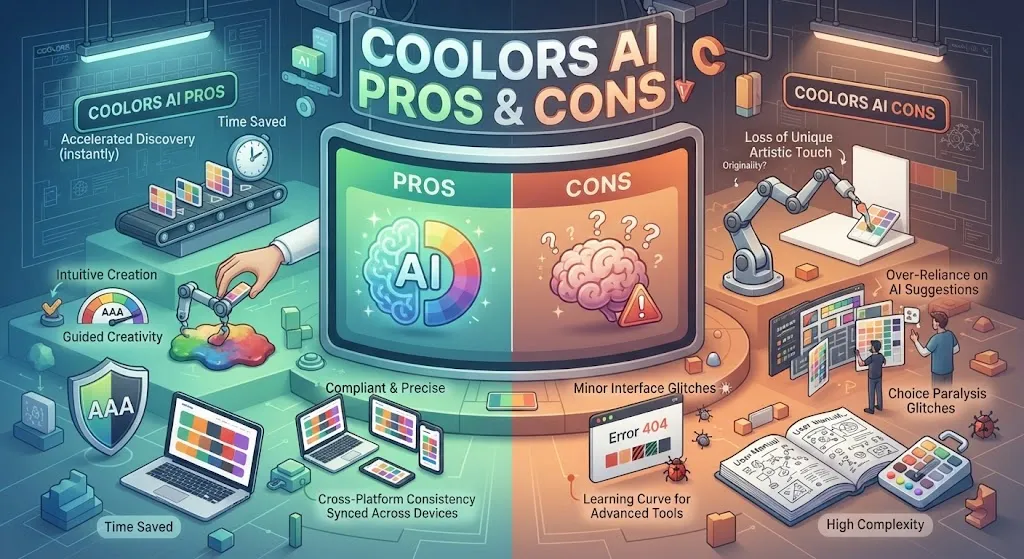
Speed is unmatched. For anyone reading this Coolors AI review, no other color tool generates and iterates on palettes as fast as Coolors. The spacebar mechanic is simple but genuinely effective for fast exploration. When you’re under deadline and need a direction in minutes, nothing else competes.
Free plan is genuinely usable. This Coolors AI review found that unlike many tools that cripple the free tier to the point of uselessness, Coolors’ free plan includes unlimited palette generation, access to the full community library, and basic export options. Students, hobbyists, and small projects can use it indefinitely without paying.
Pro pricing is exceptional value. Across this Coolors AI review, at $3/month, Coolors Pro is one of the most affordable professional design tool subscriptions available. The 3,000 monthly AI credits, unlimited palette storage, and advanced export options represent significant value at that price point.
Ecosystem integrations are robust. On this point, this Coolors AI review notes that figma plugin, Adobe extension, iOS app, Chrome extension — Coolors lives inside the tools designers already use rather than requiring a separate workflow.
Accessibility tools are built in, not bolted on. Within this Coolors AI review, the contrast checker and color blindness simulator are genuinely integrated into the core workflow, not afterthoughts. This matters practically: you’re more likely to actually use accessibility tools when they’re part of the generation process rather than a separate step.
AI prompting is genuinely useful. Considering the data, this Coolors AI review shows the text-to-palette AI feature doesn’t just generate random results — it produces contextually appropriate palettes that align with the described project. For brand work under client briefs, this accelerates the exploration phase significantly.
Drawbacks
Free plan palette limit is restrictive for active users. In the context of pricing, this Coolors AI review notes saving only 10 palettes is limiting if you’re working across multiple projects. You’ll hit this ceiling quickly, which creates pressure to upgrade or manage storage manually.
Mobile app experience is inconsistent. Per this Coolors AI review, multiple user reviews note that the iOS app feels cluttered compared to the clean web interface. The mobile experience hasn’t kept pace with the web version’s refinement.
Five-color default limits some use cases. As this Coolors AI review shows, free users are limited to five-color palettes. Pro users can extend to 10. For complex design systems requiring larger color scales, even 10 colors can be restrictive — though the gradient palette feature partially compensates for this.
Palette validation is limited. In this Coolors AI review, coolors is excellent at generation and exploration, but it intentionally stops short of showing you exactly how a palette performs across real design use cases. You can preview on mockups with the Palette Visualizer, but for in-depth validation across a full component library, you’ll still need a dedicated tool like Stark or Adobe Color.
No offline web functionality. Looking at Coolors AI review details, the web version requires an internet connection. The iOS app has limited offline capability for viewing saved palettes, but generation always requires connectivity.
Love What These AI Design Tools Can Do?
Great AI-generated visuals still need a cohesive brand identity holding them together. Let Tasknestly build your full branding — logo, guidelines, and visual system.
Explore Branding Services →Pricing Plans
Free Plan
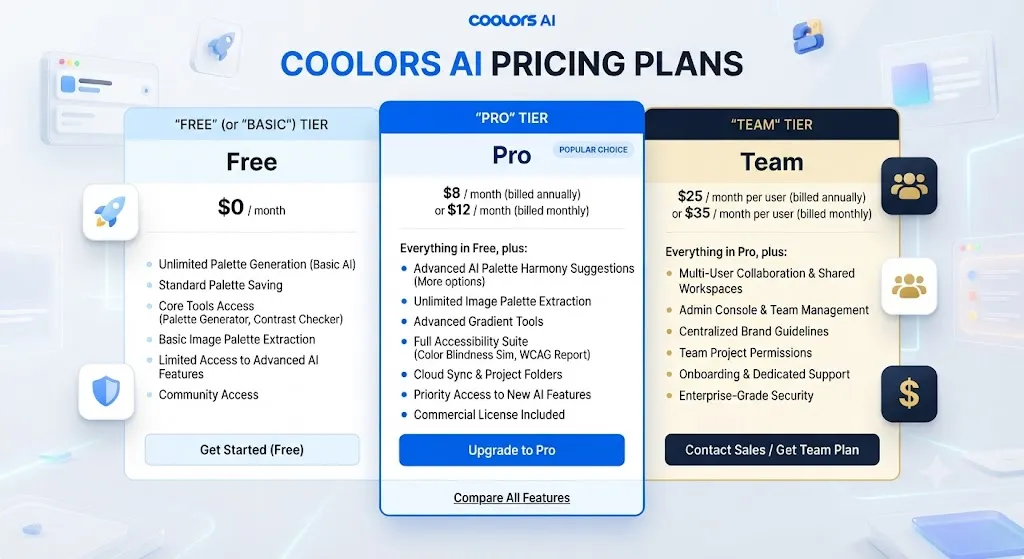
The free plan is available to anyone without a credit card and includes: This holds up throughout the Coolors AI review.
- Unlimited palette generation (spacebar generator) Keep that in mind from this Coolors AI review.
- Access to the community library of millions of palettes That’s a key point in this Coolors AI review.
- Save up to 10 palettes total
- 1 project and 1 collection
- Basic export options (PNG, PDF)
- Image Color Extractor
- Contrast Checker
- Gradient Generator
When it comes to this tool, this Coolors AI review found that the free plan has no time limit — you can use it indefinitely. This makes it genuinely useful for students, occasional users, and anyone just getting started with color work.
Pro Version
Coolors Pro is priced at $3/month (or a discounted annual rate) and includes: This holds up throughout the Coolors AI review.
- Everything in the free plan
- Unlimited palette storage
- Unlimited projects and collections
- AI-powered text-to-palette generation (3,000 credits/month) Keep that in mind from this Coolors AI review.
- 10-color palettes (vs. 5 on free)
- Advanced export options: CSS, SCSS, JSON
- Ad-free experience
- Pro profile
- For anyone reading this Coolors AI review, full access across web, iOS, Figma plugin, Adobe extension, and Chrome extension
This Coolors AI review found that at $3/month, this is one of the most competitively priced professional design tools available anywhere. For working designers managing even two or three client projects simultaneously, the cost-to-value ratio is exceptional.
Love What These AI Design Tools Can Do?
Great AI-generated visuals still need a cohesive brand identity holding them together. Let Tasknestly build your full branding — logo, guidelines, and visual system.
Explore Branding Services →Alternatives
Khroma
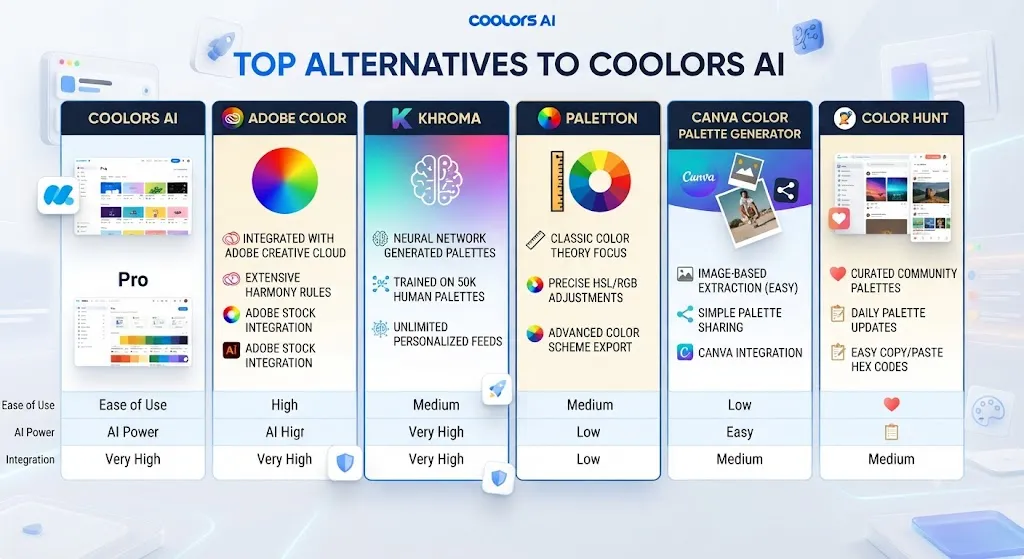
Across this Coolors AI review, khroma takes a fundamentally different approach to AI color generation. Rather than responding to prompts or generating random combinations, Khroma asks you to select 50 colors you personally like when you first sign up. It then trains a neural network on your individual preferences and generates infinite palettes customized to your taste.
On this point, this Coolors AI review notes that the result is more personalized than Coolors — palettes feel less random because they’re drawn from your actual aesthetic sensibility rather than a general training set. Khroma also offers typography, poster, gradient, and image views for each palette, giving you more context for how colors will perform in different design scenarios.
Within this Coolors AI review, the trade-off is setup time and flexibility. The initial 50-color training step takes a few minutes and is required before you can use the tool. And because Khroma is tuned to your preferences, it’s less useful for exploring directions outside your natural aesthetic range.
Best for: designers with a strong established visual voice who want AI that learns their taste. Less suited to: quick random exploration or client work requiring a fresh direction outside your personal style. That’s a key point in this Coolors AI review.
Khroma is currently free with no Pro tier, though it’s limited to web-only access with no integrations.
Adobe Color
Adobe Color is the color tool built directly into the Creative Cloud ecosystem. Its strength is color theory rigor: it gives you a full color wheel with harmony rules (complementary, analogous, triadic, split-complementary, etc.) that you can adjust with precision. Palettes saved in Adobe Color sync automatically into Photoshop, Illustrator, InDesign, and other Creative Cloud apps.
For designers who live in Adobe software, this integration is unmatched. You build a palette in Adobe Color and it appears in your Photoshop swatches without any export or import step.
Adobe Color also includes solid accessibility tools — contrast ratios update in real time as you adjust colors on the wheel, and there’s a Color Blind Safe checker similar to Coolors’.
Where Adobe Color falls short is speed and exploration. There’s no spacebar-style random generation, no community library as browsable as Coolors’, and no AI text-to-palette feature. It’s a precision instrument rather than an exploration tool.
Best for: designers already in the Adobe ecosystem who need palettes synced into Creative Cloud. Not ideal for: quick ideation, teams outside Adobe’s ecosystem, or anyone who prefers exploration over structured color theory.
Canva Color Tools
Canva’s built-in color tools — including its palette generator and color combinations feature — are designed primarily for non-designers who are already working within Canva. If your entire design workflow lives in Canva, using its native color tools makes sense for convenience.
However, Canva’s color features are significantly more limited than Coolors in both depth and precision. There’s no AI text-to-palette generation comparable to Coolors, no developer-facing export (CSS, SCSS, JSON), no Figma integration, and no accessibility checking at the depth Coolors offers.
Canva Color is best understood as a “good enough” solution for Canva-native users rather than a serious color tool for professional design work.
Love What These AI Design Tools Can Do?
Great AI-generated visuals still need a cohesive brand identity holding them together. Let Tasknestly build your full branding — logo, guidelines, and visual system.
Explore Branding Services →Final Verdict
Is Coolors Worth It?
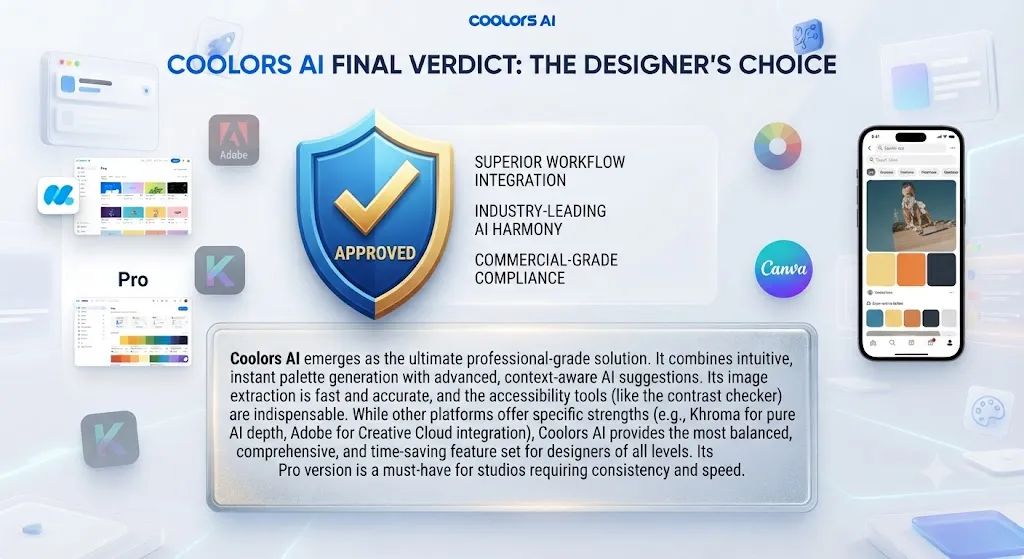
Yes — and the answer is especially clear when you factor in the pricing. For a free tool, Coolors is already one of the best color resources available to designers anywhere. For $3/month, the Pro upgrade is among the easiest calls in professional software: you get AI generation, unlimited storage, and export formats that save real time in real workflows.
The tool does what it promises exceptionally well. Speed of exploration, quality of the generated palettes, depth of the surrounding tools (accessibility checker, gradient generator, image extractor), and the ecosystem integrations all hold up against scrutiny. In head-to-head testing across design workflows, Coolors remains the fastest route from “no color direction” to “usable palette” — and that’s the job most designers actually need it to do.
The limitations are real but narrow. If you need deep palette validation across a full component library, add Stark or Adobe Color to your workflow. If you need palettes that intuitively reflect your personal aesthetic without prompting, Khroma fills that gap. But for the core task of fast, high-quality color exploration, Coolors hasn’t been surpassed.
In the words of one design reviewer from 2026: many designers end up using Coolors for quick ideation, Adobe Color for technical validation, and Khroma for long-term brand-consistent work. That framing is accurate — but it also underscores that Coolors is the starting point for most designers’ color processes, which is arguably the most important position to hold.
Best Use Cases
Coolors Pro is the right choice if you:
- Are a freelance designer or small agency working across multiple client brand projects
- Need to explore many color directions quickly before narrowing to a final system
- Build websites or UI and need WCAG-compliant color combinations without a separate tool
- Work in Figma and want palette sync without leaving your design environment
- Are a developer who needs CSS/SCSS color variable exports as a direct workflow output
- Manage social media or content creation and need a consistent, saved color system
- Want AI-assisted palette generation at a price point that doesn’t require budget approval
Stick with the free plan if you:
- Are a student, hobbyist, or working on personal projects
- Only need occasional color inspiration rather than professional palette management
- Don’t need AI generation, advanced export formats, or unlimited storage
Look at alternatives if you:
- Need palettes automatically synced into the full Adobe Creative Cloud suite → Adobe Color
- Want AI that learns your personal aesthetic over time → Khroma
- Work exclusively within Canva and need nothing beyond its ecosystem → Canva Color
Love What These AI Design Tools Can Do?
Great AI-generated visuals still need a cohesive brand identity holding them together. Let Tasknestly build your full branding — logo, guidelines, and visual system.
Explore Branding Services →Summary
| Feature | Free Plan | Pro Plan ($3/mo) |
|---|---|---|
| Palette Generation | ✅ Unlimited | ✅ Unlimited |
| Saved Palettes | 10 max | Unlimited |
| AI Text-to-Palette | ❌ | ✅ 3,000 credits/mo |
| Palette Colors | 5 max | Up to 10 |
| Contrast Checker | ✅ | ✅ |
| Gradient Generator | ✅ | ✅ |
| Image Color Extractor | ✅ | ✅ |
| CSS/SCSS Export | ❌ | ✅ |
| Figma Plugin | ✅ | ✅ |
| Adobe Extension | ✅ | ✅ |
| Ad-Free | ❌ | ✅ |
| Color Blindness Simulator | ✅ | ✅ |
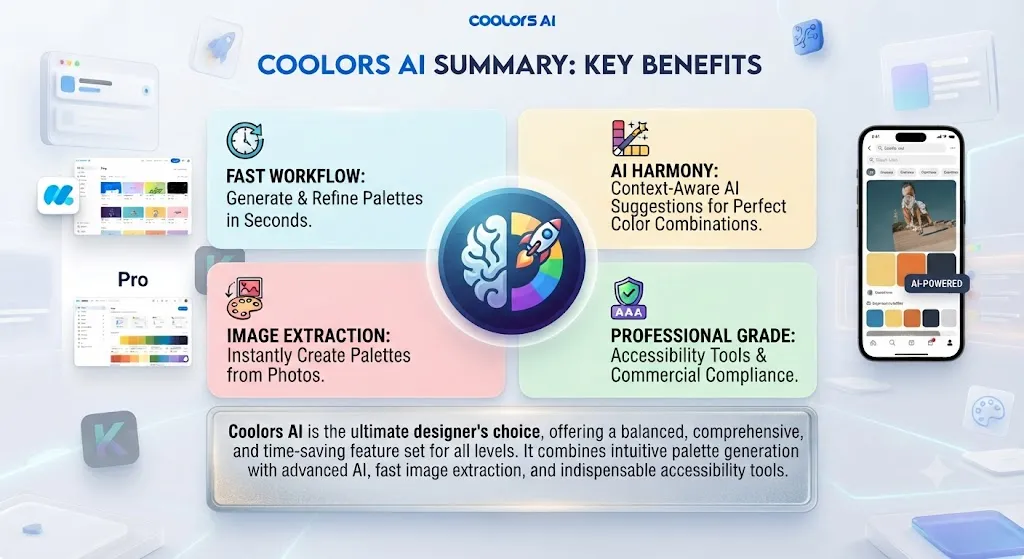
Coolors has earned its position as the go-to color tool for designers across skill levels and use cases. The 2026 AI upgrade doesn’t replace the tool’s core identity — it enhances it. Whether you’re building a brand identity, designing a web interface, or just trying to settle on a palette for a social media refresh, Coolors is the fastest, most practical, and most affordable place to start.
Rating: 8.2/10
Best for: Freelancers, agencies, web designers, and developers who need fast, professional-quality color palettes with accessibility support and design tool integrations.
Price: Free — $3/month Pro
Love What These AI Design Tools Can Do?
Great AI-generated visuals still need a cohesive brand identity holding them together. Let Tasknestly build your full branding — logo, guidelines, and visual system.
Explore Branding Services →