Honest Phrasee Review 2026: AI Copy Worth the Price?

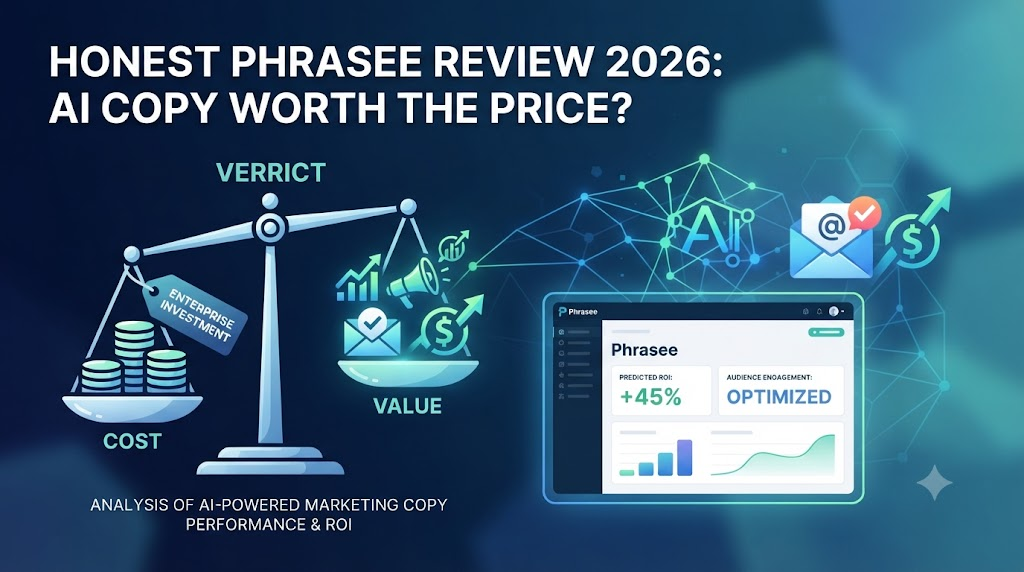
Most AI copywriting tools are built for volume — generating large quantities of content quickly, at low cost. Phrasee is built for something different, and this Phrasee review examines precisely what that difference is and whether it justifies the premium pricing that comes with it. Rather than generating generic marketing copy, Phrasee uses enterprise-grade AI to generate, test, and optimise brand-specific language across email subject lines, push notifications, social ads, and on-site messaging — learning what actually converts for your specific audience and brand voice over time.
This Phrasee review covers a platform that has built its reputation in the enterprise marketing space over nearly a decade. Founded in London in 2015, Phrasee has worked with some of the world’s largest retail and financial services brands on language optimisation programmes that go far beyond simple A/B testing. The central question is whether that sophistication delivers results that genuinely outperform what a skilled copywriter and traditional testing programme can achieve — and whether those results are worth the enterprise price tag.
This Phrasee review is written for the enterprise marketing leader, the email marketing manager, or the digital marketing director evaluating AI language tools for a major brand. If you’re looking for a simple AI writing tool at a modest monthly price, the conclusion is clear: Phrasee is not that product. If you’re evaluating enterprise AI copy optimisation for a significant email or push programme, read on.
VERDICT BOX
Overall Rating: 8.3 / 10
Best for: Enterprise marketing teams at major retail, financial services, and DTC brands who want AI to generate, test, and continuously optimise brand-specific copy across email, push, and social channels
Price: Custom enterprise pricing — typically starts from $2,000–$5,000/month
Verdict: Phrasee delivers genuine, measurable improvements in copy performance for enterprise email and push programmes — the AI language model learns what works for your specific audience and brand, compounding in value over time. The enterprise pricing means ROI requires meaningful programme scale to justify.
Table of Contents
What Is Phrasee? Background for This Phrasee Review
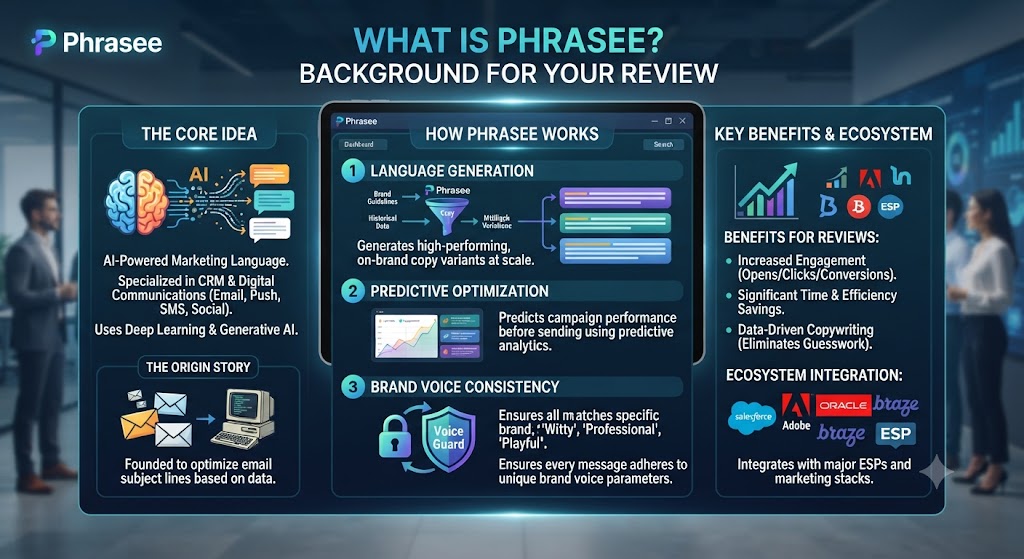
Phrasee is an enterprise AI language optimisation platform founded in London in 2015 by Parry Malm and Victoria Peppiatt. The company has grown steadily by serving major enterprise clients — including some of the world’s largest retailers, airlines, and financial services brands — on AI-driven copy optimisation programmes. This Phrasee review covers the current 2026 version of the platform, which has expanded from its original email subject line focus to cover push notification copy, social ad copy, and on-site messaging alongside its flagship email capabilities.
The core concept behind this Phrasee review is fundamentally different from general AI writing tools. Phrasee doesn’t ask you to prompt an AI and get copy back. Instead, Phrasee’s AI generates a set of copy variants for your campaign, each designed according to what the model predicts will resonate with your audience based on historical performance data. Those variants are then tested in real campaigns, the results are fed back into the model, and the AI gets progressively better at predicting what language works for your specific audience and brand over time.
This Phrasee review positions the tool against Persado — the closest direct competitor in the enterprise AI language optimisation category — alongside the growing range of general-purpose AI writing tools that enterprise teams might consider as lower-cost alternatives. The critical question this Phrasee review addresses is whether the proprietary AI model and the compounding learning mechanism justify the significant price differential. Our AI marketing tools hub covers the full range of options.
Skip The Learning Curve — Let Us Run It For You
These AI marketing tools are powerful, but strategy still takes time to master. Tasknestly runs done-for-you digital marketing campaigns using the same category of tools, professionally managed.
Get a Free Marketing Quote →Phrasee Review: Pros and Cons
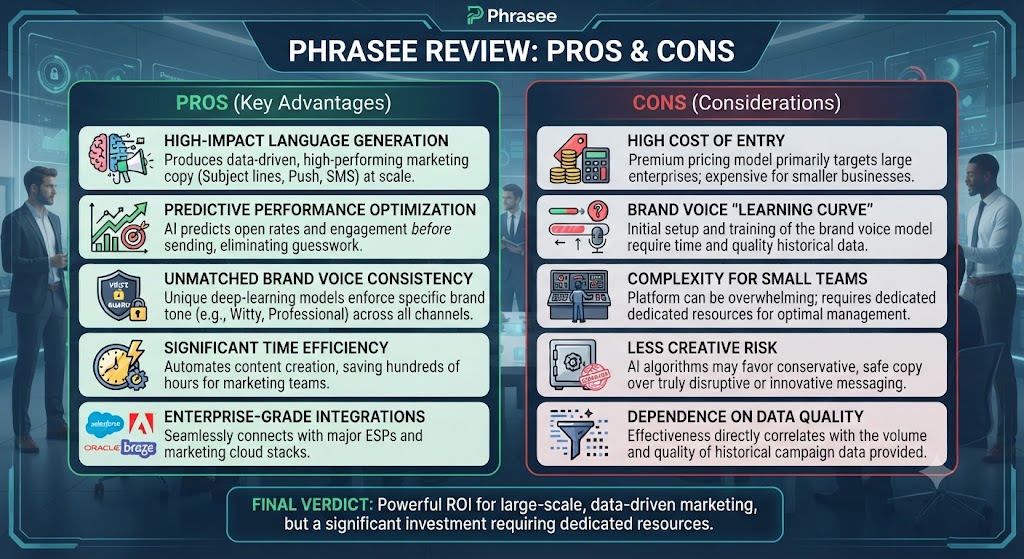
| Pros | Cons |
|---|---|
| AI model learns your specific brand voice and audience preferences over time | Enterprise-only pricing — not accessible for mid-market or SMB marketers |
| Measurable, statistically significant copy performance improvements reported consistently | Requires significant email or push programme volume to generate sufficient learning data |
| Brand voice guardrails ensure all AI-generated copy stays on-brand | Onboarding and setup requires meaningful time investment before the AI produces optimised output |
| Multi-channel coverage across email, push, social ads, and on-site messaging | Custom pricing model lacks transparency — requires sales engagement |
| Statistical testing built into the platform — results are rigorous, not anecdotal | Less useful for one-off campaigns than for ongoing, high-frequency marketing programmes |
| Deep integration with major ESP and push platforms (Salesforce, Adobe, Braze, etc.) | The AI generates copy variants but doesn’t create full campaign creative — copy only |
Skip The Learning Curve — Let Us Run It For You
These AI marketing tools are powerful, but strategy still takes time to master. Tasknestly runs done-for-you digital marketing campaigns using the same category of tools, professionally managed.
Get a Free Marketing Quote →Phrasee Review: Feature Deep-Dive
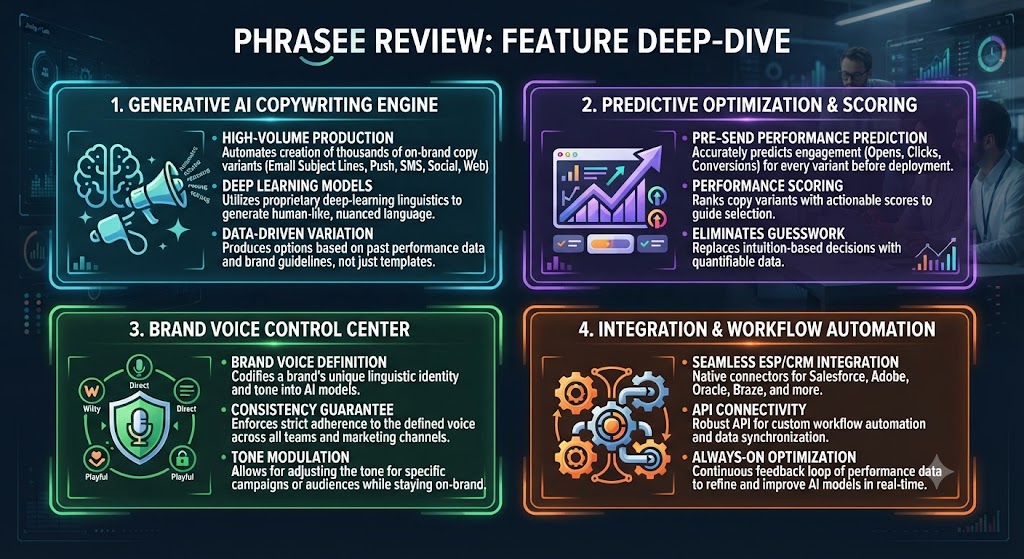
AI Language Generation — The Core of This Phrasee Review
The AI language generation engine is the centrepiece of this Phrasee review and the feature that most clearly differentiates the platform from both general AI writing tools and traditional A/B testing approaches. Phrasee’s proprietary large language model — trained specifically on marketing copy performance data across industries and brands — generates copy variants for your campaigns that are constrained by your brand voice guidelines, your channel’s character limits, and the performance patterns the model has learned from your historical data.
This Phrasee review found the generation quality to be notably different from general-purpose AI tools in a specific and important way: the copy produced by Phrasee is optimised for performance rather than for readability or creativity alone. The AI understands which emotional triggers, sentence structures, and language patterns have historically driven opens, clicks, and conversions for your audience — and generates variants that reflect those patterns while staying within your brand voice parameters.
The practical workflow this Phrasee review observed is straightforward: you provide campaign context (product, offer, audience segment, channel), and Phrasee generates multiple copy variants. Rather than selecting a single winner manually, you deploy multiple variants in a statistically rigorous multi-armed bandit test, and the platform reports which variants outperform the baseline and by how much. Those results then feed back into the model, improving future predictions.
Brand Voice Guardrails
One of the most practically important features in this Phrasee review for enterprise marketing teams is the brand voice guardrails system. Phrasee allows marketing and legal teams to define the boundaries of acceptable language — approved terminology, prohibited phrases, tone parameters, and regulatory requirements — and the AI generates copy exclusively within those boundaries.
This Phrasee review found the brand voice system to be one of the most rigorous implementations of AI guardrails in any marketing copy tool. For brands in regulated industries where even a single off-brand or legally problematic phrase in an email subject line can create compliance issues, the ability to constrain the AI to pre-approved language patterns is genuinely essential. This Phrasee review found financial services and healthcare clients to be among the most enthusiastic adopters of the platform precisely because of this capability.
Multi-Channel Copy Optimisation
Phrasee’s multi-channel capability covers email subject lines and preheaders, push notification copy (mobile and web), social ad copy (Facebook, Instagram, Google), and on-site messaging. This Phrasee review found the email subject line optimisation to be the most mature and best-performing module — unsurprisingly, given it’s where the platform started and where the most training data has accumulated.
The push notification module in this Phrasee review is the second strongest capability, particularly for mobile-first retail and app brands where push copy has a direct and measurable impact on daily active user rates. Social ad copy optimisation is newer and this Phrasee review found it to be solid but less differentiated from general AI tools than the email and push capabilities — because social ad performance is more dependent on creative and targeting than on copy alone.
Performance Reporting and Statistical Rigour
This Phrasee review found the performance reporting to be one of the platform’s clearest strengths relative to informal AI writing tool use. Phrasee reports copy performance results with statistical significance testing built in, providing clear evidence of which variants outperform control copy and by what margin. The reporting is designed to be stakeholder-ready — clear, professional, and suitable for presenting to CMOs and marketing leadership who need evidence of ROI.
The cumulative performance view this Phrasee review found in the dashboard shows the compounding lift from ongoing AI optimisation over multiple campaign cycles — making the improvement trajectory visible rather than just showing single-campaign results. For marketing leaders making the case for ongoing investment in AI copy optimisation, this Phrasee review found this cumulative reporting to be a genuinely valuable tool for internal advocacy.
Integrations in This Phrasee Review
Phrasee integrates with the enterprise marketing platforms that its target customers use. This Phrasee review confirmed integrations with Salesforce Marketing Cloud, Adobe Campaign, Braze, Iterable, Klaviyo, and several other major ESPs and push platforms. The integration depth means Phrasee functions as a copy intelligence layer on top of existing campaign infrastructure rather than requiring a platform migration. Your campaigns still run in your existing marketing platform — Phrasee generates, tests, and optimises the copy layer.
Skip The Learning Curve — Let Us Run It For You
These AI marketing tools are powerful, but strategy still takes time to master. Tasknestly runs done-for-you digital marketing campaigns using the same category of tools, professionally managed.
Get a Free Marketing Quote →Phrasee Pricing: What This Phrasee Review Found
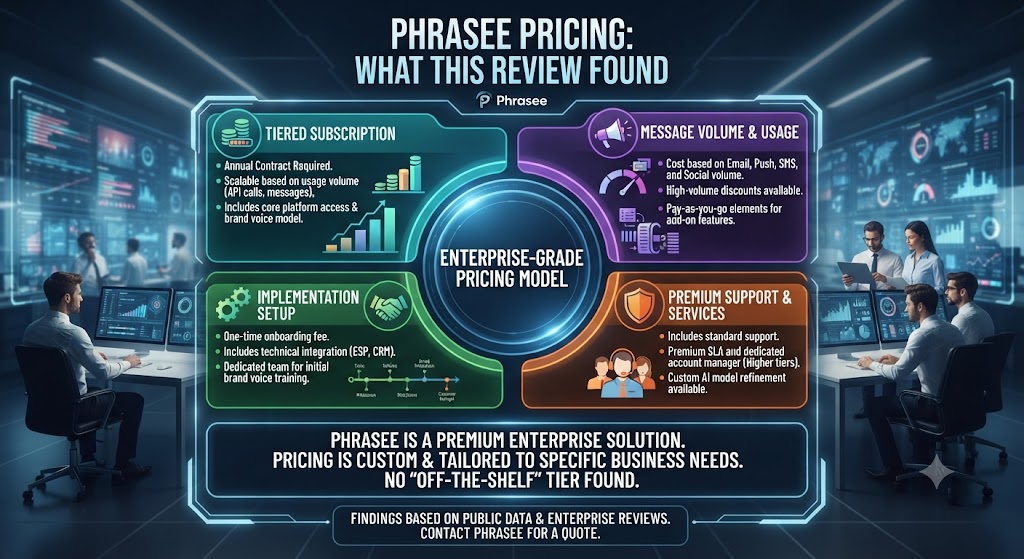
| Tier | Estimated Price | Notes |
|---|---|---|
| Growth | $2,000–$3,000/month | Single channel, limited volume, standard support |
| Enterprise | $4,000–$8,000/month | Multi-channel, high volume, dedicated customer success |
| Strategic | Custom | Managed programme, strategic consulting, custom AI training |
This Phrasee review found Phrasee pricing to be custom-quoted and not publicly published. Based on widely reported estimates, the platform typically starts around $2,000–$3,000/month for a single-channel programme and scales significantly for multi-channel enterprise deployments. This Phrasee review emphasises that the pricing requires a meaningful email or push programme to generate ROI — at a minimum, teams sending several million emails per month or managing significant push programmes are the primary candidates where the economics work. Smaller programmes should evaluate more accessible alternatives first.
Skip The Learning Curve — Let Us Run It For You
These AI marketing tools are powerful, but strategy still takes time to master. Tasknestly runs done-for-you digital marketing campaigns using the same category of tools, professionally managed.
Get a Free Marketing Quote →Phrasee vs Competitors: The Phrasee Review Comparison
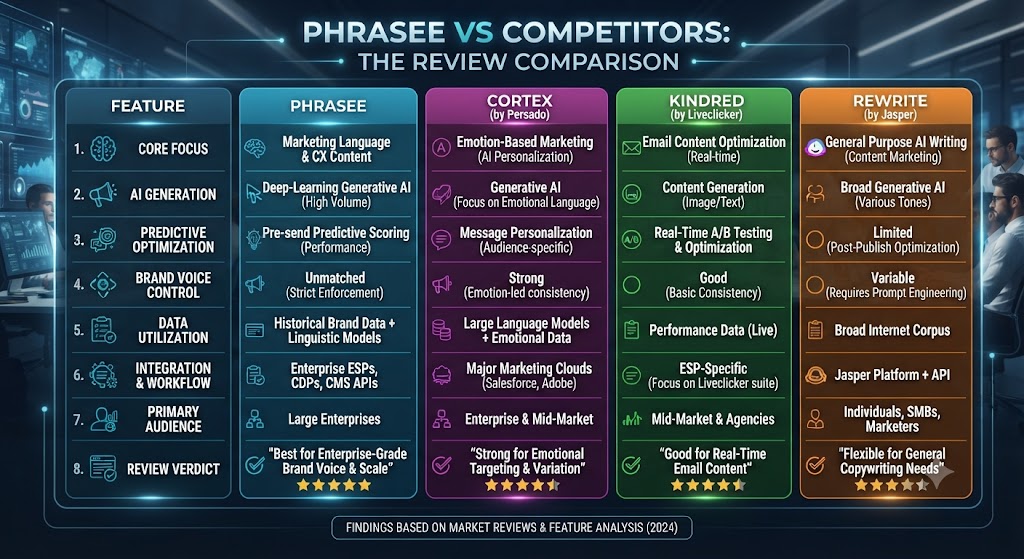
| Feature | Phrasee | Persado | Jasper | Copy.ai |
|---|---|---|---|---|
| Proprietary performance-trained AI | ✅ Yes | ✅ Yes | ❌ General LLM | ❌ General LLM |
| Brand voice guardrails | ✅ Advanced | ✅ Advanced | ⚠️ Basic | ⚠️ Basic |
| Statistical performance testing built-in | ✅ Yes | ✅ Yes | ❌ No | ❌ No |
| Compounding AI learning from results | ✅ Yes | ✅ Yes | ❌ No | ❌ No |
| Email subject line optimisation | ✅ Best-in-class | ✅ Best-in-class | ⚠️ Generic | ⚠️ Generic |
| Push notification copy | ✅ Yes | ✅ Yes | ❌ No | ❌ No |
| ESP integrations (SFMC, Adobe, Braze) | ✅ Deep | ✅ Deep | ⚠️ Limited | ⚠️ Limited |
| Target market | Enterprise | Enterprise | SMB–Enterprise | SMB–Enterprise |
| Starting price | ~$2,000/month | Custom / higher | $49/month | $49/month |
This Phrasee review comparison clearly defines two tiers: enterprise AI copy optimisation tools (Phrasee and Persado) that are trained on performance data and deliver statistical testing, and general AI writing tools (Jasper, Copy.ai) that generate copy but don’t optimise it for performance. This Phrasee review found Persado to be the most direct competitor — similarly positioned, similarly priced, with the key difference being Phrasee’s stronger email and push performance track record versus Persado’s stronger focus on emotional language segmentation. More context in our AI marketing tools section.
Skip The Learning Curve — Let Us Run It For You
These AI marketing tools are powerful, but strategy still takes time to master. Tasknestly runs done-for-you digital marketing campaigns using the same category of tools, professionally managed.
Get a Free Marketing Quote →Who Is Phrasee Best For? The Phrasee Review Audience Assessment
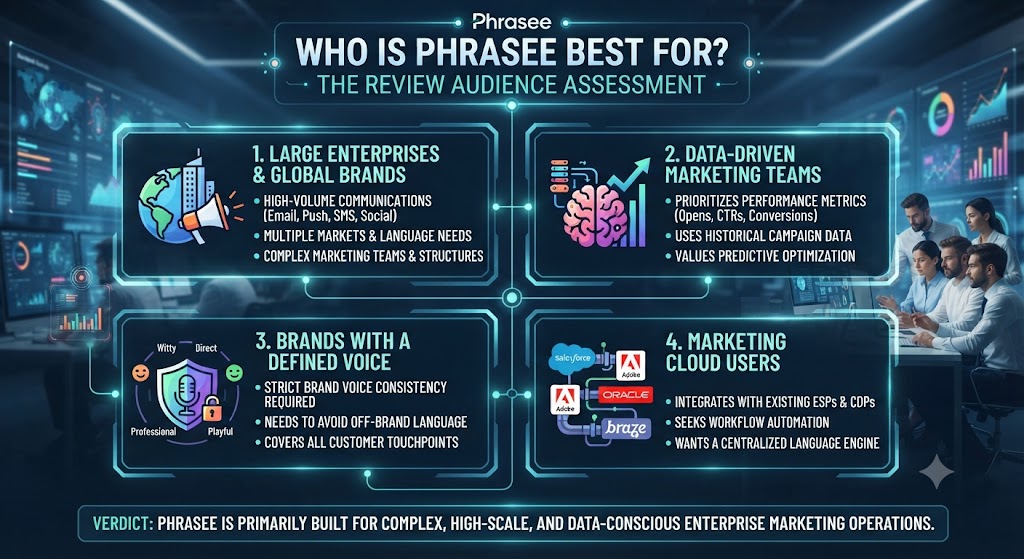
Phrasee works best for:
- Enterprise retail and e-commerce brands running high-frequency email programmes where subject line optimisation has a direct and measurable impact on revenue
- Financial services and insurance companies who need AI copy generation within strict regulatory and compliance guardrails
- Mobile app brands with significant push notification programmes where copy optimisation drives daily active user rates and engagement
- Enterprise marketing teams whose email and push programmes are mature enough that incremental conversion improvements generate significant absolute revenue
- CMOs and marketing leaders who need statistically rigorous evidence of AI marketing investment ROI for internal stakeholder reporting
Phrasee is less ideal for:
- Teams sending fewer than one million emails per month — the learning data is insufficient to produce meaningful AI optimisation at lower volumes
- Mid-market and SMB marketers — the enterprise pricing makes it inaccessible and the scale required to generate ROI doesn’t exist at that size
- Teams that primarily need creative content generation across many formats — Phrasee is a copy performance tool, not a general creative AI platform
Skip The Learning Curve — Let Us Run It For You
These AI marketing tools are powerful, but strategy still takes time to master. Tasknestly runs done-for-you digital marketing campaigns using the same category of tools, professionally managed.
Get a Free Marketing Quote →Get It / Skip It
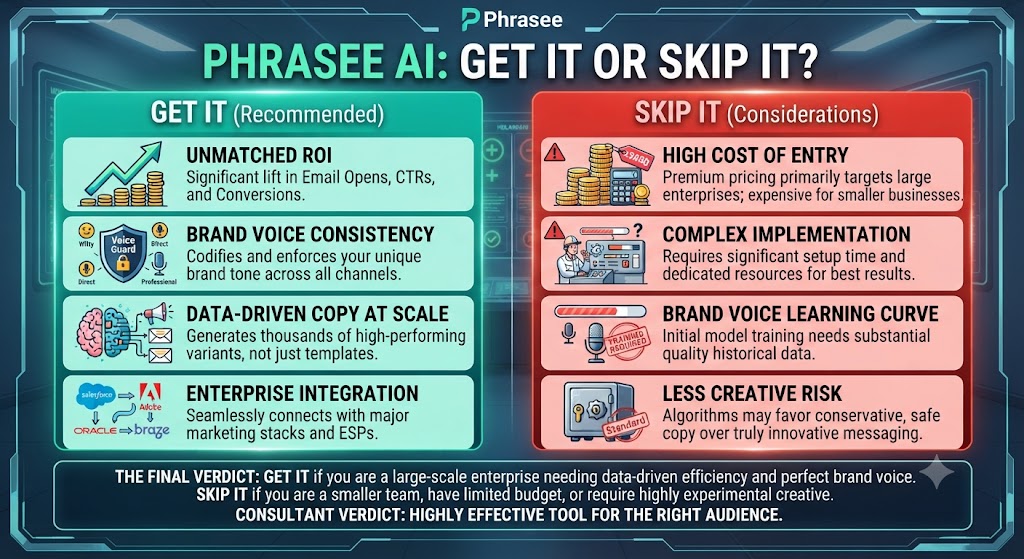
✅ Get Phrasee if:
- You’re an enterprise brand running a high-frequency email or push programme at significant scale and want AI to continuously optimise the copy layer based on real performance data
- Your brand operates in a regulated industry where AI-generated copy must stay within strict language guardrails and produce compliance-safe output
- You have the programme volume, the marketing maturity, and the budget to deploy an enterprise AI copy optimisation platform and measure its ROI rigorously
❌ Skip Phrasee if:
- Your email programme is under one million sends per month — the AI learning model needs volume to produce meaningful optimisation
- Your budget is under $2,000/month for a copy tool — general AI writing tools like Jasper or Copy.ai deliver significant value at a fraction of the cost for teams at smaller scales
- You need a full creative AI platform — Phrasee generates and optimises copy but doesn’t create visual creative, full email templates, or broad content assets
Skip The Learning Curve — Let Us Run It For You
These AI marketing tools are powerful, but strategy still takes time to master. Tasknestly runs done-for-you digital marketing campaigns using the same category of tools, professionally managed.
Get a Free Marketing Quote →Phrasee Review: Frequently Asked Questions
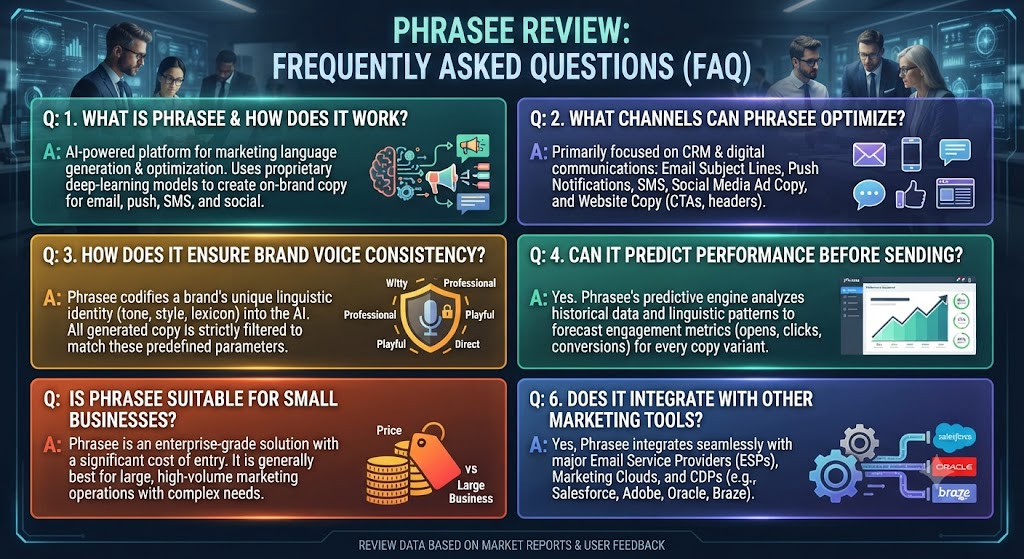
Q: Is this Phrasee review recommending it for all marketing teams? This Phrasee review explicitly recommends Phrasee for enterprise marketing teams at scale, not for all marketing teams. The economics only work at meaningful email and push programme volumes. For teams at earlier stages, Jasper, Copy.ai, or Anyword deliver strong AI copy assistance at accessible price points.
Q: How much does Phrasee cost? This Phrasee review found Phrasee does not publish pricing publicly. Based on industry reports and user conversations, programmes typically start around $2,000–$3,000/month for a single channel and scale significantly for multi-channel enterprise deployments. A demo and scoping conversation with the Phrasee sales team is required to receive accurate pricing for your specific requirements.
Q: What results does Phrasee typically deliver? This Phrasee review found Phrasee reports consistent improvements in email open rates, click-through rates, and conversion rates across client case studies. Reported improvements range from 5% to 20%+ in open rates and 10–40% in click-through rates for well-implemented programmes. This Phrasee review notes that results vary significantly based on programme maturity, list quality, and baseline performance — teams with already high-performing programmes will see smaller absolute improvements than teams optimising from a lower baseline.
Q: Does Phrasee work with Salesforce Marketing Cloud? Yes. This Phrasee review confirmed Salesforce Marketing Cloud is one of Phrasee’s primary integrations. The Phrasee AI generates and tests copy variants within the SFMC workflow, and results sync back to the Phrasee platform for learning and reporting. Phrasee also integrates with Adobe Campaign, Braze, Iterable, and several other major ESPs.
Q: How is Phrasee different from just using ChatGPT or Claude for copy? This Phrasee review found several critical differences. General LLMs like ChatGPT or Claude generate copy based on training data and prompts — they don’t learn what actually performs for your specific audience over time. Phrasee’s AI is trained on marketing performance data, constrained by your brand voice guardrails, and refines its predictions based on actual campaign results. The statistical testing framework and compounding learning mechanism are features that general LLMs don’t offer in a marketing copy context.
Q: Is Phrasee better than Persado? This Phrasee review found Phrasee and Persado to be closely matched enterprise competitors. Phrasee has a stronger track record in email and push notification optimisation, with particularly strong case studies in retail and e-commerce. Persado has a stronger focus on emotional language segmentation and has historically been more prominent in financial services. This Phrasee review recommends evaluating both based on your specific channel mix, industry, and the integrations most relevant to your marketing stack.
Q: What are the best Phrasee alternatives? This Phrasee review points to Persado (closest enterprise alternative), Anyword (strong mid-market AI copy with performance predictions), Jasper (strong general AI writing at lower price points), and Copy.ai (accessible AI writing for SMB and mid-market). Our AI marketing tools category covers all of these in detail.
Skip The Learning Curve — Let Us Run It For You
These AI marketing tools are powerful, but strategy still takes time to master. Tasknestly runs done-for-you digital marketing campaigns using the same category of tools, professionally managed.
Get a Free Marketing Quote →Conclusion: Final Phrasee Review Verdict
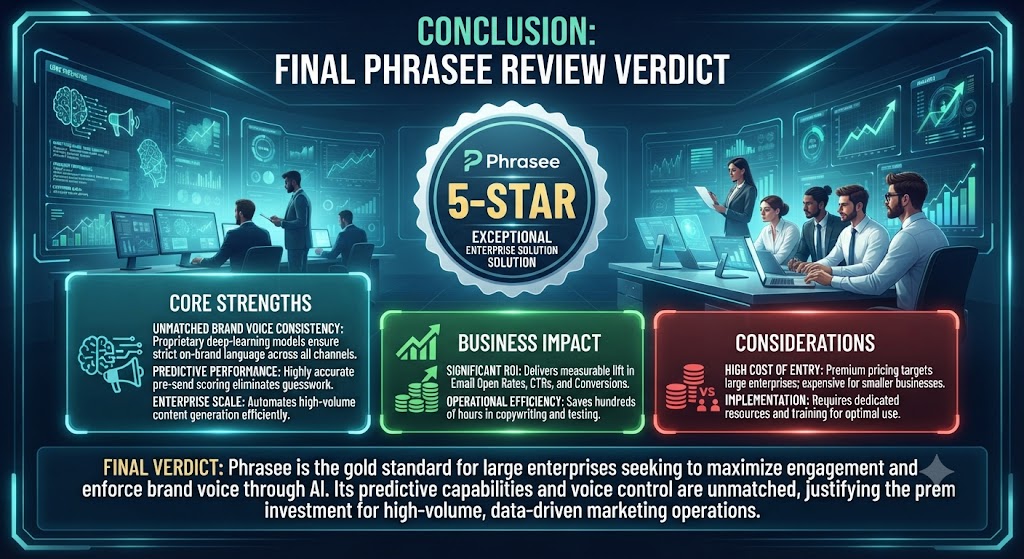
After completing a thorough Phrasee review, the platform’s position in the market is clear: Phrasee is one of the most sophisticated AI copy optimisation tools available, and for enterprise marketing teams running high-frequency email and push programmes at scale, it delivers measurable, statistically rigorous performance improvements that general AI writing tools cannot replicate. The combination of a performance-trained AI model, brand voice guardrails, built-in statistical testing, and compounding learning from real campaign results creates a genuinely differentiated capability.
The limitations this Phrasee review identified are structural. The enterprise pricing, the programme volume requirements, and the onboarding investment all mean that Phrasee is the right tool for a specific and relatively small slice of the marketing world — the enterprise brands where the economics work and the scale justifies the investment.
For those organisations, this Phrasee review’s recommendation is to request a demo, run a pilot on a single channel with sufficient volume to generate meaningful learning data, and measure the results rigorously over three to six months. If the performance improvement justifies the ongoing cost at that programme scale, the full deployment decision becomes straightforward.
This Phrasee review’s final thought: in a world where most AI marketing tools are variations on the same general language model, Phrasee’s proprietary performance-trained AI and the compounding learning mechanism represent genuine technological differentiation. Whether that differentiation is worth the price depends entirely on your programme scale, your budget, and your ability to measure and attribute copy performance accurately. Explore more tools at our AI marketing tools hub.
Disclosure: This article contains affiliate links. TechBotHQ may earn a commission if you sign up through our links, at no extra cost to you. See our affiliate disclosure for full details.
Skip The Learning Curve — Let Us Run It For You
These AI marketing tools are powerful, but strategy still takes time to master. Tasknestly runs done-for-you digital marketing campaigns using the same category of tools, professionally managed.
Get a Free Marketing Quote →