Honest Mutiny Review 2026: Best AI Website Personalization Tool?

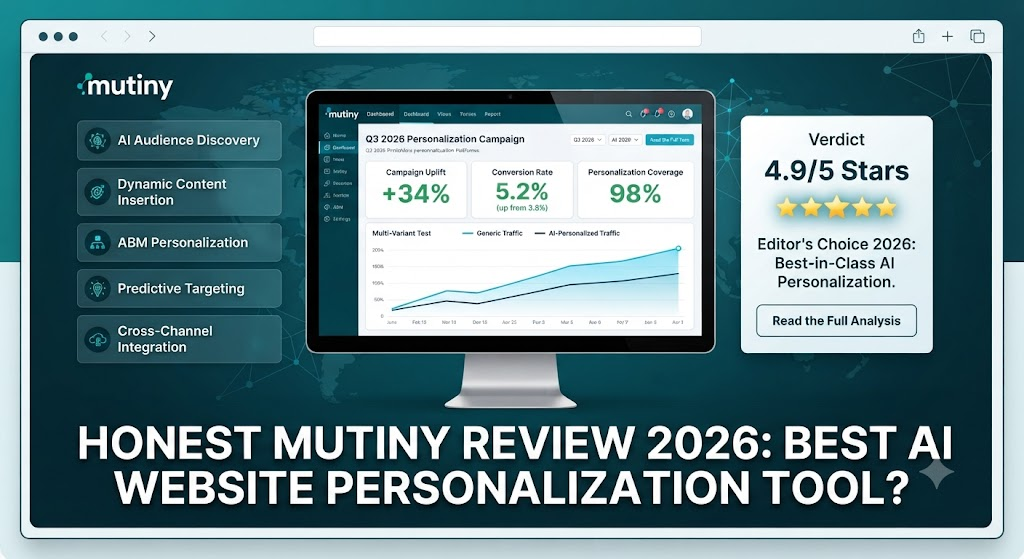
Your B2B website serves one message to every visitor — whether they’re a five-person startup or a Fortune 500 company, a first-time visitor or a returning prospect who downloaded your whitepaper last month. Mutiny is built to change that, and this Mutiny review examines whether AI-powered website personalisation genuinely improves pipeline conversion or whether it’s a technically impressive capability that marketers configure, forget about, and eventually turn off when the complexity outweighs the results.
Mutiny launched in 2018 and has built a strong reputation among B2B marketing teams at growth-stage and enterprise SaaS companies for a specific use case: using firmographic data to serve different website experiences to visitors from different company sizes, industries, and account tiers — without requiring engineering resources to configure or maintain. This Mutiny review tests the platform against its core promise: no-code website personalisation that improves account-level engagement and conversion.
This Mutiny review covers the platform’s segmentation capabilities, its no-code personalisation editor, the AI content generation tools that accelerate personalisation creation, the analytics layer, and the integrations that make it work within a broader B2B marketing stack. Whether you’re comparing Mutiny against Intellimize, Optimizely, or simply Clearbit Reveal plus manual content updates, this Mutiny review gives you the complete assessment you need before entering a significant procurement conversation.
VERDICT BOX
Overall Rating: 8.4 / 10
Best for: B2B SaaS and technology companies at growth-to-enterprise scale who want to personalise their website for different account segments, industries, and company sizes without requiring engineering resources for each change
Price: Custom enterprise pricing — typically starts from $36,000–$100,000+/year depending on traffic volume and features
Verdict: Mutiny delivers on its core promise — no-code B2B website personalisation that improves account-level engagement for teams with the traffic volume and account-based marketing strategy to benefit from it. The AI content generation accelerates the biggest barrier to personalisation at scale: creating enough content variants to make segmentation meaningful.
Table of Contents
What Is Mutiny? Background for This Mutiny Review
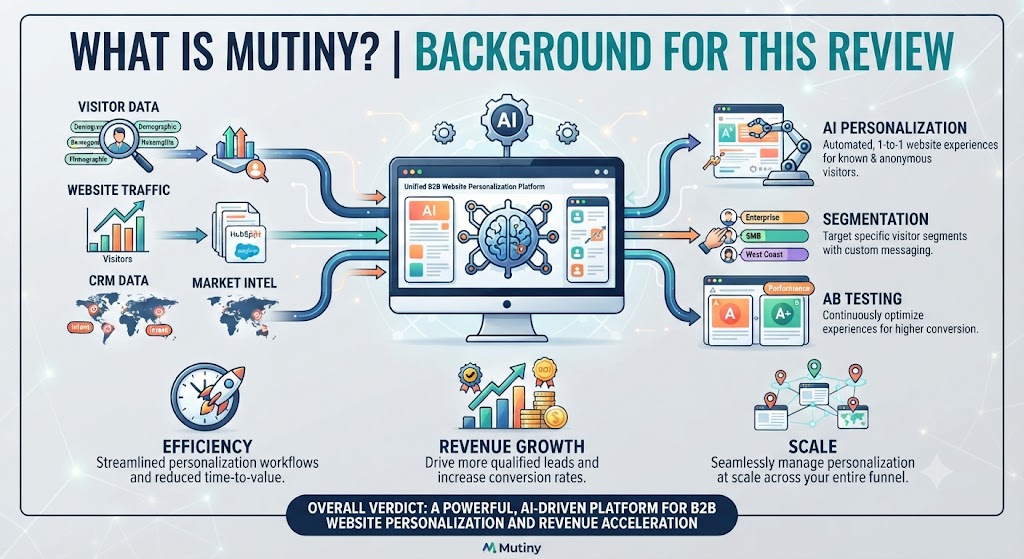
Mutiny is a B2B website personalisation platform founded in San Francisco in 2018 by Jaleh Rezaei and Nikhil Mathew. The company has built a strong reputation among growth-focused B2B marketers — particularly at SaaS and technology companies in the $10M–$500M ARR range — by solving a specific and long-standing problem: the inability of marketing teams to personalise their website for different account segments without developer involvement. This Mutiny review covers the 2026 version of the platform, which has added significant AI capabilities for content generation and personalisation recommendations.
The core concept this Mutiny review evaluates is account-based website personalisation. Using firmographic data from Clearbit (now Breeze Intelligence) and other sources, Mutiny identifies the company behind each website visit and serves a version of the website configured for that company’s size, industry, and any known attributes. A visitor from a 2,000-person financial services company sees a homepage headline, hero message, and social proof that speaks specifically to enterprise financial services buyers — without that visitor ever identifying themselves through a form.
For B2B companies running account-based marketing programmes, the promise this Mutiny review evaluates is compelling: the same traffic that was previously receiving generic messaging is now receiving account-relevant messaging, with the expected outcome of improved engagement, longer session durations, higher form conversion rates, and more pipeline from the same ad spend. Our AI marketing tools category covers the broader B2B marketing technology landscape.
Skip The Learning Curve — Let Us Run It For You
These AI marketing tools are powerful, but strategy still takes time to master. Tasknestly runs done-for-you digital marketing campaigns using the same category of tools, professionally managed.
Get a Free Marketing Quote →Mutiny Review: Pros and Cons
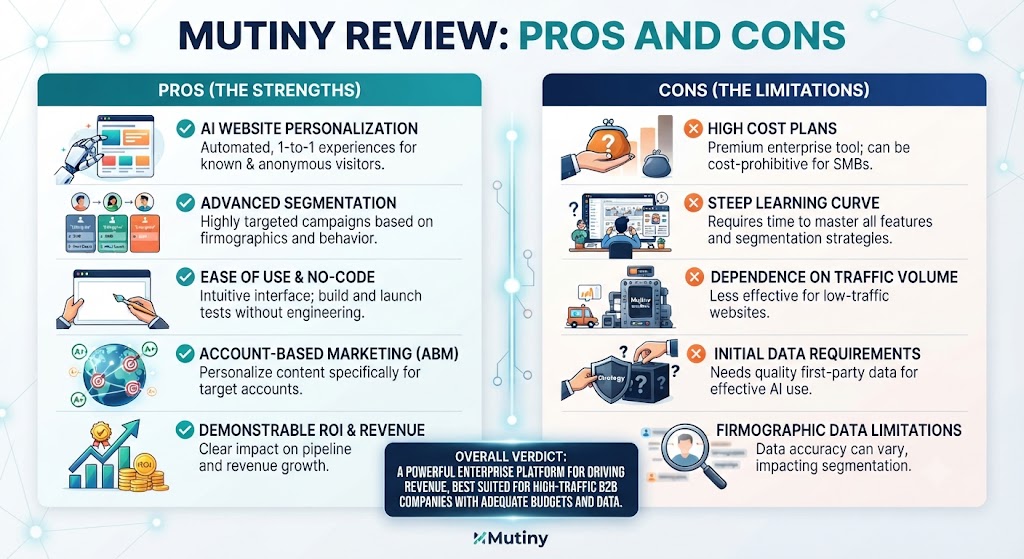
| Pros | Cons |
|---|---|
| No-code personalisation editor — marketing teams can configure and update experiences without engineering | Enterprise pricing ($36,000+/year) puts it out of reach for early-stage companies |
| AI content generation creates personalised copy variants at scale without manual writing for each segment | Requires meaningful B2B website traffic to produce statistically significant personalisation results |
| Strong account identification layer — Clearbit integration provides firmographic data for visitor segmentation | ROI requires a clear ABM strategy and defined target segments to personalise for |
| Segment performance analytics show which personalised experiences outperform the generic baseline | Some segments with lower traffic volumes may not accumulate sufficient data for reliable performance conclusions |
| Recommendation engine suggests which segments to personalise for based on traffic analysis | Setup and strategy work requires investment before first personalisation goes live |
| Integrates with HubSpot, Salesforce, Marketo, and major B2B marketing platforms | Less useful for B2B companies without a clear ideal customer profile and ABM motion |
Skip The Learning Curve — Let Us Run It For You
These AI marketing tools are powerful, but strategy still takes time to master. Tasknestly runs done-for-you digital marketing campaigns using the same category of tools, professionally managed.
Get a Free Marketing Quote →Mutiny Review: Feature Deep-Dive
Account Identification and Segmentation — The Foundation of This Mutiny Review
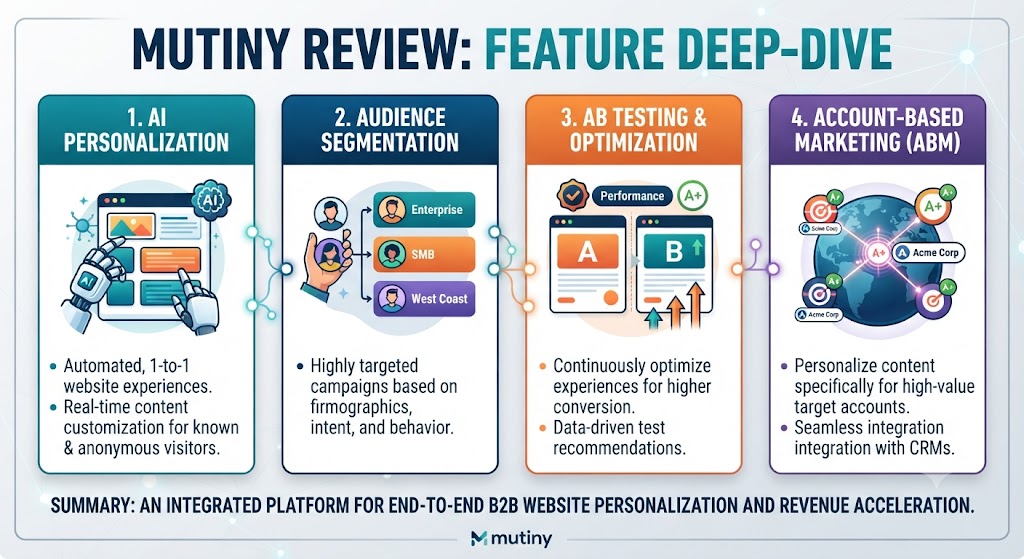
The account identification layer is where this Mutiny review begins, because without accurate identification of who is visiting your website, personalisation produces irrelevant experiences. Mutiny integrates with Clearbit (Breeze Intelligence) and other data providers to identify the company behind each website visit — mapping IP addresses to company firmographic data including company name, size, industry, revenue range, technology stack, and geography.
This Mutiny review found the identification accuracy to be good but imperfect — as with all IP-to-company mapping approaches, the match rate depends on visitors arriving from corporate networks rather than home offices or VPNs. This Mutiny review found typical match rates of 25–45% for B2B website traffic, meaning a meaningful minority of visitors receive personalised experiences while the remainder see the default. For companies running significant paid campaigns to target accounts, the match rate for those visitors is typically higher because ad-driven traffic from corporate environments is more likely to arrive from identifiable IPs.
The segmentation system in this Mutiny review allows you to create audience segments based on any combination of firmographic attributes — industry (financial services, healthcare, retail), company size (SMB vs mid-market vs enterprise), geography (US, UK, DACH, APAC), technology stack (uses Salesforce, uses HubSpot, uses Shopify), or named account lists uploaded directly. This Mutiny review found the segmentation flexibility to be one of the platform’s clearest competitive advantages — the ability to define segments based on technographic attributes (target companies using competitor technology or complementary technology) is particularly powerful for competitive displacement campaigns and technology ecosystem plays.
No-Code Personalisation Editor
The no-code personalisation editor is the feature this Mutiny review found to be most directly responsible for Mutiny’s adoption among marketing-owned technology stacks. Rather than requiring engineering to create new pages, new routes, or conditional rendering logic for personalised experiences, Mutiny’s visual editor allows marketers to select any element on a webpage — a headline, a paragraph, an image, a CTA button, a social proof logo — and replace it with segment-specific content.
This Mutiny review found the editor to be genuinely marketer-accessible. Creating a new personalisation experience — selecting a segment, identifying the elements to change, writing the personalised content, and publishing the experience — takes 20–45 minutes for a simple homepage personalisation, with no engineering involvement required. For teams that have historically needed to submit engineering tickets for every content change to their website, this Mutiny review found the no-code editor to represent a significant reduction in the time and friction required to run website personalisation programmes.
The editor in this Mutiny review supports personalisation of headline text, body copy, images, logos, CTA copy and links, social proof elements, form copy, navigation elements, and entire page sections. The breadth of element coverage means marketers can create meaningfully differentiated experiences rather than changing only the headline while the rest of the page remains generic.
AI Content Generation
Mutiny’s AI content generation tools — added significantly in 2023 and refined through 2026 — address the biggest practical barrier to running effective personalisation programmes at scale: the content production burden. Creating personalised experiences for ten different industry segments requires writing ten different headline variants, ten different value proposition paragraphs, and ten different CTA formulations. Without AI assistance, that content production burden falls on marketing copywriters who have many other priorities.
This Mutiny review found Mutiny’s AI content generation to be one of the most practically impactful features in the platform for teams that want to expand personalisation coverage beyond a handful of segments. You provide your target segment’s characteristics and Mutiny’s AI generates personalised headline, body copy, and CTA variants calibrated to that segment. The output quality this Mutiny review found is solid for industry and persona-based personalisation — the AI has sufficient context about different B2B buyer types to produce relevant messaging — and requires human review and editing before publishing but significantly reduces the blank-page barrier.
Segment Performance Analytics
Mutiny’s analytics layer shows how personalised experiences perform against the default baseline — measuring engagement metrics, session duration, form conversion rates, and pipeline influence for each active personalisation. This Mutiny review found the analytics to be well-structured and focused on the metrics B2B marketers care most about: pipeline contribution and deal acceleration rather than just engagement metrics.
The pipeline influence reporting in this Mutiny review — showing how many target accounts that received personalised experiences progressed through the pipeline versus those that didn’t — is one of the most important analytics outputs for justifying continued investment in personalisation. For ABM-focused marketing teams that need to demonstrate revenue impact, this Mutiny review found the pipeline attribution data to be commercially relevant and well-implemented.
Integrations in This Mutiny Review
Mutiny integrates with HubSpot, Salesforce, and Marketo for CRM and MAP data sync — allowing account attributes and pipeline data to flow into Mutiny’s segmentation and analytics. The 6sense and Demandbase integrations allow intent data to inform personalisation — serving different experiences to accounts that are actively in-market versus those showing early research behaviour. This Mutiny review found the intent data personalisation use case to be one of the most sophisticated applications of the platform, producing personalisation that responds not just to who a visitor is but to where they are in their buying journey.
Skip The Learning Curve — Let Us Run It For You
These AI marketing tools are powerful, but strategy still takes time to master. Tasknestly runs done-for-you digital marketing campaigns using the same category of tools, professionally managed.
Get a Free Marketing Quote →Mutiny Pricing: What This Mutiny Review Found
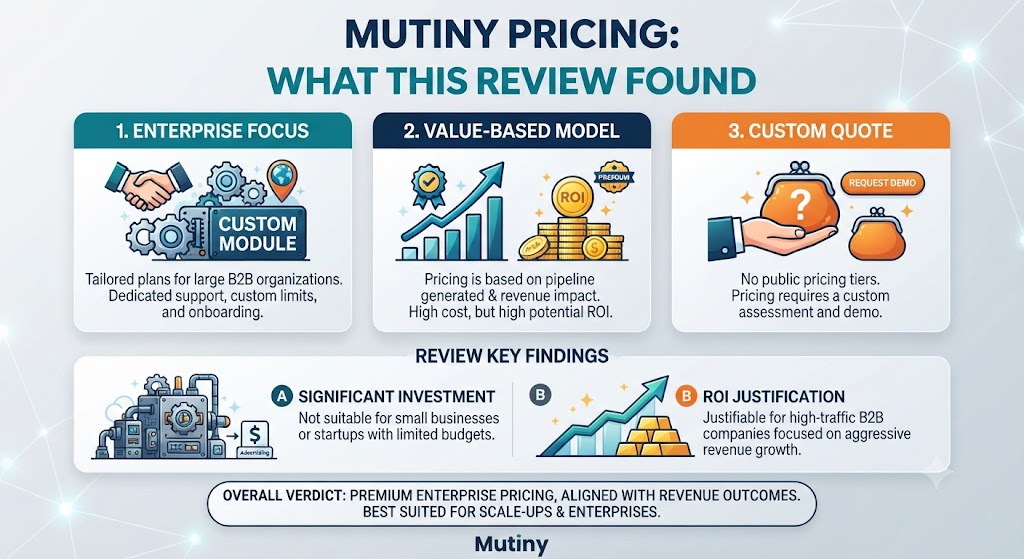
| Tier | Estimated Price | Notes |
|---|---|---|
| Growth | $36,000–$60,000/year | Core personalisation, analytics, standard integrations |
| Enterprise | $60,000–$100,000+/year | Full feature set, unlimited segments, advanced analytics, ABM integrations |
| Custom | Custom | Strategic partnerships, dedicated success management, multi-instance |
This Mutiny review must be direct about pricing: Mutiny is an enterprise-positioned product with enterprise pricing, and all contracts are custom-quoted through a sales process. The estimates this Mutiny review found — $36,000–$100,000+/year — reflect the platform’s positioning for growth-stage and enterprise B2B companies where the ROI from improved website conversion on existing traffic justifies the investment. Teams should model their specific website traffic volume, account identification rate, and expected conversion improvement before entering pricing discussions.
Skip The Learning Curve — Let Us Run It For You
These AI marketing tools are powerful, but strategy still takes time to master. Tasknestly runs done-for-you digital marketing campaigns using the same category of tools, professionally managed.
Get a Free Marketing Quote →Mutiny vs Competitors: The Mutiny Review Comparison
| Feature | Mutiny | Intellimize | Optimizely | Clearbit + Custom |
|---|---|---|---|---|
| No-code personalisation editor | ✅ Core feature | ✅ Yes | ✅ Yes | ❌ Requires dev |
| B2B account identification | ✅ Native (Clearbit) | ✅ Yes | ⚠️ Requires integration | ✅ Clearbit native |
| AI content generation | ✅ Yes | ⚠️ Limited | ⚠️ Limited | ❌ No |
| Firmographic segmentation | ✅ Advanced | ✅ Yes | ⚠️ Basic | ✅ Yes |
| Intent data integration | ✅ 6sense, Demandbase | ✅ Yes | ⚠️ Limited | ⚠️ Limited |
| Pipeline analytics | ✅ Yes | ⚠️ Limited | ✅ Yes | ❌ Manual |
| Target market | B2B SaaS / Enterprise | B2B / Enterprise | All industries | B2B |
| Starting price | $36,000/year | Custom | Custom ($50,000+) | Clearbit + dev cost |
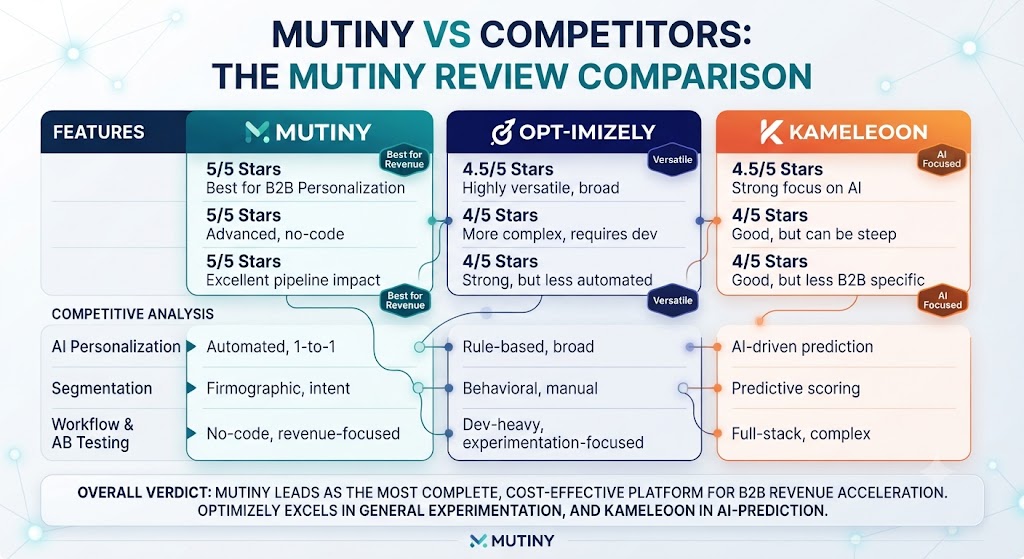
This Mutiny review comparison positions the platform as the most purpose-built B2B website personalisation tool available, with AI content generation and intent data integration that Intellimize doesn’t offer and Optimizely requires significant configuration to replicate. The “Clearbit + custom development” alternative is what many companies default to before implementing Mutiny — and this Mutiny review found the no-code editor alone to justify the platform cost over the ongoing engineering overhead of bespoke personalisation development. More comparisons at our AI marketing tools hub.
Skip The Learning Curve — Let Us Run It For You
These AI marketing tools are powerful, but strategy still takes time to master. Tasknestly runs done-for-you digital marketing campaigns using the same category of tools, professionally managed.
Get a Free Marketing Quote →Who Is Mutiny Best For? The Mutiny Review Audience Assessment
Mutiny works best for:
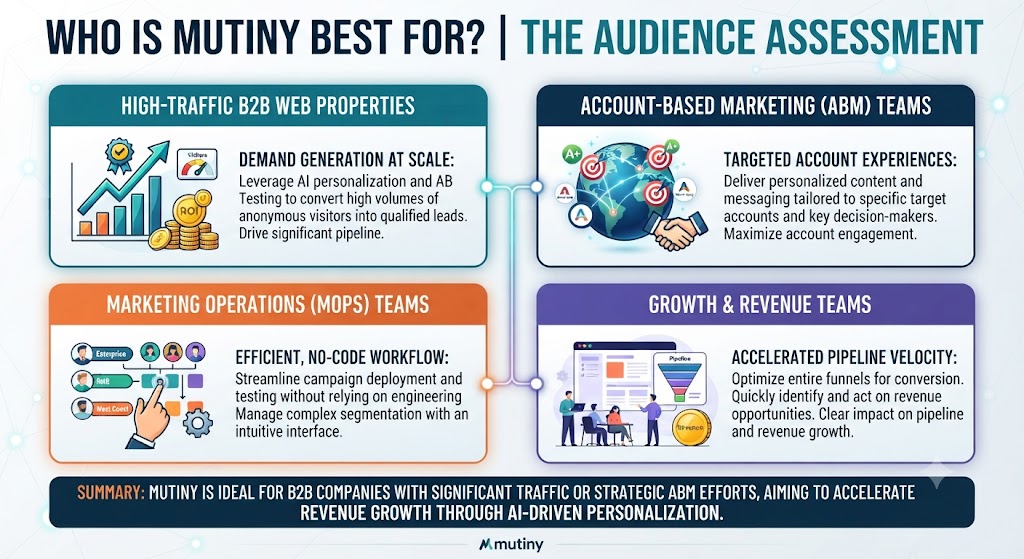
- B2B SaaS companies at growth-to-enterprise scale ($10M–$500M ARR) with meaningful website traffic and defined target account segments who want to improve pipeline conversion from existing traffic
- ABM-focused marketing teams running account-based programmes who want website experience to reinforce account-specific messaging across the buyer journey
- Marketing teams without engineering bandwidth for website personalisation — Mutiny’s no-code editor makes personalisation marketing-owned rather than engineering-dependent
- Revenue teams using 6sense or Demandbase who want intent data to drive personalised website experiences rather than just triggering SDR outreach
- Companies in competitive SaaS markets where website differentiation for specific industry verticals or company sizes creates meaningful conversion lift on paid traffic
Mutiny is less ideal for:
- Early-stage companies with limited website traffic — personalisation requires sufficient traffic per segment to produce meaningful results and justify the investment
- B2B companies without clear ICP definition and target segments — Mutiny personalisation requires knowing who you’re personalising for
- Organisations that need website A/B testing and experimentation as their primary capability — Optimizely or VWO serve that use case with more testing sophistication
Skip The Learning Curve — Let Us Run It For You
These AI marketing tools are powerful, but strategy still takes time to master. Tasknestly runs done-for-you digital marketing campaigns using the same category of tools, professionally managed.
Get a Free Marketing Quote →Get It / Skip It
✅ Get Mutiny if:
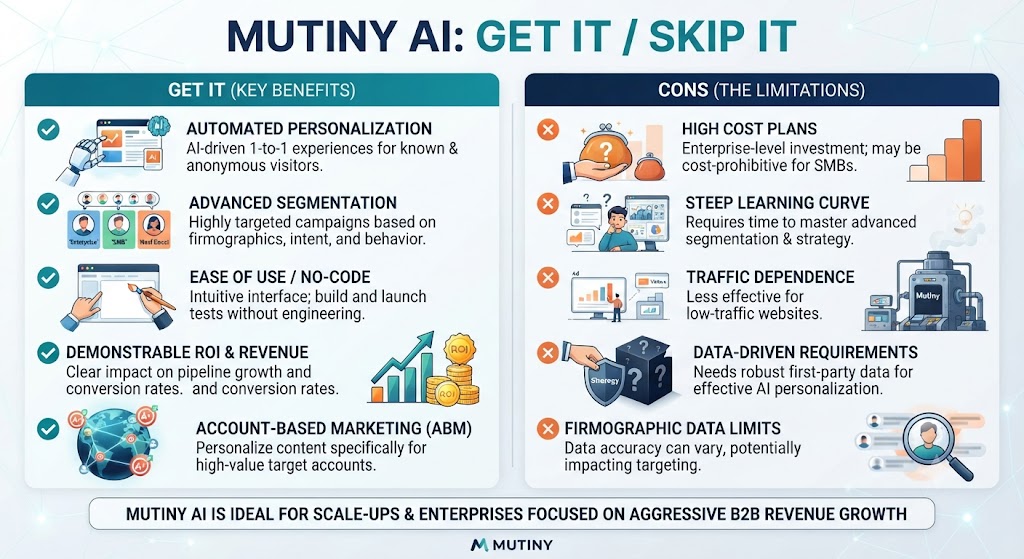
- You’re a B2B company with 10,000+ monthly visitors and defined ICP segments who want to serve personalised messaging without engineering involvement for every content change
- Your ABM programme identifies target accounts but your website serves them the same generic experience as everyone else — Mutiny closes that gap
- You’re already investing in 6sense or Demandbase intent data and want to operationalise that data in real-time website experiences
❌ Skip Mutiny if:
- Your B2B website gets fewer than 5,000 monthly visitors — the segment traffic volumes won’t be sufficient for meaningful personalisation results at most pricing tiers
- You don’t have a defined ABM motion or target segment strategy — personalisation without clear segments to personalise for produces generic “personalised” experiences that underperform the baseline
- Your budget doesn’t support $36,000+/year for a personalisation platform — focus on getting more traffic and defining your ICP before investing in personalisation infrastructure
Skip The Learning Curve — Let Us Run It For You
These AI marketing tools are powerful, but strategy still takes time to master. Tasknestly runs done-for-you digital marketing campaigns using the same category of tools, professionally managed.
Get a Free Marketing Quote →Mutiny Review: Frequently Asked Questions
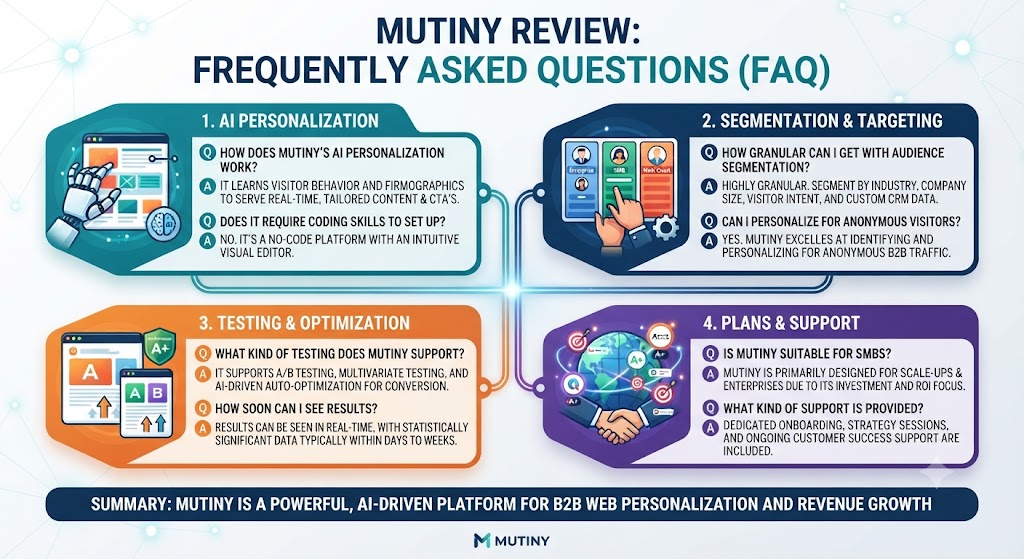
Q: Is this Mutiny review recommending it for all B2B companies? This Mutiny review recommends Mutiny for B2B companies with meaningful website traffic, a clear ICP and ABM motion, and the budget to support the investment. For early-stage companies or those without defined target segments, the ROI case is harder to make and simpler alternatives should be explored first.
Q: How much does Mutiny cost? This Mutiny review found Mutiny pricing to be custom-quoted and not publicly published. Based on industry reports, contracts typically start around $36,000/year for growth-stage companies and reach $100,000+/year for full enterprise deployments. A demo and formal scoping process is required before pricing is provided.
Q: Does Mutiny require engineering resources to implement? The initial implementation requires engineering to add Mutiny’s JavaScript snippet to your website. This Mutiny review found the initial setup to be a one-time engineering task of roughly two to four hours. After that, all personalisation creation, editing, publishing, and analytics are managed by marketing in Mutiny’s no-code interface without further engineering involvement.
Q: How does Mutiny identify which company is visiting my website? Mutiny uses IP-to-company mapping through its Clearbit integration and other data sources to identify the organisation behind each website visit. This Mutiny review found typical match rates of 25–45% for B2B website traffic, meaning roughly one-quarter to nearly half of visitors receive personalised experiences based on their identified company, while unidentified visitors see the default experience.
Q: Does Mutiny work for companies with complex multi-product or multi-persona websites? Yes, but complexity of personalisation increases with site complexity. This Mutiny review found Mutiny to work well for companies that want to personalise specific high-traffic pages — homepage, product pages, pricing pages — rather than personalising every page of a large site. For the most important conversion pages in a B2B buyer journey, Mutiny’s personalisation delivers clear value without requiring personalisation of every page.
Q: How does Mutiny compare to just using Clearbit for website personalisation? Clearbit (Breeze Intelligence) provides the data layer — identifying which company is visiting. Building personalised experiences on top of that data requires either engineering development or a tool like Mutiny. This Mutiny review found the no-code editor, AI content generation, and purpose-built analytics in Mutiny to be worth the investment over Clearbit-plus-custom-development for most teams, primarily because the ongoing maintenance of bespoke personalisation code creates engineering debt that slows iteration.
Q: What are the best Mutiny alternatives? This Mutiny review points to Intellimize (B2B personalisation, similar positioning), Optimizely (stronger testing and experimentation, enterprise pricing), VWO (A/B testing focus, mid-market pricing), and for intent-driven personalisation: building natively on top of 6sense or Demandbase’s web personalisation modules. Our AI marketing tools category covers these alternatives.
Skip The Learning Curve — Let Us Run It For You
These AI marketing tools are powerful, but strategy still takes time to master. Tasknestly runs done-for-you digital marketing campaigns using the same category of tools, professionally managed.
Get a Free Marketing Quote →Conclusion: Final Mutiny Review Verdict
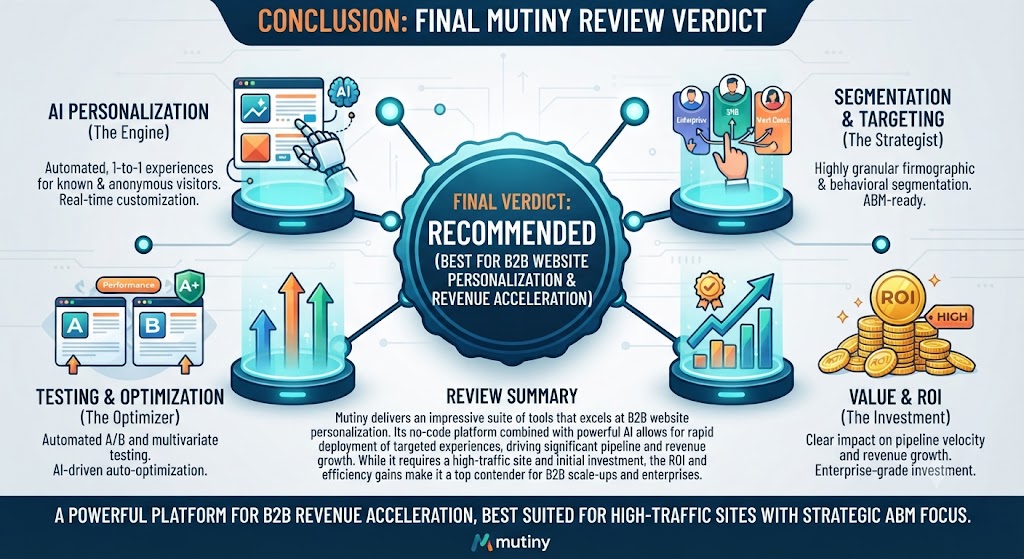
After completing a thorough Mutiny review, the platform’s position in the B2B marketing technology stack is clear: for growth-stage and enterprise B2B companies with meaningful website traffic and a defined ABM motion, Mutiny delivers meaningful and measurable improvements in website conversion from existing traffic, without requiring the engineering overhead that previously made personalisation programmes unsustainable for marketing teams.
The limitations this Mutiny review identified are specific and important to acknowledge. The enterprise pricing requires programme-level ROI modelling before commitment. The no-code editor is genuinely no-code, but the strategic thinking about who to personalise for, what to say to each segment, and how to measure success requires sophisticated B2B marketing expertise to execute well. And the identification match rate — 25–45% of visitors — means personalisation impacts a significant but not total share of your traffic.
For the right B2B marketing team, this Mutiny review’s recommendation is clear: if your ABM programme is mature, your website traffic is meaningful, and your engineering bandwidth for personalisation is limited, Mutiny closes the gap between your account strategy and your website experience in a way that pays for itself in improved pipeline conversion. Request a demo, model your specific traffic volume and conversion improvement expectation, and evaluate whether the numbers work for your programme. More tools at our AI marketing tools hub.
Disclosure: This article contains affiliate links. TechBotHQ may earn a commission if you sign up through our links, at no extra cost to you. See our affiliate disclosure for full details.
Skip The Learning Curve — Let Us Run It For You
These AI marketing tools are powerful, but strategy still takes time to master. Tasknestly runs done-for-you digital marketing campaigns using the same category of tools, professionally managed.
Get a Free Marketing Quote →