Honest MarketMuse Review 2026: Best AI Content Intelligence Tool?


Most SEO content tools tell you what your competitors are doing. MarketMuse tells you what they’re missing — and that distinction is at the heart of why this MarketMuse review matters for serious content teams. Where tools like Surfer SEO optimise individual articles against current SERP results, MarketMuse takes a broader view: analysing an entire topic domain, identifying the content gaps in your existing site, and guiding you toward a content strategy that builds genuine topical authority rather than just ranking for individual keywords.
This MarketMuse review covers a platform that has been building its content intelligence capabilities since 2013 — one of the longest track records in the AI content category. The platform serves a specific and demanding user: the content strategist, SEO director, or head of marketing at a brand serious enough about content that they need data-driven guidance on which content to create, how thoroughly to cover each topic, and where their existing content is underperforming relative to its authority potential. This MarketMuse review tests whether the platform delivers on that ambitious proposition.
This MarketMuse review is relevant for content teams, SEO agencies, and marketing leaders at established brands who produce significant volumes of content and need strategic intelligence to prioritise it effectively. Whether you’re comparing MarketMuse against Surfer SEO, Frase, or Clearscope, this MarketMuse review gives you the evidence-based assessment you need before committing to what is typically one of the more significant AI content tool investments.
VERDICT BOX
Overall Rating: 8.5 / 10
Best for: Content strategists, SEO directors, and established content teams at brands that publish significant volumes of content and want AI-driven topic modelling and authority analysis to guide their content strategy
Price: Free plan available; Standard at $149/month; Team at $399/month; Premium custom
Verdict: MarketMuse delivers the most sophisticated content intelligence available in the category — the topic modelling, authority scoring, and content gap analysis go deeper than any competing tool. The premium pricing and complexity mean it’s best suited to established content operations rather than early-stage teams.
Table of Contents
What Is MarketMuse? Background for This MarketMuse Review
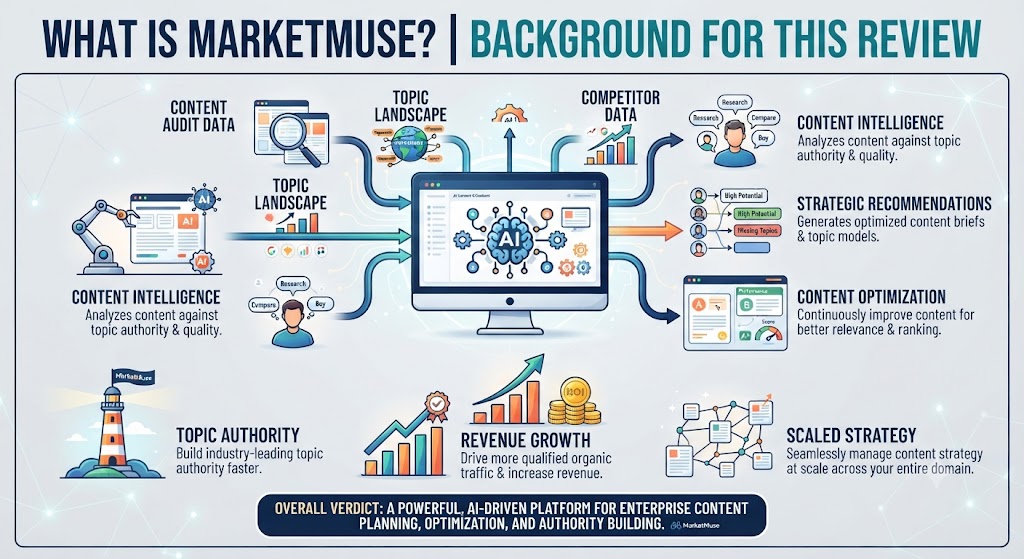
MarketMuse is an AI content intelligence platform founded in Atlanta in 2013 by Jeff Coyle. The company has built a reputation as one of the most analytically rigorous content intelligence tools available — a platform that goes well beyond on-page optimisation to provide strategic content planning guidance based on proprietary topic modelling and site-level authority analysis. This MarketMuse review covers the 2026 version of the platform, which has refined its core AI models and expanded its strategic planning features significantly from the earlier versions.
The core concept behind this MarketMuse review is the distinction between content optimisation and content intelligence. Tools like Surfer SEO and Frase help you optimise a specific article against current SERP competitors. MarketMuse analyses your entire content programme — identifying which topics you have authority in, which you’re thin on, which competitor gaps represent your best opportunity, and which of your existing articles are underperforming relative to their potential and can be improved for quick wins.
This MarketMuse review evaluates whether that broader view of content strategy genuinely produces better content outcomes than article-level optimisation alone. The answer this MarketMuse review found: yes, but only if you have the content volume and team capacity to act on strategic guidance at programme level. For teams publishing 20+ pieces of content per month, this MarketMuse review found the strategic intelligence to be transformational. For smaller operations, the article-level tools of Surfer SEO or Frase may deliver equivalent value at lower cost. Our AI writing tools category covers the full landscape.
Skip The Learning Curve — Let Us Run It For You
These AI marketing tools are powerful, but strategy still takes time to master. Tasknestly runs done-for-you digital marketing campaigns using the same category of tools, professionally managed.
Get a Free Marketing Quote →MarketMuse Review: Pros and Cons
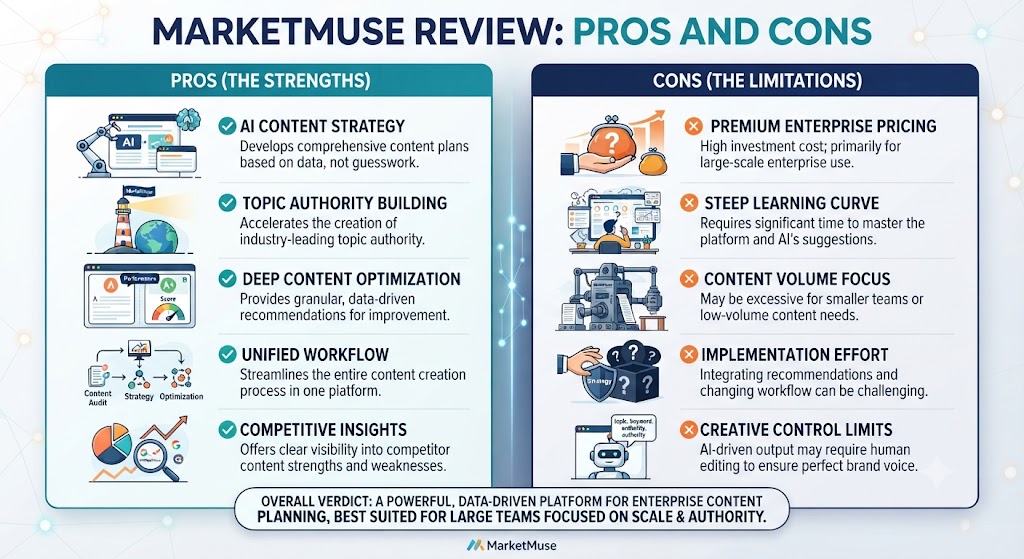
| Pros | Cons |
|---|---|
| Most sophisticated topic modelling and content authority analysis in the category | Premium pricing — $149/month for Standard and $399/month for Team is expensive relative to alternatives |
| Content gap analysis identifies strategic opportunities competitors have missed entirely | Significant learning curve — full value requires investment in understanding the platform’s models |
| Site-level authority scoring shows where you’re strong and where you’re thin across your domain | AI writing features are less polished than dedicated writing tools at the same price point |
| Personalised difficulty scores calibrated to your specific site’s authority — not generic metrics | Best value requires significant existing content volume to analyse |
| Content briefs are among the most comprehensive in the category | Free plan is very limited — serious use requires Standard plan minimum |
| Competitive content gap analysis identifies topics your competitors rank for but you don’t cover | Overkill for teams publishing fewer than 15 articles per month |
Skip The Learning Curve — Let Us Run It For You
These AI marketing tools are powerful, but strategy still takes time to master. Tasknestly runs done-for-you digital marketing campaigns using the same category of tools, professionally managed.
Get a Free Marketing Quote →MarketMuse Review: Feature Deep-Dive
Topic Modelling and Authority Analysis — The Core of This MarketMuse Review
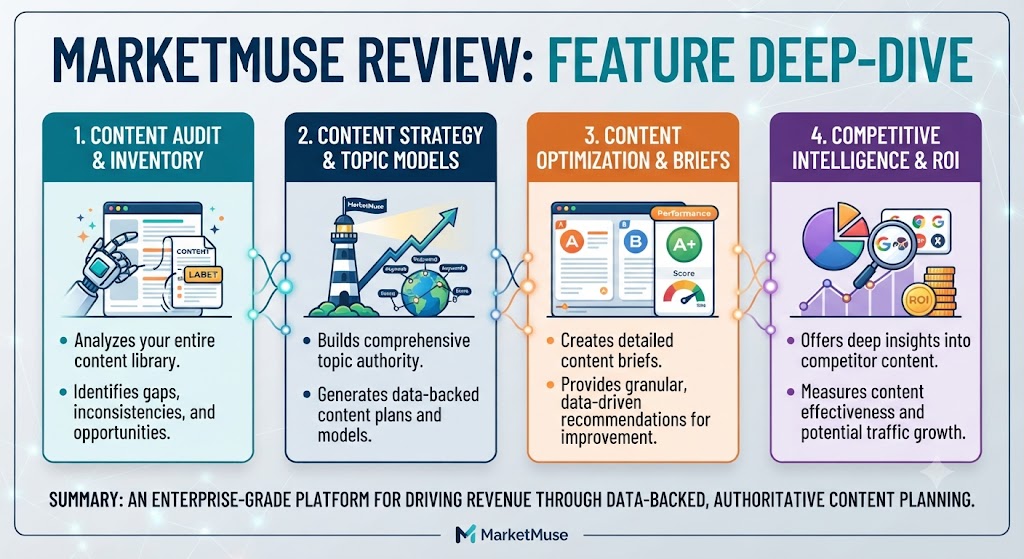
The topic modelling engine is the feature that most fundamentally distinguishes this MarketMuse review from reviews of other content tools. MarketMuse analyses your entire website — every indexed page — and maps your content against a proprietary model of how topics relate to each other within your domain. The result is a topic authority score for your site across hundreds of relevant topic areas: where your content depth earns strong topical authority, where you’re thin, and where competitors have built authority that you currently lack.
This MarketMuse review found the topic authority model to be genuinely different from the domain authority metrics available in tools like Ahrefs or Semrush. Those tools measure link-based authority. MarketMuse measures content-based authority — specifically, how thoroughly your site covers the full semantic scope of topics in your niche. A site with many thin articles spread across many topics has poor MarketMuse authority scores despite potentially strong link metrics. A site with fewer, deeply comprehensive articles covering a narrower topic set earns strong scores. For content teams deciding between breadth and depth, this MarketMuse review found the authority modelling to be one of the most useful strategic inputs available.
The personalised difficulty scores are one of this MarketMuse review’s most practically important findings. Unlike generic keyword difficulty metrics that apply the same score for every site, MarketMuse’s personalised difficulty score calibrates to your specific site’s existing authority. A topic that’s extremely difficult to rank for on a new site may be achievable for an established authority site that already covers adjacent topics extensively. This MarketMuse review found the personalised difficulty scoring to produce more actionable content prioritisation than generic difficulty metrics, particularly for established content programmes looking to efficiently extend their ranking footprint.
Content Gap Analysis
Content gap analysis is where this MarketMuse review found the platform’s strategic intelligence to be most actionable for content teams building out a topic area. MarketMuse identifies topics that your competitors rank for but that your site doesn’t adequately cover — giving content teams a prioritised list of content opportunities where creating or improving an article could capture traffic currently going to competitors.
This MarketMuse review found two types of content gaps to be most valuable in practice. The first is competitive gaps — topics where a competitor has a strong, comprehensive piece and you have nothing or a thin article. The second, and more strategic, is coverage gaps — topics within your domain where neither you nor your direct competitors have produced comprehensive content, representing an opportunity to establish authority before the competitive set catches up.
The prioritisation framework MarketMuse applies to content gap analysis — weighting opportunities by the potential traffic value, the difficulty relative to your site’s authority, and the strategic importance of the topic to your broader content programme — produces a content planning output this MarketMuse review found to be among the most practically useful strategic deliverables in any content tool category.
Content Briefs and Research
MarketMuse’s content briefs are the most comprehensive in the SEO content category, and this MarketMuse review found them to be significantly more detailed than the briefs produced by Frase or Scalenut. A MarketMuse brief for a target topic covers: recommended word count range calibrated to competitive depth, key topics and subtopics to address (derived from topic modelling rather than just competitor headings), NLP terms and their recommended frequency, questions to address, external link recommendations, and internal link opportunities within your existing content.
The internal link recommendations in this MarketMuse review are particularly valuable for established sites with large existing content libraries. MarketMuse identifies which existing articles on your site are semantically related to your new piece and recommends specific links — both linking from the new article to existing relevant content and linking from existing articles to the new piece. For content teams that manage internal linking manually across hundreds of articles, this MarketMuse review found the automated internal link intelligence to be a significant operational efficiency improvement.
AI Writing and Optimisation Editor
MarketMuse includes an AI writing assistant and real-time content editor that shows your content score as you write. This MarketMuse review found the content editor to be functional and the AI writing to be serviceable — but this MarketMuse review’s honest assessment is that the AI writing quality is not the platform’s primary value proposition. Teams that purchase MarketMuse primarily for AI writing will find dedicated tools like Jasper or Frase’s AI writer to be more capable per dollar.
The content score in this MarketMuse review measures topical coverage depth and NLP term inclusion — similar to competing tools but with the distinctive addition of MarketMuse’s own proprietary content authority model informing the scoring. This MarketMuse review found the score to be a useful real-time feedback mechanism for ensuring comprehensive topic coverage, with the same caveat that applies across all such tools: editorial judgment about readability, originality, and genuine insight should take precedence over score optimisation.
Competitive Research and SERP Intelligence
MarketMuse’s competitive research tools allow you to analyse specific competing pages, compare your content against them across topic coverage dimensions, and identify specific gaps in your content relative to individual competitors. This MarketMuse review found the page-level competitive analysis to be most useful when combined with the broader topic modelling — using the site-level authority analysis to identify priority topics and then using the page-level comparison to understand exactly what a competitive piece covers that yours doesn’t.
Skip The Learning Curve — Let Us Run It For You
These AI marketing tools are powerful, but strategy still takes time to master. Tasknestly runs done-for-you digital marketing campaigns using the same category of tools, professionally managed.
Get a Free Marketing Quote →MarketMuse Pricing: What This MarketMuse Review Found
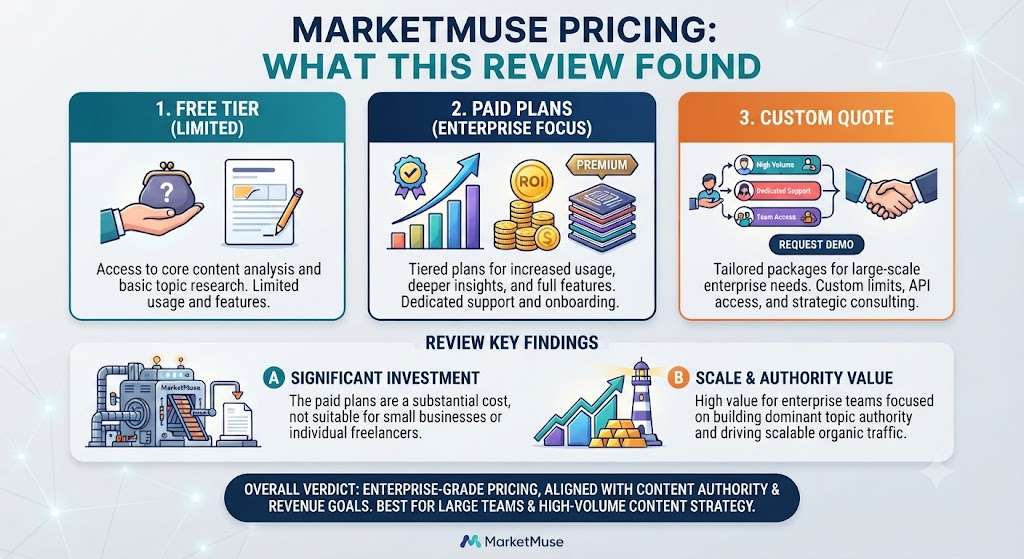
| Plan | Price | Key Features |
|---|---|---|
| Free | $0 | 10 queries/month, basic topic research |
| Standard | $149/month | Unlimited queries, full topic modelling, content briefs, 1 user |
| Team | $399/month | Everything in Standard + 3 users, content clusters, advanced analytics |
| Premium | Custom | Unlimited users, managed onboarding, API, white-label reporting |
This MarketMuse review found the pricing to be among the highest in the AI content tool category — reflecting the sophistication of the underlying models and the strategic depth of the intelligence provided. The Standard plan at $149/month is where most content teams this MarketMuse review evaluated begin, and the Team plan at $399/month is appropriate for agencies and larger teams with multiple content strategists. The free plan is insufficient for production use — it’s effectively a trial tier. A 7-day free trial with expanded access is also available on paid plans.
MarketMuse vs Competitors: The MarketMuse Review Comparison
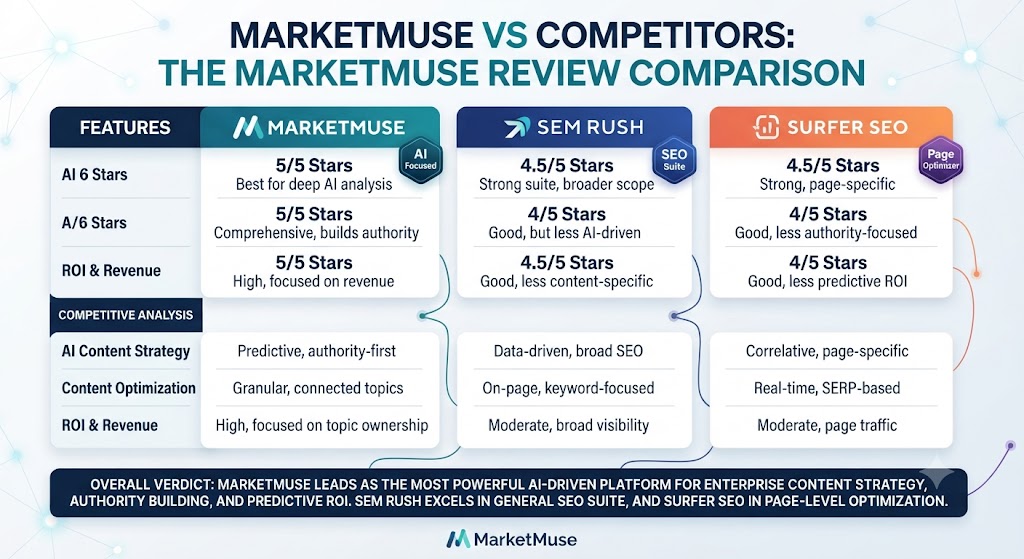
| Feature | MarketMuse | Surfer SEO | Frase | Clearscope |
|---|---|---|---|---|
| Topic modelling / authority analysis | ✅ Best-in-class | ❌ No | ❌ No | ❌ No |
| Personalised difficulty scoring | ✅ Yes | ❌ No | ❌ No | ❌ No |
| Content gap analysis | ✅ Advanced | ❌ No | ⚠️ Basic | ❌ No |
| Content briefs | ✅ Most comprehensive | ✅ Strong | ✅ Good | ✅ Good |
| Real-time content scoring | ✅ Yes | ✅ Best-in-class | ✅ Yes | ✅ Yes |
| AI writing built-in | ✅ Yes | ✅ Scale AI plan | ✅ Yes | ❌ No |
| Internal link recommendations | ✅ Yes | ❌ No | ❌ No | ❌ No |
| Free trial | ✅ 7 days | ✅ 7 days | ✅ 5 days | ❌ No |
| Starting price | $149/month | $89/month | $45/month | $189/month |
This MarketMuse review comparison shows the platform winning decisively on strategic content intelligence features — topic modelling, personalised difficulty, content gap analysis, and internal link recommendations — while being matched or beaten on individual article optimisation accuracy by Surfer SEO. For content teams that need article-level optimisation primarily, Surfer SEO or Frase deliver comparable outcomes at lower price points. For content teams that need programme-level strategic intelligence, this MarketMuse review found no comparable alternative. More context at our AI writing tools hub.
Skip The Learning Curve — Let Us Run It For You
These AI marketing tools are powerful, but strategy still takes time to master. Tasknestly runs done-for-you digital marketing campaigns using the same category of tools, professionally managed.
Get a Free Marketing Quote →Who Is MarketMuse Best For? The MarketMuse Review Audience Assessment
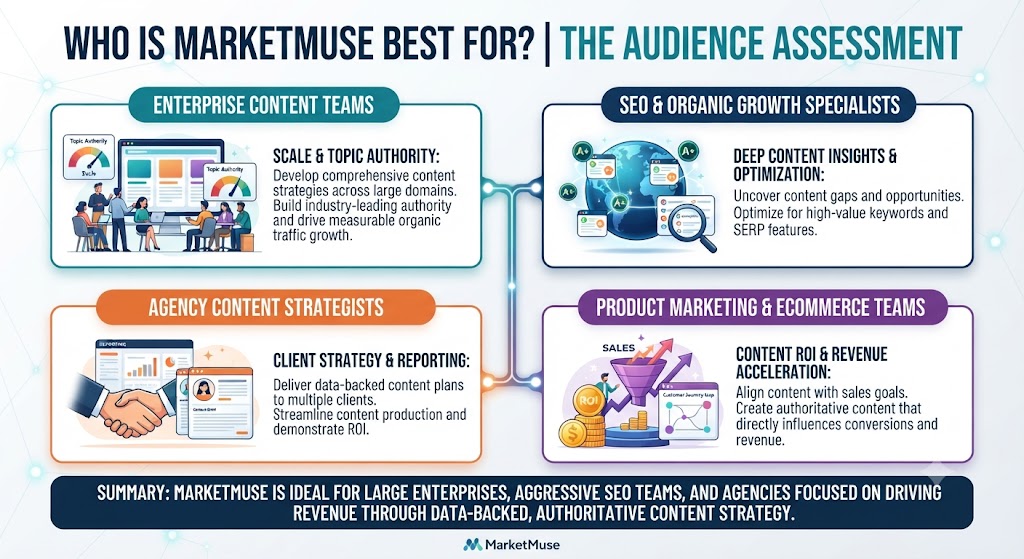
MarketMuse works best for:
- Enterprise content teams and established brands publishing 20+ articles per month who need strategic intelligence to prioritise their content programme rather than just optimise individual pieces
- SEO directors and content strategists responsible for building topical authority across a domain and needing data-driven guidance on where to invest content resources
- Content agencies managing large client programmes who want proprietary AI-driven content strategy to differentiate their work from competitors
- Established sites with large existing content libraries where the site authority analysis and internal link intelligence are immediately applicable to improving existing content performance
- Teams competing in high-authority niches where rank-and-file optimisation isn’t enough and genuine content depth and topical authority are the primary differentiators
MarketMuse is less ideal for:
- Early-stage brands and startups with small content libraries — the site authority analysis requires existing content volume to be meaningful
- Teams publishing fewer than 15 articles per month — the strategic planning features deliver more value at higher publishing cadences
- Budget-conscious teams for whom the $149/month Standard plan is disproportionate to their content volume — Frase or Scalenut deliver strong core functionality at lower entry prices
Skip The Learning Curve — Let Us Run It For You
These AI marketing tools are powerful, but strategy still takes time to master. Tasknestly runs done-for-you digital marketing campaigns using the same category of tools, professionally managed.
Get a Free Marketing Quote →Get It / Skip It
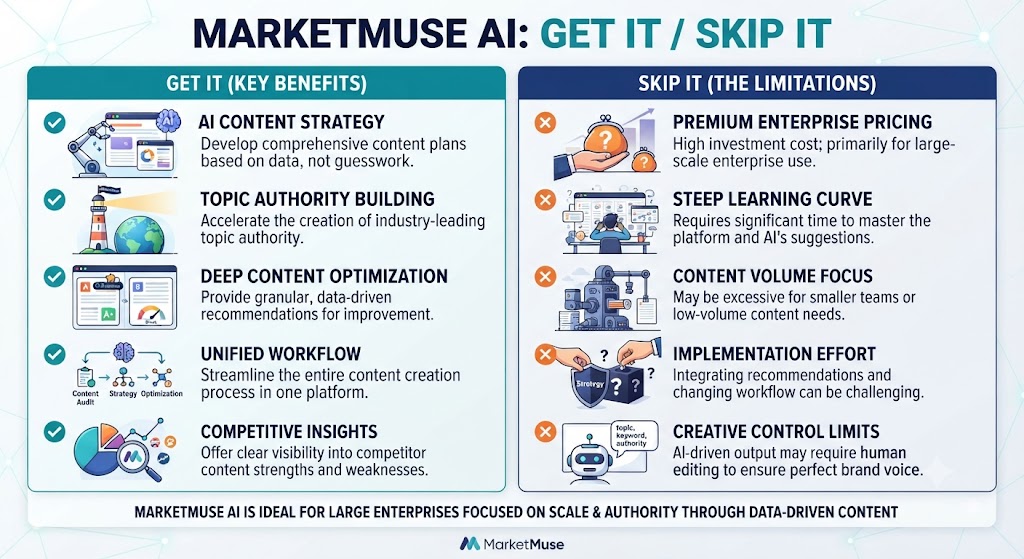
✅ Get MarketMuse if:
- You run an established content programme at 20+ articles per month and want AI-driven strategic intelligence to prioritise topics, identify content gaps, and build genuine topical authority across your domain
- You manage a large existing content library and want internal link intelligence and content improvement prioritisation based on authority modelling rather than manual analysis
- You’re a content agency whose clients need differentiated strategic guidance that goes beyond the article-level optimisation any competitor with Surfer SEO can deliver
❌ Skip MarketMuse if:
- Your content programme is early-stage or low-volume — the strategic intelligence features require existing content and publishing scale to deliver maximum value
- Your primary need is on-page article optimisation for individual pieces — Surfer SEO delivers better accuracy on that specific task at a lower price point
- The $149/month Standard plan is a stretch for your current budget — Frase at $45/month or Scalenut at $39/month are more appropriate entry points
Skip The Learning Curve — Let Us Run It For You
These AI marketing tools are powerful, but strategy still takes time to master. Tasknestly runs done-for-you digital marketing campaigns using the same category of tools, professionally managed.
Get a Free Marketing Quote →MarketMuse Review: Frequently Asked Questions
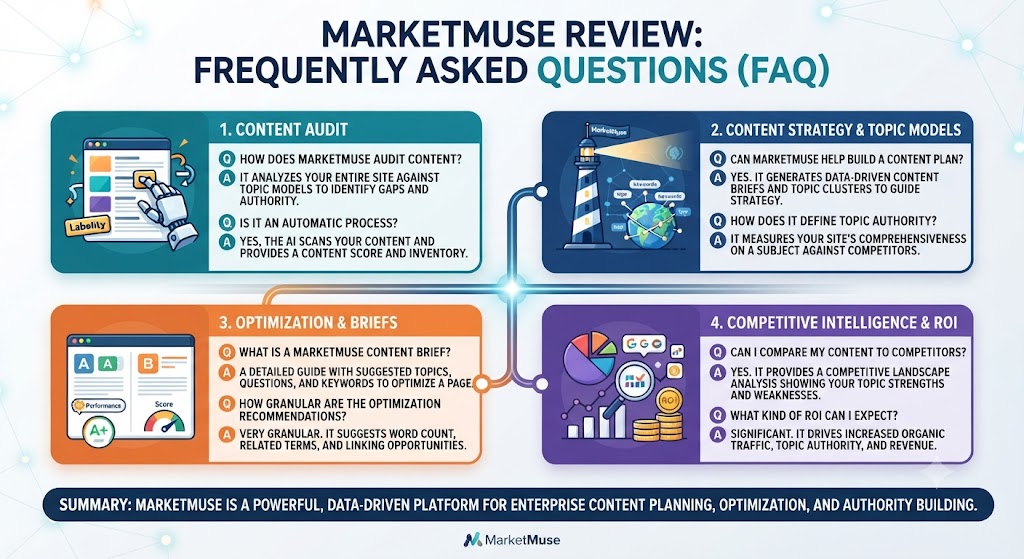
Q: Is this MarketMuse review recommending it over Surfer SEO? This MarketMuse review recommends MarketMuse over Surfer SEO specifically for established content teams that need programme-level strategic intelligence — topic modelling, authority analysis, content gap identification, and internal link recommendations. For teams whose primary need is individual article optimisation, Surfer SEO has better on-page scoring accuracy at a lower price. The two tools serve different but complementary purposes.
Q: Is MarketMuse free to use? Yes, with significant limitations. The free plan provides 10 queries per month — sufficient to explore the platform’s capabilities but not for production content work. This MarketMuse review found the Standard plan at $149/month to be the practical entry point for meaningful production use. A 7-day trial with expanded access is available on paid plans.
Q: How does MarketMuse’s content scoring compare to Surfer SEO? This MarketMuse review found MarketMuse’s content scoring to be based on its proprietary topic model — measuring genuine topical coverage depth — while Surfer SEO’s scoring is based on NLP term frequency relative to top SERP results. Surfer SEO’s scoring correlates more tightly with current SERP signals, making it more precise for individual article optimisation. MarketMuse’s scoring is more meaningful for assessing topical authority relative to your site’s overall content programme.
Q: What is a personalised difficulty score in MarketMuse? MarketMuse’s personalised difficulty score is a keyword difficulty metric calibrated specifically to your site’s existing content authority. Unlike generic difficulty scores that apply the same metric across all sites, this MarketMuse review found the personalised score to account for your site’s existing topical authority — identifying opportunities where your site’s existing strength in adjacent topics makes a normally difficult keyword more achievable for you specifically.
Q: How large does my content library need to be for MarketMuse to be useful? This MarketMuse review found MarketMuse’s site authority and gap analysis features to become meaningfully useful once a site has 50+ indexed pieces of content covering a reasonably defined topic area. Below that threshold, the authority modelling has insufficient data to produce reliable guidance. Teams with smaller libraries are better served starting with article-level optimisation tools and graduating to MarketMuse once their content volume justifies the investment.
Q: Does MarketMuse provide content briefs? Yes. This MarketMuse review found MarketMuse content briefs to be the most comprehensive in the category — covering recommended word count, topics and subtopics to address, NLP terms and frequencies, questions to answer, internal link opportunities to existing content, and external link recommendations. The brief quality is significantly more detailed than Frase or Scalenut briefs, reflecting MarketMuse’s deeper topic modelling capability.
Q: What are the best MarketMuse alternatives? This MarketMuse review points to Surfer SEO (best individual article optimisation, $89/month), Frase (best value all-in-one research and optimisation, $45/month), Clearscope (strong enterprise NLP scoring, custom pricing), and Scalenut (best value entry-level all-in-one, $39/month). Our AI writing tools section covers all of these.
Skip The Learning Curve — Let Us Run It For You
These AI marketing tools are powerful, but strategy still takes time to master. Tasknestly runs done-for-you digital marketing campaigns using the same category of tools, professionally managed.
Get a Free Marketing Quote →Conclusion: Final MarketMuse Review Verdict
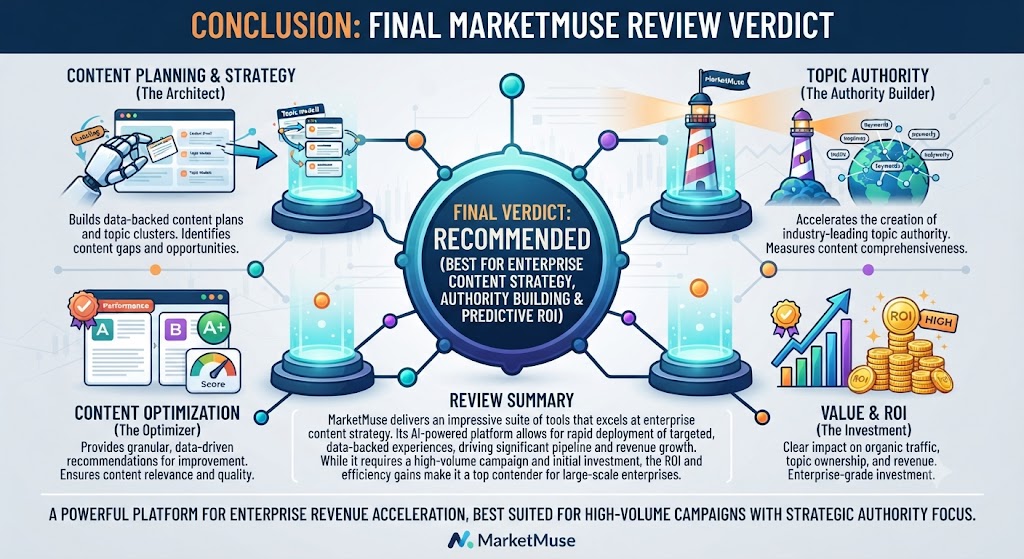
After completing a thorough MarketMuse review, the platform’s position in the content intelligence category is unambiguous: MarketMuse offers the most sophisticated topic modelling, content authority analysis, and strategic content intelligence available in any AI content tool. The personalised difficulty scoring, the site-level authority mapping, the content gap analysis, and the internal link intelligence are capabilities that no competing tool matches in depth or strategic value.
The limitations this MarketMuse review identified are similarly unambiguous. The premium pricing puts MarketMuse out of reach for early-stage teams and budget-conscious content operations. The complexity requires investment to unlock full value. And the strategic intelligence features are most powerful for established content programmes with the volume and team capacity to act on them.
For the content teams this MarketMuse review describes — established programmes, publishing at scale, competing in authority-sensitive niches — MarketMuse delivers a genuinely differentiated strategic advantage. The 7-day trial gives you enough access to run your site through the authority analysis and evaluate whether the strategic intelligence justifies the ongoing investment. This MarketMuse review’s recommendation is clear: if content strategy is a core business function and budget allows, MarketMuse belongs in your tool stack. Explore more in our AI writing tools hub.
🎯 CTA BOX 3 — Start Building Content Authority with MarketMuse
Stop optimising articles one at a time and start building a content programme that owns its niche. MarketMuse’s AI maps your content authority and tells you exactly where to invest next — start your free MarketMuse plan at marketmuse.com and see your content gaps from the outside.
Disclosure: This article contains affiliate links. TechBotHQ may earn a commission if you sign up through our links, at no extra cost to you. See our affiliate disclosure for full details.
Skip The Learning Curve — Let Us Run It For You
These AI marketing tools are powerful, but strategy still takes time to master. Tasknestly runs done-for-you digital marketing campaigns using the same category of tools, professionally managed.
Get a Free Marketing Quote →