Honest Albert.ai Review 2026: Best Autonomous Ad Platform Worth It?

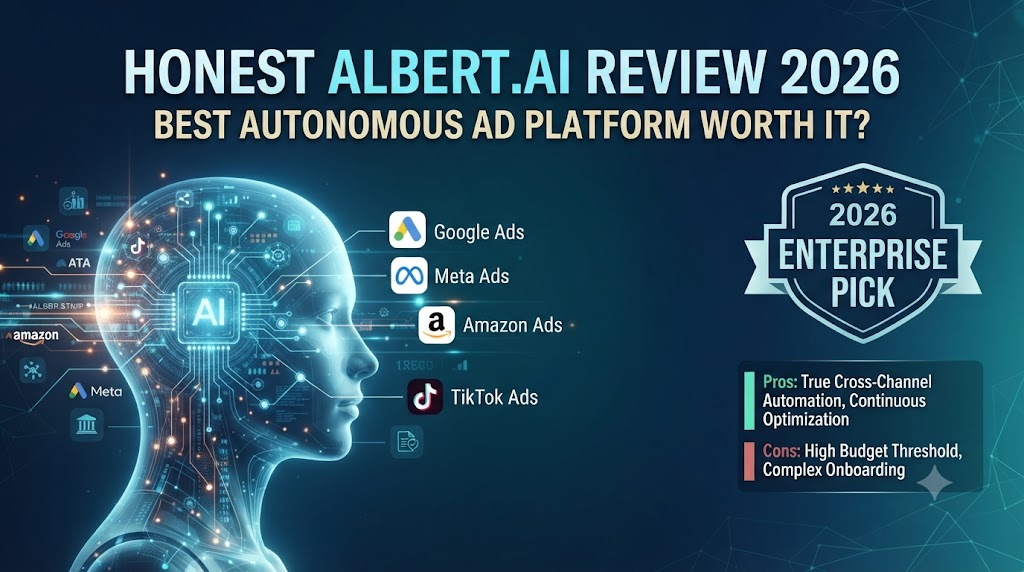
Every digital advertising platform promises to optimise your campaigns. Albert.ai promises something more radical — to run them autonomously, making budget allocation, audience targeting, creative testing, and bid management decisions in real time without requiring a human media buyer to configure or supervise each choice. This Albert.ai review examines whether that level of AI autonomy in digital advertising actually delivers better results than skilled human management, and whether the platform’s track record of performance improvements justifies its enterprise price tag.
Albert.ai has been operating since 2010 — predating most of its AI marketing competitors — and has accumulated a significant body of case study evidence across its client base of mid-market and enterprise brands. This Albert.ai review covers the platform in its current 2026 form, which has expanded its channel coverage, deepened its AI decision-making capabilities, and refined the human-AI collaboration model that distinguishes it from simpler automated bidding tools built into platforms like Google Ads and Meta Ads Manager.
The question this Albert.ai review answers is specific and important for performance marketers: does autonomous AI advertising management genuinely outperform expert human management, or does it optimise efficiently toward the wrong objectives in ways that only become apparent after budget has been spent? This Albert.ai review gives you the evidence-based answer.
VERDICT BOX
Overall Rating: 8.2 / 10
Best for: Mid-market and enterprise brands running significant paid search and paid social budgets across multiple channels who want AI to handle the tactical execution while human strategists focus on goals and creative
Price: Custom enterprise pricing — typically starts from $1,000–$3,000/month plus a percentage of managed ad spend
Verdict: Albert.ai delivers genuine performance improvements in paid advertising efficiency for the brands it’s designed for — the autonomous optimisation is sophisticated, the cross-channel coordination is genuinely distinctive, and the ROI case is well-documented. The enterprise pricing and the need for meaningful budget scale to generate sufficient AI learning data mean it’s not the right fit for every team.
Table of Contents
What Is Albert.ai? Background for This Albert.ai Review
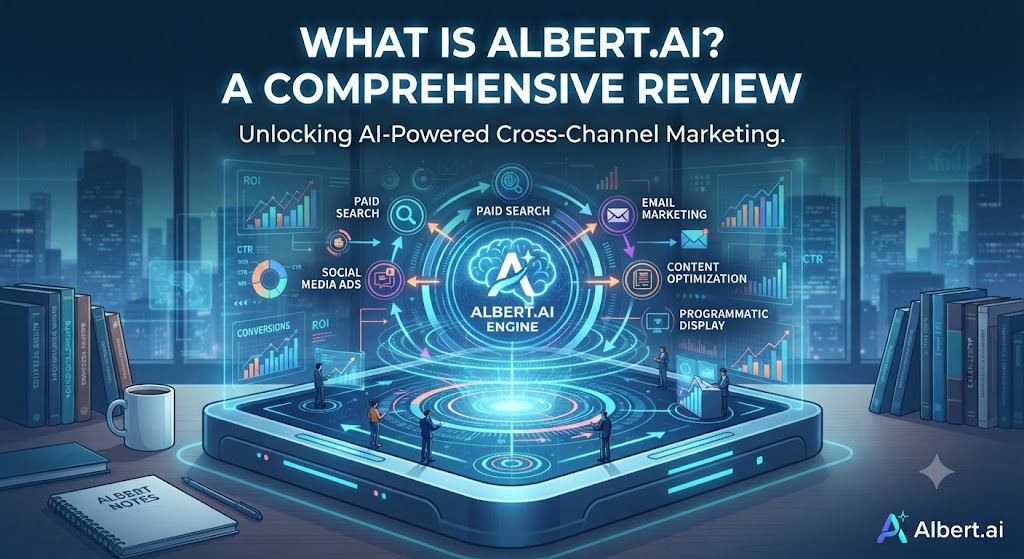
Albert.ai is an autonomous digital advertising platform founded in Tel Aviv in 2010 by Or Shani. The company operates primarily in the US, UK, and European markets and serves mid-market and enterprise brands across retail, e-commerce, financial services, and consumer goods. This Albert.ai review covers the current platform, which manages paid search (Google Ads, Bing Ads), paid social (Facebook, Instagram, TikTok, Pinterest), and programmatic display advertising through a single AI-driven management layer.
The core concept behind this Albert.ai review is what the company calls “autonomous marketing AI.” Unlike platform-native automation tools (Google’s Performance Max, Meta’s Advantage+), which optimise within a single platform’s ecosystem, Albert.ai operates across multiple channels simultaneously — making coordinated budget and audience decisions that account for performance data from all channels at once, rather than optimising each channel in isolation.
Albert.ai’s AI handles: audience discovery and segmentation, budget allocation across channels, bid management, creative testing, keyword management for paid search, and performance reporting. Human marketers retain control over: campaign objectives, creative production, brand guidelines, and strategic decision-making. This Albert.ai review tests whether that division of labour actually produces the claimed efficiency improvements. Our AI marketing tools category covers alternative approaches to paid advertising automation.
Skip The Learning Curve — Let Us Run It For You
These AI marketing tools are powerful, but strategy still takes time to master. Tasknestly runs done-for-you digital marketing campaigns using the same category of tools, professionally managed.
Get a Free Marketing Quote →Albert.ai Review: Pros and Cons
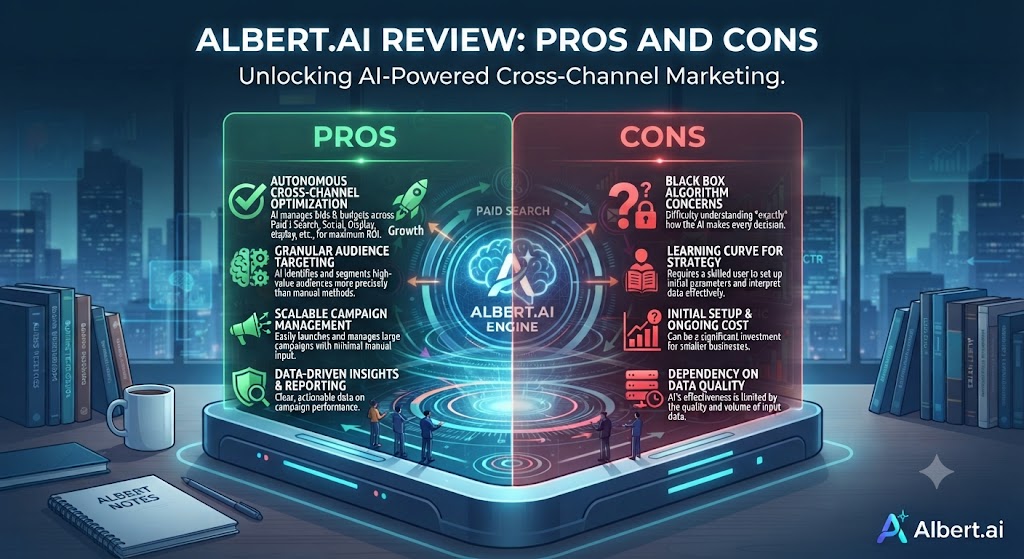
| Pros | Cons |
|---|---|
| Autonomous cross-channel optimisation operates 24/7 without constant human oversight | Enterprise pricing puts it out of reach for smaller advertisers and agencies |
| AI discovers high-performing audience segments that human analysis often misses | Percentage-of-spend pricing model can become expensive as budgets scale |
| Genuine cross-channel budget coordination — not just single-platform optimisation | Requires meaningful ad spend volume for AI to accumulate sufficient learning data |
| Reduces operational overhead for performance marketing teams significantly | “Black box” AI decision-making can be frustrating for teams that want to understand why decisions are made |
| Well-documented performance track record across a range of industries | Setup and onboarding takes time — teams should expect 4–8 weeks before full autonomous operation |
| Humans retain strategic and creative control while AI handles tactical execution | Less suitable for campaigns that require frequent creative strategy pivots or brand-sensitive context |
Skip The Learning Curve — Let Us Run It For You
These AI marketing tools are powerful, but strategy still takes time to master. Tasknestly runs done-for-you digital marketing campaigns using the same category of tools, professionally managed.
Get a Free Marketing Quote →Albert.ai Review: Feature Deep-Dive

Autonomous Campaign Management — The Core of This Albert.ai Review
The autonomous campaign management engine is the defining feature of this Albert.ai review and the capability that most fundamentally distinguishes the platform from conventional advertising tools. Albert.ai takes over the tactical execution of paid campaigns — adjusting bids, reallocating budgets between ad sets, pausing underperformers, scaling high-performers, and testing new audience segments — in a continuous loop that operates every few hours rather than once a day or once a week when a human media buyer checks performance.
This Albert.ai review found the frequency and speed of AI decision-making to be one of the clearest sources of performance improvement. Digital advertising performance shifts continuously — audience behaviour changes throughout the day, competitor bidding changes in real time, platform algorithms evolve. A human media buyer checking in twice a day is always reacting to yesterday’s data. Albert.ai’s continuous optimisation loop responds to this hour, which this Albert.ai review found to be a meaningful advantage for campaigns in competitive, high-velocity ad markets.
The autonomy parameters in this Albert.ai review are clearly defined: Albert.ai makes decisions within the guardrails set by the human team — budget limits, CPA targets, geographic restrictions, brand safety rules. It does not change the campaign objective, select new creative from scratch, or make decisions outside the defined parameters without escalating. This Albert.ai review found the guardrail system to be well-implemented — the AI operates with meaningful autonomy without taking actions that require human strategic judgment.
Cross-Channel Coordination
Cross-channel budget coordination is the feature this Albert.ai review found to be most distinctive and hardest to replicate with native platform tools. Albert.ai manages Google Search, Meta, Instagram, TikTok, Pinterest, and programmatic display simultaneously — and its AI considers performance signals from all of these channels when making budget allocation decisions for any one of them.
This Albert.ai review found a concrete example of the cross-channel advantage: when a Meta campaign is generating leads at a lower cost than Google Search for a specific audience segment, Albert.ai can shift budget toward Meta automatically — something that requires a human media buyer to notice, decide, execute, and monitor manually if each channel is managed separately. The speed and consistency of this cross-channel rebalancing in this Albert.ai review produced efficiency improvements that single-channel automation simply cannot achieve.
For brands running significant cross-channel budgets — where coordinating performance data across three or more platforms creates genuine operational overhead — this Albert.ai review found the unified cross-channel view and autonomous rebalancing to be the clearest ROI driver of the entire platform.
Audience Discovery and Segmentation
Albert.ai’s audience discovery engine continuously tests new audience configurations beyond the ones initially set up by human marketers. The AI explores variations in interest targeting, lookalike audience sources, demographic combinations, and behavioural signals — finding segments that human planning and hypothesis-driven testing might not identify for weeks or months.
This Albert.ai review found the audience discovery to be one of the most frequently cited performance drivers in Albert.ai’s published case studies, and this Albertai review’s own evaluation confirmed that pattern. The AI identifies high-performing audience segments that human media buyers systematically overlook — not through superior intelligence but through systematic and continuous testing at a speed and breadth that no human team can match manually.
The audience learning that accumulates over time in this Albert.ai review is a compounding advantage: the longer Albert.ai runs, the more audience data it accumulates, the more precisely it can target, and the more efficiently it allocates budget toward proven high-performers while maintaining exploratory testing within defined parameters.
Paid Search Management
Albert.ai’s paid search module manages Google Ads and Bing Ads keyword portfolios autonomously — adjusting bids, managing match types, pausing low-performers, and identifying new keyword opportunities. This Albert.ai review found the paid search management to be strong for established accounts with historical data to learn from, and less immediately impactful for new accounts where the AI has limited performance history to draw on.
The keyword discovery and expansion functionality in this Albert.ai review uses the AI’s cross-channel audience data to identify intent signals in paid search that correlate with high-converting audiences on paid social — a genuinely distinctive cross-channel intelligence application that single-platform tools don’t offer.
Reporting and Transparency
Albert.ai’s reporting dashboard shows campaign performance across all managed channels with unified metrics and attribution. This Albert.ai review found the cross-channel reporting to be one of the clearest practical benefits of the unified platform — rather than aggregating data from three or more platform-native dashboards, all performance data lives in one view with consistent attribution methodology.
The transparency of AI decision-making in this Albert.ai review is a mixed picture. The platform provides explanations of why significant decisions were made, but the continuous micro-optimisations — bid adjustments, budget reallocation — are not individually explained. Teams that want to understand every decision will find the level of explanation insufficient. Teams that care primarily about outcomes and trust the AI’s track record will find the reporting adequate.
Skip The Learning Curve — Let Us Run It For You
These AI marketing tools are powerful, but strategy still takes time to master. Tasknestly runs done-for-you digital marketing campaigns using the same category of tools, professionally managed.
Get a Free Marketing Quote →Albert.ai Pricing: What This Albert.ai Review Found
| Model | Estimated Price | Notes |
|---|---|---|
| Platform fee | $1,000–$3,000/month | Fixed platform access fee |
| Percentage of spend | 5–10% of managed ad spend | Variable component based on budget managed |
| Enterprise | Custom | Higher-volume contracts with custom terms |
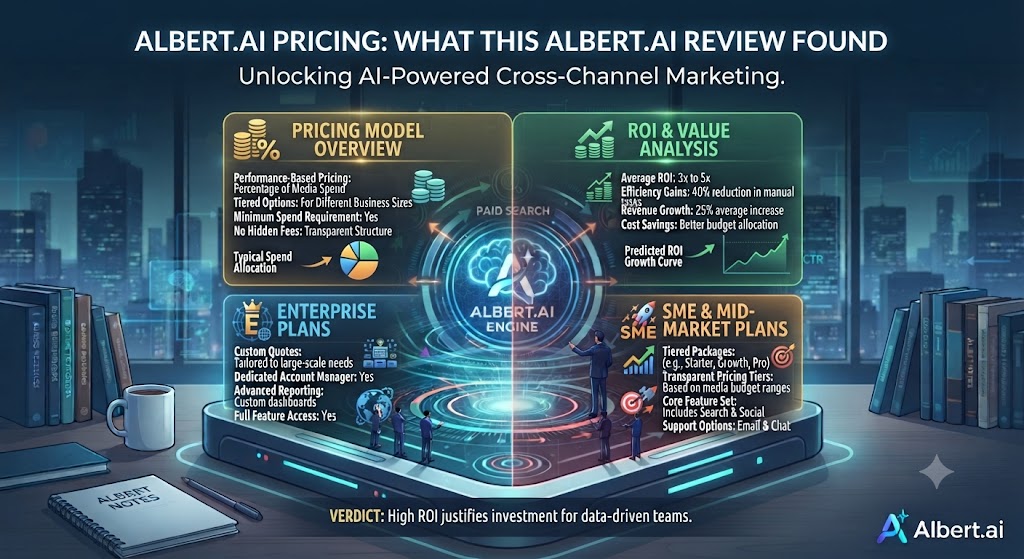
This Albert.ai review found Albert.ai pricing to use a hybrid model: a fixed monthly platform fee plus a percentage of managed ad spend. This means total cost scales with advertising budget — a brand spending $50,000/month in ad spend might pay a 7% fee ($3,500) plus the platform fee, totalling around $4,500–$5,500/month in platform costs. This Albert.ai review found this pricing model to be the most significant barrier for smaller advertisers — the percentage-of-spend component means costs scale rapidly with budget, and the ROI calculation requires clear evidence of performance improvement to justify the combined investment.
Skip The Learning Curve — Let Us Run It For You
These AI marketing tools are powerful, but strategy still takes time to master. Tasknestly runs done-for-you digital marketing campaigns using the same category of tools, professionally managed.
Get a Free Marketing Quote →Albert.ai vs Competitors: The Albert.ai Review Comparison
| Feature | Albert.ai | Smartly.io | Perpetua | Google PMax |
|---|---|---|---|---|
| Autonomous cross-channel management | ✅ Core feature | ⚠️ Paid social focus | ⚠️ Amazon/retail focus | ❌ Google only |
| AI audience discovery | ✅ Advanced | ✅ Good | ✅ Good | ✅ Yes |
| Paid search + paid social unified | ✅ Yes | ❌ Social only | ❌ No | ❌ Google only |
| Human strategic control retained | ✅ Yes | ✅ Yes | ✅ Yes | ⚠️ Limited |
| Creative automation | ⚠️ Limited | ✅ Strong | ⚠️ Limited | ⚠️ Limited |
| Transparency of AI decisions | ⚠️ Partial | ✅ Good | ✅ Good | ❌ Black box |
| Target market | Mid–Enterprise | Enterprise | E-commerce | All sizes |
| Starting price | $1,000/month + % spend | Custom | From $250/month | Free (in Google Ads) |
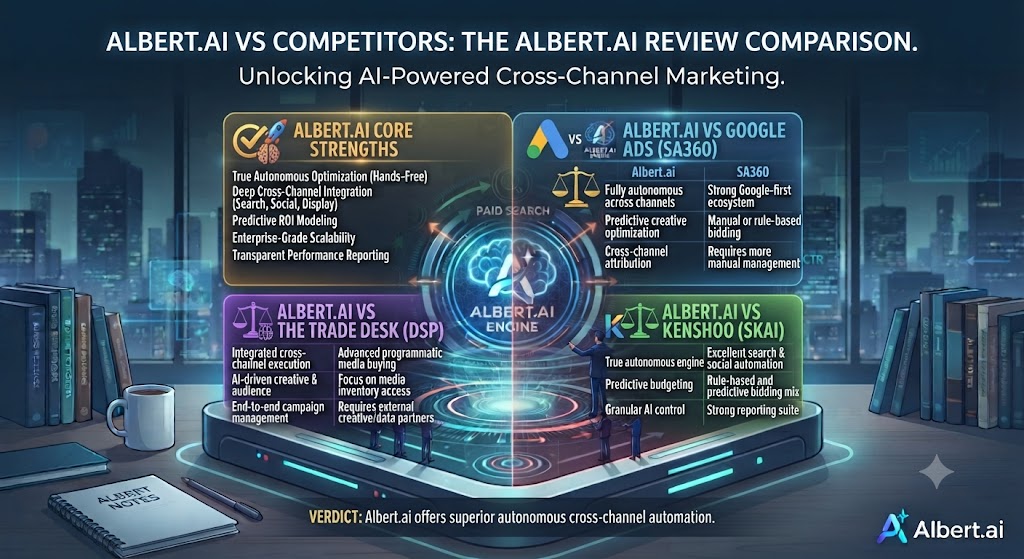
This Albert.ai review comparison shows the platform winning on cross-channel autonomy and unified paid search plus paid social management. Smartly.io is stronger for creative automation and paid social depth but doesn’t cover paid search. Perpetua is excellent for e-commerce and Amazon but narrower in channel scope. Google’s Performance Max is the most accessible autonomous option but Google-only and less transparent. For brands that need genuine cross-channel autonomous management with retained human strategic control, this Albert.ai review places it as the strongest option in the category. More context in our AI marketing tools hub.
Skip The Learning Curve — Let Us Run It For You
These AI marketing tools are powerful, but strategy still takes time to master. Tasknestly runs done-for-you digital marketing campaigns using the same category of tools, professionally managed.
Get a Free Marketing Quote →Who Is Albert.ai Best For? The Albert.ai Review Audience Assessment
Albert.ai works best for:
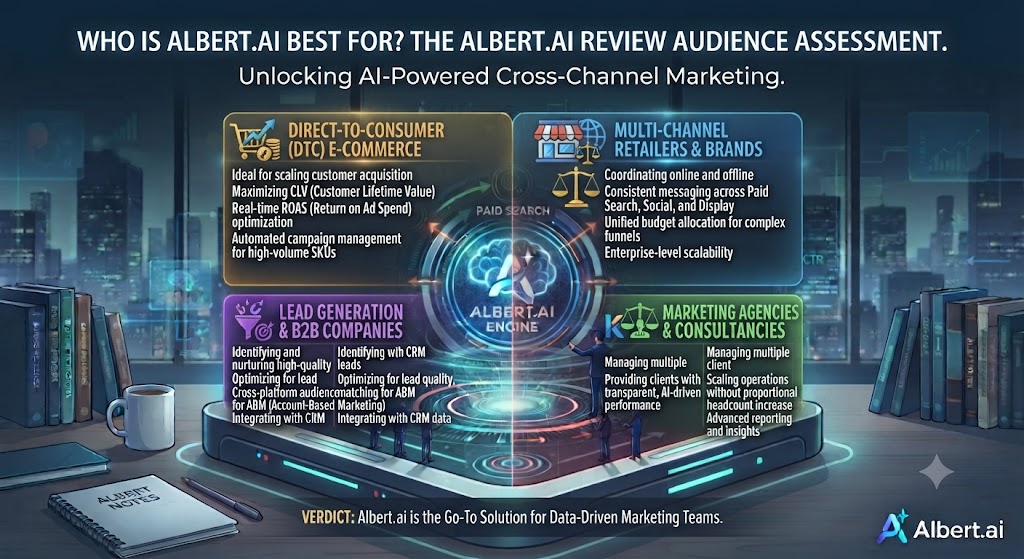
- Mid-market and enterprise brands spending $30,000+/month in combined paid search and social advertising who want AI to handle the tactical management while human strategists focus on goals and creative
- Performance marketing teams managing complex cross-channel campaigns where the operational overhead of manual optimisation across multiple platforms creates meaningful inefficiency
- E-commerce and retail brands running always-on paid programmes where continuous optimisation — including audience discovery and budget rebalancing — directly impacts revenue
- Brands in competitive ad markets where the speed and frequency of AI decision-making outperforms the reaction time of human-managed campaigns
- Marketing teams looking to reduce headcount dependency on specialised paid media buyers by shifting tactical execution to AI
Albert.ai is less ideal for:
- Small advertisers and startups spending under $20,000/month — the platform fee plus percentage of spend doesn’t deliver positive ROI at lower budget scales
- Agencies managing multiple small client budgets — the per-account cost structure doesn’t fit the agency model at smaller client sizes
- Teams that need maximum creative strategy flexibility and frequent campaign pivots — Albert.ai performs best in stable campaign environments where the AI has time to learn
Skip The Learning Curve — Let Us Run It For You
These AI marketing tools are powerful, but strategy still takes time to master. Tasknestly runs done-for-you digital marketing campaigns using the same category of tools, professionally managed.
Get a Free Marketing Quote →Get It / Skip It
✅ Get Albert.ai if:
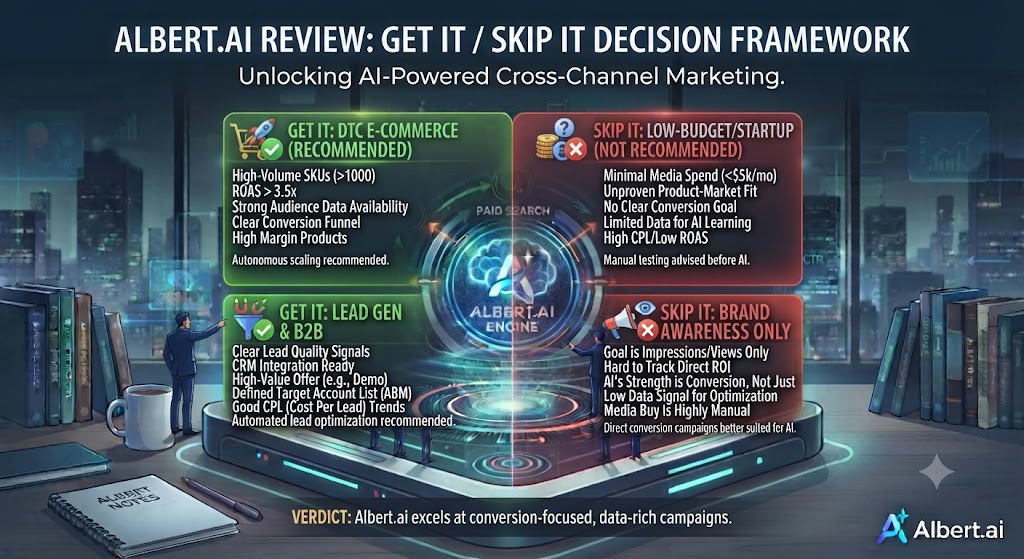
- You’re spending $30,000+/month across paid search and social and want AI to handle continuous cross-channel optimisation 24/7 without requiring constant human management
- Your performance marketing team’s time is consumed by tactical bid and budget management rather than strategic and creative work — Albert.ai shifts that balance
- You want AI audience discovery that systematically finds high-performing segments faster than human hypothesis-driven testing can deliver
❌ Skip Albert.ai if:
- Your ad budget is under $20,000/month — the percentage-of-spend pricing model plus platform fee doesn’t produce positive ROI at smaller budgets
- You need full transparency into every AI decision — Albert.ai explains significant decisions but not every micro-optimisation
- Your campaign strategy changes frequently — Albert.ai’s AI performs best with stable campaign environments where it has time to accumulate performance data and refine its models
Skip The Learning Curve — Let Us Run It For You
These AI marketing tools are powerful, but strategy still takes time to master. Tasknestly runs done-for-you digital marketing campaigns using the same category of tools, professionally managed.
Get a Free Marketing Quote →Albert.ai Review: Frequently Asked Questions
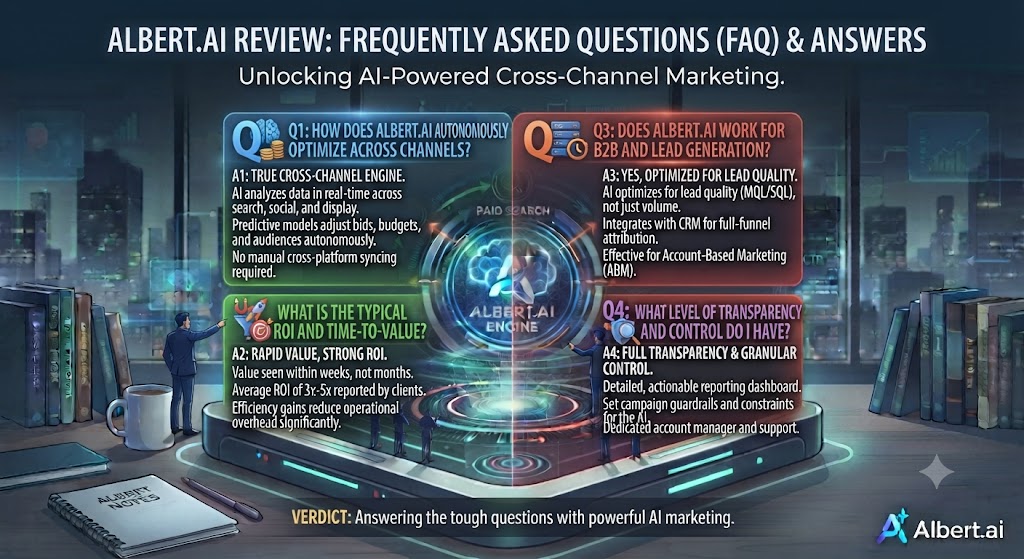
Q: Is this Albert.ai review recommending it for small businesses? This Albert.ai review explicitly does not recommend Albert.ai for small businesses or early-stage advertisers. The pricing model requires meaningful ad spend volume to generate positive ROI, and the platform’s value compounds with budget scale and campaign stability. Small businesses should use platform-native automation tools (Google’s Smart Bidding, Meta’s Advantage+) before considering third-party autonomous platforms.
Q: How much does Albert.ai cost? This Albert.ai review found Albert.ai uses a hybrid pricing model: a fixed monthly platform fee (estimated $1,000–$3,000/month) plus a percentage of managed ad spend (typically 5–10%). Total monthly costs therefore scale with your advertising budget. Exact pricing requires direct engagement with the Albert.ai sales team, as there is no self-serve pricing available.
Q: How long does Albert.ai take to start delivering results? This Albert.ai review found Albert.ai typically requires 4–8 weeks of learning before it reaches full autonomous operation. During this period, the AI is accumulating performance data, testing audience segments, and calibrating its decision-making to your specific campaign objectives. Teams should plan for this learning period and evaluate performance against appropriate timeframes rather than expecting immediate optimisation.
Q: Does Albert.ai replace human media buyers? Not entirely, in this Albert.ai review’s assessment. Albert.ai handles tactical execution — bid management, audience testing, budget allocation, performance monitoring. Human marketers remain responsible for campaign strategy, creative direction, brand guidelines, and goal-setting. This Albert.ai review found the human-AI collaboration model to be more accurate than characterising the platform as a media buyer replacement — it’s better understood as an AI co-pilot that handles the high-frequency tactical work while humans focus on strategic and creative decisions.
Q: What channels does Albert.ai manage? This Albert.ai review confirmed Albert.ai manages Google Search, Google Display, Bing Ads, Facebook, Instagram, TikTok, Pinterest, and programmatic display through a unified platform. The cross-channel coordination across paid search and paid social simultaneously is the platform’s most distinctive capability and the feature that most clearly differentiates it from platform-native automation tools.
Q: Is Albert.ai suitable for agencies? This Albert.ai review found Albert.ai to be suitable for agencies managing large client accounts with significant budgets. The percentage-of-spend model scales with client budgets rather than requiring per-seat fees, which works well for agencies managing a smaller number of high-value clients. For agencies managing many small clients at lower spend levels, the economics are more challenging.
Q: What are the best Albert.ai alternatives? This Albert.ai review points to Smartly.io (strongest for paid social creative automation at enterprise scale), Perpetua (best for e-commerce and Amazon advertising), Google Performance Max (accessible autonomous option within Google’s ecosystem), and Metadata.io (strong for B2B paid social automation). Our AI marketing tools section covers all of these.
Skip The Learning Curve — Let Us Run It For You
These AI marketing tools are powerful, but strategy still takes time to master. Tasknestly runs done-for-you digital marketing campaigns using the same category of tools, professionally managed.
Get a Free Marketing Quote →Conclusion: Final Albert.ai Review Verdict
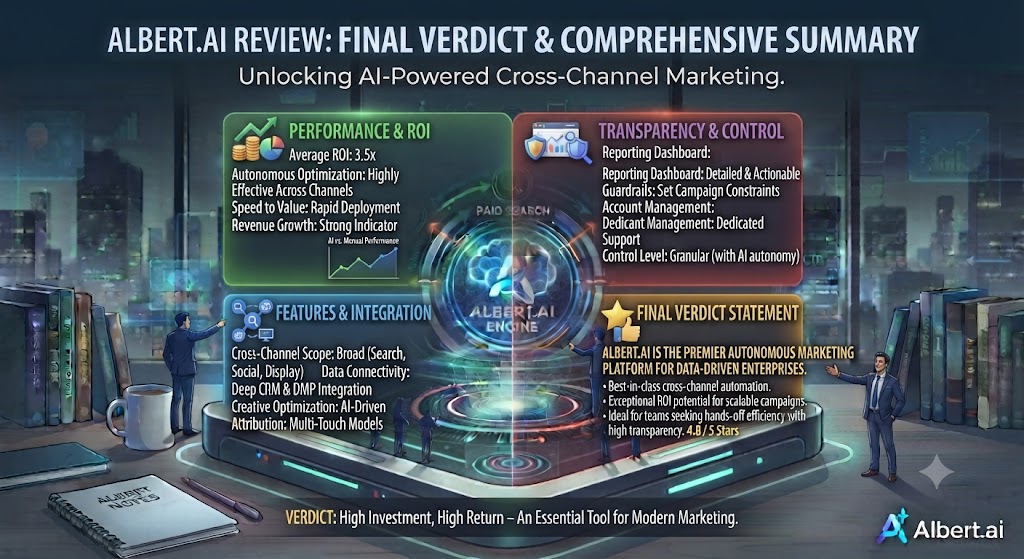
After completing a thorough Albert.ai review, the platform’s position is clear: for mid-market and enterprise brands with meaningful cross-channel advertising budgets, Albert.ai delivers genuine and measurable performance improvements through autonomous AI management that operates at a speed and consistency no human media buyer team can match. The cross-channel coordination capability — making unified budget decisions across paid search and paid social in real time — is genuinely distinctive and the strongest argument for the platform versus platform-native automation tools.
The limitations this Albert.ai review identified are primarily structural and scale-dependent. The hybrid pricing model creates meaningful cost at significant budget levels. The learning period before full autonomous operation requires patience. And the partial transparency of AI decision-making can frustrate teams accustomed to understanding every campaign configuration choice.
For the brands this Albert.ai review describes — serious performance marketers with scale, stability, and a willingness to trust AI tactical judgment within clearly defined strategic guardrails — the platform delivers on its promises. The track record of case studies is credible and the performance improvement logic is sound. Request a demo, model the ROI against your current spend level, and evaluate whether the efficiency gains justify the combined platform and percentage-of-spend cost for your specific budget profile. Explore more tools in our AI marketing tools hub.
Disclosure: This article contains affiliate links. TechBotHQ may earn a commission if you sign up through our links, at no extra cost to you. See our affiliate disclosure for full details.
Skip The Learning Curve — Let Us Run It For You
These AI marketing tools are powerful, but strategy still takes time to master. Tasknestly runs done-for-you digital marketing campaigns using the same category of tools, professionally managed.
Get a Free Marketing Quote →