Physical Address
304 North Cardinal St.
Dorchester Center, MA 02124
Physical Address
304 North Cardinal St.
Dorchester Center, MA 02124

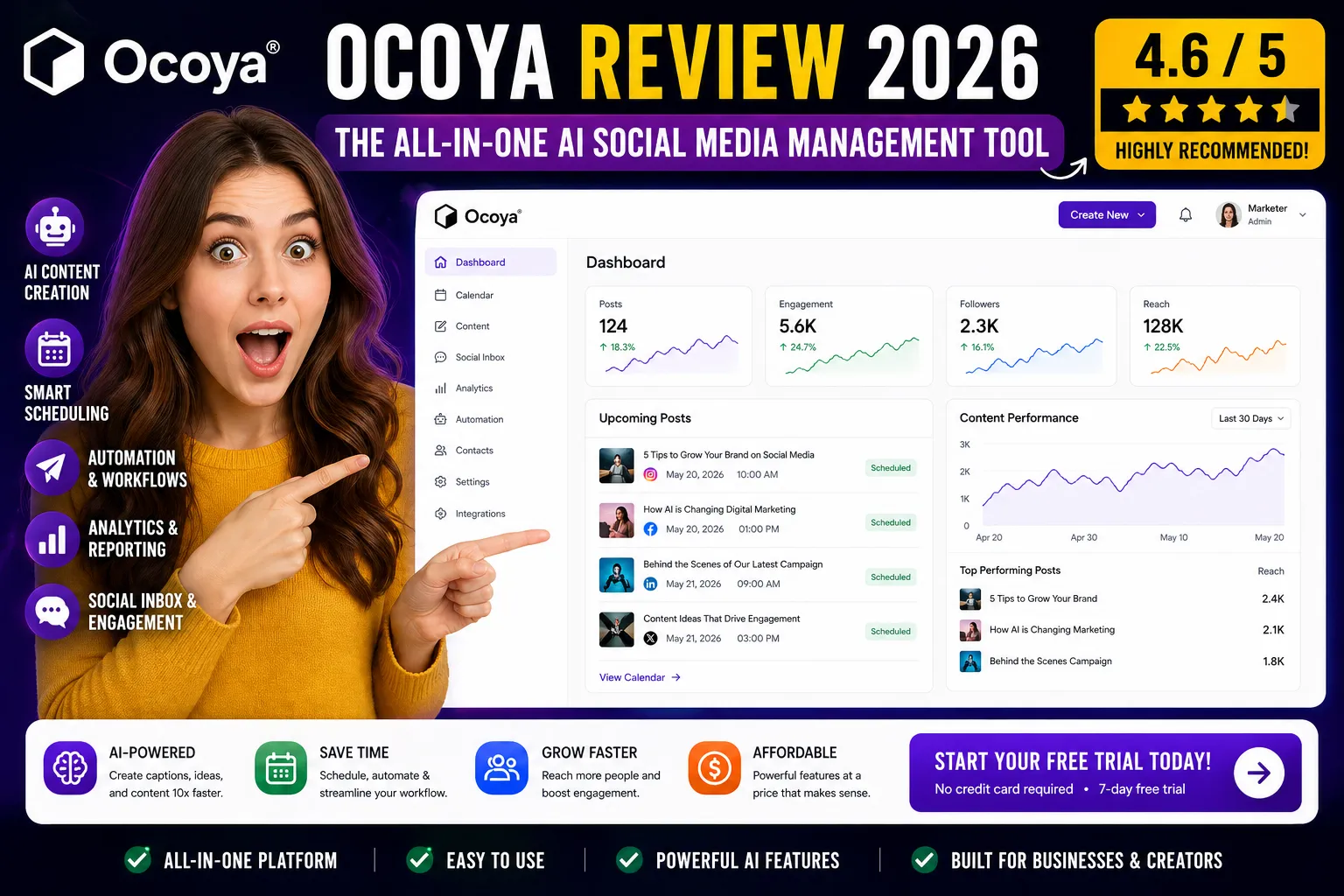
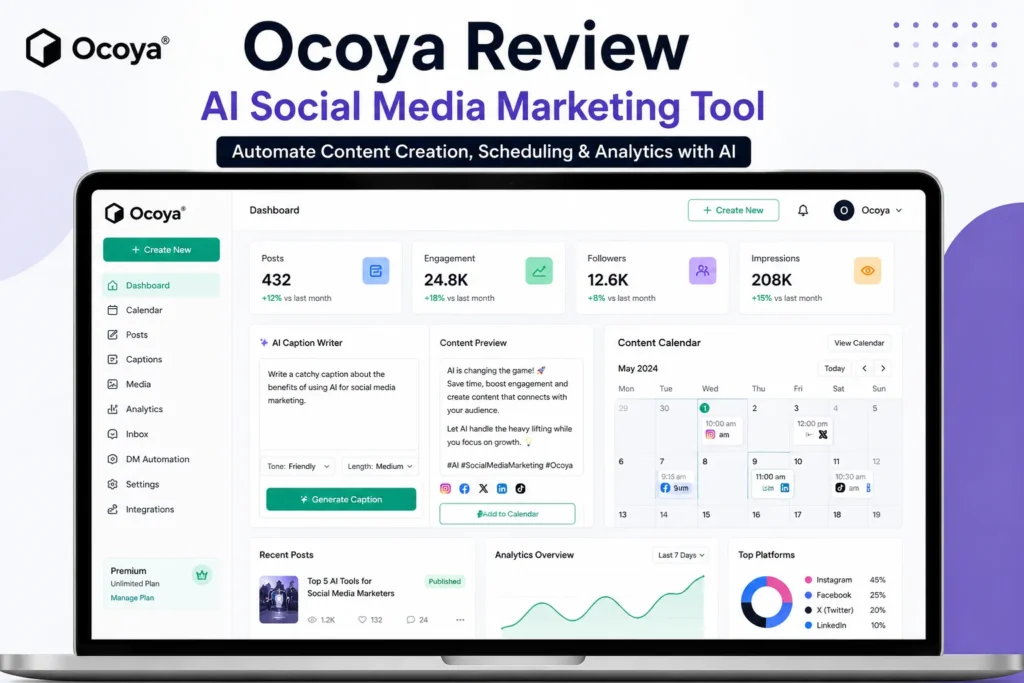
This Ocoya review explores one of the fastest-growing AI marketing tools in 2026 — and for good reason.
Social media today demands consistent posting, high-quality visuals, engaging captions, and data-driven decisions. Managing all of this manually — or using multiple tools — quickly becomes expensive and time-consuming.
That’s exactly where Ocoya comes in.
Ocoya is designed to be an all-in-one AI social media marketing platform, combining:
All inside a single dashboard.
Instead of using tools like Canva, Buffer, and AI writers separately, Ocoya merges everything into one streamlined workflow.
In this Ocoya review, you’ll discover:
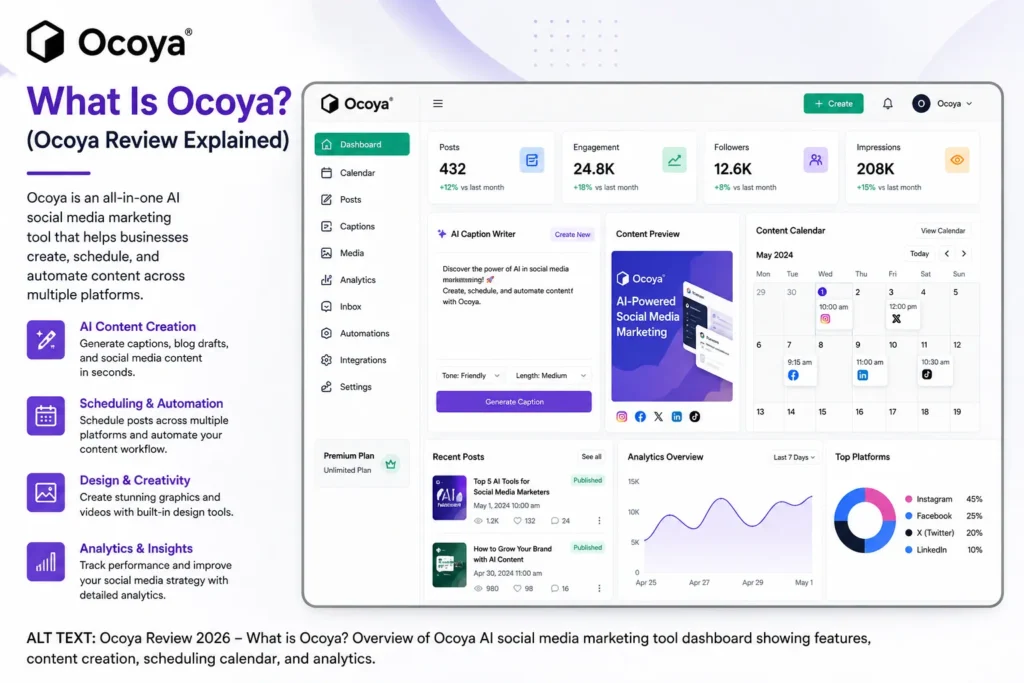
Ocoya is an AI-powered marketing platform built to simplify how content is created, published, and managed across social media.
At its core, Ocoya helps users:
One of its biggest strengths is its built-in AI system called Travis AI, which generates marketing content using proven frameworks like AIDA and PAS.
This means you can create:
The platform supports major channels including:
Unlike basic schedulers, Ocoya is not just a publishing tool — it’s a complete marketing system.
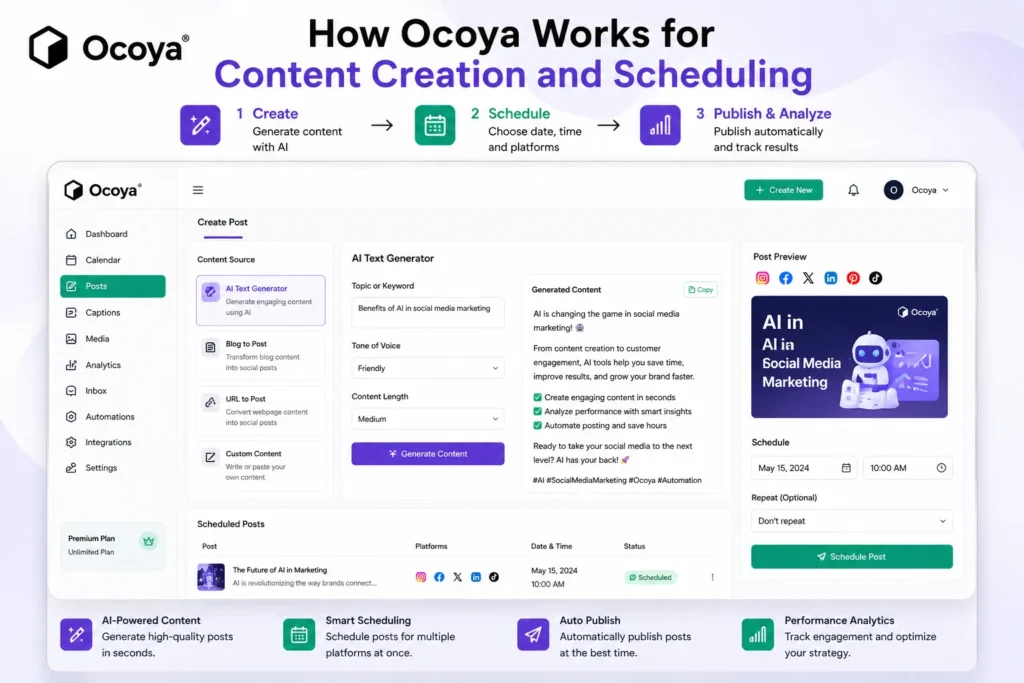
Understanding how the platform works is key to this Ocoya review.
The workflow is simple but powerful:
You input a topic or product description, and Travis AI generates multiple content variations instantly.
Use built-in design tools or import from Canva to create graphics.
Select platforms, choose dates, and plan content using a calendar view.
Set triggers like:
Track engagement, growth, and performance trends.
This end-to-end workflow is what makes Ocoya stand out — everything happens in one place.
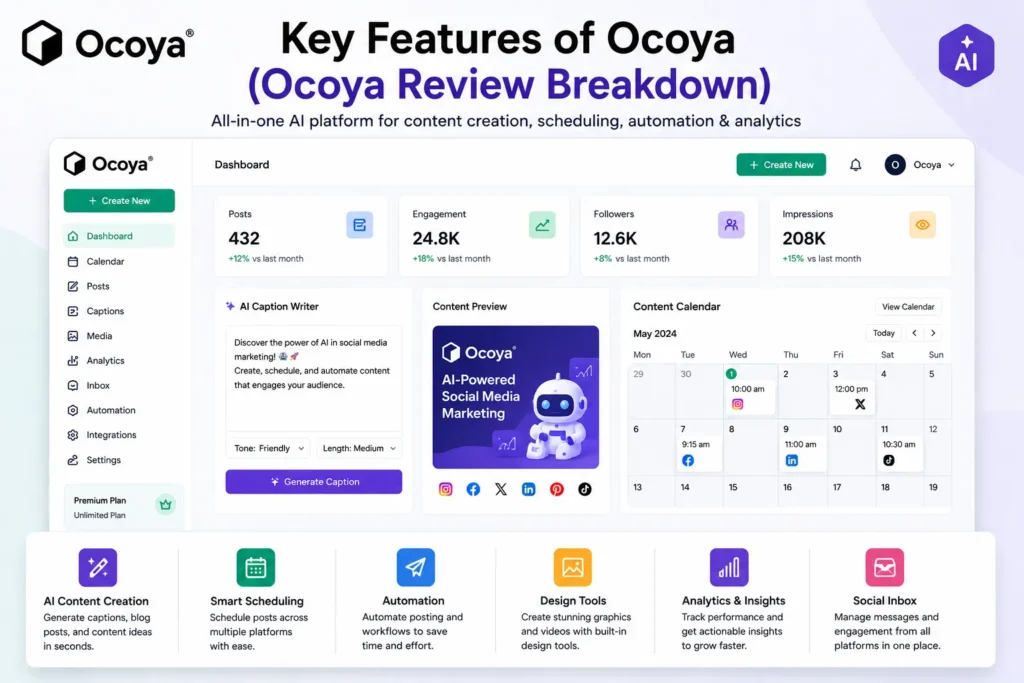
The core of this Ocoya review is its AI-powered content generation engine, Travis AI.
While many platforms focus on either content creation or social media management, Ocoya combines both into a single system. This allows users to create, optimize, and publish content without constantly switching between multiple tools.
Travis AI is designed to help businesses generate marketing content quickly while maintaining flexibility across different channels and audiences.
The platform offers:
• 100+ content templates
• Multiple writing tones
• Multilingual support (50+ languages)
• Framework-based copywriting models
• AI-assisted content generation
• Social media content creation
Users can choose from tones such as:
• Friendly
• Professional
• Persuasive
• Informative
• Conversational
• Promotional
This flexibility makes it easier to adapt content to different audiences, industries, and marketing objectives.
One of the strongest features is support for proven copywriting frameworks, including:
• AIDA (Attention, Interest, Desire, Action)
• PAS (Problem, Agitate, Solution)
• BAB (Before, After, Bridge)
These frameworks help marketers create content that is more structured and persuasive than simple AI-generated text.
For example, an e-commerce business can quickly generate:
• Product descriptions
• Promotional posts
• Ad copy
• Social media captions
• Email campaigns
• Landing page content
Another major advantage is multilingual support. Businesses targeting international audiences can generate content in dozens of languages without relying on separate translation tools.
This is particularly useful for:
• Global brands
• International e-commerce stores
• Agencies serving multiple regions
• Businesses expanding into new markets
Speed is another key benefit. Content that might normally require significant manual writing can often be generated within seconds, allowing teams to maintain a more consistent publishing schedule.
The feature is especially valuable for:
• Marketers
• E-commerce sellers
• Agencies
• Content creators
• Social media managers
• Small business owners
Because Travis AI is integrated directly into Ocoya’s publishing ecosystem, users can move seamlessly from content creation to scheduling and distribution.
This is one reason many users view Ocoya as a strong social media automation tool rather than simply another AI writing platform. The goal is not only to create content faster but also to streamline the entire social media workflow from ideation to publication.
For businesses managing multiple social platforms, this integrated approach can save significant time while maintaining content consistency across channels.
Overall, Travis AI is one of Ocoya’s strongest features. By combining templates, multilingual support, proven marketing frameworks, and fast content generation inside a broader social media automation tool, it helps marketers and businesses create and distribute content more efficiently while reducing the workload associated with day-to-day social media management.
Another major advantage of Ocoya is its built-in design system, which helps users create social media content without relying on multiple design platforms.
Many marketers manage content creation using several separate tools. One platform is used for writing captions, another for graphic design, another for stock images, and yet another for scheduling posts. This fragmented workflow can slow down content production and create unnecessary complexity.
Ocoya simplifies the process by bringing design and content creation into a single workspace.
The platform includes:
• Ready-made templates
• Stock image libraries
• Video support
• Typography tools
• Graphic editing capabilities
• Social media design assets
This allows users to create visual content directly inside the platform without needing advanced design experience.
One of the biggest advantages is speed. Instead of starting from a blank canvas, users can select pre-designed templates and customize them for their brand, campaign, or audience.
This is particularly useful for:
• Social media posts
• Promotional graphics
• Product announcements
• Marketing campaigns
• Content calendars
• E-commerce promotions
The built-in stock image library further reduces the need for external resources. Users can access visual assets directly within the platform, helping accelerate the content creation process.
Video support adds another layer of flexibility. Since video content continues to dominate social media engagement, having access to video-friendly content creation tools helps businesses create more diverse campaigns without leaving the platform.
Another standout feature is integration with Canva.
This integration allows users to:
• Import Canva designs
• Edit them inside Ocoya
• Combine them with AI-generated content
• Publish directly to social media channels
For businesses already using Canva, this creates a smoother workflow because existing designs can be reused without requiring manual downloads, uploads, or transfers between platforms.
One of the biggest productivity benefits is reduced tool switching.
Instead of moving between:
• Writing software
• Design platforms
• Stock image websites
• Publishing tools
users can handle much of the workflow from a single dashboard.
This can save significant time for:
• Social media managers
• Marketing teams
• Agencies
• E-commerce brands
• Content creators
• Small business owners
Another advantage is consistency. When content creation, design, and publishing happen within the same environment, it becomes easier to maintain branding, messaging, and visual standards across multiple campaigns.
For teams producing content at scale, this streamlined approach can dramatically improve efficiency while reducing the complexity associated with managing multiple software platforms.
Overall, Ocoya’s built-in design system is a valuable complement to its AI content generation capabilities. By combining templates, stock assets, video support, typography tools, and Canva integration within a single social media automation tool, the platform helps businesses create, manage, and publish content more efficiently without relying on multiple disconnected applications.
The scheduler is one of the strongest features highlighted in this Ocoya review and a major reason why many marketers use the platform as their central social media management hub.
Creating content is only half the battle. Consistently publishing that content across multiple channels is often where the real challenge begins. Managing posting schedules manually can become time-consuming, especially for businesses handling multiple brands, campaigns, or social media accounts.
Ocoya addresses this problem with a scheduling system designed to simplify planning, organization, and publishing.
The platform includes features such as:
• Calendar view
• Drag-and-drop scheduling
• Multi-platform posting
• Draft management
• Content organization tools
• Publishing automation
One of the most useful aspects is the visual calendar interface. Rather than viewing content as a simple list of scheduled posts, users can see their entire publishing schedule laid out across days, weeks, or months.
This makes it much easier to identify content gaps, maintain posting consistency, and coordinate marketing campaigns across different channels.
The drag-and-drop scheduling system adds another layer of convenience. If priorities change or campaigns need to be adjusted, posts can be moved quickly without rebuilding the schedule from scratch.
This flexibility is especially useful for:
• Marketing teams
• Social media managers
• Agencies managing multiple clients
• E-commerce businesses
• Content creators
• Small business owners
Multi-platform posting is another major advantage. Instead of logging into multiple social networks individually, users can schedule content from a single dashboard and distribute it across several platforms simultaneously.
This helps reduce repetitive work and ensures that content is published consistently across all marketing channels.
Draft management is equally important for larger teams. Content often goes through multiple stages before publication, including creation, editing, approval, and final scheduling. Ocoya allows teams to save drafts, review content, and maintain an organized workflow throughout the publishing process.
One of the biggest benefits is long-term planning.
Users can:
• Plan content weeks ahead
• Build monthly campaigns
• Organize seasonal promotions
• Schedule product launches
• Coordinate marketing initiatives
• Maintain consistent posting schedules
This proactive approach helps reduce last-minute content creation and gives teams more time to focus on strategy, engagement, and campaign optimization.
Another advantage is visibility. With a centralized content calendar, everyone involved in the marketing process can quickly understand what is scheduled, what is pending approval, and what still needs to be created.
This improves collaboration and helps prevent duplicated efforts or missed publishing opportunities.
For businesses producing large amounts of social content, the scheduler becomes a critical productivity tool because it transforms content management from a daily task into a structured planning process.
Overall, the scheduling system is one of the strongest components of this Ocoya review. By combining calendar planning, drag-and-drop scheduling, draft management, and multi-platform publishing into a single social media automation tool, Ocoya helps marketers stay organized, save time, and maintain a consistent presence across their social media channels.
This is where Ocoya becomes particularly powerful and starts to separate itself from many traditional social media management platforms.
Most social media tools help users create content and schedule posts. Ocoya goes a step further by introducing automation systems that can continuously generate, publish, and manage content with minimal manual involvement.
For businesses handling multiple products, brands, or marketing campaigns, these automations can save a significant amount of time while maintaining a consistent online presence.
The platform includes automation features such as:
• RSS feed auto-posting
• Product-based content creation
• Scheduled content generation
• AI-powered engagement assistance
• Automated publishing workflows
• Content distribution automation
One of the most useful features is RSS feed auto-posting.
Instead of manually sharing every new blog article or website update, users can connect their RSS feed and allow Ocoya to automatically create and publish social media posts whenever new content is released.
This is especially valuable for:
• Blogs
• News websites
• Content publishers
• Affiliate marketers
• E-commerce businesses
• Business websites
For example, every new article published on TechBotHQ could automatically trigger social media content without requiring manual posting each time.
Another powerful capability is product-based content generation.
E-commerce businesses often spend countless hours creating promotional posts for products. Ocoya can help automate this process by generating content directly from product information, making it easier to maintain active marketing campaigns without constantly writing new copy.
This can be particularly useful for:
• Online stores
• Shopify businesses
• Product launches
• Seasonal promotions
• Catalog marketing campaigns
Scheduled content generation adds another layer of automation. Rather than creating every post manually, users can establish workflows that generate content automatically according to predefined schedules.
This helps maintain consistency even during busy periods when marketing teams have limited time available.
One of the most forward-looking features is the use of AI-driven engagement systems. These tools can assist with content recommendations, audience interaction strategies, and ongoing social media management tasks that would normally require manual oversight.
The result is a workflow where content can be:
• Generated automatically
• Organized automatically
• Scheduled automatically
• Published automatically
• Managed more efficiently
This dramatically reduces repetitive work and allows teams to focus on higher-value activities such as campaign strategy, customer relationships, and business growth.
For agencies and businesses managing multiple social accounts, these automations can provide substantial productivity improvements by reducing the number of manual steps required throughout the content lifecycle.
This automation-first approach is one reason many users consider Ocoya a powerful social media automation tool rather than simply a content scheduler.
Instead of helping users post content faster, the platform aims to reduce the amount of work required to create and distribute content in the first place.
Overall, Ocoya’s automation capabilities are among its strongest features. By combining RSS automation, product-driven content creation, scheduled generation, and AI-assisted engagement into a single social media automation tool, the platform helps businesses scale their social media efforts while significantly reducing the manual workload associated with content marketing.
No social media management platform would be complete without analytics, and Ocoya includes a solid reporting system that helps users understand how their content is performing across different channels.
While analytics may not be the first feature people notice, they are critical for improving long-term marketing results. Creating and publishing content is important, but understanding what works—and what doesn’t—is what allows businesses to grow their audience and improve engagement over time.
Ocoya provides insights such as:
• Engagement tracking
• Post performance analysis
• Growth analytics
• Audience interaction metrics
• Content performance trends
• Social media reporting
One of the biggest advantages is visibility. Instead of guessing which posts are generating results, users can review performance data and identify the types of content that resonate most with their audience.
This helps marketers answer questions such as:
• Which posts generate the most engagement?
• What content drives the most clicks?
• Which campaigns perform best?
• How fast are social accounts growing?
• What posting strategies are producing results?
The engagement tracking feature allows users to monitor audience interactions and understand how followers respond to different types of content.
This can include:
• Likes
• Comments
• Shares
• Clicks
• Reach and engagement trends
Post performance reporting helps identify top-performing content and uncover patterns that can be applied to future campaigns. For example, businesses may discover that educational posts consistently outperform promotional content or that certain posting times generate higher engagement.
Growth analytics add another layer of insight by tracking how social media accounts evolve over time. Rather than focusing only on individual posts, users can monitor broader trends and evaluate whether their overall social media strategy is producing sustainable growth.
This information is particularly valuable for:
• Small businesses
• Content creators
• Marketing agencies
• E-commerce brands
• Personal brands
• Freelancers managing social media accounts
While Ocoya’s analytics are useful, they are not intended to compete with large enterprise-level reporting platforms that provide advanced attribution modeling, deep audience segmentation, and highly detailed performance analysis.
However, for most users, that level of complexity is unnecessary.
For small businesses, creators, and agencies, Ocoya provides more than enough insight to make informed decisions, improve content performance, and track overall growth without becoming overwhelmed by excessive data.
Another benefit is convenience. Because analytics are integrated directly into the platform, users can create content, schedule posts, automate workflows, and monitor performance from a single dashboard.
This unified workflow helps reduce the need for additional reporting tools and makes it easier to connect content creation efforts with measurable results.
Overall, Ocoya’s analytics system strikes a strong balance between simplicity and usefulness. By providing engagement tracking, post performance reporting, and growth analytics inside a comprehensive social media automation tool, it gives users the information they need to optimize their content strategy while keeping reporting accessible and easy to understand.
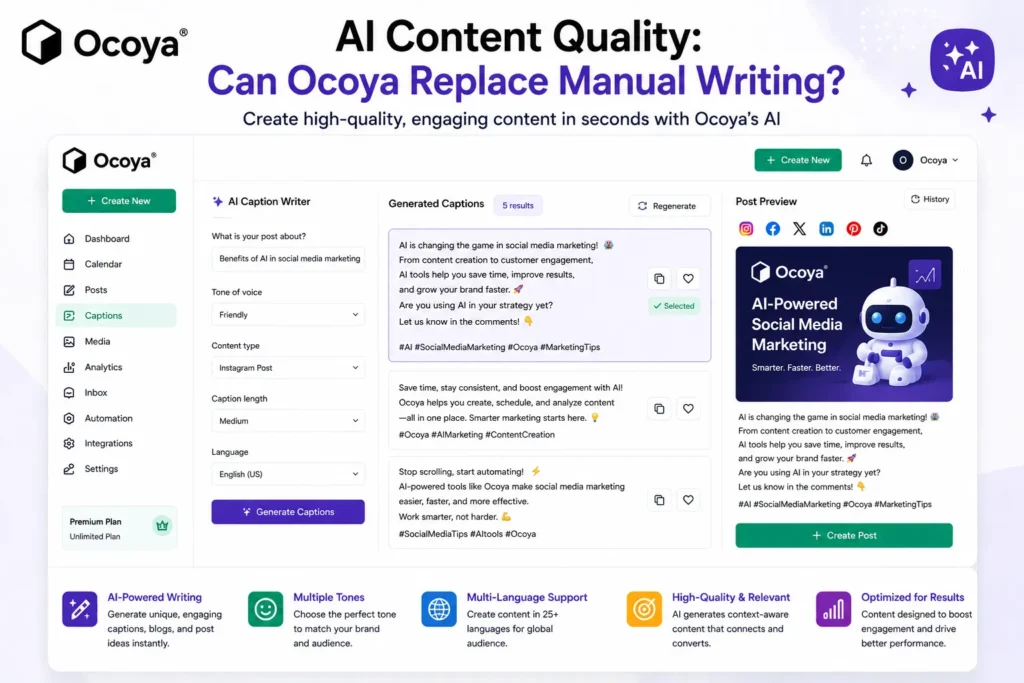
This is a key question in any Ocoya review.
The answer: partially yes — but not completely.
Best use cases:
Overall, Ocoya saves time, not replaces creativity.
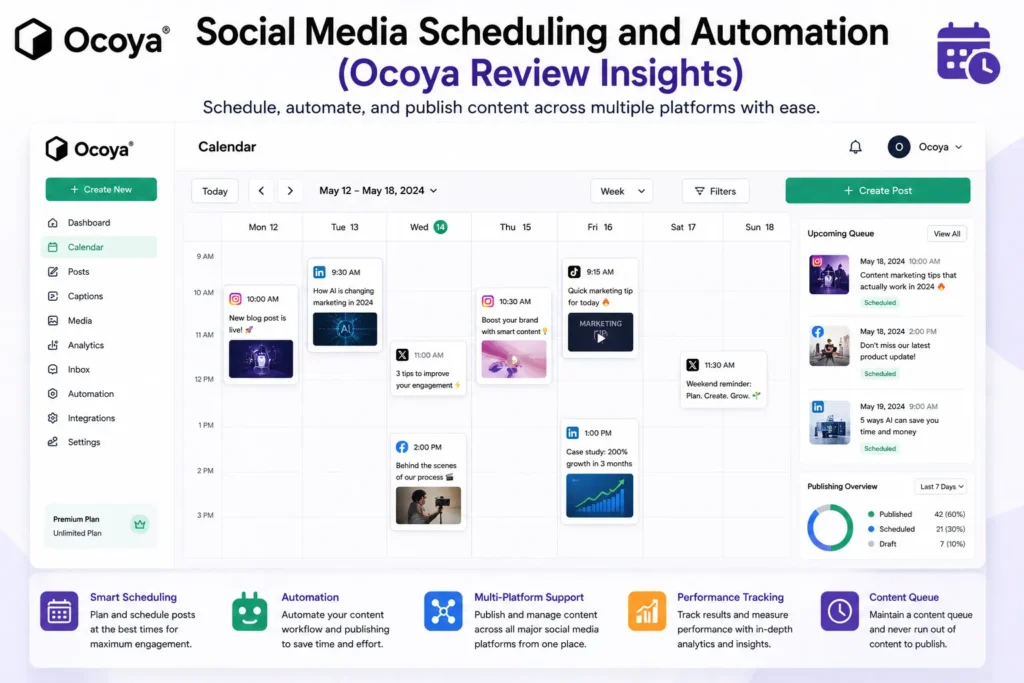
Automation is a major advantage highlighted in this Ocoya review.
You can:
Benefits:
Consistency is critical for growth — and Ocoya solves that.
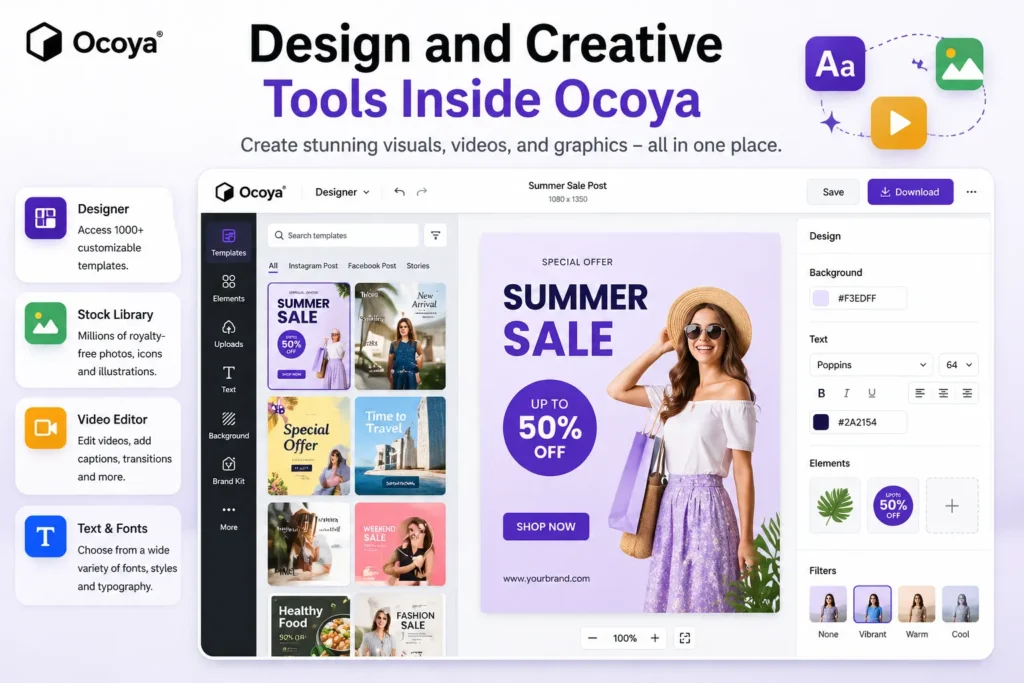
Unlike many tools, Ocoya combines:
This means:
This improves workflow efficiency.
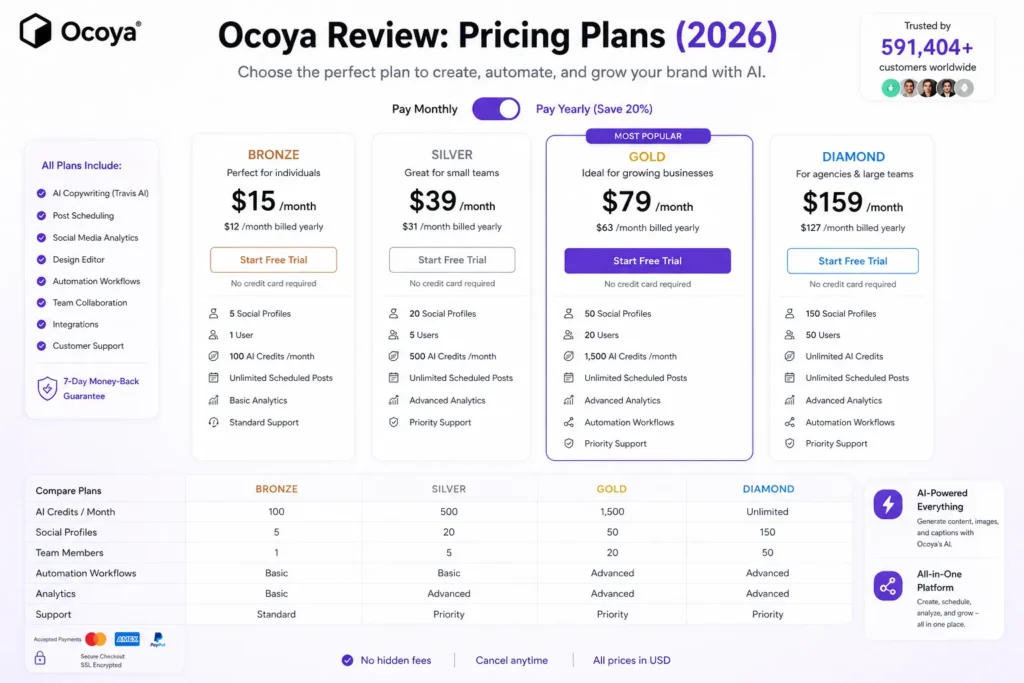
Ocoya offers 4 main plans:
Best for beginners.
Best for small teams.
Best for agencies.
Best for large teams.
Compared to buying:
Ocoya is cost-effective.
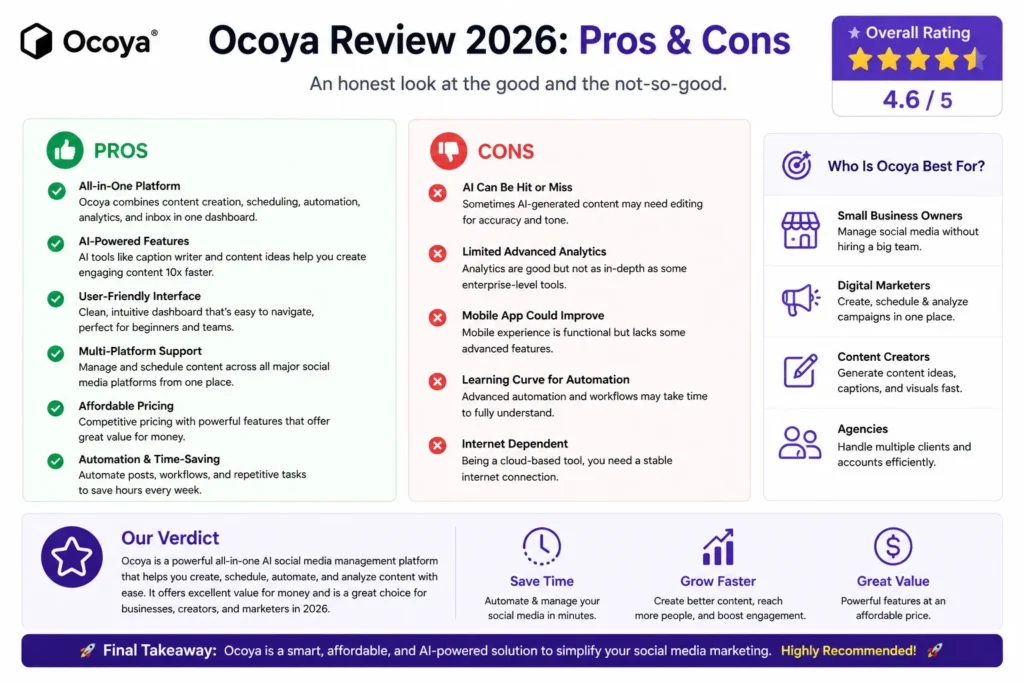
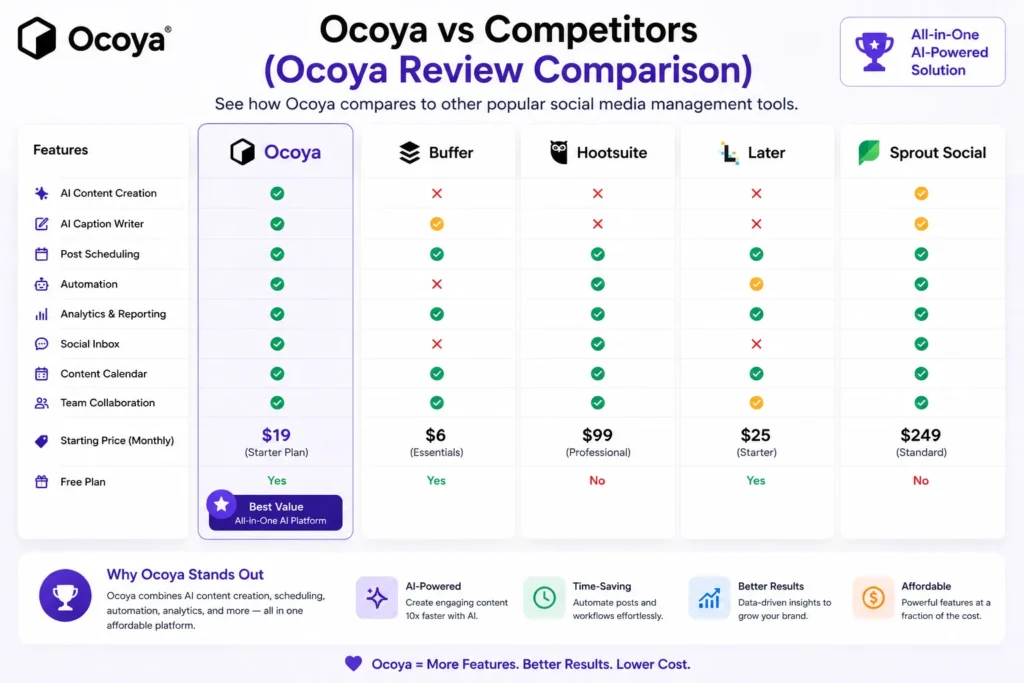
Ocoya wins in overall functionality.
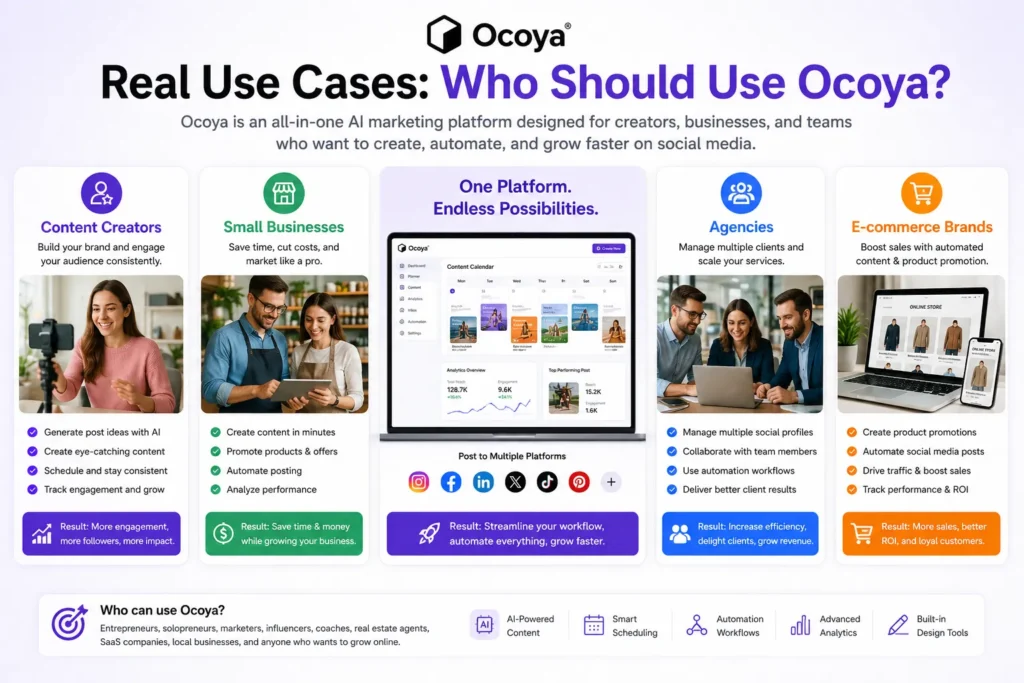
This Ocoya review shows it’s ideal for:
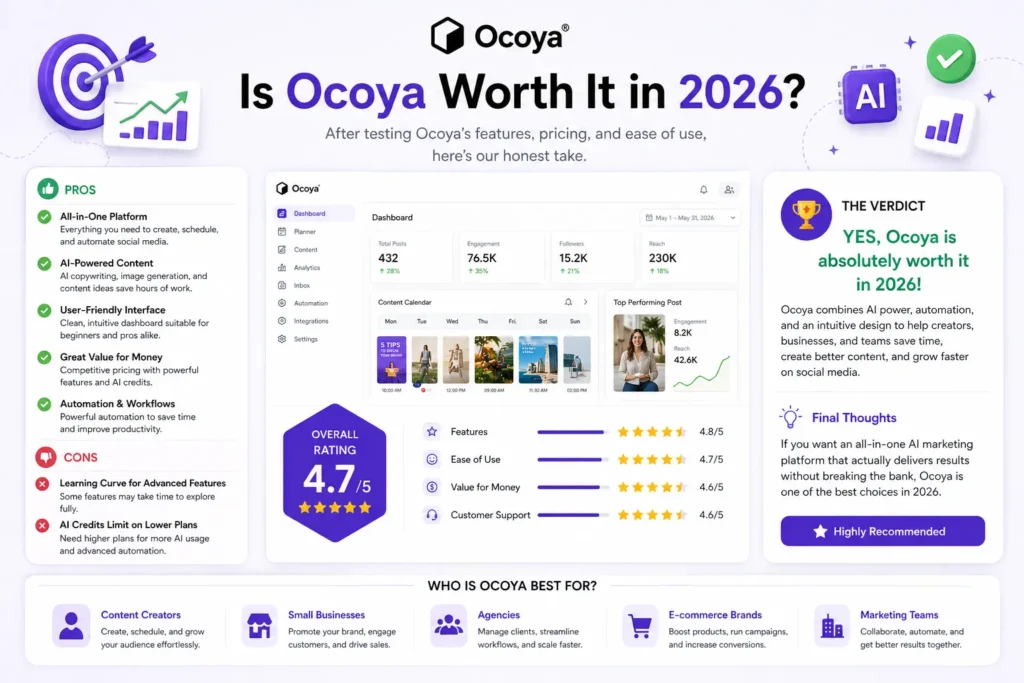
Short answer: Yes — for most users.
Ocoya is worth it if you:
Not ideal if you:
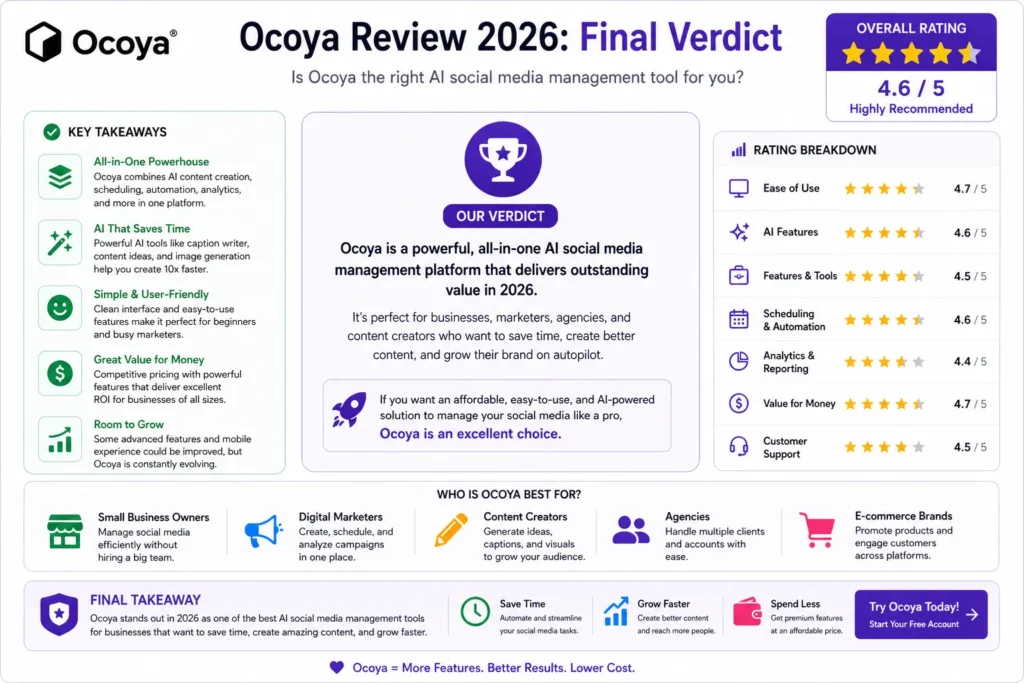
After this full Ocoya review, the conclusion is clear:
Ocoya is one of the best AI marketing tools in 2026.
It combines:
Into one platform.
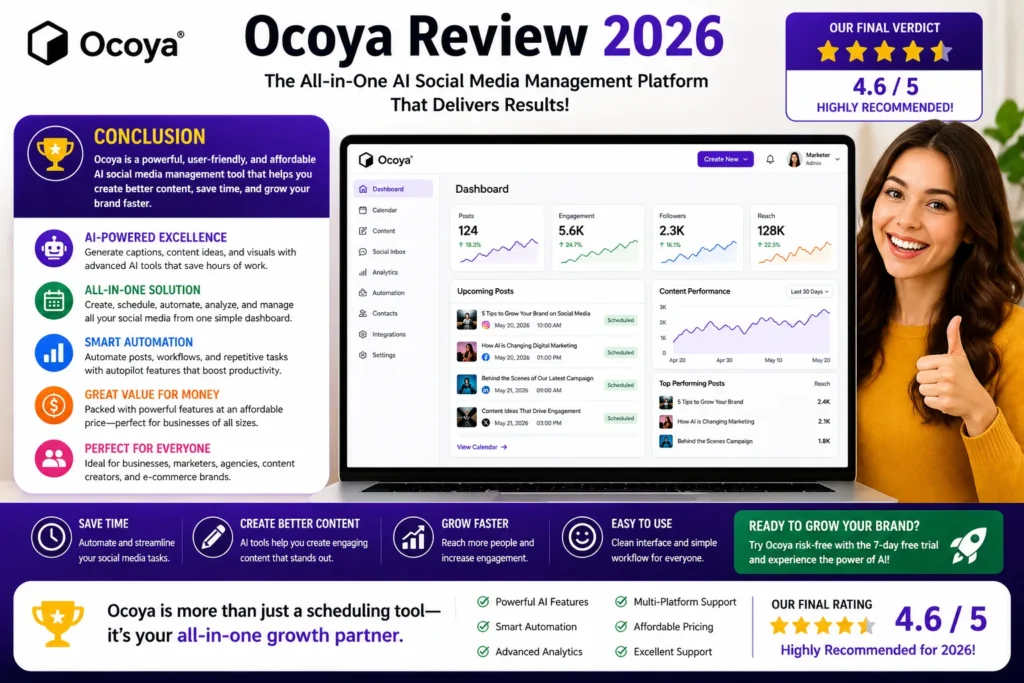
If you’re serious about growing your brand online, Ocoya is a strong choice.
It simplifies everything:
All in one place.
For creators, businesses, and agencies — Ocoya is a powerful productivity tool that can transform your marketing workflow.