Physical Address
304 North Cardinal St.
Dorchester Center, MA 02124
Physical Address
304 North Cardinal St.
Dorchester Center, MA 02124


This HubSpot AI review explores one of the most powerful all-in-one AI platforms available today. As AI continues to reshape how businesses operate, HubSpot has taken a unique approach by embedding artificial intelligence directly into its CRM ecosystem rather than offering it as a separate tool.
In 2026, HubSpot AI—branded as Breeze AI—is no longer just an add-on. It’s a deeply integrated system designed to help marketing, sales, and customer service teams automate workflows, generate content, analyze data, and make smarter decisions—all from a single platform.
Unlike standalone AI tools that require integrations and data syncing, HubSpot AI works directly with your customer data. This makes it significantly more powerful in real-world business use cases, especially for companies already using HubSpot as their core system.
In this detailed HubSpot AI review, we’ll break down its features, pricing, real-world performance, pros and cons, and whether it’s actually worth the investment in 2026.
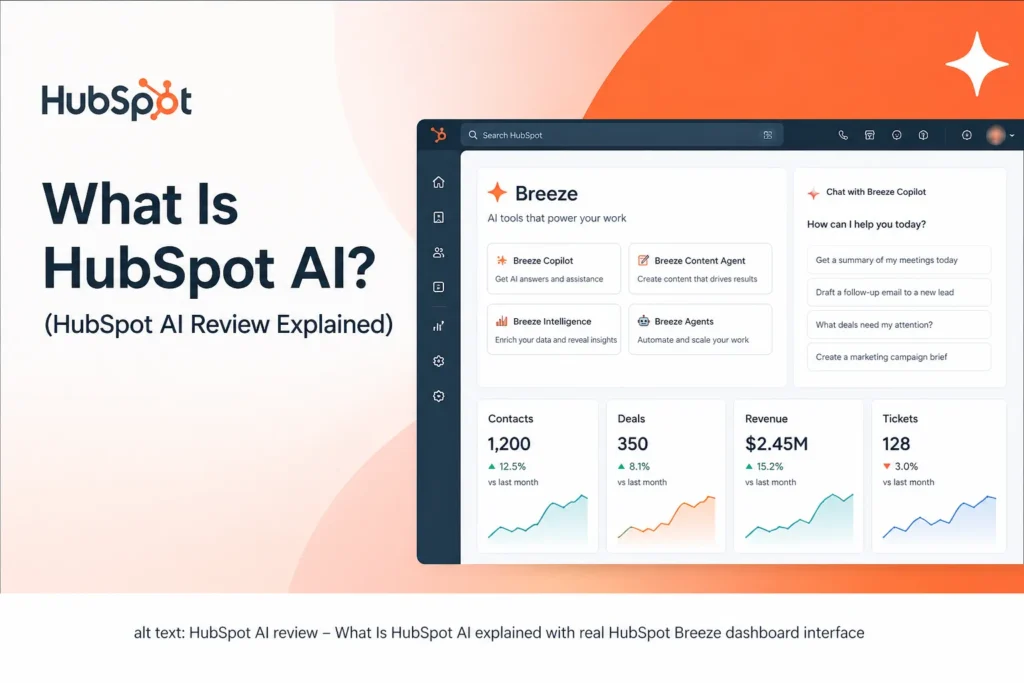
HubSpot AI refers to a suite of artificial intelligence tools built into the HubSpot platform, collectively known as Breeze AI. Instead of being a single feature, it’s a system that enhances every part of the HubSpot ecosystem.
HubSpot itself is an all-in-one customer platform that combines CRM, marketing automation, sales tools, customer support, and content management. AI sits on top of this system, making everything smarter and more efficient.
The key idea behind HubSpot AI is simple:
Bring AI directly to where your data already lives.
This eliminates the need for external AI tools and reduces friction in workflows.
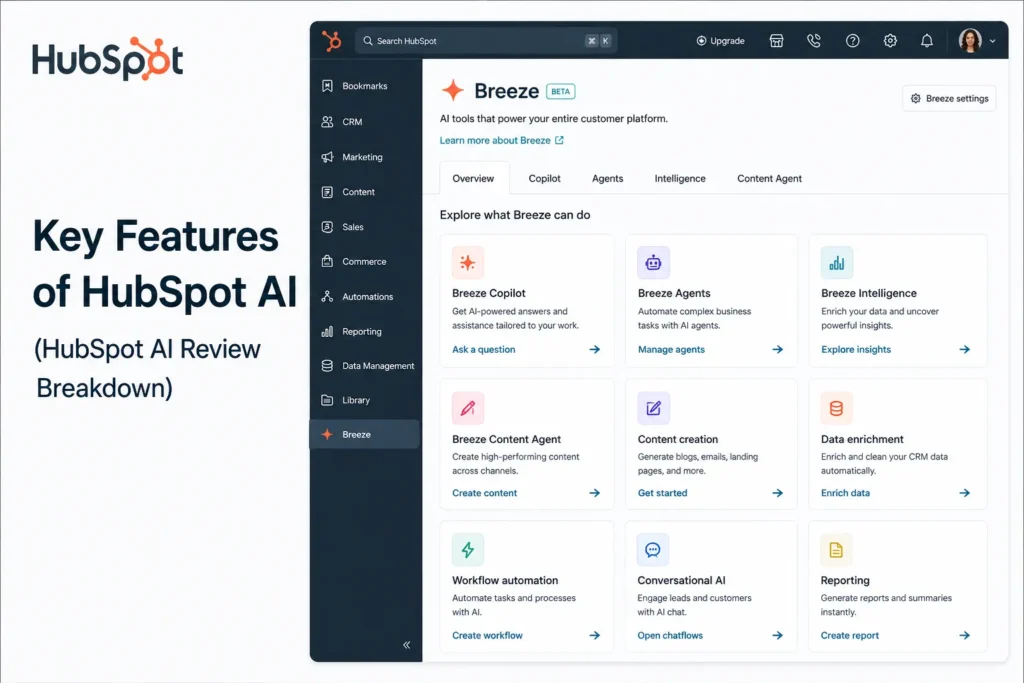
HubSpot AI is built around three main components:
A built-in AI assistant that helps users perform everyday tasks such as:
Autonomous AI tools that can handle multi-step workflows like:
A data-focused AI system that enhances CRM data by:
This structure makes HubSpot AI one of the most complete AI ecosystems available in 2026.
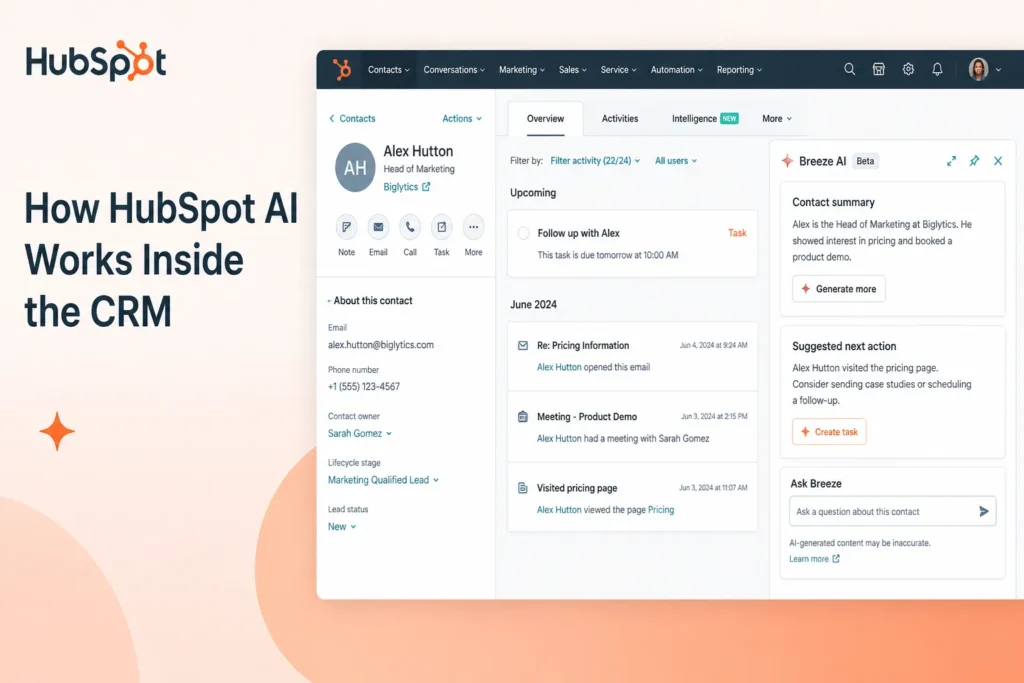
The biggest strength of HubSpot AI is how deeply it integrates with the CRM.
Instead of switching between tools, everything happens inside one platform. This means AI has direct access to:
Because of this, HubSpot AI can generate much more relevant and personalized outputs compared to generic AI tools.
For example:
This tight integration is what makes HubSpot AI stand out.
One of the most valuable capabilities of HubSpot Breeze AI is its built-in content generation system, which is deeply integrated into HubSpot’s marketing, sales, and CRM ecosystem.
Unlike standalone AI writing tools that rely solely on prompts, HubSpot Breeze AI can leverage customer, marketing, and CRM data to create content that is more personalized and contextually relevant.
This makes it particularly useful for organizations that need to produce large amounts of content while maintaining consistency and relevance.
The platform can generate:
• Blog posts
• Marketing emails
• Landing pages
• Ad copy
• Website content
• Sales outreach messages
• Campaign assets
One of the biggest advantages is efficiency. Marketing teams often spend significant time creating content for multiple channels, campaigns, and audience segments. Breeze AI helps accelerate this process by generating first drafts that can be reviewed, refined, and published much faster than writing from scratch.
The feature is especially useful for:
• Marketing teams
• Sales departments
• Agencies
• SaaS companies
• E-commerce businesses
• B2B organizations
Beyond content generation, the platform also includes powerful editing and optimization capabilities.
Users can:
• Rewrite content
• Expand text
• Shorten content
• Generate subject lines
• Improve messaging clarity
• Personalize communications
• Adapt content for different audiences
This flexibility allows marketers to quickly repurpose content across different channels without manually rewriting every asset.
For example, a long-form blog article can be condensed into an email campaign, expanded into a landing page, or transformed into multiple promotional messages.
One of the strongest advantages of HubSpot Breeze AI is personalization.
Because the system has access to CRM information, it can generate content that aligns more closely with customer data, audience segments, and marketing objectives. This creates a level of relevance that many standalone AI writing platforms struggle to match.
For example, marketers can create content tailored to:
• Customer lifecycle stages
• Industry segments
• Lead categories
• Buyer personas
• Existing customer relationships
• Campaign-specific audiences
This CRM-driven approach helps improve communication quality because messaging can be adapted to the actual people receiving it rather than relying on generic content generation.
Another major benefit is workflow integration.
Instead of moving between separate AI writing platforms and marketing software, teams can generate, edit, personalize, and distribute content directly within the HubSpot ecosystem.
This reduces:
• Context switching
• Manual copying and pasting
• Workflow complexity
• Content production time
For organizations producing content at scale, these efficiency gains can become significant over time.
While many AI writing tools focus primarily on content generation, HubSpot Breeze AI focuses on content generation within a broader marketing and customer relationship framework. This integration is what makes the platform particularly effective for businesses already using HubSpot as their central marketing and CRM system.
Overall, HubSpot Breeze AI provides a powerful combination of content creation, editing, personalization, and CRM intelligence. By generating blog posts, emails, landing pages, ad copy, and marketing assets while leveraging customer data, it delivers more relevant and actionable content than many traditional AI writing tools.
Automation has always been one of HubSpot’s greatest strengths, and the addition of AI makes the platform even more powerful for sales and revenue teams.
Managing leads manually becomes increasingly difficult as businesses grow. Sales representatives often spend large amounts of time qualifying prospects, prioritizing opportunities, updating CRM records, and determining which actions to take next. These administrative tasks can reduce the time available for actual selling and relationship building.
HubSpot AI helps streamline this process by automating many of the repetitive activities involved in lead management and sales operations.
The platform can:
• Identify high-quality leads
• Score prospects automatically
• Suggest next actions
• Generate personalized outreach messages
• Prioritize opportunities
• Support pipeline management
• Automate sales workflows
One of the most valuable features is lead qualification.
Rather than requiring sales teams to manually review every contact, the AI can analyze customer behavior, engagement history, and CRM data to identify which prospects are most likely to convert.
This helps teams focus their attention on opportunities with the highest potential value.
Lead scoring is another major advantage.
Traditionally, scoring systems require manual setup and ongoing maintenance. HubSpot AI can assist by automatically evaluating prospects based on multiple factors, helping sales representatives understand where they should invest their time and effort.
This can improve:
• Sales efficiency
• Lead prioritization
• Conversion rates
• Pipeline visibility
• Resource allocation
The AI also provides guidance throughout the sales pipeline.
For example, it can suggest:
• Follow-up actions
• Outreach timing
• Pipeline updates
• Engagement strategies
• Relationship-building opportunities
These recommendations help sales teams maintain momentum and reduce the risk of promising opportunities being overlooked.
Another powerful capability is personalized outreach generation.
Instead of sending generic emails, HubSpot AI can create messages tailored to specific prospects using available CRM information. This can make communication more relevant and increase the likelihood of engagement.
Personalized outreach can be used for:
• Lead nurturing
• Follow-up emails
• Sales introductions
• Meeting requests
• Customer retention efforts
• Account management communications
Because the AI has access to customer and prospect data within the CRM, it can often generate more contextual messaging than standalone AI writing tools that operate without access to relationship history.
For sales managers, these automation capabilities provide additional visibility into pipeline health and team performance. By reducing administrative workload, representatives can spend more time on conversations, negotiations, and closing deals.
This is particularly valuable for:
• Sales teams
• B2B organizations
• SaaS companies
• Agencies
• Service businesses
• Growing startups
Another important benefit is scalability. As lead volume increases, manually managing every prospect becomes increasingly difficult. AI-powered automation allows teams to handle larger pipelines without dramatically increasing operational complexity.
Ultimately, HubSpot AI helps transform sales processes from reactive to proactive. By identifying the best opportunities, scoring leads automatically, recommending next steps, and generating personalized outreach, it enables sales teams to work more efficiently and focus on activities that directly contribute to revenue growth.
Overall, HubSpot’s AI-driven automation capabilities are among the platform’s strongest features. By reducing manual work and helping sales teams prioritize the right opportunities, the system improves productivity, strengthens pipeline management, and allows organizations to focus more on closing deals and building customer relationships.
Marketing teams are among the biggest beneficiaries of HubSpot AI because the platform combines customer data, campaign management, automation, and AI-powered insights within a single ecosystem.
Modern marketing involves much more than creating content. Teams must analyze performance, understand audience behavior, optimize campaigns, and continuously improve results. HubSpot AI helps simplify these responsibilities by providing intelligent recommendations and automation based on real business data.
Marketing teams can benefit from features such as:
• Campaign performance insights
• Content recommendations
• Audience segmentation
• Automated workflows
• Marketing optimization suggestions
• Customer behavior analysis
• Performance forecasting
One of the most valuable capabilities is campaign performance analysis.
Instead of manually reviewing reports and metrics, HubSpot AI helps identify patterns and trends that may influence campaign success. This allows marketers to understand which strategies are producing results and where improvements may be needed.
For example, the AI can help answer questions such as:
• Which campaigns generate the most leads?
• Which channels perform best?
• What content drives engagement?
• Which audiences convert most effectively?
• Where are opportunities for improvement?
Content recommendations provide another major advantage.
By analyzing marketing performance and customer behavior, HubSpot AI can suggest content ideas, messaging improvements, and campaign adjustments that align with audience interests and business goals.
This helps marketers create more relevant campaigns while reducing the guesswork often involved in content planning.
Audience segmentation is equally important.
Not all customers behave the same way, and successful marketing often depends on delivering the right message to the right audience. HubSpot AI helps organize contacts into meaningful segments based on behavior, engagement, demographics, and other CRM data.
This enables more personalized marketing efforts such as:
• Targeted email campaigns
• Personalized offers
• Lead nurturing workflows
• Customer retention initiatives
• Industry-specific messaging
Automated workflows further improve efficiency by reducing repetitive marketing tasks.
Teams can automate actions such as:
• Lead nurturing sequences
• Follow-up communications
• Customer onboarding processes
• Campaign triggers
• Internal notifications
This allows marketers to focus more on strategy and creativity while the platform handles routine execution.
One of the strongest aspects of HubSpot AI is its ability to make recommendations based on actual business data rather than generic best practices.
Because the system has access to CRM records, marketing performance metrics, customer interactions, and campaign history, its suggestions can be more relevant and actionable.
For example, the AI may recommend:
• Adjusting audience targeting
• Improving messaging
• Optimizing email subject lines
• Increasing focus on high-performing channels
• Refining campaign timing
These recommendations help businesses identify opportunities more quickly and make informed decisions without spending hours analyzing reports manually.
The feature is especially valuable for:
• Marketing departments
• SaaS companies
• E-commerce brands
• Agencies
• B2B organizations
• Growing businesses
By combining analytics, segmentation, automation, and AI-driven recommendations, HubSpot helps marketing teams move beyond simple reporting and toward continuous optimization.
Overall, HubSpot AI provides marketers with a powerful set of tools for improving campaign performance. Through intelligent insights, audience segmentation, content recommendations, and automated workflows, it helps businesses make better decisions, improve marketing efficiency, and optimize campaigns faster using real-world data rather than assumptions.
Customer support is another area where HubSpot AI delivers significant value by helping businesses respond faster, improve service quality, and reduce the workload placed on support teams.
As companies grow, the volume of customer inquiries often increases rapidly. Support agents can spend a large portion of their day answering repetitive questions, reviewing lengthy conversations, and managing support tickets. HubSpot AI helps automate many of these tasks while improving the overall customer experience.
The platform includes advanced support capabilities such as:
• AI-powered chatbots
• Ticket summarization
• Suggested responses
• Sentiment analysis
• Automated customer assistance
• Conversation insights
• Support workflow automation
One of the most impactful features is the AI chatbot system.
These chatbots can handle many common customer requests without requiring human intervention. Customers can receive immediate answers to frequently asked questions, access support resources, and resolve simple issues without waiting for an agent.
This is particularly useful for:
• Account-related questions
• Product information requests
• Basic troubleshooting
• Order status inquiries
• Appointment scheduling
• General support questions
By handling routine conversations automatically, support teams can focus their attention on more complex issues that require human expertise.
Ticket summarization is another major productivity benefit.
Support conversations can often become lengthy, especially when multiple agents are involved or issues remain unresolved for extended periods. HubSpot AI can generate concise summaries that highlight key details, helping agents understand situations quickly without reading entire conversation histories.
This can significantly reduce response times and improve efficiency.
Suggested responses add another layer of support.
Instead of writing every reply from scratch, agents can receive AI-generated recommendations based on the context of the conversation. These suggestions help maintain consistency, improve response speed, and reduce repetitive typing.
The feature is particularly valuable for teams handling large volumes of customer interactions.
Sentiment analysis provides additional insight by helping businesses understand how customers are feeling during conversations.
The AI can identify signals that indicate:
• Frustration
• Satisfaction
• Urgency
• Positive sentiment
• Negative sentiment
This allows support teams to prioritize sensitive cases and respond more effectively to customers who may require additional attention.
Another advantage is scalability.
As customer inquiry volume increases, many businesses struggle to maintain fast response times. HubSpot AI helps absorb a portion of that workload through automation, making it easier to support more customers without proportionally increasing support staff.
This can lead to improvements in:
• Response times
• Customer satisfaction
• Support efficiency
• Agent productivity
• Service consistency
• Operational costs
In many organizations, AI can successfully resolve a significant percentage of routine inquiries before they ever reach a human representative. This not only reduces workload but also provides customers with faster access to information and assistance.
Because these capabilities are integrated directly into the broader HubSpot ecosystem, support teams can also benefit from CRM data, customer history, and marketing insights when managing interactions.
Overall, HubSpot AI’s customer support features help organizations deliver faster, smarter, and more efficient service. Through AI-powered chatbots, ticket summarization, suggested responses, sentiment analysis, and workflow automation, the platform enables support teams to handle growing demand while maintaining a high-quality customer experience.
Data intelligence is one of HubSpot AI’s biggest competitive advantages and a major reason many businesses choose the platform over standalone marketing or sales tools.
While most AI platforms focus on generating content or automating tasks, HubSpot goes a step further by helping organizations improve the quality of the data that powers their marketing, sales, and customer success efforts.
This is where HubSpot Breeze AI and Breeze Intelligence become particularly valuable.
Rather than relying solely on manually entered information, the platform can automatically enrich customer records and provide additional insights that help teams make better decisions.
With Breeze Intelligence, businesses can:
• Enrich contact data automatically
• Identify buying signals
• Improve lead targeting
• Reduce form friction
• Enhance customer profiles
• Support sales qualification
• Improve marketing segmentation
One of the most useful capabilities is automatic data enrichment.
Incomplete contact records are a common challenge for growing businesses. Missing information can make it difficult to personalize campaigns, prioritize leads, or understand customer needs.
Breeze Intelligence helps address this issue by supplementing contact records with additional information when available, giving teams a more complete picture of prospects and customers.
This creates benefits for:
• Marketing teams
• Sales departments
• Customer success teams
• Business development teams
• Revenue operations teams
Another powerful feature is buying signal identification.
Not every lead is equally likely to convert, and understanding customer intent can significantly improve sales efficiency. Breeze Intelligence helps identify behavioral indicators that suggest a prospect may be moving closer to a purchasing decision.
These insights allow sales teams to focus on opportunities with higher conversion potential rather than treating every lead the same way.
Lead targeting also becomes more effective.
With richer customer profiles and stronger segmentation capabilities, marketers can create campaigns that are better aligned with audience interests, needs, and buying behavior.
This can improve:
• Campaign relevance
• Engagement rates
• Lead quality
• Conversion performance
• Customer acquisition efficiency
Another important advantage is reducing form friction.
Long forms often discourage users from completing sign-ups, lead generation forms, or contact requests. By using enriched data, businesses can often collect less information upfront while still maintaining detailed customer records behind the scenes.
This creates a smoother user experience while preserving valuable business intelligence.
For growing organizations, better data often translates directly into better decision-making.
When teams have access to more complete information, they can:
• Prioritize leads more effectively
• Personalize communications more accurately
• Allocate resources more efficiently
• Improve customer experiences
• Make more informed strategic decisions
One of the reasons HubSpot Breeze AI stands out is that it combines artificial intelligence with CRM intelligence. Rather than generating insights in isolation, the platform uses customer and prospect data to deliver recommendations that are directly relevant to business objectives.
This creates a stronger foundation for both marketing and sales activities.
Ultimately, good decisions depend on good data. By enriching contact records, identifying buying signals, improving targeting, and reducing friction throughout the customer journey, Breeze Intelligence helps businesses operate more effectively and achieve stronger results.
Overall, data intelligence is one of the most powerful aspects of HubSpot Breeze AI. Its ability to enhance customer data and transform raw information into actionable insights helps organizations improve lead quality, optimize marketing performance, increase conversion rates, and make smarter business decisions at scale.
pot AI simplifies automation through:
Even complex workflows can be created without technical expertise.
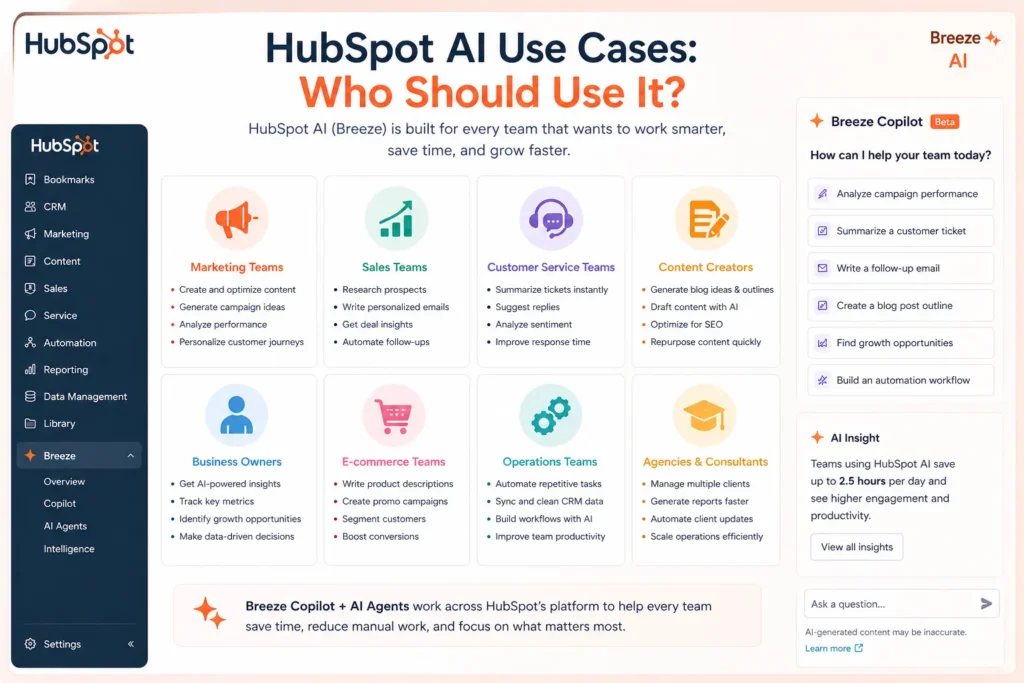
This HubSpot AI review shows that the platform is best suited for:
Companies scaling operations benefit from automation and centralized data.
AI helps create content, analyze campaigns, and improve ROI.
Automated outreach and lead scoring increase efficiency.
AI reduces response times and improves customer satisfaction.
Managing multiple clients becomes easier with automation and reporting tools.
However, it’s not ideal for:
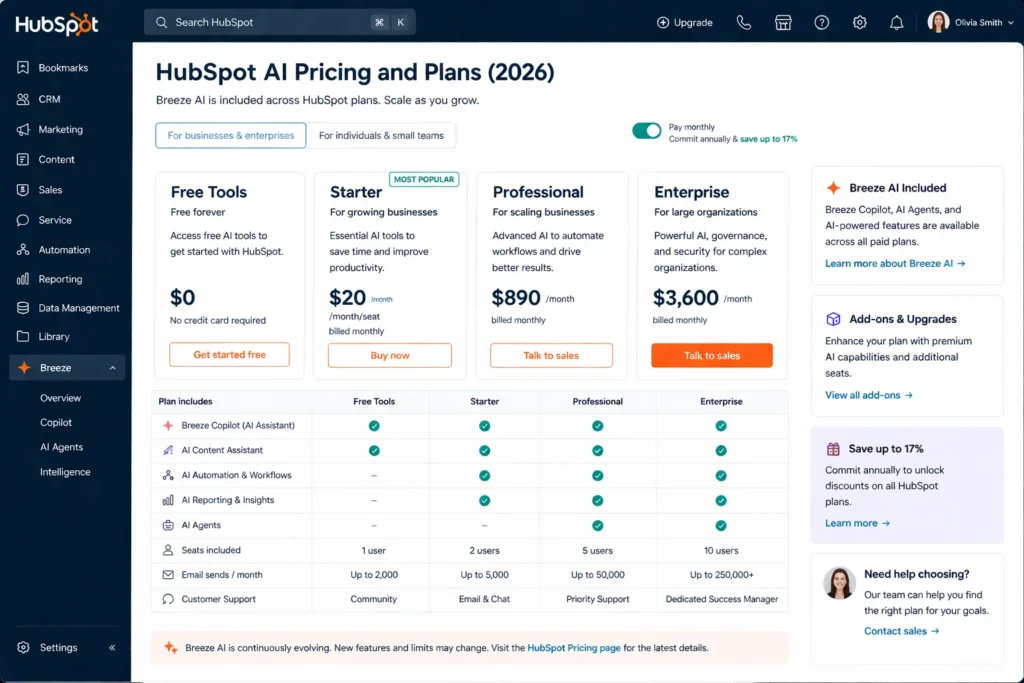
HubSpot AI pricing is tied to HubSpot’s overall platform.
There is a free tier, but advanced AI features are mostly available in higher plans.
Typical pricing includes:
Some AI features, like data enrichment, may use a credit-based system.
While expensive, the pricing reflects the platform’s enterprise-level capabilities.
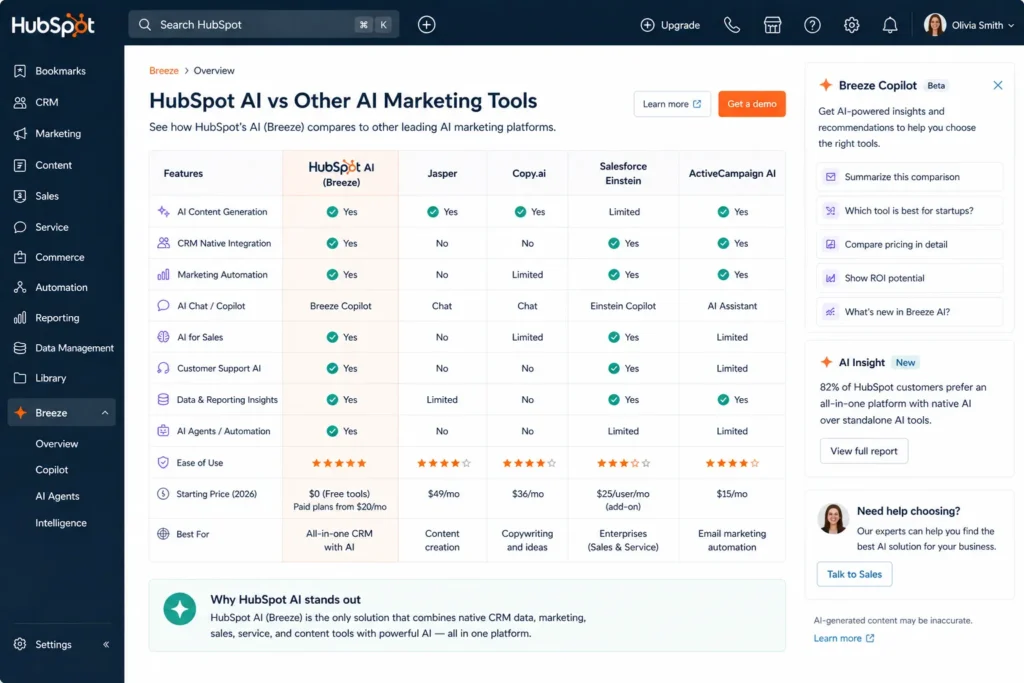
Compared to tools like Jasper, Copy.ai, or standalone AI platforms, HubSpot AI offers:
Most standalone tools focus on one function, while HubSpot AI covers everything.
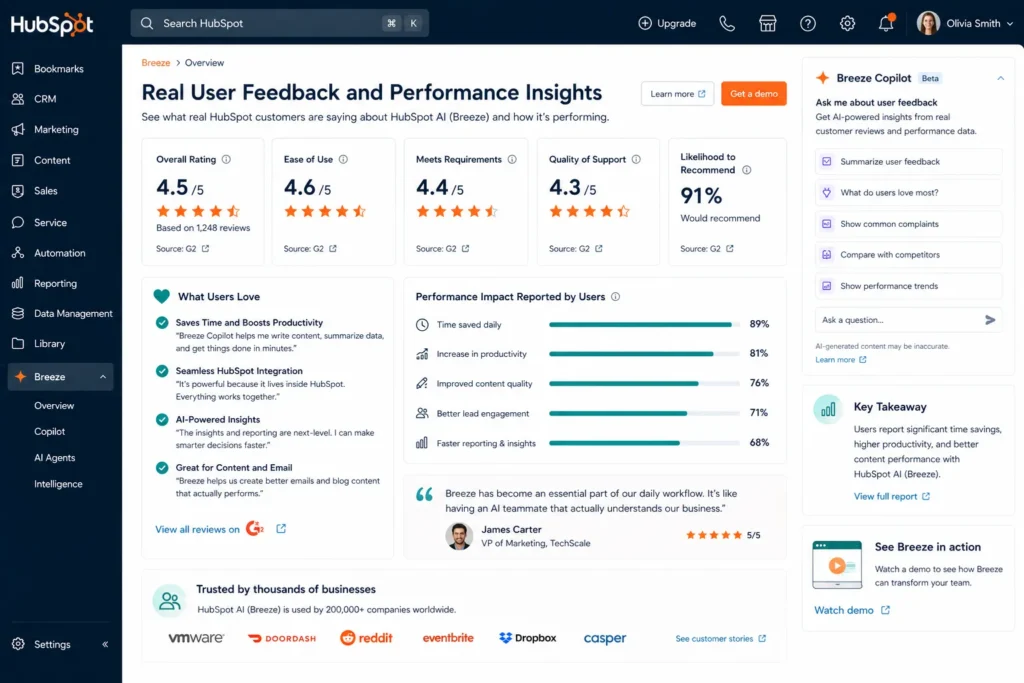
User feedback for HubSpot is generally positive.
Average ratings across platforms are around:
Users commonly praise:
Common complaints include:
Overall, users agree that HubSpot is powerful—but requires time to learn.
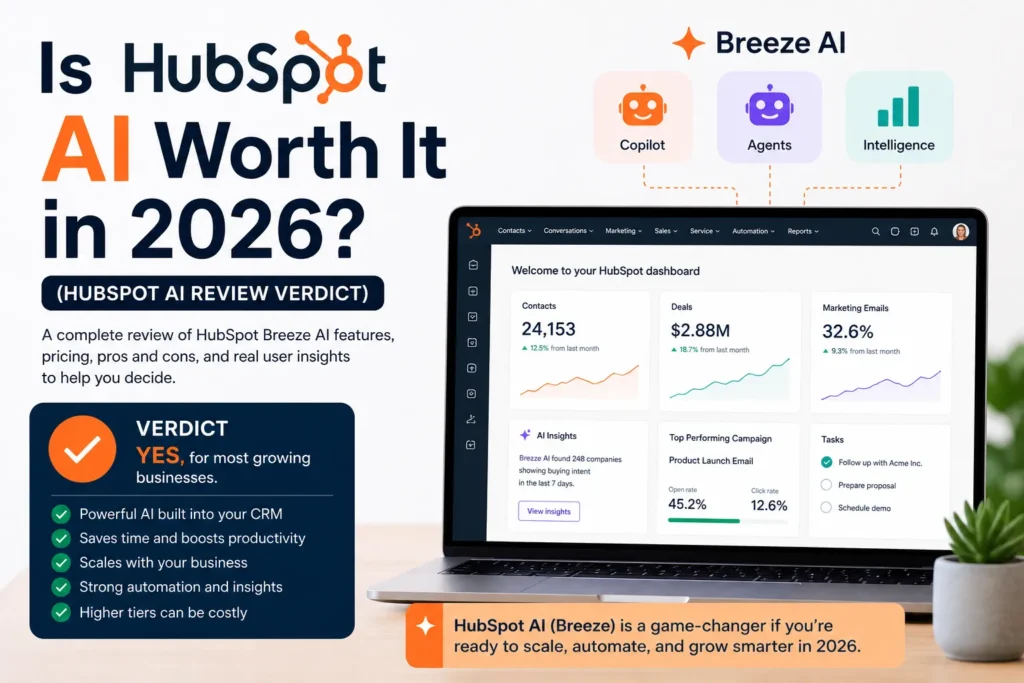
This HubSpot AI review makes one thing clear:
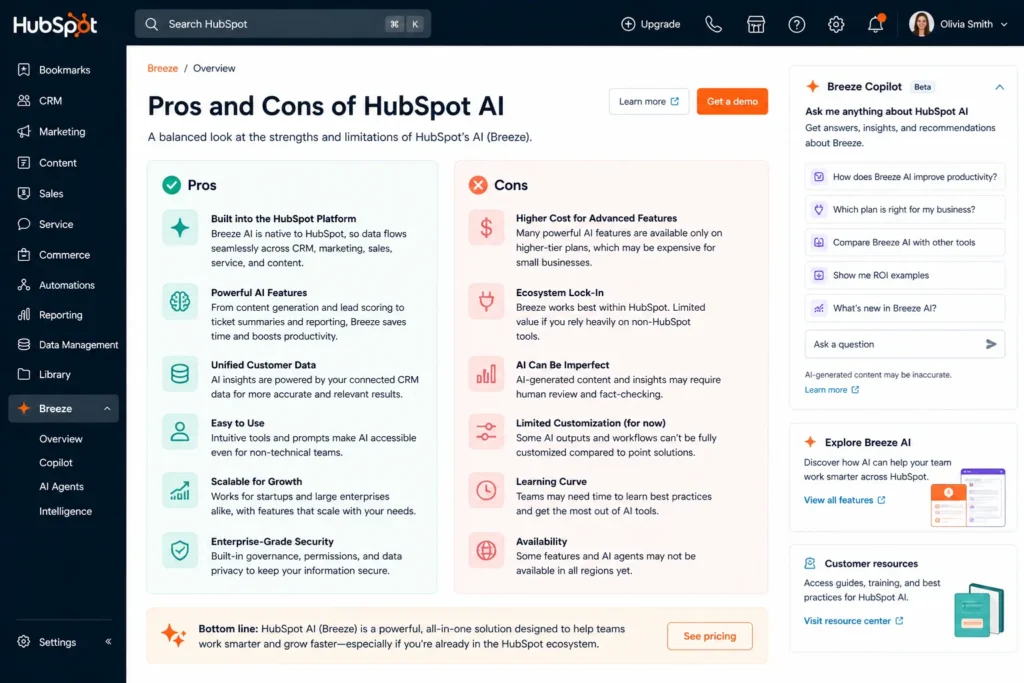
HubSpot AI is one of the most powerful AI platforms available—but it’s not for everyone.
It’s worth it if:
It’s not worth it if:
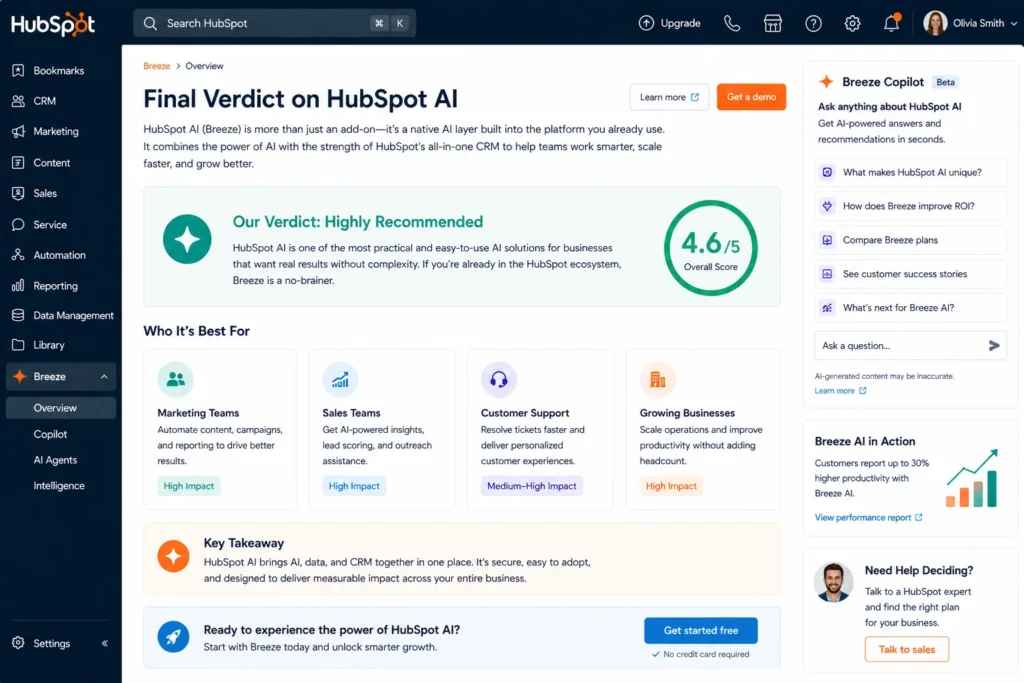
HubSpot AI is not just another AI tool—it’s a complete business system enhanced by artificial intelligence.
Its biggest strength is integration. Everything works together seamlessly, from CRM data to marketing automation and customer support.
While the price may seem high, the value becomes clear for businesses that fully utilize the platform.
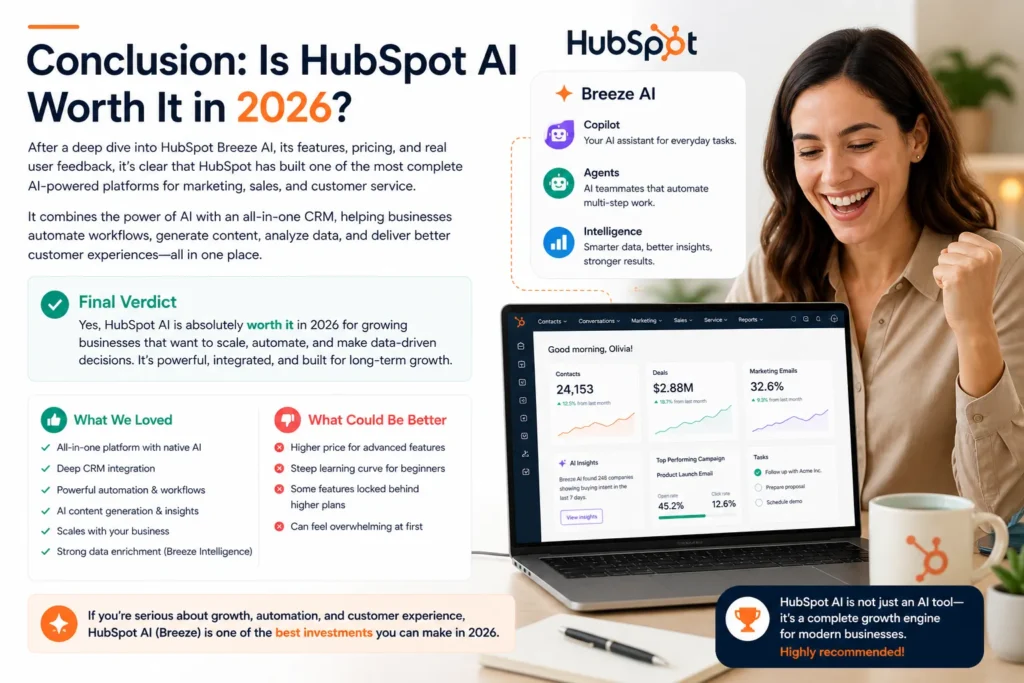
To wrap up this HubSpot AI review, HubSpot has successfully transformed its platform into a fully AI-powered ecosystem.
It combines:
All in one place.
For businesses ready to scale and invest in a long-term solution, HubSpot AI is one of the best options available in 2026.
If you’re serious about growth, automation, and data-driven decisions, HubSpot AI is absolutely worth considering.