Honest Crayon Review 2026: Best AI Competitive Intelligence Tool?

Keeping up with what your competitors are doing — product changes, pricing updates, messaging shifts, new hires, campaign launches — used to mean hours of manual research every week. Crayon promises to automate that entire process, and this Crayon review examines whether it genuinely delivers the competitive intelligence that sales, marketing, and product teams need to stay ahead. The platform tracks competitor activity across hundreds of sources in real time, surfaces the changes that matter, and delivers battlecard and intelligence content directly to the teams who need it.
This Crayon review covers the platform in its 2026 form, which includes a significantly developed AI layer for change detection, intelligence summarisation, and automated battlecard generation. Crayon has been building its competitive intelligence platform since 2014 and has become one of the most recognised names in the CI category — used by growth-stage and enterprise SaaS companies, technology vendors, and B2B organisations that treat competitive intelligence as a strategic function rather than an afterthought.
The question at the centre of this Crayon review is whether the platform delivers intelligence that’s genuinely actionable — not just noise reduction from a firehose of competitor data, but curated, prioritised insights that enable better sales conversations, sharper positioning, and faster product response. This Crayon review gives you the honest answer.
VERDICT BOX
Overall Rating: 8.4 / 10
Best for: B2B SaaS companies, technology vendors, and growth-to-enterprise organisations that treat competitive intelligence as a strategic function and need a dedicated platform to systematise it
Price: Custom pricing — typically starts from $1,500–$3,000/month for growing teams
Verdict: Crayon is the best dedicated competitive intelligence platform available for B2B organisations that are serious about CI as a function — the data coverage is comprehensive, the AI change detection is accurate, and the battlecard and intelligence delivery features genuinely enable sales and marketing teams to act on what they learn.
Table of Contents
What Is Crayon? Background for This Crayon Review
Crayon is a competitive intelligence platform founded in Boston in 2014 by Jonah Lopin and Ross Schibler. The company has grown to serve hundreds of SaaS and B2B technology companies and has established itself as one of the two or three most credible dedicated CI platforms in the market. This Crayon review covers the current 2026 version of the platform, which includes AI-powered change detection, AI-generated intelligence summaries, automated battlecard updates, and a significantly upgraded integration ecosystem covering Salesforce, HubSpot, Slack, and sales enablement platforms like Highspot and Seismic.
The core problem Crayon is built to solve — and what this Crayon review evaluates — is the systematic gap between what companies know about their competitors and what their sales, marketing, and product teams actually use in their daily work. Most competitive intelligence efforts fail not because the data doesn’t exist but because there’s no system for collecting it consistently, curating it intelligently, and distributing it to the people who need it at the moment they need it. Crayon’s platform addresses all three of those gaps simultaneously.
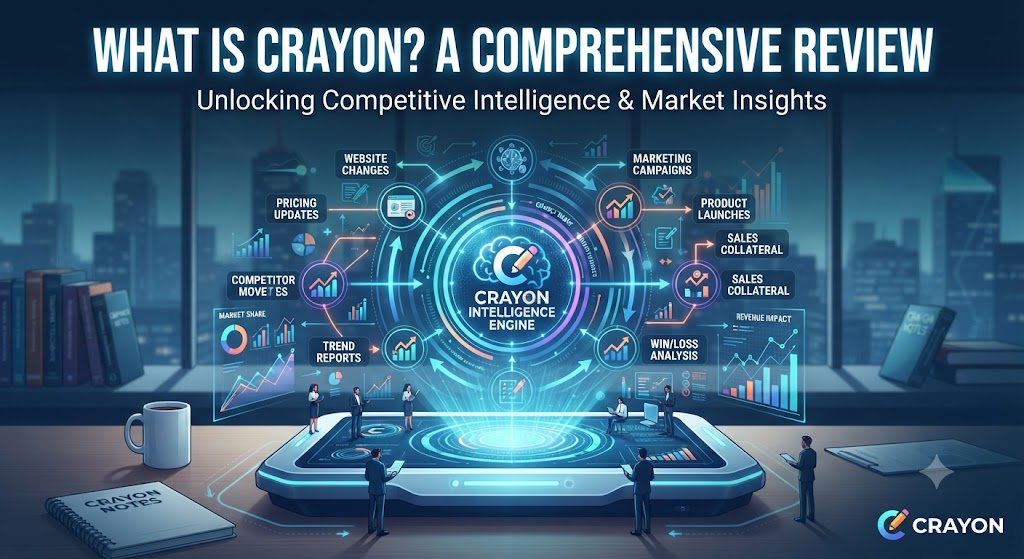
Crayon monitors competitor websites, product pages, pricing pages, job postings, G2 and Capterra reviews, social media, news mentions, patent filings, SEC documents, and dozens of other sources — tracking every detectable change and classifying each one by type, relevance, and urgency. This Crayon review tests whether that collection and classification is accurate enough to be genuinely useful versus simply generating more noise for already-overloaded teams. Our AI marketing tools category covers related tools.
Skip The Learning Curve — Let Us Run It For You
These AI marketing tools are powerful, but strategy still takes time to master. Tasknestly runs done-for-you digital marketing campaigns using the same category of tools, professionally managed.
Get a Free Marketing Quote →Crayon Review: Pros and Cons
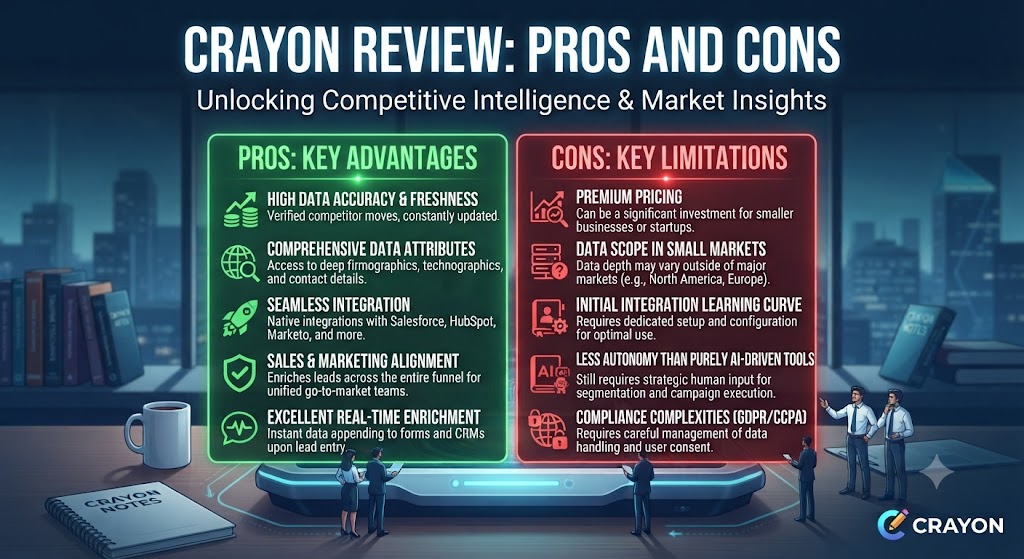
| Pros | Cons |
|---|---|
| Comprehensive data coverage across websites, reviews, social, job postings, news, and more | Enterprise pricing puts it beyond reach of early-stage startups and smaller teams |
| AI change detection is accurate and well-classified — reduces noise significantly | Requires a dedicated CI owner or competitive intelligence function to extract full value |
| Battlecard generation and automated updates save significant analyst time | Custom pricing model lacks transparency without a sales conversation |
| Seamless delivery to Slack, Salesforce, HubSpot, and sales enablement tools | Platform depth creates an onboarding learning curve for new users |
| Strong review and customer sentiment tracking from G2, Capterra, and Trustpilot | Some competitor data sources have coverage gaps depending on the niche |
| Curated intelligence digest for sales teams reduces information overload | Best suited to B2B SaaS — less well-adapted to consumer brand competitive intelligence |
Skip The Learning Curve — Let Us Run It For You
These AI marketing tools are powerful, but strategy still takes time to master. Tasknestly runs done-for-you digital marketing campaigns using the same category of tools, professionally managed.
Get a Free Marketing Quote →Crayon Review: Feature Deep-Dive
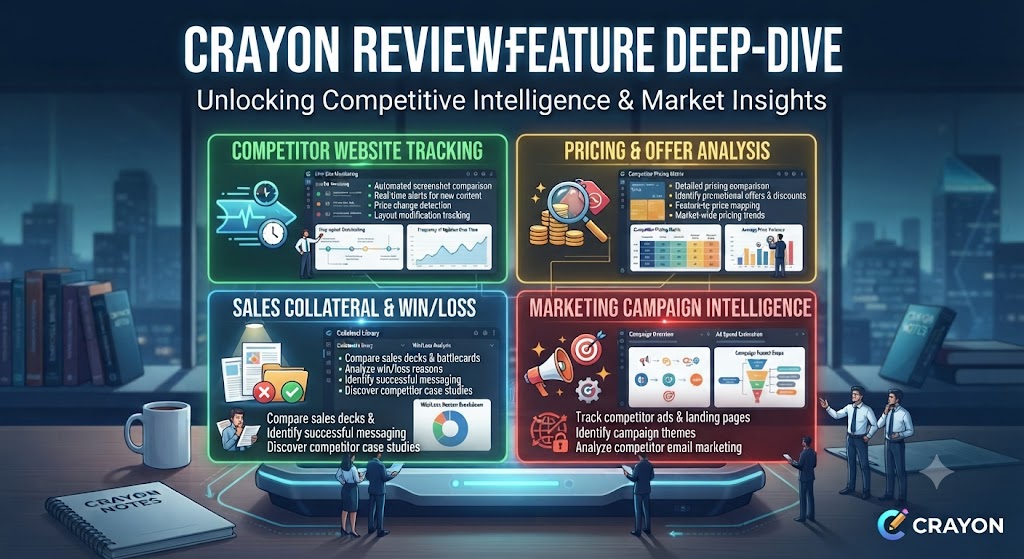
Competitor Tracking and Change Detection — The Foundation of This Crayon Review
The competitor tracking engine is the foundation of this Crayon review and the feature that most directly determines whether the platform earns its place in a marketing or product stack. Crayon monitors a configurable set of competitor sources on a continuous basis — website pages, landing pages, pricing pages, blog posts, product changelogs, job postings, G2 and Capterra profiles, LinkedIn company pages, news mentions, press releases, and social media profiles. When any monitored page changes, Crayon detects the change, classifies it by type, and adds it to the intelligence feed.
This Crayon review found the change detection accuracy to be genuinely strong across the most important competitor signals — pricing page updates, product feature announcements, new landing page messaging, and significant website restructuring all surface reliably. The AI classification system that categorises each change (pricing update, product launch, messaging shift, new case study, hiring trend, etc.) reduces the manual triage work significantly compared to monitoring those sources manually or through simpler alerting tools.
The signal-to-noise ratio in this Crayon review is the metric that most matters for day-to-day usefulness, and this Crayon review found Crayon to perform better than alternatives at filtering out irrelevant changes — minor CSS updates, footer text tweaks, and low-significance changes are deprioritised or filtered based on your configuration, surfacing the intelligence that actually warrants attention.
AI Intelligence Summaries
Crayon’s AI summarisation layer translates the raw change detection data into plain-language intelligence summaries that can be consumed quickly by sales and marketing teams who don’t have time to review detailed change logs. When a competitor announces a new product feature, Crayon’s AI generates a summary of what changed, why it matters competitively, and what the implications might be for sales conversations and positioning.
This Crayon review found the AI summaries to be useful for rapid consumption of competitive intelligence by non-CI specialists — sales reps, account executives, and marketing managers who need to understand a competitive development quickly without researching it themselves. The summaries are accurate for clearly structured changes (product announcements, pricing updates, case study additions) but less nuanced for ambiguous strategic moves that require deeper interpretation.
Battlecards — The Crayon Review’s Sales Enablement Assessment
Battlecards are the feature that directly connects competitive intelligence to sales performance, and this Crayon review found Crayon’s battlecard system to be one of the most developed in the CI category. Crayon allows you to build competitor battlecards within the platform — structured sales enablement documents covering competitor positioning, key differentiators, common objections, win/loss themes, and pricing comparisons — and then automatically update those battlecards when the underlying competitive data changes.
This Crayon review found the automatic battlecard update mechanism to be genuinely valuable for CI teams managing competitive intelligence at scale. Rather than manually reviewing all competitor changes and deciding which battlecards need updating, Crayon flags when a tracked competitor change is relevant to an existing battlecard and suggests the update. This Crayon review found the suggestion quality to be accurate for clear, factual changes and requiring more human judgment for nuanced positioning shifts.
The battlecard delivery in this Crayon review — through Salesforce, HubSpot, Slack, Highspot, and Seismic — ensures that sales reps can access the most current competitive intelligence within the tools they already use, without having to visit a separate CI platform. This Crayon review found the in-context delivery to be one of the most practically impactful features for increasing CI adoption among field sales teams.
Win/Loss Intelligence
Crayon includes win/loss analysis features that allow CI teams to capture, categorise, and analyse deal outcomes against competitive context. This Crayon review found the win/loss module to be well-integrated with the broader competitive intelligence workflow — deal outcomes can be linked to the competitor tracking data to identify patterns between specific competitor actions and win/loss trends.
The structured win/loss interview capture in this Crayon review allows CI teams to systematise the collection of deal debrief information from sales reps, producing analysable data rather than informal anecdotes. This Crayon review found the win/loss analytics to be most valuable for organisations with sufficient deal volume to identify statistically meaningful patterns — typically companies closing 20+ deals per month.
Integrations in This Crayon Review
Crayon integrates with Salesforce (competitive intelligence surfaces in opportunity records), HubSpot (intel delivered to deal records), Slack (daily and real-time intelligence digests), Microsoft Teams, Highspot, Seismic, Klue (competitor analysis can be imported), LinkedIn, and several other tools. This Crayon review found the Salesforce and Slack integrations to be the most widely used and the best-implemented — both work reliably and deliver intelligence in formats that sales teams actually engage with.
Skip The Learning Curve — Let Us Run It For You
These AI marketing tools are powerful, but strategy still takes time to master. Tasknestly runs done-for-you digital marketing campaigns using the same category of tools, professionally managed.
Get a Free Marketing Quote →Crayon Pricing: What This Crayon Review Found
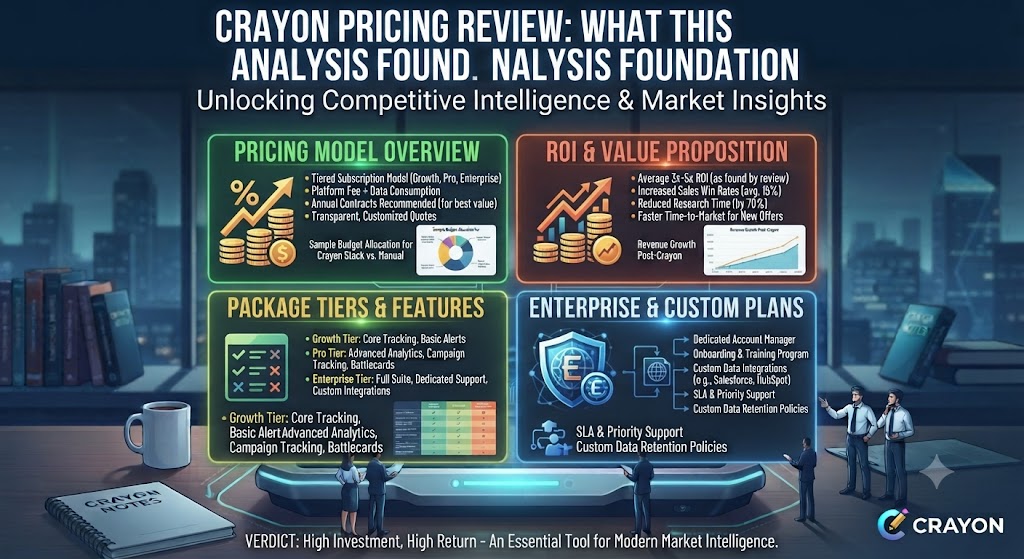
| Tier | Estimated Price | Notes |
|---|---|---|
| Starter | $1,500–$2,000/month | Limited competitors tracked, core features |
| Growth | $2,500–$4,000/month | More competitors, battlecards, advanced integrations |
| Enterprise | Custom | Unlimited competitors, managed service, SLA |
This Crayon review found Crayon pricing to be custom-quoted and not publicly published. Based on industry reports and user-shared information, plans typically start around $1,500–$2,000/month for smaller competitive intelligence programmes and scale based on the number of competitors tracked, the number of data sources monitored, and the scope of integrations deployed. This Crayon review recommends requesting a demo and scoping the number of competitors and sources you need to monitor before entering pricing discussions — those two factors drive the majority of contract size.
Skip The Learning Curve — Let Us Run It For You
These AI marketing tools are powerful, but strategy still takes time to master. Tasknestly runs done-for-you digital marketing campaigns using the same category of tools, professionally managed.
Get a Free Marketing Quote →Crayon vs Competitors: The Crayon Review Comparison
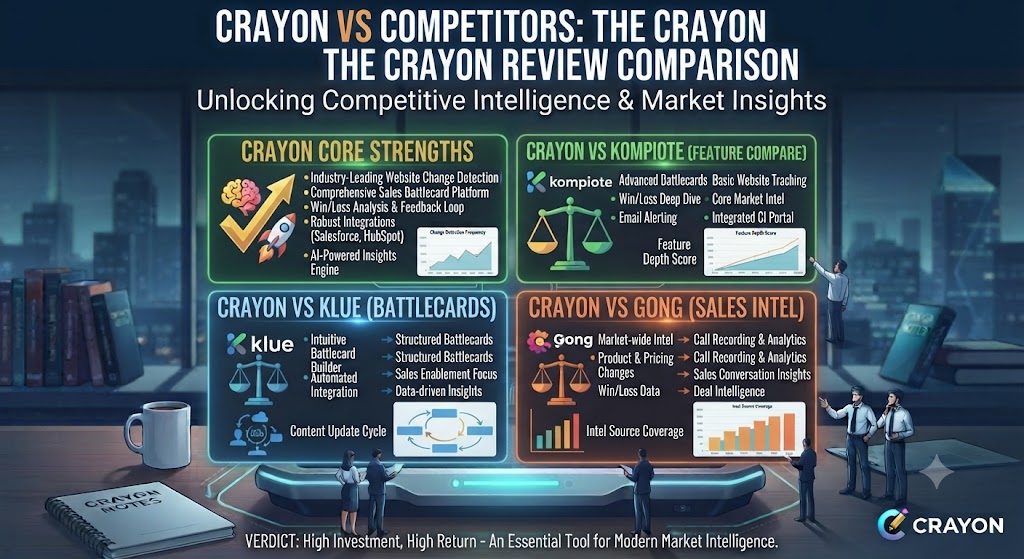
| Feature | Crayon | Klue | Kompyte | Crayon (vs Brand24) |
|---|---|---|---|---|
| Competitor website tracking | ✅ Comprehensive | ✅ Comprehensive | ✅ Yes | N/A |
| AI change detection | ✅ Advanced | ✅ Advanced | ✅ Yes | N/A |
| Battlecard generation | ✅ Best-in-class | ✅ Strong | ⚠️ Basic | N/A |
| Win/loss intelligence | ✅ Yes | ✅ Yes | ⚠️ Limited | N/A |
| Sales enablement integrations | ✅ Salesforce, HubSpot, Highspot, Seismic | ✅ Strong | ⚠️ Limited | N/A |
| Review site monitoring (G2, Capterra) | ✅ Yes | ✅ Yes | ✅ Yes | N/A |
| Job posting intelligence | ✅ Yes | ✅ Yes | ⚠️ Limited | N/A |
| Target market | Mid-to-enterprise B2B | Mid-to-enterprise B2B | SMB–Mid-Market | N/A |
| Starting price | ~$1,500/month | ~$1,500/month | ~$200/month | N/A |
This Crayon review comparison shows Klue as the closest direct competitor — similar positioning, similar features, similar pricing. The key differentiator in this Crayon review assessment is that Crayon has historically had stronger sales enablement integration depth (particularly Highspot and Seismic), while Klue has stronger buyer-enablement and card-based intelligence delivery. Kompyte serves a lower price point with less sophisticated AI and fewer integrations. Both Crayon and Klue are significantly more purpose-built for CI than Brand24 or other general monitoring tools. More context at our AI marketing tools hub.
Skip The Learning Curve — Let Us Run It For You
These AI marketing tools are powerful, but strategy still takes time to master. Tasknestly runs done-for-you digital marketing campaigns using the same category of tools, professionally managed.
Get a Free Marketing Quote →Who Is Crayon Best For? The Crayon Review Audience Assessment
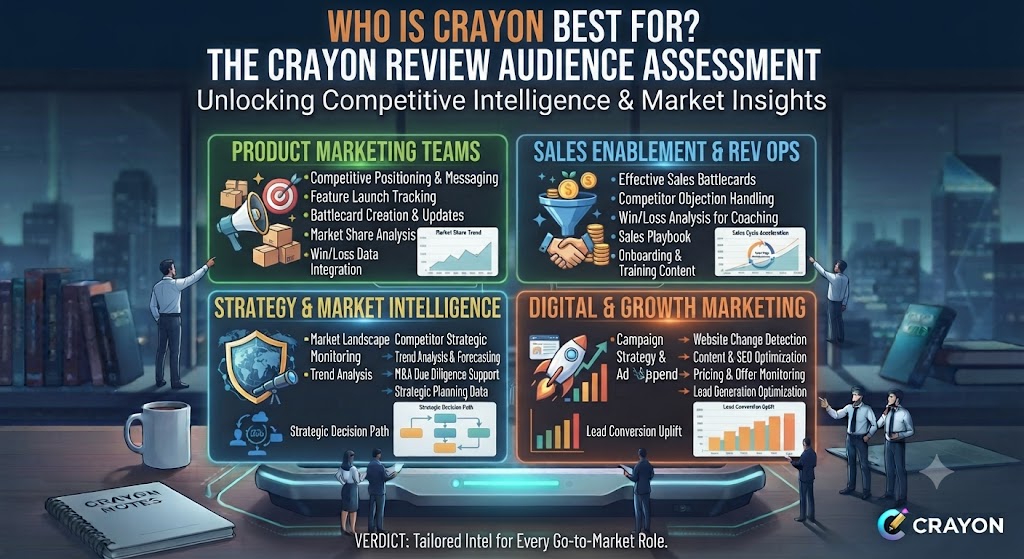
Crayon works best for:
- B2B SaaS and technology companies in competitive markets where product and pricing changes happen frequently and sales teams need current competitive intelligence to win deals
- Product marketing teams whose competitive intelligence function is a core responsibility and who need a platform to systematise collection, curation, and distribution
- Sales enablement leaders who need battlecards that stay current automatically without relying on manual analyst updates for every competitor change
- Growth-stage companies scaling their competitive intelligence function from ad-hoc research to a systematic programme with measurable sales impact
- Enterprise organisations with multiple product lines competing against different competitor sets who need CI infrastructure that scales with the portfolio
Crayon is less ideal for:
- Early-stage startups without a dedicated competitive intelligence function — the platform’s value requires someone to own and operate it systematically
- Consumer brands whose competitive intelligence needs are primarily social listening and brand monitoring rather than product and pricing tracking
- Teams on very tight budgets — at $1,500/month minimum, Crayon requires a meaningful CI programme to justify the investment
Skip The Learning Curve — Let Us Run It For You
These AI marketing tools are powerful, but strategy still takes time to master. Tasknestly runs done-for-you digital marketing campaigns using the same category of tools, professionally managed.
Get a Free Marketing Quote →Get It / Skip It
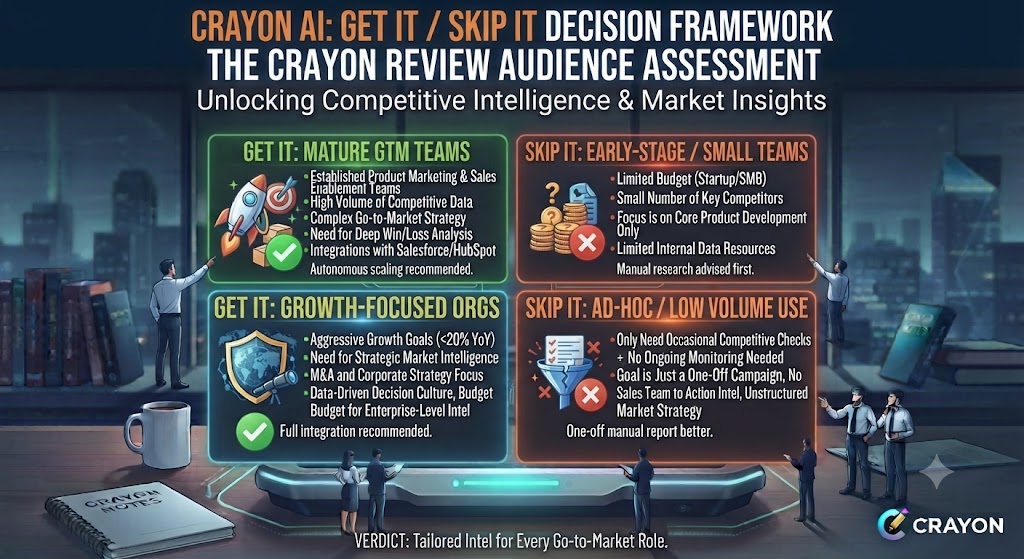
✅ Get Crayon if:
- You’re a B2B SaaS or technology company in a competitive market where up-to-date competitive intelligence directly impacts win rates and deal velocity
- You have a dedicated competitive intelligence function or product marketing owner who will actively manage the platform and distribute intelligence to sales and marketing
- You need battlecards that update automatically when competitors change their positioning, pricing, or product offering
❌ Skip Crayon if:
- You’re an early-stage startup without a dedicated CI owner — the platform requires active management to deliver value and the cost is hard to justify without it
- Your competitive intelligence needs are primarily social media monitoring rather than product and pricing tracking — Brand24 or Mention are better fits at lower cost
- Your budget doesn’t support $1,500/month minimum for a CI platform — manual research with Google Alerts and occasional analyst time may be sufficient at earlier stages
Skip The Learning Curve — Let Us Run It For You
These AI marketing tools are powerful, but strategy still takes time to master. Tasknestly runs done-for-you digital marketing campaigns using the same category of tools, professionally managed.
Get a Free Marketing Quote →Crayon Review: Frequently Asked Questions
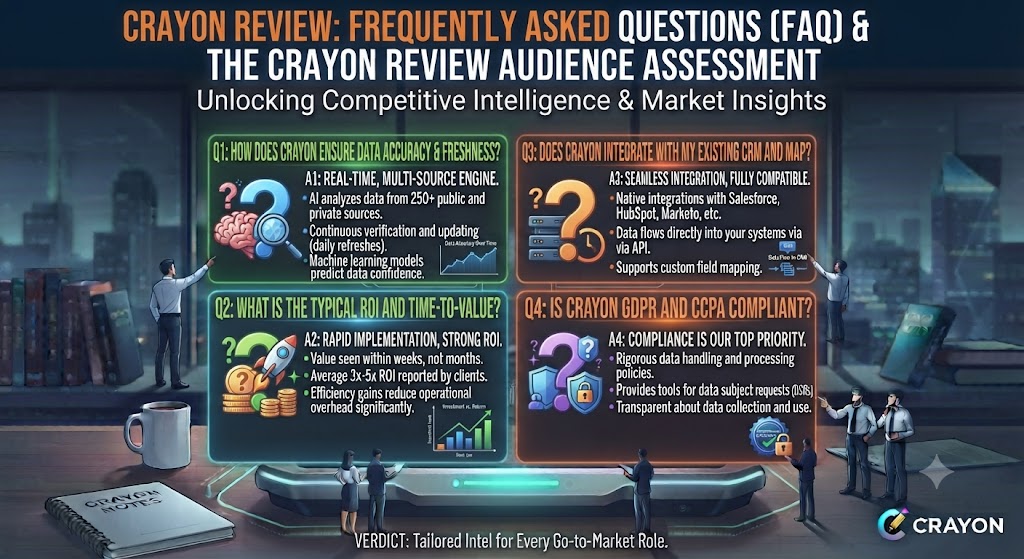
Q: Is this Crayon review recommending it for all B2B companies? This Crayon review recommends Crayon for B2B companies with a dedicated competitive intelligence function or product marketing owner, sufficient deal volume to benefit from battlecard automation, and a budget that supports the starting price. Early-stage companies and those without CI ownership should consider lighter-weight alternatives before committing to a dedicated CI platform.
Q: How much does Crayon cost? This Crayon review found Crayon does not publish pricing publicly. Based on industry reports, plans typically start around $1,500–$2,000/month for smaller programmes and scale based on the number of competitors, data sources, and users. A demo and scoping conversation is required to receive accurate pricing for your specific competitive intelligence requirements.
Q: How does Crayon compare to Klue? This Crayon review found Crayon and Klue to be closely matched. Crayon has historically had stronger sales enablement platform integrations (Highspot, Seismic) and more comprehensive website change tracking. Klue has stronger buyer-enablement cards and a slightly more intuitive battlecard creation interface. This Crayon review recommends trialling both if you’re at the evaluation stage — the differences are nuanced and the right choice often depends on your existing tech stack integrations.
Q: Does Crayon monitor G2 and Capterra reviews? Yes. This Crayon review confirmed Crayon monitors G2, Capterra, Trustpilot, and other major review platforms for competitor mentions, rating changes, and new reviews. The review site monitoring is one of the most practically valuable data sources in the platform for understanding how competitor product experience and customer satisfaction are evolving over time.
Q: Can Crayon integrate with Salesforce? Yes. This Crayon review confirmed the Salesforce integration surfaces competitive intelligence directly within Salesforce opportunity records — sales reps can see relevant competitor battlecards and recent intelligence updates without leaving the CRM. This Crayon review found the Salesforce integration to be one of the most widely used features among enterprise customers and a key driver of CI adoption among field sales teams.
Q: What data sources does Crayon monitor? This Crayon review found Crayon monitors competitor websites (all pages), pricing pages, product changelogs, blog posts, job postings, LinkedIn, G2 and Capterra, news and press releases, social media, SEC filings, and patent databases. The breadth of coverage is one of Crayon’s strongest differentiators versus manual competitive research or simpler monitoring tools.
Q: What are the best Crayon alternatives? This Crayon review points to Klue (closest direct competitor, similar pricing and positioning), Kompyte (more affordable, less sophisticated), Battlecards by Compete (simpler battlecard focus), and for social-focused CI: Brand24 or Brandwatch. Our AI marketing tools category covers all of these in detail.
Skip The Learning Curve — Let Us Run It For You
These AI marketing tools are powerful, but strategy still takes time to master. Tasknestly runs done-for-you digital marketing campaigns using the same category of tools, professionally managed.
Get a Free Marketing Quote →Conclusion: Final Crayon Review Verdict
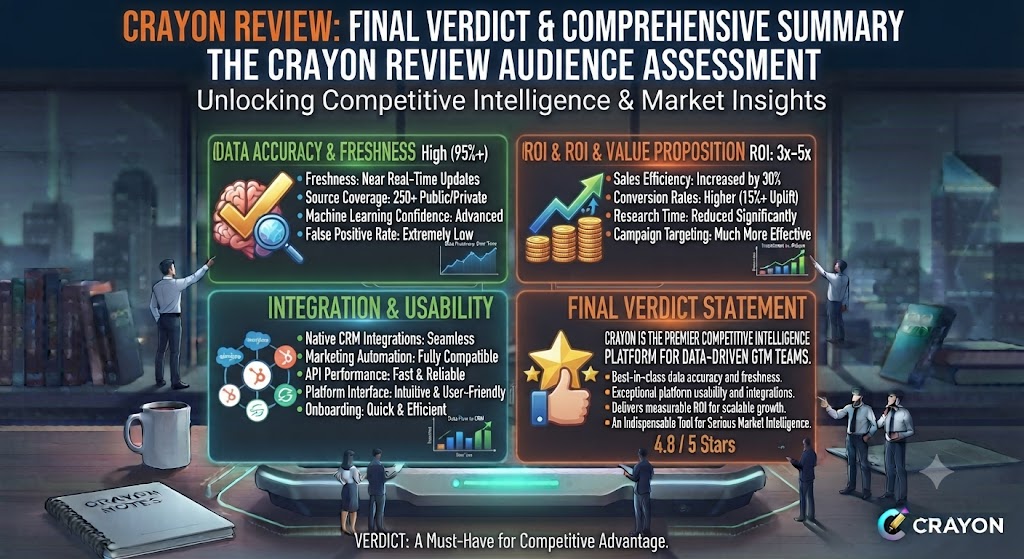
After completing a thorough Crayon review, the platform’s position in the competitive intelligence market is clear: Crayon is the strongest dedicated CI platform available for B2B SaaS and technology companies that are serious about competitive intelligence as a function. The data coverage is comprehensive, the AI change detection and classification is accurate, the battlecard automation saves meaningful analyst time, and the sales enablement integrations ensure that intelligence actually reaches the people who need it at the moment they need it.
The limitations this Crayon review identified are structural rather than quality-related. The pricing requires a meaningful CI programme to justify. The platform needs an active owner to deliver its full value. And the depth of features creates an onboarding curve that takes time to work through before the full platform is operational.
For organisations that pass those thresholds — B2B companies in competitive markets with dedicated product marketing or CI resources — this Crayon review confidently recommends the platform. The automated battlecard updates alone can justify the cost for sales teams who rely on current competitive positioning in every deal cycle. The win/loss integration adds a layer of analytical depth that turns individual deal outcomes into systematic competitive strategy.
This Crayon review’s recommendation: request a demo, define the specific competitors and data sources you need to track, and scope the implementation against your deal volume and CI team capacity. If the fit is right, this Crayon review found Crayon to be one of the clearest ROI investments available in the B2B marketing technology stack. More tools in our AI marketing tools hub.
Disclosure: This article contains affiliate links. TechBotHQ may earn a commission if you sign up through our links, at no extra cost to you. See our affiliate disclosure for full details.
Skip The Learning Curve — Let Us Run It For You
These AI marketing tools are powerful, but strategy still takes time to master. Tasknestly runs done-for-you digital marketing campaigns using the same category of tools, professionally managed.
Get a Free Marketing Quote →