Physical Address
304 North Cardinal St.
Dorchester Center, MA 02124
Physical Address
304 North Cardinal St.
Dorchester Center, MA 02124

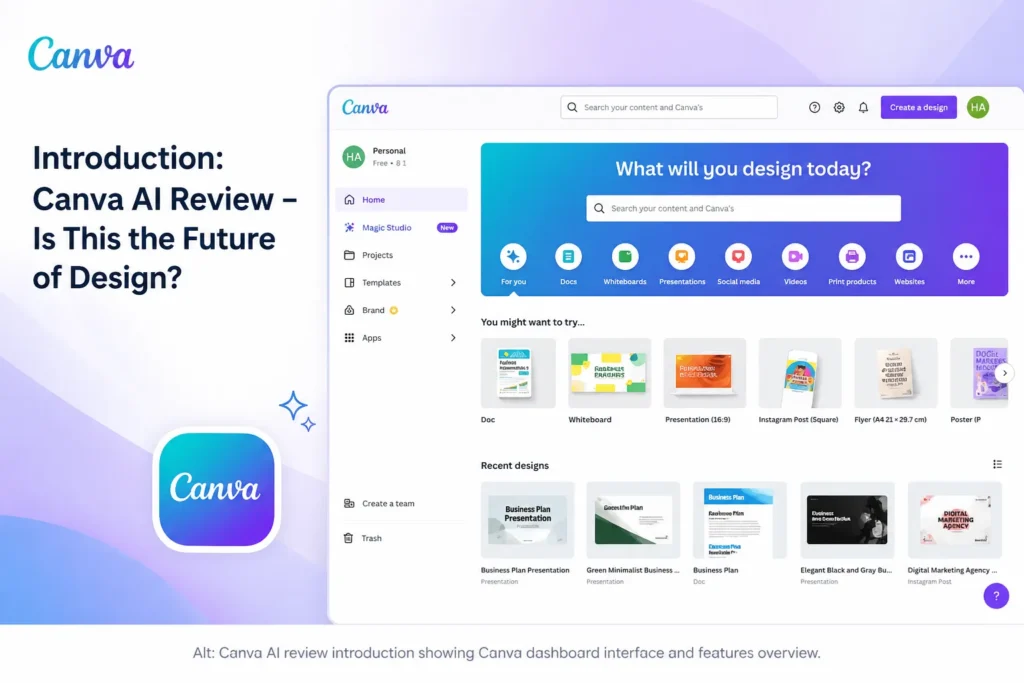
Canva AI review — if you’re searching for a tool that can turn ideas into designs instantly, you’ve probably come across Canva’s latest AI-powered features. And honestly, there’s a reason why.
Canva AI has quickly become one of the most widely used AI design tools in the world. It’s not trying to be the most advanced tool. It’s trying to be the most usable—and that difference is everything.
After extensive real-world use, one thing becomes clear: Canva AI is not about perfection. It’s about speed, accessibility, and getting things done.
You type a prompt, tweak a few elements, and suddenly you have something that looks… good. Sometimes surprisingly good.
But there’s also a catch. A big one.
In this Canva AI review, you’ll get the full breakdown—real features, real limitations, and whether it’s actually worth using in 2026.
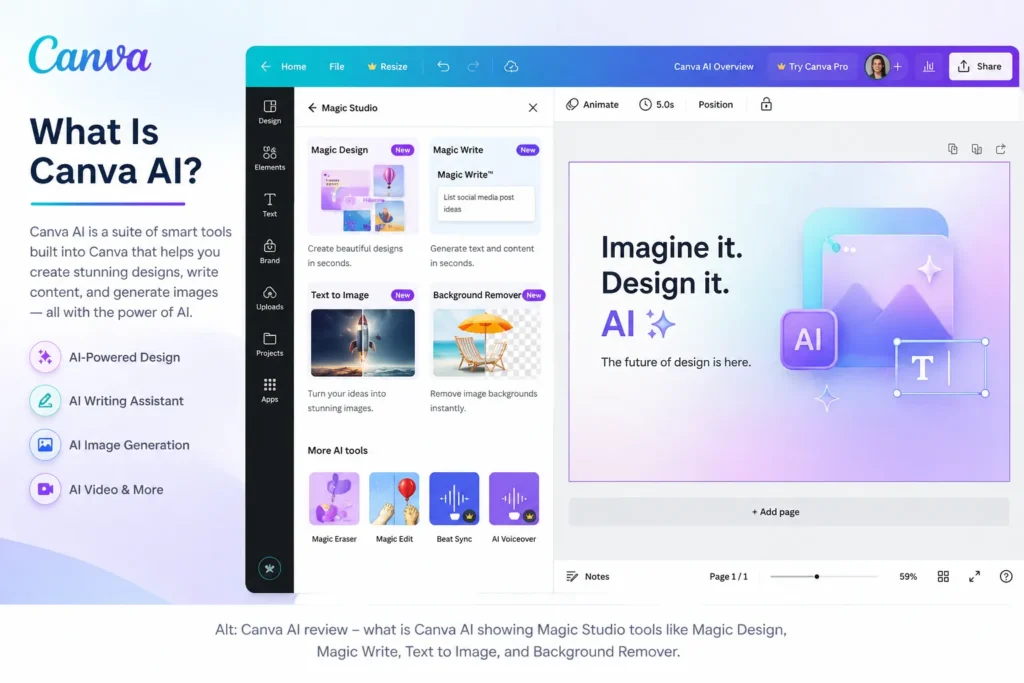
Canva AI is an all-in-one creative assistant built directly into Canva’s design platform. It combines multiple AI tools into a single workflow, allowing you to:
Unlike standalone AI tools, Canva AI is not separate. It lives inside the Canva editor, which means everything you generate is fully editable immediately.
This is one of its biggest advantages.
Instead of generating something and exporting it elsewhere, you stay inside one environment—from idea to final output.
According to Canva’s own platform positioning, it’s designed as a “creative teammate” that helps you brainstorm, design, and refine content in one seamless workflow .
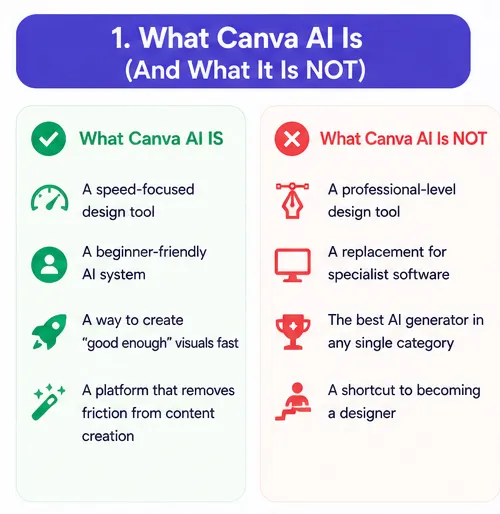
Let’s be very clear here, because this is where most people misunderstand the tool.
That distinction matters.
Canva AI doesn’t try to beat tools like Photoshop, Illustrator, or advanced AI generators.
It wins because it makes everything usable for almost anyone.
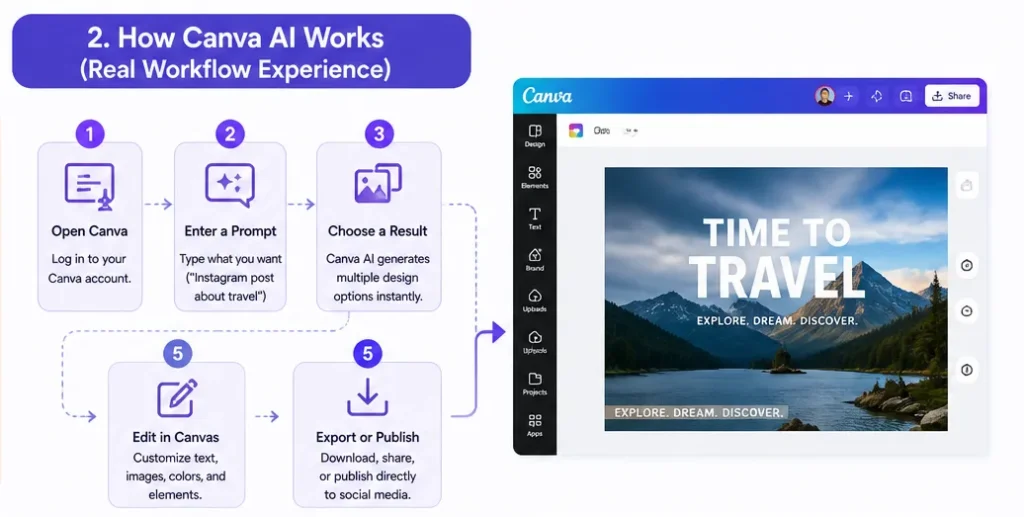
One of the strongest points in this Canva AI review is how simple the workflow is.
There’s no setup. No onboarding complexity.
You log in, and AI is already integrated.
That’s it.
This “zero friction” approach is intentional.
In real use, you’re not thinking about tools—you’re just creating.
That’s why Canva AI works so well for:
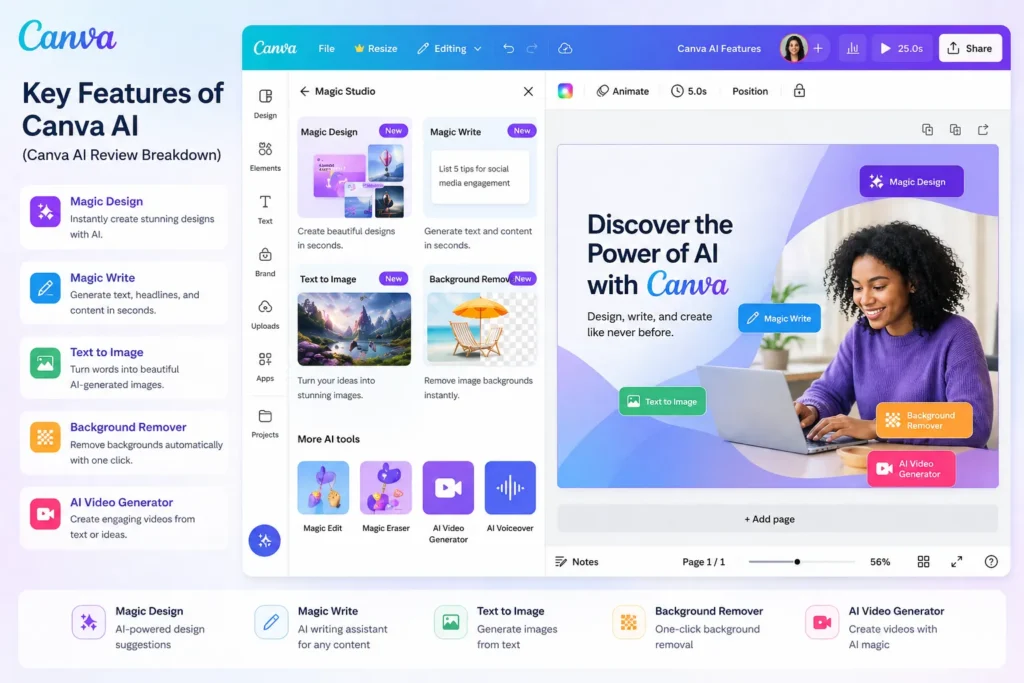
This is arguably the most powerful feature within Canva AI and one of the biggest reasons the platform has become so popular among creators, marketers, and business owners.
Traditionally, creating a design starts with a blank canvas. Users must choose layouts, arrange elements, select colors, position text, and build everything manually. For many people, this is often the most difficult part of the creative process.
Canva AI helps eliminate that challenge.
Instead of starting from scratch, users simply describe what they want, and the platform generates complete design concepts automatically.
With a simple prompt, Canva can generate:
• Social media posts
• Presentations
• Posters
• YouTube thumbnails
• Marketing graphics
• Flyers
• Business materials
• Promotional designs
One of the biggest advantages is speed.
For example, a user could enter a prompt such as:
“Create a modern social media post promoting an AI productivity tool.”
Within seconds, Canva generates a complete design that includes layout suggestions, typography, imagery, colors, and content placement.
The real power, however, is not just generation—it’s editability.
Unlike many AI design tools that produce fixed outputs, Canva creates fully editable designs. Every element can be modified, adjusted, or replaced according to the user’s needs.
Users can easily:
• Change text
• Replace images
• Adjust colors
• Modify layouts
• Add branding elements
• Rearrange components
• Customize typography
This flexibility is extremely important because AI-generated designs are often strongest as starting points rather than final products.
The platform allows users to combine AI speed with human creativity, creating a workflow that is both efficient and customizable.
This feature is especially valuable for:
• Marketers
• Content creators
• Small business owners
• Social media managers
• Students
• Entrepreneurs
• Agencies
Another major benefit is reducing creative friction.
Many people experience what designers often call “blank canvas anxiety”—the difficulty of knowing where to start when faced with an empty design project.
Canva AI effectively removes this obstacle by generating an initial concept instantly. Users no longer need to spend time deciding on basic structure, layout, or visual hierarchy before making progress.
Instead, they begin with a completed draft and focus on refinement.
This often leads to:
• Faster design creation
• Increased productivity
• More creative experimentation
• Reduced decision fatigue
• Better workflow efficiency
For teams producing content at scale, these productivity gains can be substantial. What previously required significant design effort can now be accomplished much more quickly while still allowing full creative control.
Another advantage is accessibility.
Users without professional design experience can create polished visuals because the AI handles many of the foundational design decisions. At the same time, experienced designers can use the feature to accelerate concept development and streamline repetitive work.
Overall, Canva’s AI-powered layout generation is one of its most transformative features. By turning simple prompts into fully editable social posts, presentations, posters, thumbnails, and marketing materials, it removes the fear of starting from a blank canvas while preserving complete creative control. This combination of automation and flexibility is what makes the feature such a powerful productivity tool for modern content creation.
One of the most practical Canva AI features is its built-in image generation system, which focuses on speed, convenience, and seamless integration with the Canva design workflow.
Unlike standalone AI image generators that are built primarily for advanced image creation, Canva’s approach is designed to help users quickly create visuals without leaving their design project.
Users can generate:
• Images
• Icons
• Illustrations
• Graphic elements
• Social media visuals
• Marketing assets
• Design components
One of the biggest advantages is accessibility.
Instead of switching between multiple platforms, users can create AI-generated visuals directly inside Canva and immediately add them to presentations, social media posts, flyers, thumbnails, or marketing materials.
This creates a much smoother workflow for:
• Marketers
• Content creators
• Small business owners
• Students
• Social media managers
• Entrepreneurs
Another benefit is speed.
When creating a design, users often need a supporting image, icon, or illustration quickly. Canva AI allows them to generate those assets without searching stock libraries or opening separate design tools.
For example, users can instantly create:
• Blog graphics
• Social media illustrations
• Presentation visuals
• Website assets
• Marketing elements
However, it is important to be realistic about its strengths and limitations.
While Canva’s image generator is useful, it is not currently the most advanced AI image generation system available.
Compared to dedicated platforms such as Midjourney, the results are often:
• Less detailed
• Less photorealistic
• More illustration-focused
• More cartoon-like in appearance
For users seeking highly realistic photography, cinematic artwork, or complex artistic compositions, specialized AI image generators may produce stronger results.
Another limitation is refinement flexibility.
Many advanced image generation platforms allow extensive iteration through follow-up prompts, detailed modifications, and complex image adjustments. Canva’s image generator is generally more focused on quick creation than deep creative control.
As a result, users may have fewer options for refining generated images through multiple prompt-based revisions.
However, these limitations are often less important for Canva’s target audience.
Most users simply need:
• Quick visuals
• Simple illustrations
• Design assets
• Marketing graphics
• Supporting content elements
For these use cases, Canva AI performs very well because it prioritizes convenience and workflow efficiency.
The real strength of the feature is integration. Generated images can be edited, resized, combined with templates, enhanced with branding, and incorporated into larger projects immediately after creation.
This eliminates many of the extra steps required when using standalone image generation tools.
Overall, Canva’s image generation capabilities are among the most useful Canva AI features for everyday content creation. While it may not match specialized AI art platforms in realism or advanced image refinement, its ability to generate images, icons, illustrations, and visual assets directly inside the Canva ecosystem makes it an extremely practical tool for users who value speed, simplicity, and convenience.
of the most useful real-world features.
Instead of using external tools, you can:
In real workflows, this saves massive time.
It works well most of the time, though not perfectly.
One of the more impressive Canva AI features is its image expansion capability, which allows users to extend images beyond their original boundaries.
This feature is especially useful when an image almost fits a design but needs additional space around the edges. Instead of searching for a new image or manually redesigning a layout, Canva AI can generate new content that expands the existing visual.
The tool is commonly used to:
• Fix cropping issues
• Adjust layouts
• Expand visuals for different formats
• Create extra background space
• Adapt images for multiple platforms
• Improve design flexibility
One of the most practical use cases is content repurposing.
For example, an image originally designed for a square Instagram post may need to be converted into:
• A vertical Story format
• A YouTube thumbnail
• A website banner
• A presentation slide
• A marketing advertisement
Rather than cropping important elements or stretching the image, Canva AI can generate additional visual content around the edges to fit the new dimensions.
This can save a significant amount of time when creating content for multiple platforms.
Another valuable application is correcting composition problems.
Sometimes an image contains the right subject but lacks enough empty space for:
• Headlines
• Logos
• Call-to-action buttons
• Product information
• Branding elements
Image expansion can create additional room without requiring users to start over with a different visual.
The feature is particularly useful for:
• Marketers
• Social media managers
• Content creators
• Designers
• Business owners
• Advertising teams
One of the biggest advantages is convenience.
What would normally require advanced photo editing techniques can often be accomplished with a few clicks inside Canva. This makes the feature accessible even to users with little or no design experience.
However, it is important to acknowledge its limitations.
Like most generative AI technologies, the results are not always perfect.
Occasionally, the AI may generate:
• Unnatural objects
• Distorted backgrounds
• Inconsistent textures
• Strange visual details
• Unexpected elements
These issues tend to occur more frequently when the original image contains complex scenes, intricate patterns, or detailed subjects near the edges.
Because of this, generated expansions should always be reviewed before final use.
In many cases, the results look surprisingly natural and require little to no editing. In other situations, minor adjustments may be necessary to achieve a polished final design.
Despite these occasional imperfections, the feature remains extremely valuable because it solves a common design problem that traditionally required significant manual effort.
For content creators working across multiple formats and platforms, the ability to quickly expand images can dramatically improve workflow efficiency and reduce the need to recreate designs from scratch.
Overall, Canva’s image expansion tool is a powerful addition to its AI toolkit. By helping users fix cropping issues, adapt layouts, and resize visuals for different formats, it provides greater creative flexibility while saving considerable time—even if the occasional AI-generated oddity still appears from time to time.
Another useful component of the Canva AI ecosystem is its built-in text generation tool, which helps users create content directly within their design workflow.
Rather than switching between separate writing and design platforms, Canva allows users to generate text while working on presentations, social media graphics, marketing materials, and other visual projects.
The tool can help generate:
• Captions
• Headlines
• Short-form content
• Marketing copy
• Social media text
• Product descriptions
• Call-to-action phrases
One of the biggest advantages is convenience.
When designing content, users often need supporting text quickly. Instead of leaving Canva to brainstorm ideas elsewhere, they can generate text directly inside the platform and immediately apply it to their designs.
This is particularly useful for:
• Social media posts
• Marketing graphics
• Presentations
• Advertisements
• Promotional materials
• Business content
The feature works especially well for generating short pieces of content.
For example, users can quickly create:
• Instagram captions
• Facebook post text
• Ad headlines
• Promotional messages
• Email subject lines
• Simple marketing copy
This can significantly speed up the content creation process and help overcome creative blocks when users are unsure how to start.
Another benefit is productivity.
Instead of staring at a blank text box, users receive instant suggestions that can be edited, refined, or combined with their own ideas. This often makes it easier to move projects forward and complete designs faster.
However, it is important to understand the tool’s limitations.
While Canva’s AI writer is helpful for short-form content, it is not designed to compete with dedicated long-form writing platforms.
Tasks such as:
• Detailed blog posts
• Comprehensive articles
• In-depth reports
• Long-form SEO content
• Extensive research-based writing
are generally better handled by specialized AI writing tools.
The primary reason is depth. Canva’s text generation capabilities focus on supporting design workflows rather than producing highly detailed written content.
As a result, the generated text is often strongest when used for:
• Quick ideas
• Marketing snippets
• Headlines
• Captions
• Short promotional copy
Many reviewers and users report similar experiences. The feature is widely appreciated for speed and convenience, but most agree that it performs best when generating concise content rather than complete articles.
For Canva’s target audience, this approach makes sense.
Most users are creating visual content and simply need assistance generating supporting text, not writing thousands of words of long-form content.
When viewed in that context, the tool becomes a valuable productivity feature that helps users create complete designs more efficiently.
Overall, Canva’s AI text generator is a practical addition to the platform. By helping users quickly generate captions, headlines, and short-form marketing content, it streamlines the creative process and reduces time spent brainstorming. While it is not the ideal solution for long-form writing, it performs well in the short-form content scenarios where most Canva users need assistance.
One of the newer and more experimental Canva AI features is its ability to generate lightweight interactive experiences directly within the Canva ecosystem.
While Canva is primarily known for design, presentations, and content creation, the platform has started expanding into simple interactive content generation. This opens up new possibilities for users who want more than static visuals without needing advanced development skills.
The feature can be used to create:
• Basic interactive elements
• Simple websites
• Lightweight tools
• Interactive presentations
• Clickable content experiences
• Landing page concepts
One of the biggest advantages is speed.
Rather than building everything manually, users can generate functional concepts and interactive layouts quickly, allowing them to test ideas and create simple digital experiences without extensive technical knowledge.
This can be particularly useful for:
• Marketers
• Content creators
• Educators
• Small business owners
• Freelancers
• Entrepreneurs
For example, users may create:
• Simple promotional pages
• Event landing pages
• Interactive presentations
• Portfolio concepts
• Lead generation pages
• Product showcases
The feature is designed to make experimentation easier by lowering the barrier to entry.
Traditionally, creating interactive experiences often requires knowledge of:
• Web development
• UI design
• Front-end frameworks
• Hosting and deployment workflows
Canva simplifies much of this process by providing ready-made building blocks and AI-assisted creation tools.
Another benefit is rapid prototyping.
Instead of spending days building an idea from scratch, users can create a working concept quickly and determine whether it is worth further development.
This is especially valuable during:
• Brainstorming sessions
• Client presentations
• Marketing campaigns
• Product planning
• Content experimentation
However, it is important to set realistic expectations.
While the feature is innovative and useful, it is not intended to replace professional development platforms.
Advanced requirements such as:
• Complex web applications
• Custom databases
• Enterprise websites
• Sophisticated user interactions
• Large-scale software projects
are beyond its intended scope.
The generated experiences are generally best suited for lightweight projects rather than production-grade applications.
Because of this, many users view the feature as a creative experimentation tool rather than a complete website or software development solution.
For beginners and non-technical users, that is actually one of its strengths. It provides a fast way to explore ideas, build simple interactive content, and test concepts without a significant investment of time or resources.
For experienced developers, it may be more useful as a prototyping and ideation tool than a final deployment platform.
Overall, this emerging Canva AI feature represents an interesting step beyond traditional design. By enabling users to create basic interactive elements, simple websites, and lightweight digital experiences quickly, Canva expands its creative toolkit while remaining focused on accessibility and ease of use. The feature is best viewed as a powerful experimentation platform rather than a replacement for professional development tools.
This is Canva AI’s biggest competitive advantage and ultimately the reason it has become one of the most widely used creative platforms in the world.
Many AI tools excel in a single area. Some focus on writing, others specialize in image generation, while others are built for video editing or graphic design. The challenge is that users often need multiple subscriptions and constantly switch between platforms to complete a single project.
Canva takes a different approach.
Instead of offering one specialized capability, it brings multiple creative tools together within a single ecosystem.
Users can access:
• Design tools
• AI writing assistance
• Image generation
• Video editing
• Presentation creation
• Background removal
• Image expansion
• Content scheduling
• Brand management tools
One of the biggest advantages is workflow efficiency.
A typical content creation process might require:
• Generating ideas
• Writing captions
• Creating graphics
• Editing images
• Producing videos
• Preparing presentations
With many platforms, this means constantly moving between different applications.
Canva reduces this friction by allowing users to perform most of these tasks from one dashboard.
This is especially valuable for:
• Content creators
• Social media managers
• Small business owners
• Marketing teams
• Agencies
• Entrepreneurs
Another major benefit is reduced context switching.
Every time users move between different tools, productivity is interrupted. Files need to be exported, uploaded, reformatted, and reorganized.
By keeping design, writing, image generation, and video editing together, Canva minimizes these interruptions and helps users stay focused on creating.
The platform is particularly effective for businesses that need to produce content quickly and consistently.
For example, a marketer can:
• Generate a headline
• Create a graphic
• Remove a background
• Generate supporting visuals
• Edit a short video
• Publish the final asset
all within the same environment.
This level of integration saves time and simplifies content production.
Another reason Canva succeeds is accessibility.
Many competing tools are more powerful in specific areas, but they often require specialized skills or steeper learning curves. Canva prioritizes ease of use, allowing beginners and professionals alike to create polished content without extensive technical knowledge.
This makes the platform appealing to a wide range of users, from solo creators to large organizations.
While dedicated tools may outperform Canva in individual categories such as advanced image generation, professional video editing, or long-form writing, very few platforms match the convenience of having everything connected under one roof.
That convenience becomes increasingly valuable as content demands continue to grow.
Ultimately, Canva AI’s greatest strength is not any single feature—it is the complete ecosystem. By combining design, writing, image generation, video editing, and creative automation into one unified platform, Canva eliminates the need to constantly switch between tools. For many users, that simplicity, efficiency, and all-in-one workflow is exactly why it wins over competing solutions.
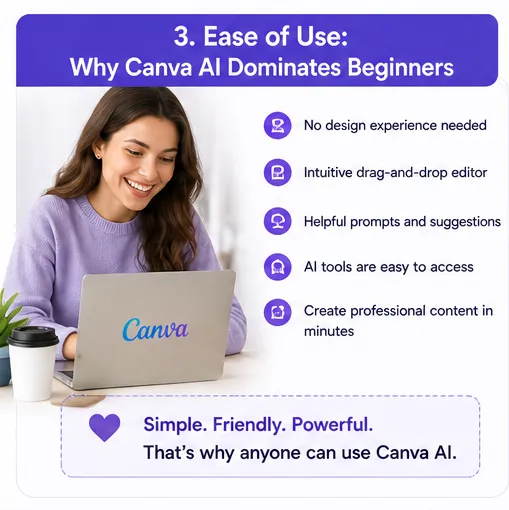
If there’s one reason Canva AI is so popular, it’s this:
It’s ridiculously easy to use.
You don’t need:
The interface is intuitive.
Even complete beginners can create professional-looking content quickly.
That’s why Canva consistently scores high for usability, with reviews highlighting its friendly interface and accessibility .
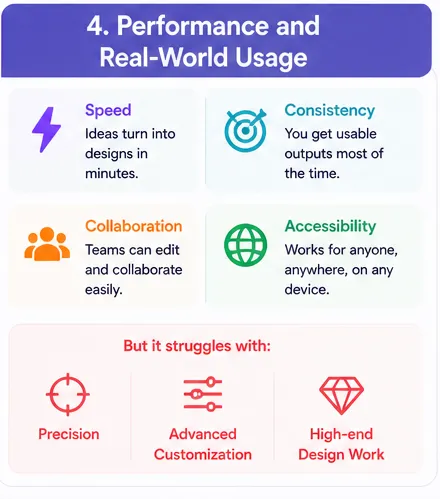
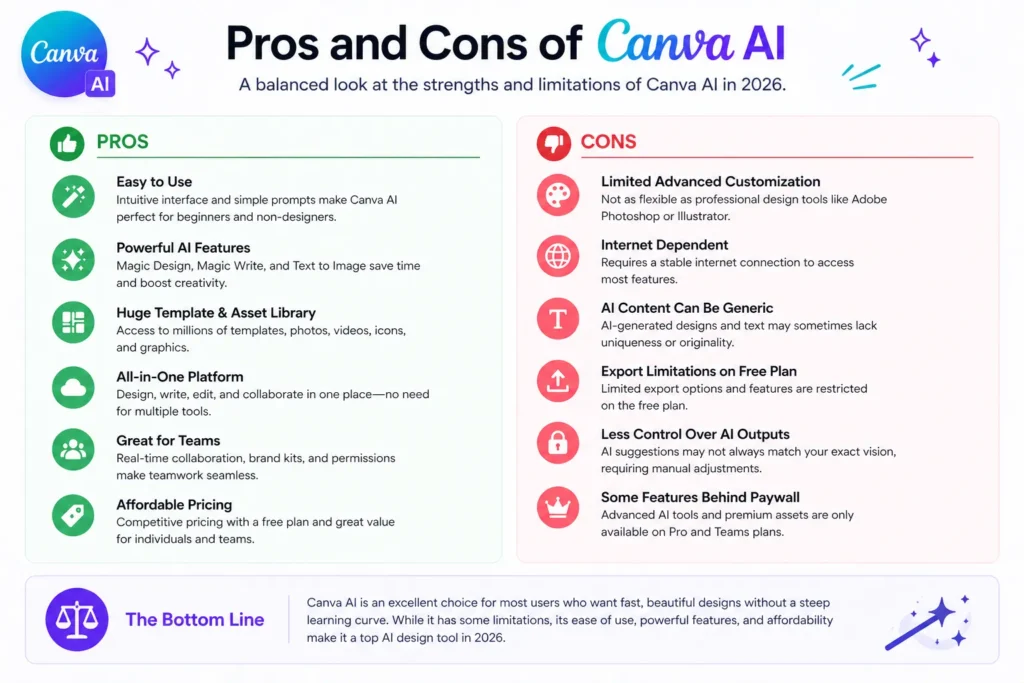
From real usage, Canva AI excels in:
Ideas turn into designs in minutes.
You get usable outputs most of the time.
Teams can edit designs easily.
Anyone can use it without fear.
But it struggles with:
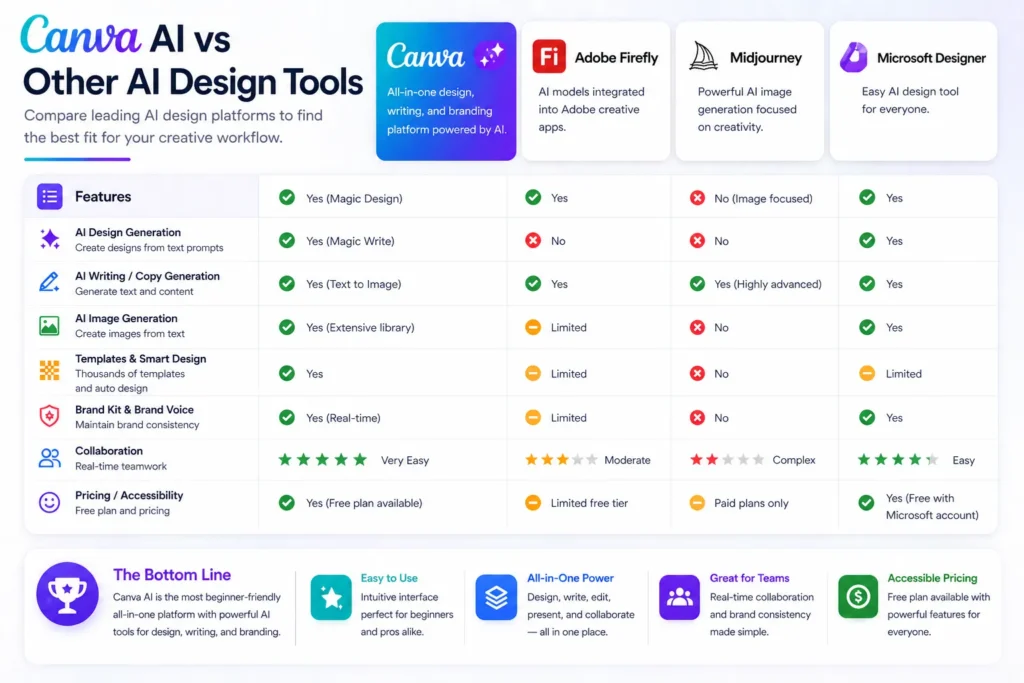
This is where things get interesting.
| Category | Canva AI | Specialist Tools |
|---|---|---|
| Ease of Use | Very High | Medium–Low |
| Speed | Very Fast | Medium |
| Quality | Good | Excellent |
| Flexibility | Limited | High |
| Learning Curve | Low | High |
Canva AI wins on accessibility and speed
Specialist tools win on quality and depth
And that’s the tradeoff.
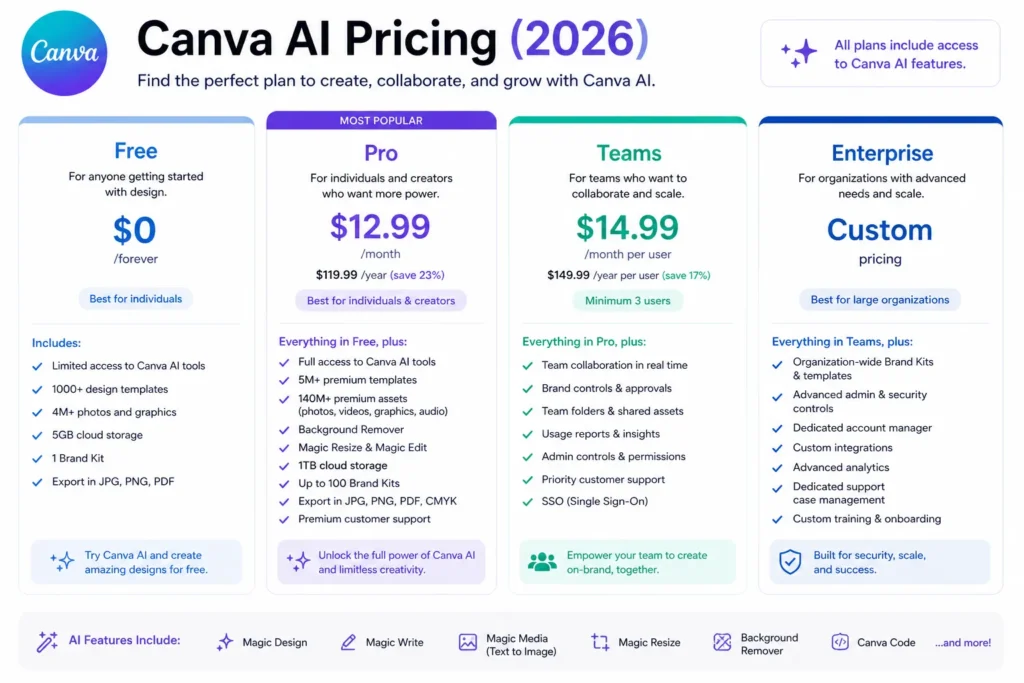
Here’s a realistic breakdown based on current data:
Most users will eventually need Pro.
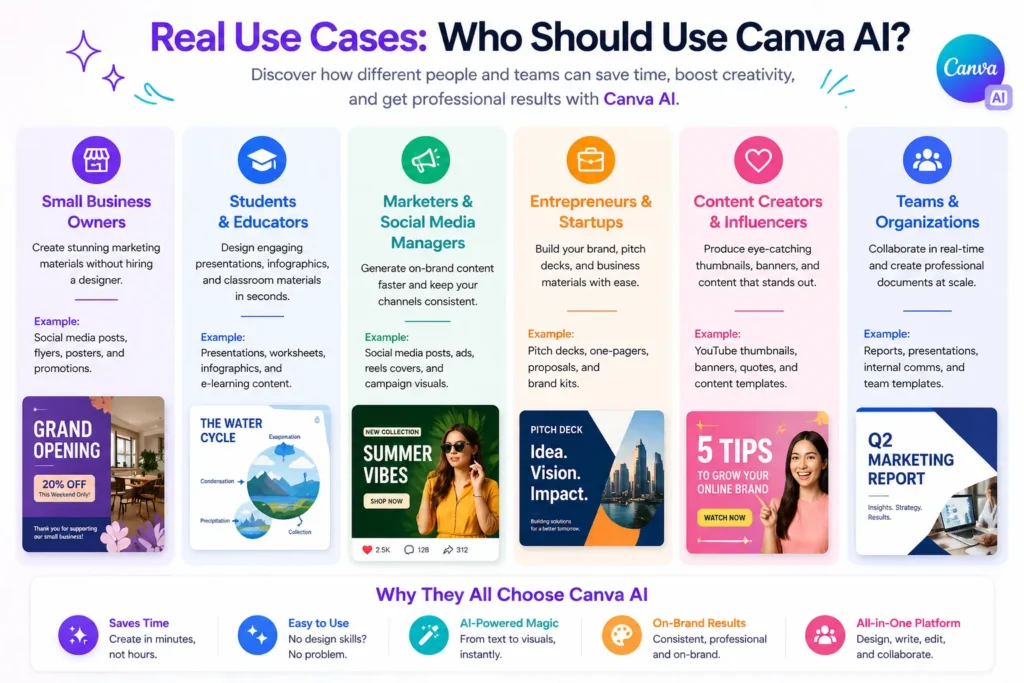
Canva AI is perfect for:
It’s ideal if you:
This is important.
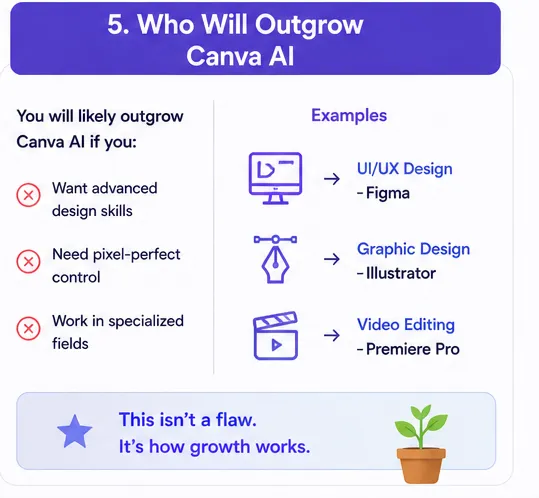
You will likely outgrow Canva AI if you:
Examples:
This isn’t a flaw.
It’s how growth works.
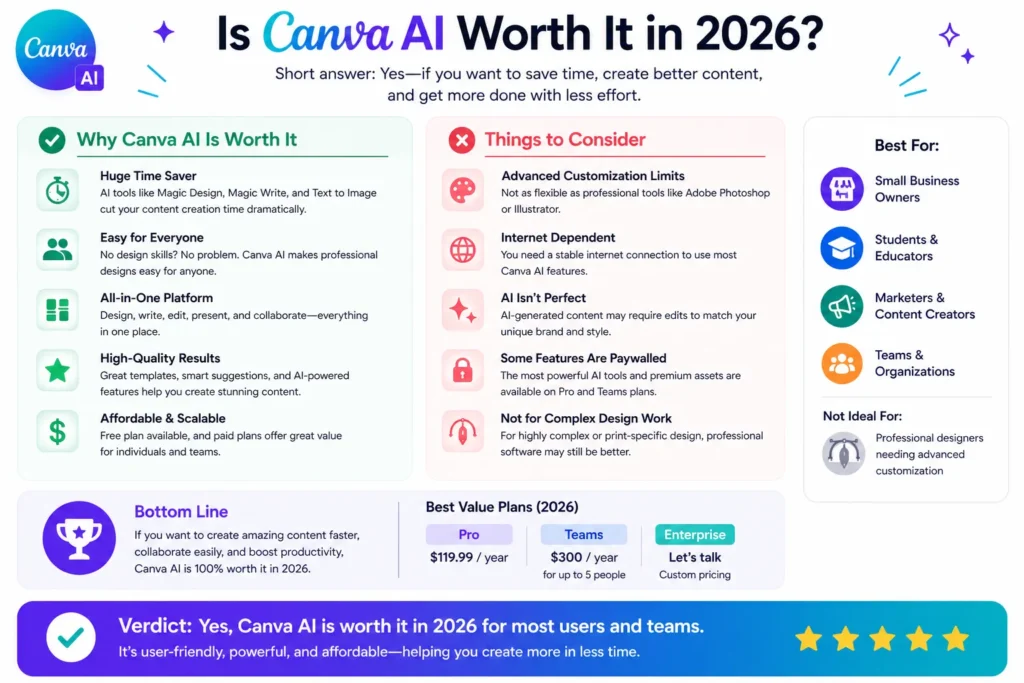
Short answer:
Yes—for most people.
Long answer:
Canva AI is worth it if:
It is NOT worth it if:
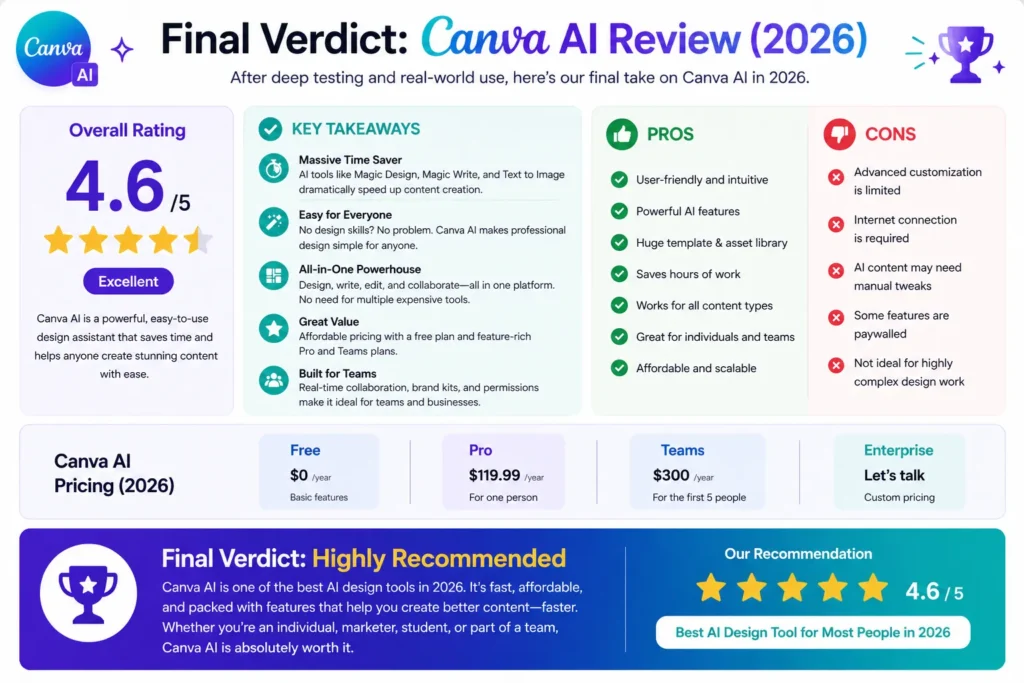
Here’s the honest truth.
Canva AI is not the best tool in any category.
But it might be the most useful tool overall.
It succeeds because it:
But remember the key point from this Canva AI review:
Canva AI is a shortcut—not a substitute.
It helps you move fast.
It helps you create.
It helps you deliver.
But it doesn’t replace skill.
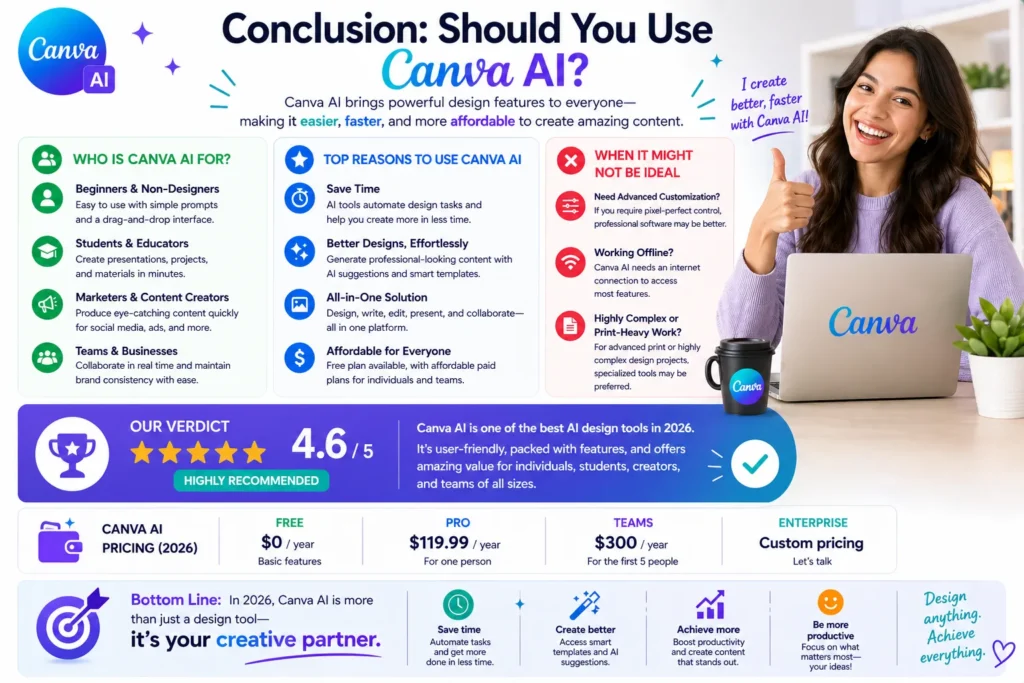
If your goal is to:
Then yes—Canva AI is absolutely worth using in 2026.
It’s one of the few tools that genuinely delivers on its promise.
But if your goal is mastery…
You’ll eventually need more.
And that’s exactly how it should be.