Rytr vs Writesonic 2026: Budget vs Mid-Tier AI Writer?

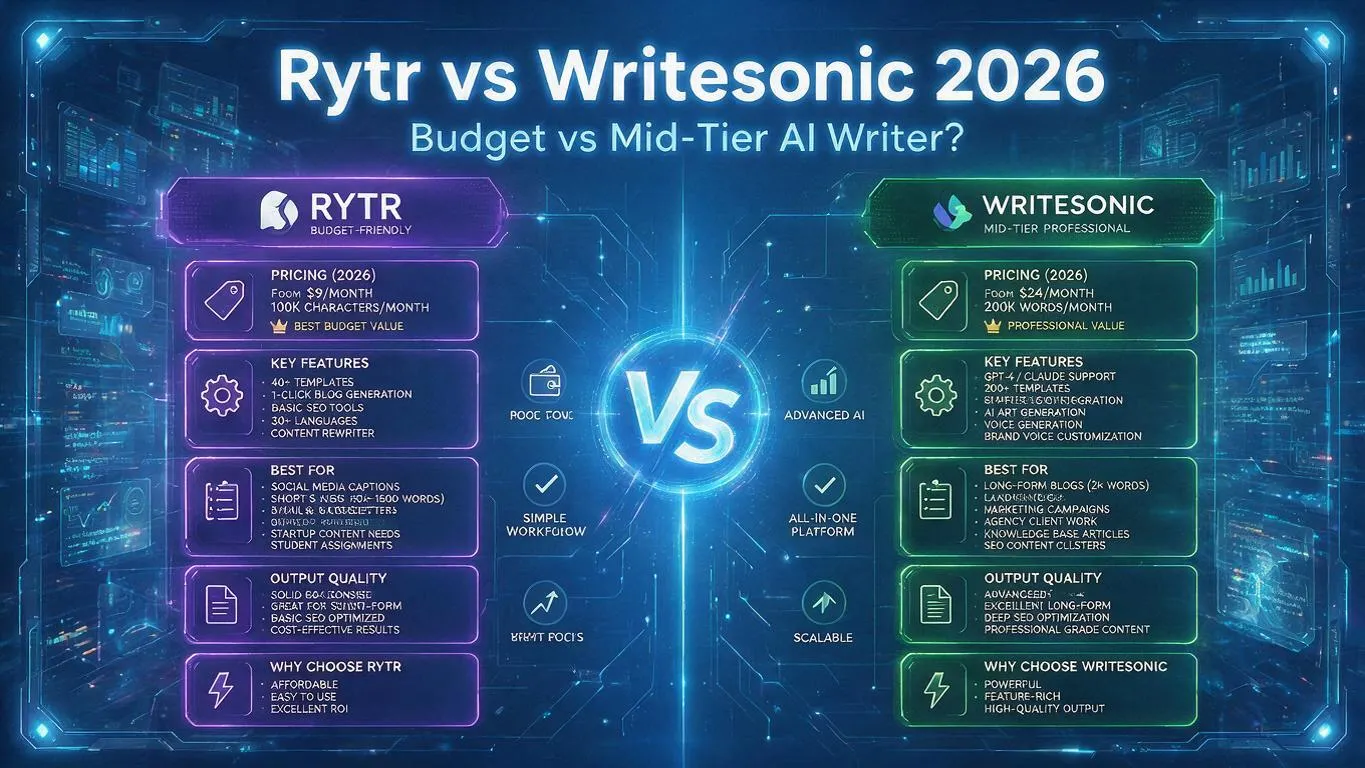
Not every AI writing decision is between premium enterprise platforms. For solo creators, freelancers, and small businesses operating on tight budgets, the more practical question is which affordable tool delivers the most usable output per dollar. This Rytr vs Writesonic comparison answers exactly that question — pitting the most budget-conscious AI writing tool on the market against a mid-tier platform that has built genuine SEO content capability without enterprise pricing.
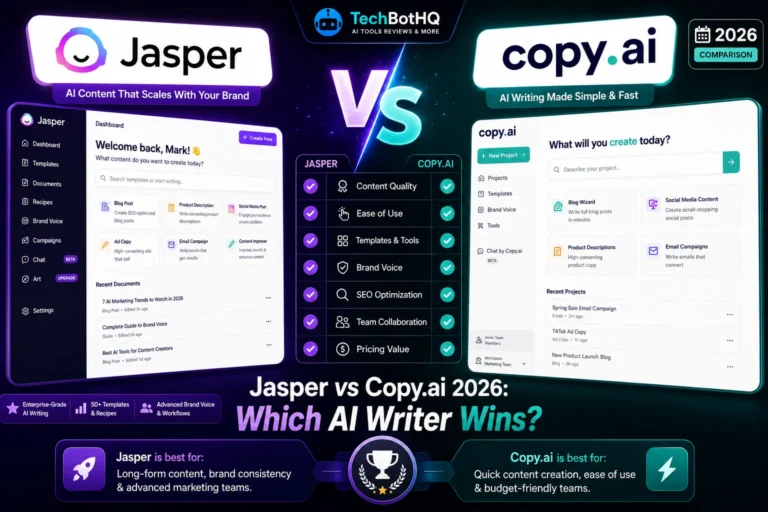
Rytr has carved out a specific position as the cheapest credible AI writing tool available, built around simplicity and an extremely low price point that makes it accessible to anyone testing AI writing for the first time. Writesonic sits a tier above on both price and capability, with dedicated SEO research tools, content scoring, and built-in image generation that Rytr doesn’t attempt to match. This Rytr vs Writesonic comparison covers output quality, feature depth, pricing, and exactly which budget profile each tool serves best.
This Rytr vs Writesonic guide is built for solo creators, freelance writers, small business owners, and anyone evaluating AI writing tools where cost is a primary decision factor — not just a secondary consideration after feature comparison. By the end, you’ll know exactly which tool fits your specific budget and content needs, and why the gap between them matters more for some use cases than others.
VERDICT BOX
Rytr vs Writesonic — Quick Verdict:
Choose Rytr if: You want the absolute lowest-cost AI writing tool for short-form content and don’t need SEO research or content optimisation features
Choose Writesonic if: You’re producing SEO-targeted blog content and want keyword research and content scoring built in, and can stretch your budget slightly higher
Overall Winner: Writesonic for serious content production; Rytr for absolute minimum-cost short-form writing
Table of Contents
Rytr vs Writesonic: Background and Positioning
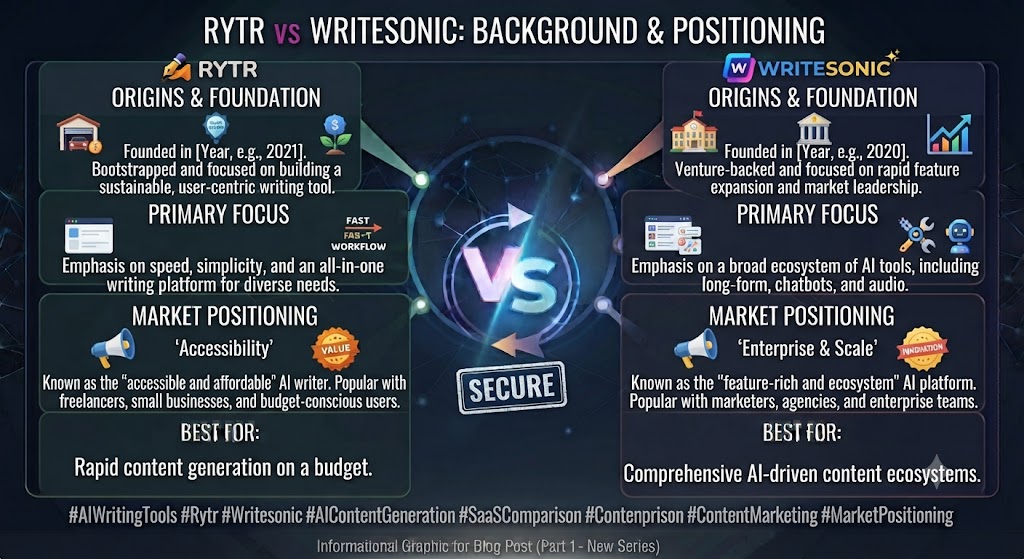
Before the detailed Rytr vs Writesonic feature comparison, understanding each platform’s market position clarifies why the products differ so significantly despite both targeting budget-conscious users.
Rytr launched in 2021 with a singular focus: make AI writing as cheap and accessible as possible. The platform’s pricing has remained aggressively low relative to the rest of the AI writing market, and its feature set has stayed deliberately focused on short-form and mid-form content generation across a wide range of use cases — emails, social posts, product descriptions, blog ideas — without the SEO research depth or workflow automation found in pricier competitors.
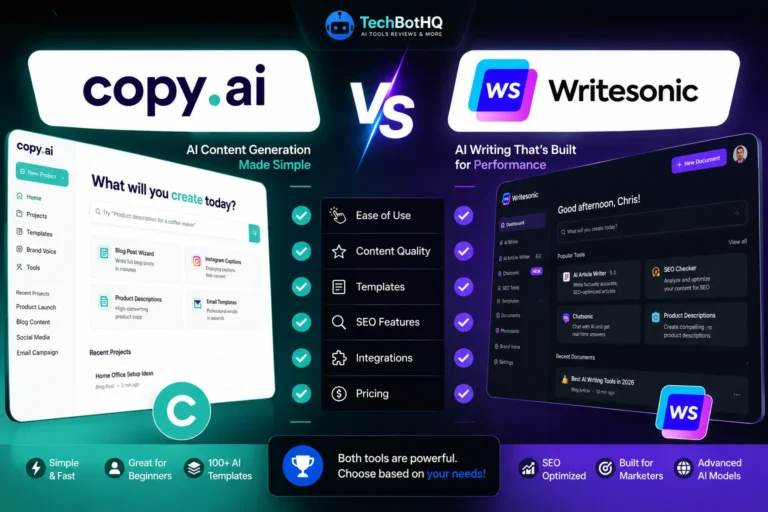
Writesonic launched the same year but pursued a different strategy — building toward comprehensive SEO content production with keyword research, SERP competitor analysis, and real-time content optimisation scoring integrated into its Article Writer tool. Writesonic costs more than Rytr but delivers meaningfully more capability for content marketers whose primary goal is producing content that ranks in search. The platform has also expanded into AI image generation and a chat-based interface called Chatsonic, positioning itself increasingly as a broader content creation suite rather than a pure writing tool. You can find our full standalone reviews of both tools in our AI writing tools hub.
Great AI Writing Still Needs An SEO Strategy Behind It
AI can draft your content fast — but ranking it takes structure, keywords, and technical SEO. Tasknestly builds the SEO strategy your content needs to actually get found.
Get SEO Services →Rytr vs Writesonic: Output Quality Comparison
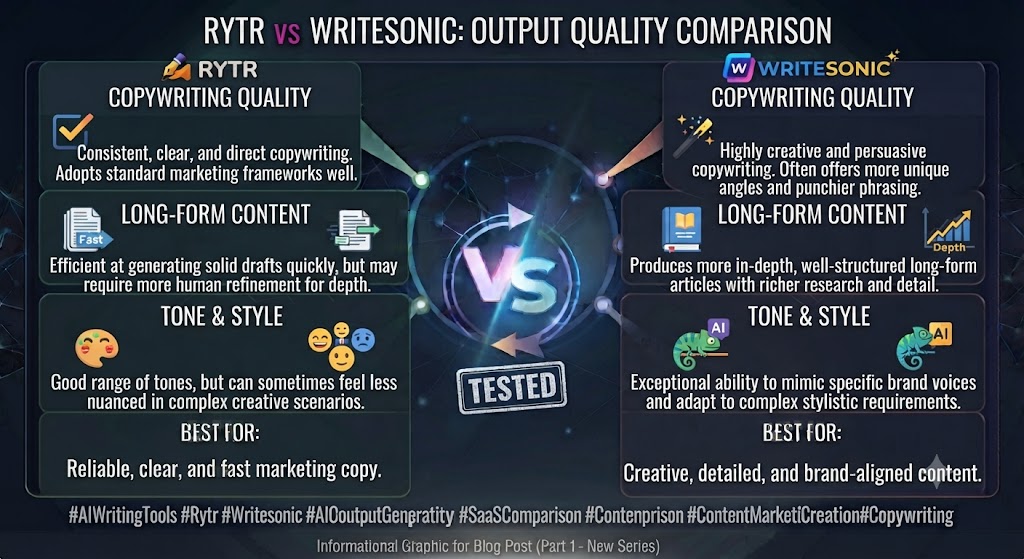
Output quality differences between these two budget-tier tools are real and worth understanding before committing to either.
Short-Form Content Quality
For short-form content — emails, social captions, product descriptions — this Rytr vs Writesonic comparison found both tools to produce genuinely usable output. Rytr’s templates are simple and the generation is fast, with output quality that’s perfectly adequate for routine short-form writing tasks. Writesonic’s short-form output is comparable in quality, with slightly more structural variety across multiple generations of the same prompt.
Long-Form Blog Content
This is where the Rytr vs Writesonic gap becomes significant. Writesonic’s Article Writer produces structured, SEO-informed long-form content with headings derived from competitor analysis and a content score guiding topical completeness. Rytr can generate longer content, but this Rytr vs Writesonic comparison found the output to lack the same structural sophistication — Rytr’s long-form generation tends to require more manual restructuring and expansion to reach publish-ready quality, while Writesonic’s output starts closer to that bar.
Tone and Voice Consistency
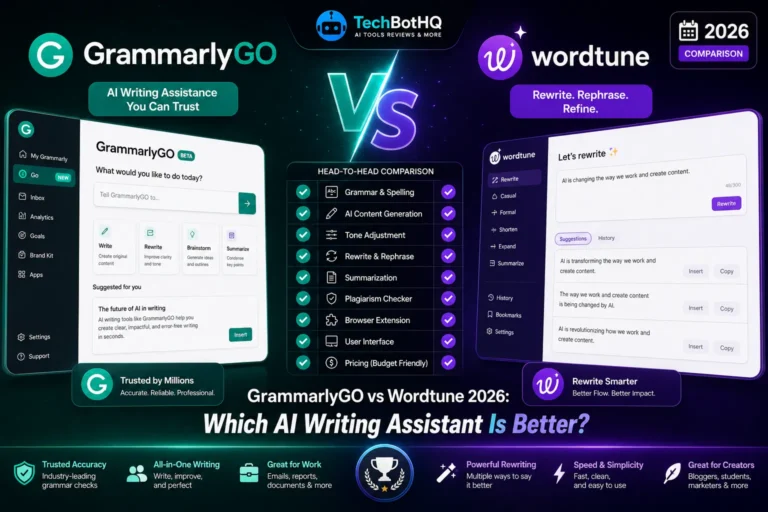
Both tools offer tone selection options, and this Rytr vs Writesonic comparison found tone consistency to be reasonably comparable across short pieces. Neither tool offers the sophisticated brand voice training available in premium tools like Jasper, but for budget-tier users who don’t need that level of brand consistency, both Rytr and Writesonic deliver acceptable tone control for everyday content needs.
Great AI Writing Still Needs An SEO Strategy Behind It
AI can draft your content fast — but ranking it takes structure, keywords, and technical SEO. Tasknestly builds the SEO strategy your content needs to actually get found.
Get SEO Services →Rytr vs Writesonic: Feature Comparison
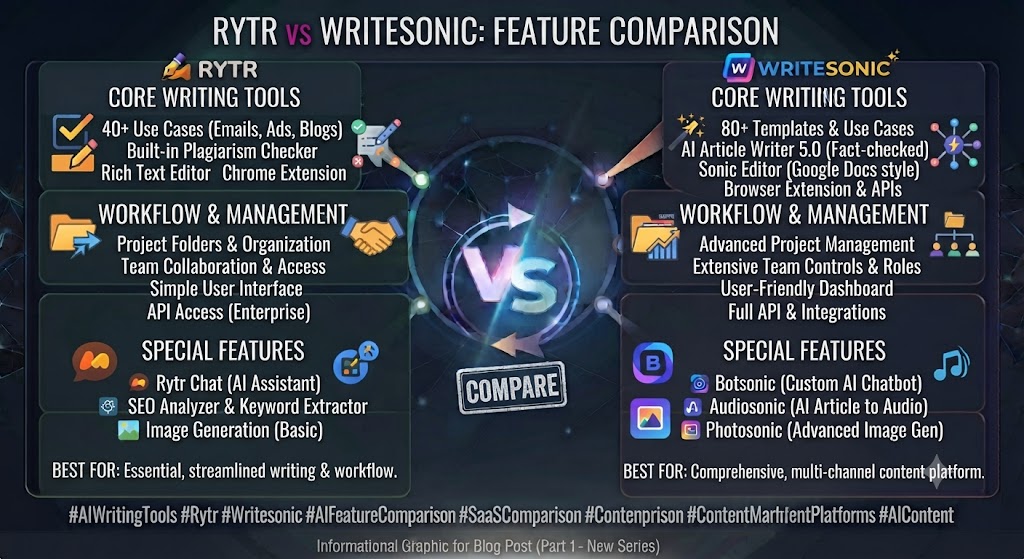
| Feature | Rytr | Writesonic |
|---|---|---|
| Short-form content generation | ✅ Strong, simple | ✅ Strong |
| Long-form SEO article writing | ⚠️ Basic | ✅ Best-in-class with SERP analysis |
| Built-in keyword research | ❌ No | ✅ Yes |
| Content optimisation scoring | ❌ No | ✅ Yes |
| AI image generation | ❌ No | ✅ Built-in |
| Chat-based generation interface | ⚠️ Limited | ✅ Chatsonic |
| Browser extension | ✅ Yes | ✅ Yes |
| Plagiarism checker | ✅ Built-in | ⚠️ Add-on |
| Number of use case templates | ✅ 40+ templates | ✅ 100+ templates |
| Free tier | ✅ Yes (10,000 characters/month) | ✅ Yes (10,000 words one-time) |
The Rytr vs Writesonic feature comparison shows a clear capability gap that reflects the price difference. Rytr keeps things deliberately simple and cheap; Writesonic builds meaningfully more SEO and content production capability for a moderately higher cost.
Great AI Writing Still Needs An SEO Strategy Behind It
AI can draft your content fast — but ranking it takes structure, keywords, and technical SEO. Tasknestly builds the SEO strategy your content needs to actually get found.
Get SEO Services →Rytr vs Writesonic: Pricing Comparison
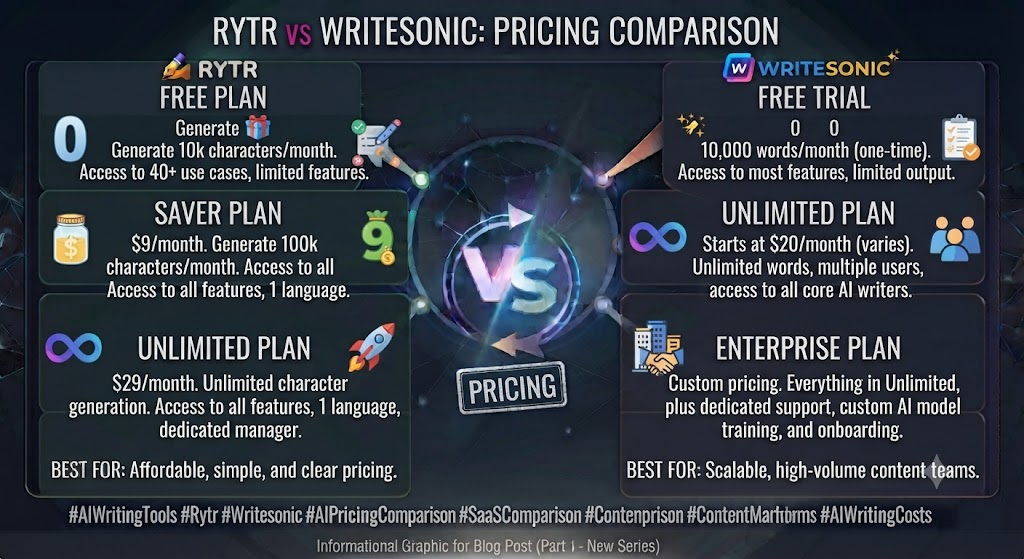
| Plan | Rytr | Writesonic |
|---|---|---|
| Free | 10,000 characters/month | 10,000 words (one-time) |
| Entry | $9/month (Unlimited — single user) | $19/month (Solo — 100,000 words) |
| Mid-tier | N/A | $79/month (Standard) |
| Higher tier | $29/month (Premium — team features) | $399/month (Business) |
This Rytr vs Writesonic pricing comparison shows Rytr as the unambiguous budget winner at entry level — $9/month for unlimited generation is one of the lowest prices in the entire AI writing category. Writesonic’s Solo plan at $19/month costs roughly double but delivers significantly more capability for content marketers specifically. For pure cost-per-word value on simple content, Rytr wins this Rytr vs Writesonic pricing comparison decisively. For cost relative to SEO content capability, Writesonic delivers more value despite the higher price.
Great AI Writing Still Needs An SEO Strategy Behind It
AI can draft your content fast — but ranking it takes structure, keywords, and technical SEO. Tasknestly builds the SEO strategy your content needs to actually get found.
Get SEO Services →Rytr vs Writesonic: Use Case Recommendations
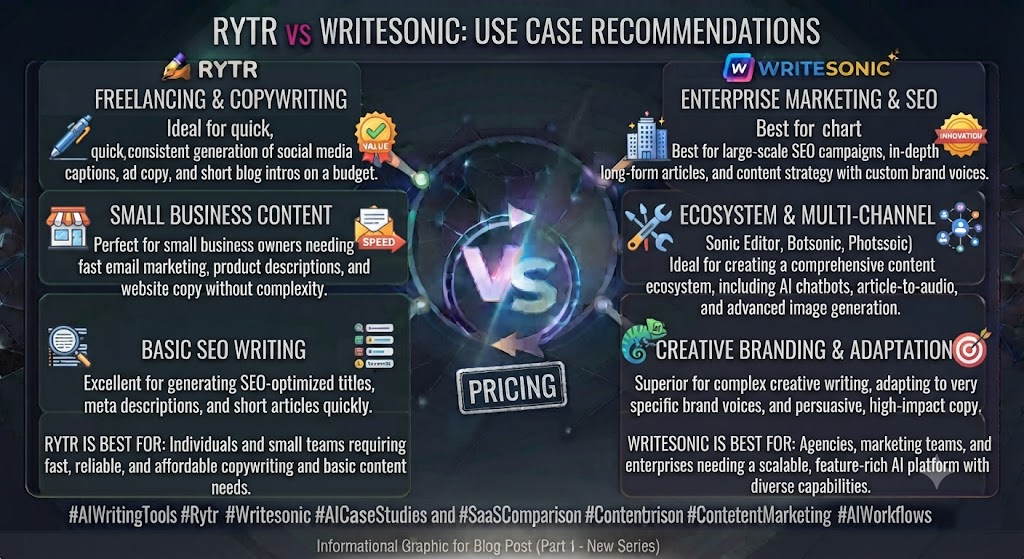
Choose Rytr for:
- Solo creators and freelancers on the tightest possible budget who need basic content generation without SEO research features
- Small businesses writing routine content — product descriptions, email replies, social captions — where speed and low cost matter more than sophisticated optimisation
- Users testing AI writing for the first time who want to evaluate the category without committing to a higher-priced subscription
- Teams that already have a separate SEO tool and only need raw content generation rather than an integrated SEO writing workflow
- Anyone who values a built-in plagiarism checker as part of their standard content workflow without paying extra for that capability separately
Choose Writesonic for:
- Content marketers and bloggers whose primary output is SEO-targeted articles requiring keyword research and competitive content scoring
- Solo creators who want AI image generation bundled with writing rather than maintaining a separate design tool subscription
- Small content teams who can stretch slightly beyond the absolute minimum budget for meaningfully better long-form content structure
- Anyone producing content intended to rank in search — Writesonic’s SEO research tools deliver real strategic value that Rytr doesn’t attempt to replicate
- Teams that want a conversational generation interface alongside structured templates, via the built-in Chatsonic feature
Great AI Writing Still Needs An SEO Strategy Behind It
AI can draft your content fast — but ranking it takes structure, keywords, and technical SEO. Tasknestly builds the SEO strategy your content needs to actually get found.
Get SEO Services →Who Wins the Rytr vs Writesonic Comparison?
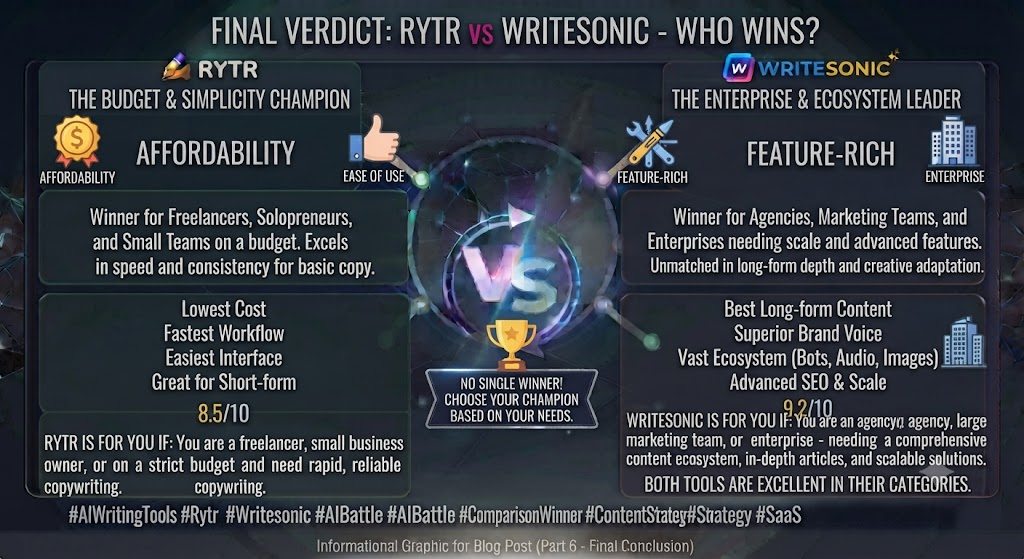
After covering output quality, features, and pricing, the Rytr vs Writesonic conclusion depends entirely on what you’re optimising for: absolute lowest cost, or the best value relative to SEO content capability. Rytr wins on pure price — nothing in the AI writing category beats $9/month for unlimited generation, and for simple, routine content needs that’s a genuinely compelling value proposition. Writesonic wins on content quality and SEO capability — the keyword research, SERP analysis, and content scoring justify the roughly $10/month premium for anyone whose content needs to perform in search results.
The most useful question for resolving your own Rytr vs Writesonic decision: is your content primarily routine short-form writing, or are you producing content that needs to rank organically? If the former, Rytr’s rock-bottom pricing is hard to beat. If the latter, Writesonic’s SEO tooling pays for the price difference many times over in saved research time and improved content performance. Our AI writing tools hub covers both tools and their main competitors in full detail.
Great AI Writing Still Needs An SEO Strategy Behind It
AI can draft your content fast — but ranking it takes structure, keywords, and technical SEO. Tasknestly builds the SEO strategy your content needs to actually get found.
Get SEO Services →Rytr vs Writesonic: Pros and Cons at a Glance
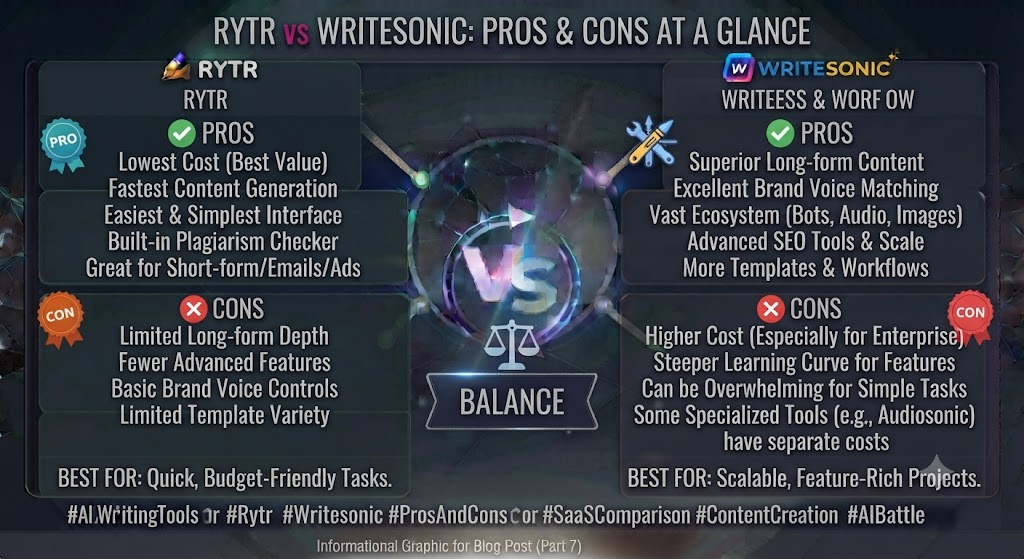
| Rytr | Writesonic | |
|---|---|---|
| Pros | Lowest cost AI writing tool with unlimited generation | Best-in-class SEO research and content scoring |
| Built-in plagiarism checker at no extra cost | Built-in AI image generation | |
| Simple, fast interface with minimal learning curve | Chatsonic conversational generation interface | |
| Genuinely free recurring monthly tier | Stronger long-form content structure | |
| 40+ practical templates for everyday content | Larger template library (100+) | |
| Cons | No SEO research or keyword tools | Higher price than Rytr at every tier |
| Weaker long-form content structure | Free tier is one-time, not recurring | |
| No AI image generation | Steeper learning curve due to feature breadth | |
| Limited tone customisation vs trained brand voice | Output can feel formulaic on repeated generations |
Great AI Writing Still Needs An SEO Strategy Behind It
AI can draft your content fast — but ranking it takes structure, keywords, and technical SEO. Tasknestly builds the SEO strategy your content needs to actually get found.
Get SEO Services →Rytr vs Writesonic: Real-World Workflow Examples
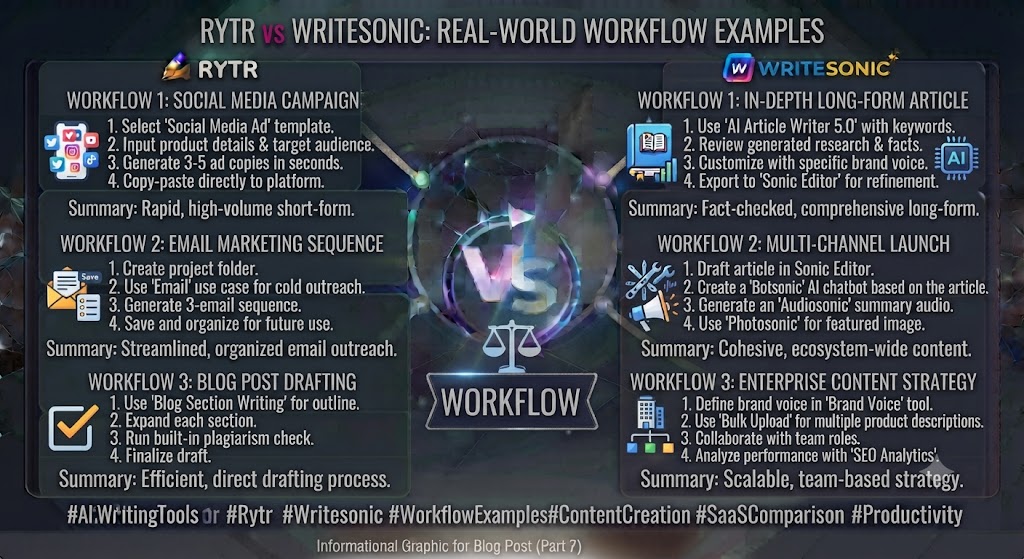
Seeing how each tool performs in actual daily use clarifies the Rytr vs Writesonic decision better than a feature table alone.
The Freelance Copywriter’s Workflow
A freelance copywriter producing routine product descriptions and email copy for multiple small business clients finds Rytr’s speed and low cost ideal for high-volume, low-complexity work. This Rytr vs Writesonic comparison found Rytr’s $9/month unlimited plan to make per-client profitability easier to maintain on routine content tasks where SEO research isn’t part of the deliverable.
The Content Marketer’s Workflow
A content marketer producing two SEO blog posts per week finds Writesonic’s workflow more efficient end-to-end: enter the target keyword, review the AI-suggested outline informed by SERP analysis, generate a draft, and refine using the real-time content score. This Rytr vs Writesonic comparison found that workflow to consistently produce a publish-ready draft faster than attempting the same task in Rytr, which lacks the dedicated SERP research step entirely.
The Solo Business Owner’s Workflow
A solo business owner writing their own marketing emails, social posts, and website copy without any SEO ambition beyond basic visibility finds Rytr’s simplicity and low cost well-matched to their actual needs. This Rytr vs Writesonic comparison found that paying for Writesonic’s SEO research capability in this scenario delivers little additional value relative to the higher monthly cost.
Great AI Writing Still Needs An SEO Strategy Behind It
AI can draft your content fast — but ranking it takes structure, keywords, and technical SEO. Tasknestly builds the SEO strategy your content needs to actually get found.
Get SEO Services →Rytr vs Writesonic: Switching Considerations
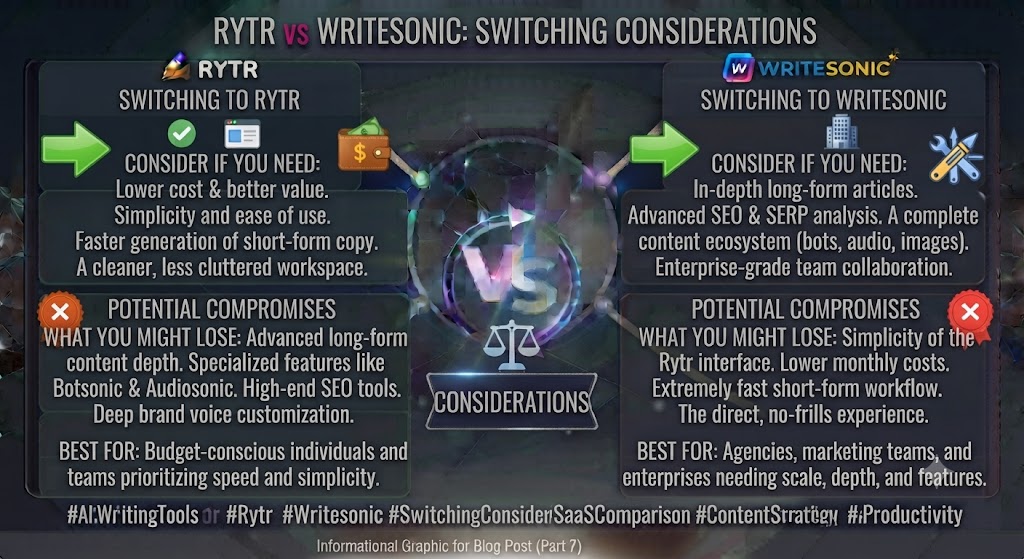
If you’re currently using one tool and weighing a switch, this Rytr vs Writesonic comparison found a few practical factors worth considering beyond raw feature comparison.
Migrating from Rytr to Writesonic
Teams switching from Rytr to Writesonic typically do so once their content needs shift from routine writing toward SEO-driven traffic growth, where Rytr’s lack of keyword research becomes a genuine limitation. This Rytr vs Writesonic comparison found the switching cost to be low — Writesonic’s templates cover most use cases Rytr serves, plus the added SEO layer — though users accustomed to Rytr’s built-in plagiarism checker will need a separate tool, since Writesonic doesn’t include one natively.
Migrating from Writesonic to Rytr
Teams switching from Writesonic to Rytr typically do so to cut costs when their content needs turn out to be simpler than initially anticipated — realising they’re paying for SEO research tools they rarely use. This Rytr vs Writesonic comparison found this downgrade path to make sense specifically for users whose actual content output is short-form and routine rather than SEO-targeted long-form work, and the savings can be meaningful over a full year of subscription costs.
Running Both Tools for Different Needs
This Rytr vs Writesonic comparison found that some budget-conscious creators run both tools for distinct purposes — Rytr for quick, routine content and Writesonic specifically when producing SEO-targeted articles. At a combined cost of roughly $28/month ($9 plus $19), this dual-tool approach remains inexpensive relative to a single premium platform while covering both use cases adequately.
Great AI Writing Still Needs An SEO Strategy Behind It
AI can draft your content fast — but ranking it takes structure, keywords, and technical SEO. Tasknestly builds the SEO strategy your content needs to actually get found.
Get SEO Services →Rytr vs Writesonic: Frequently Asked Questions
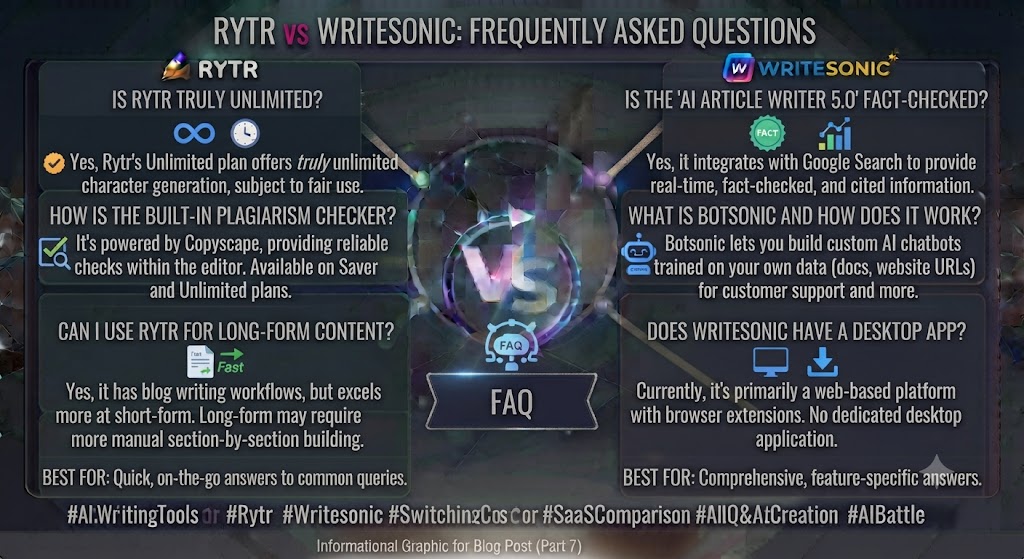
Q: Which is cheaper — Rytr or Writesonic? Rytr is significantly cheaper. This Rytr vs Writesonic comparison found Rytr’s Unlimited plan at $9/month to be roughly half the cost of Writesonic’s comparable Solo plan at $19/month, and Rytr’s pricing remains one of the lowest in the entire AI writing software category.
Q: Which tool is better for SEO content? Writesonic wins this Rytr vs Writesonic comparison clearly for SEO purposes. The Article Writer’s built-in keyword research, SERP competitor analysis, and content optimisation scoring are purpose-built for ranking content. Rytr has no equivalent SEO research capability.
Q: Does Rytr have a free plan? Yes. Rytr offers a free plan with 10,000 characters per month, recurring monthly. Writesonic’s free tier provides 10,000 words as a one-time allocation rather than a recurring monthly limit. This Rytr vs Writesonic comparison found Rytr’s free tier to be better suited to ongoing light usage, while Writesonic’s free tier is better for a single, more thorough evaluation period.
Q: Can Rytr generate images? No. This Rytr vs Writesonic comparison confirmed Rytr is text-only, with no AI image generation capability. Writesonic includes built-in AI image generation, making it more of an all-in-one content creation tool for users who want writing and visuals from a single subscription.
Q: Which tool is easier to use for beginners? This Rytr vs Writesonic comparison found Rytr to have a slight edge for absolute beginners due to its simpler interface and narrower template focus. Writesonic offers more capability but with a correspondingly larger interface to learn, particularly around the SEO research and content scoring features.
Q: Is Rytr good enough for professional content production? This Rytr vs Writesonic comparison found Rytr to be adequate for routine professional content — emails, descriptions, social posts — but insufficient on its own for serious SEO content marketing, where Writesonic’s research tools provide meaningfully better strategic guidance and output structure.
Q: Are there better alternatives to both Rytr and Writesonic? Depending on your specific needs, alternatives include Jasper (best brand voice for larger marketing teams, higher price), Copy.ai (best for workflow automation), Scalenut (similar SEO positioning to Writesonic at comparable pricing), and Surfer SEO (deepest SEO optimisation if paired with any AI writer). Our AI writing tools category covers all of these in detail.
Q: Can I switch between Rytr and Writesonic plans without losing my content? Both platforms store generated content within your account, and this Rytr vs Writesonic comparison found no native export limitation that would lock content into either tool. Downgrading from Writesonic to Rytr, or vice versa, doesn’t risk losing previously generated content as long as you export or copy it before cancelling a subscription.
Q: Which tool updates its AI model more frequently? This Rytr vs Writesonic comparison found both platforms to update their underlying AI models regularly as new versions of GPT and other foundation models become available, though neither company publishes a fixed update schedule. Writesonic’s larger engineering investment in its SEO-specific tooling suggests slightly more frequent feature-level updates beyond core model upgrades.
Q: Does either tool offer a discount for annual billing? Yes. This Rytr vs Writesonic comparison found both platforms to offer meaningful discounts — typically 15–25% — for annual billing compared to month-to-month plans. For users confident in their tool choice after testing the free tiers, committing annually is a straightforward way to reduce the already low monthly cost further on either platform.
Great AI Writing Still Needs An SEO Strategy Behind It
AI can draft your content fast — but ranking it takes structure, keywords, and technical SEO. Tasknestly builds the SEO strategy your content needs to actually get found.
Get SEO Services →Conclusion: Rytr vs Writesonic Final Verdict
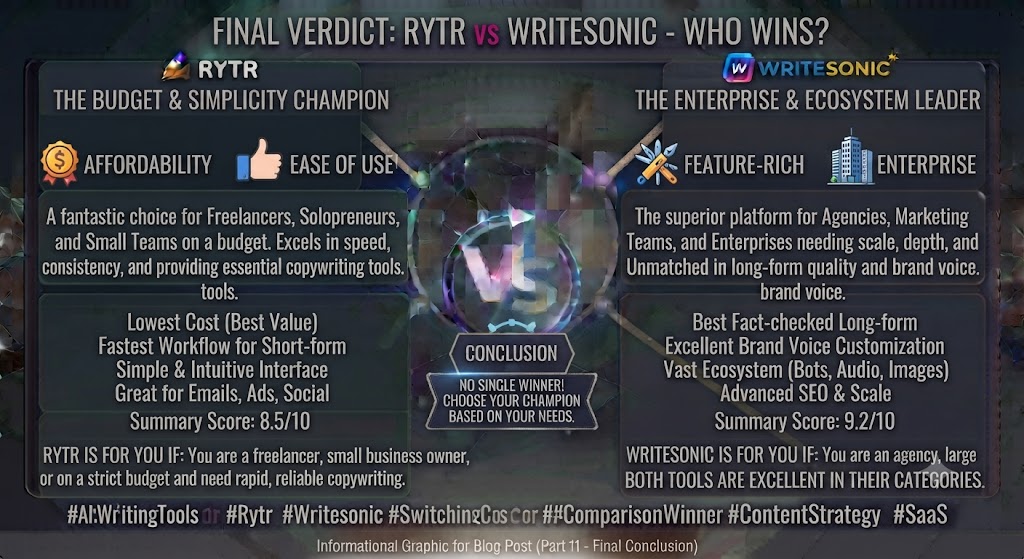
The Rytr vs Writesonic conclusion ultimately comes down to recognising that these tools serve genuinely different budget and capability tiers, even though both market themselves as affordable options. Rytr has built the cheapest credible AI writing tool available, and for users whose content needs are simple and routine, that low cost is a real and valid value proposition. There’s no reason to pay more for capability you won’t use.
Writesonic costs more but delivers substantially more strategic value for content marketers specifically — the keyword research and content optimisation scoring built into the Article Writer tool address a genuine gap that Rytr doesn’t attempt to fill. For anyone producing content with the explicit goal of ranking in search results, that gap matters enough to justify the price difference.
The final Rytr vs Writesonic verdict: if your budget is the absolute deciding factor and your content needs are simple, Rytr delivers genuine value at an unbeatable price. If you’re a content marketer producing SEO-targeted articles and can stretch your budget by roughly $10/month, Writesonic’s research and optimisation tools will pay for themselves in saved time and improved content performance. Whichever direction you lean, run both free tiers against a real piece of content from your actual workflow before committing — the practical difference in daily use will be more informative than any feature comparison table, and the cost of testing both is essentially zero. Explore the full landscape of AI writing tools in our AI writing tools hub.
Disclosure: This article contains affiliate links. TechBotHQ may earn a commission if you sign up through our links, at no extra cost to you. See our affiliate disclosure for full details.
Great AI Writing Still Needs An SEO Strategy Behind It
AI can draft your content fast — but ranking it takes structure, keywords, and technical SEO. Tasknestly builds the SEO strategy your content needs to actually get found.
Get SEO Services →